Is AI a Bubble? How to Tell a Boom From a Bubble
Parts of the AI market show classic bubble signs, but the technology is in real, paid use. Here is a five-sign test, an honest dot-com comparison, three burst scenarios and what it means for developers.


Is AI a bubble? In November 2026 the honest answer is "partly, and nobody can prove which part yet." AI stock prices and data-center spending show several classic bubble signs. At the same time, the technology is in real, paid use. The Bank for International Settlements and the IMF warn that a correction is possible. Forrester argues a burst is not imminent. No one can date a crash, and this article does not try.
This explainer gives you a five-sign test for telling a boom from a bubble, with each side's evidence shown next to the other. It adds a watchlist so you can track those signs yourself, compares today with the dot-com crash, and sets out three clearly labeled scenarios for a burst. It ends with what the Reserve Bank of India, Nasscom and the IndiaAI Mission's data mean for developers and students in India.
What "AI bubble" means, and why the answer can be "both yes and no"
A bubble is when prices run far ahead of what the underlying business can ever earn. A boom is heavy spending that the business can eventually pay back. The two look identical while they are happening. They only separate when revenue arrives or fails to.
The Bank for International Settlements (BIS), the Basel-based body owned by central banks, puts today's spending in a long line of investment manias. In Chapter I of its Annual Economic Report 2026, published on 28 June 2026, it names the 1830s canal mania, the 1840s British railway mania, the late-1920s electrification boom and the late-1990s dot-com boom. In each case a real breakthrough drew more capital than commercial returns could justify. The BIS says the current AI boom bears resemblance to these precedents, and notes that those episodes ended in investment reversals and recessions.
MIT economist Ricardo J. Caballero offers a third option beyond "fundamentals" or "bubble." In his paper Speculative Growth and the AI "Bubble" (latest version dated 11 June 2026), he argues that "a price bubble can have a permanent real legacy." Inflated prices pull in investment. If enough data centers and chips get installed before prices correct, that capacity stays useful after the valuations fall. Caballero calls the mechanism fragile: the legacy appears only if enough capital is in place before the correction arrives. His figures are illustrative, not a forecast.
Is AI a bubble? 5 signs that separate a boom from a bubble
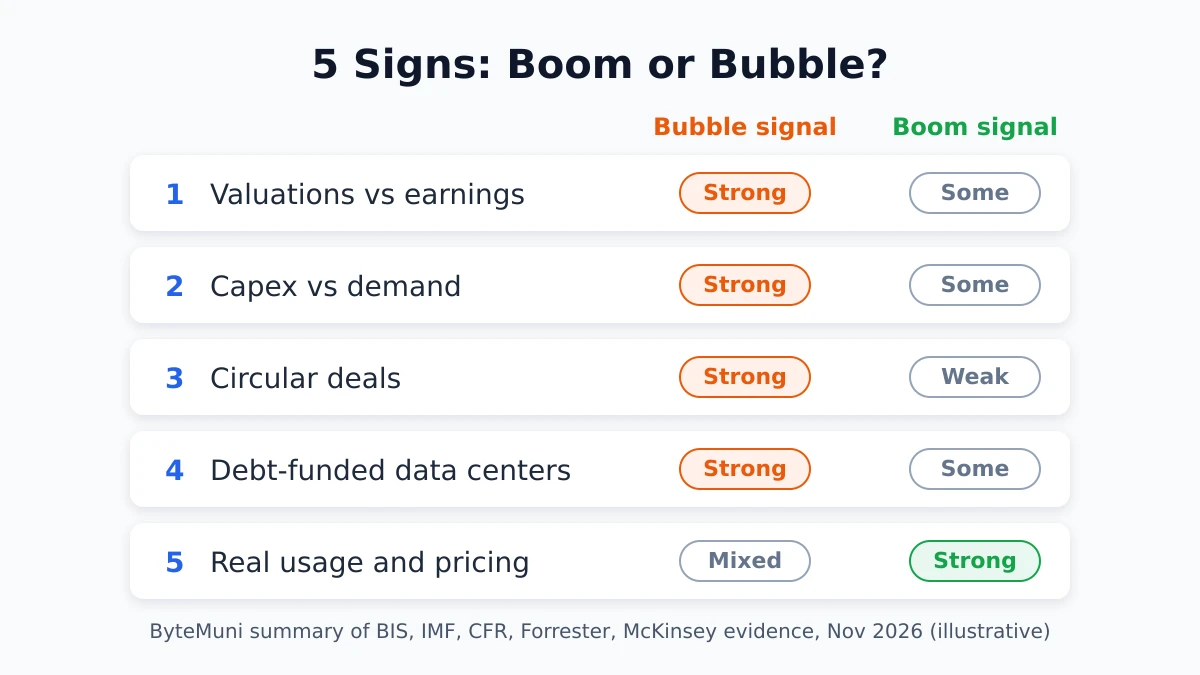
Brookings senior fellow Darrell M. West wrote in a November 2025 analysis that bubbles are hard to forecast. Instead he proposed watching indicators such as investment levels, data-center timelines, adoption, prices and competition. The table below groups the evidence from major institutions into five signs. Each row puts the worried view next to the confident one.
| Sign | What a bubble looks like | Bubble camp: evidence and who says it | Boom camp: evidence and who says it |
|---|---|---|---|
| 1. Valuations vs earnings | Prices assume growth that earnings cannot deliver | The BIS says implied long-term earnings growth for the largest firms "sits well above" historical benchmarks. West notes that about 80% of US stock gains in 2025 came from AI companies. The Council on Foreign Relations (CFR) cites Goldman Sachs: the ten largest AI stocks made up about half of the S&P 500's 2026 gains. | The IMF's October 2026 Global Financial Stability Report says core AI-ecosystem firms have been profitable so far, which has eased pressure on valuations. |
| 2. Capex vs demand | Capacity is built far faster than paying customers appear | The BIS says the five largest hyperscalers are set to spend over $1 trillion on AI capex across 2025 and 2026, outpacing their earnings and free cash flow. CFR reports these firms expect to spend $800 billion or more in 2026, about 94% more than in 2025. McKinsey's 2026 survey found only 37% of organizations report any positive EBIT (operating profit) contribution from AI. | Forrester's AI Bubble Model put demand absorption at 3.44 in Q2 2026, above a normal reading of 3. McKinsey found about eight in ten respondents say AI has improved their own productivity. |
| 3. Circular deals | Suppliers fund customers who then buy from the suppliers | In Harvard Business Review, Paulo Carvão of Harvard Kennedy School compares deals like Nvidia's planned investment in OpenAI to late-1990s circular financing. The BIS warns that such deal terms are poorly disclosed, with a risk of the same asset being pledged several times. CFR cites research firm Sona's count of 176 AI-related circular deals worth $3.6 trillion over about three and a half years. | None of these sources defends circular deals. The boom camp's point is that the biggest buyers are large, cash-generating firms rather than fragile startups. |
| 4. Debt-funded data centers | Borrowed money replaces earned cash | The BIS says direct-lending funds have quadrupled their lending to AI and IT over five years, to about 15% of their portfolios. CFR reports that Alphabet, Amazon, Meta and Microsoft borrowed $214 billion so far in 2026, against $83 billion in all of 2025. Forrester calculates that Amazon spent $1.28 of capex per dollar of operating cash over 12 months, and Oracle $1.61. | Forrester's "builder health" score was 82.3 in Q2 2026, inside its green zone, which starts at about 73. Alphabet spent $0.89 per operating dollar, so it was still funding capex from earned cash. |
| 5. Real usage and pricing | Usage is free or subsidized, and price wars erase margins | West flags price pressure and many competitors as threats to revenue targets. Stanford HAI's 2025 AI Index measured a more than 280-fold fall in the cost of running a GPT-3.5-level model between November 2022 and October 2024. That is good for users but squeezes sellers' margins. | Nearly nine in ten respondents in McKinsey's 2026 survey say their organizations use AI regularly in at least one business function. CFR reports productivity gains showing up in software development and finance. |
Read across the rows and a pattern appears. On signs 1, 2 and 4, the bubble camp has more hard numbers. On sign 5, real usage, the boom camp is stronger. On sign 3 no one argues that circular deals are healthy.
Forrester's latest reading is the clearest single data point. In a 5 November 2026 post, analyst Brian Hopkins and colleagues placed the market in the "build-out" phase near its top. Supply pressure stood at 4.95, close to the scale's maximum. Their Q3 nowcast of builder health was 79.1 as of 2 November, down from 82.1 on 29 October. It is still green, but falling. Forrester sells advisory services built on this model, so treat it as one analyst's tool, not a neutral measurement.
How to track the AI bubble yourself: a quarterly watchlist
You do not need a paid terminal to follow this debate. These public readings move before most headlines do. The "warning sign" column is ByteMuni's suggestion of what to watch for, based on the sources above. It is not a trading signal.
| Reading | Where to find it | Warning sign to watch for |
|---|---|---|
| Capex vs operating cash at the big spenders | Each company's quarterly cash-flow statement: divide capital expenditure (often labeled "purchases of property and equipment") by net cash from operating activities | Ratios staying above 1.0 at more companies. Forrester already puts Amazon at 1.28 and Oracle at 1.61 |
| Forrester builder-health score | Forrester's public blog, roughly quarterly | A fall below about 73, out of the green zone. Forrester says the score turned yellow, then red, before the telecom and housing bubbles burst in its back-tests |
| Borrowing costs for AI firms | Credit-market news and central bank reports | Spreads widening further. The BIS said in June that some AI firms' spreads "have already begun to widen somewhat" |
| Enterprise return on AI | McKinsey's annual State of AI survey | The share reporting EBIT impact staying near 37% while spending keeps rising |
| Official stability warnings | IMF Global Financial Stability Report (April, October), RBI Financial Stability Report (June, December), BIS Annual Economic Report (June) | Language shifting from "risk" to reported stress at lenders or funds |
| What you pay for AI tools | Your own invoices and providers' pricing pages | Free tiers cut, sudden price rises or vendors shutting down. This is usually the first sign developers notice |
How does today's AI boom compare with the dot-com bubble?
Bloomberg's explainer on trillion-dollar AI bubble fears notes that dot-com comparisons began almost as soon as the boom did. Here is that comparison done in both directions.
| Question | What looks similar | What looks different |
|---|---|---|
| Who is spending? | A rush of capital into one theme, which the BIS places in the same family as the dot-com boom | CFR notes that today's spenders are far larger and more profitable than the dot-com-era startups |
| How is it funded? | Bloomberg reports funding from venture capital, debt and "circular financing arrangements" | A growing share is now bonds and private credit (BIS, CFR), so stress could show up in credit markets as well as in stock prices |
| Vendor financing | Carvão (HBR) draws a direct line to late-1990s circular deals | The BIS adds a newer twist: data centers built by third parties and leased back to hyperscalers on long contracts, which keeps debt off their balance sheets |
| Is anyone using it? | Revenue still trails spending, and CFR says revenues have fallen short of expectations | Usage is already broad: nearly nine in ten organizations in McKinsey's 2026 survey use AI. Roger Ferguson Jr., quoted by CFR, says adoption has been faster than for the PC or the internet |
| Productivity | Promises of transformation are running ahead of measured gains | The BIS cites task-level time savings "often" between 20% and 50%, but aggregate productivity estimates of under 1% over a long horizon |
The honest summary: the money pattern rhymes with 1999, but the spenders and the level of usage do not. That does not rule out a crash. It changes who would get hurt first.
What happens if the AI bubble bursts? Three scenarios
Official bodies have modeled the risk without predicting it. The IMF's October 2026 Global Financial Stability Report warns that "weaker or less durable investment and profitability in AI could trigger a correction." It says rising leverage, concentrated exposures and circular financing would make that correction worse. Its global bank stress test combines an AI-led market correction with an energy price shock and higher bond yields. Banks stay broadly resilient in that test, but a meaningful share turn out to be vulnerable.
Paul Donovan, chief economist at UBS Global Wealth Management, sketched one possible sequence in a January 2026 World Economic Forum piece. In the first week, a burst is mostly a market and media event. Around two months later, speculative firms that relied on cheap capital cut jobs. By six months, companies turn to using the AI they already bought. He expects the damage to be smaller than in 2008. The same piece reports that 52% of chief economists polled by the WEF expected AI-related US stocks to fall in 2026.
Corrections do happen. ByteMuni covered one in China's AI bubble bursting, when about $480 billion vanished from the STAR50 index of Chinese AI and chip stocks in under four months. US AI stocks held up far better during that drop.
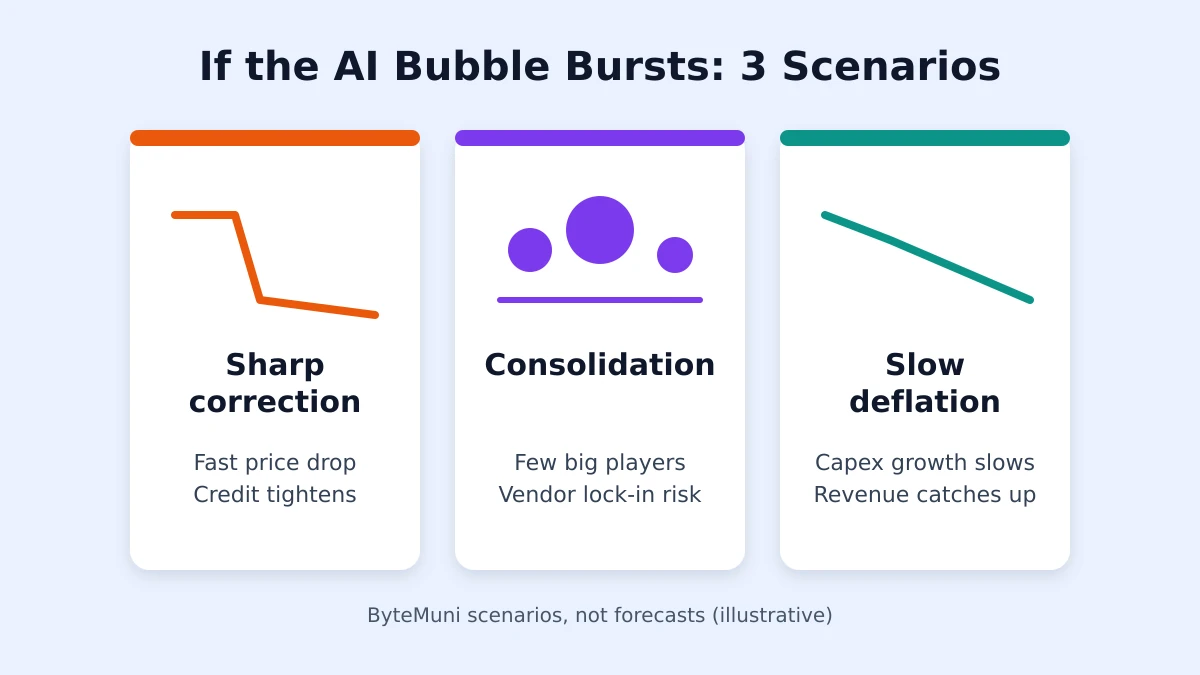
The three scenarios below are ByteMuni's own illustrations. They are built from the risks the BIS, IMF, WEF and Forrester describe. They are not forecasts, and real outcomes could mix them.
| Scenario (illustrative) | What happens | AI startups | GPU and cloud prices | AI tools developers use | Hiring |
|---|---|---|---|---|---|
| A. Sharp correction | AI stocks fall fast and credit for AI projects tightens. This is the path the IMF and WEF model | Startups that depend on new funding rounds struggle or shut down | Planned data centers get delayed. Already-built capacity may have to be sold more cheaply to fill it | Some tools disappear or raise prices. Tools backed by large, profitable firms are more likely to survive | Freezes at AI-branded firms. Donovan expects job cuts to stay contained |
| B. Consolidation | Valuations settle while a few large players buy or squeeze out the rest | Many get acquired. Those with a real niche survive | Prices follow the few remaining large providers, so there is less choice of vendor | Fewer, bigger platforms. Being locked into one vendor becomes the main risk | Demand shifts toward people who integrate and run AI rather than people who build new models |
| C. Slow deflation | No crash. Capex growth slows over years while revenue slowly catches up, closest to Forrester's view that a burst is not imminent | Funding gets choosier, and profit matters more than growth | The trend of falling cost per unit of work, which Stanford HAI measured, likely continues | Tools that show clear return on investment win budget. Experimental ones get cut | Steady demand for engineering skills, and more scrutiny of AI projects |
Where India sits in these scenarios. The Reserve Bank of India sees two sides. Its June 2026 Financial Stability Report says "concentrated exposures due to substantial investments in AI have become more pronounced" globally, while domestic financial stability risks "remain contained." In an October 2026 speech, Governor Sanjay Malhotra warned that a slowdown in AI investment or earnings could trigger a sharp repricing. He also said corrections in AI valuations in advanced economies may be positive for capital inflows into India. For compute, Indian teams that qualify for the IndiaAI Mission's subsidized GPU pool are partly shielded from global cloud prices in any of the three scenarios.
What stays useful after an AI correction
A fall in share prices does not uninstall a data center. This is Caballero's central point. His paper puts it as speculation that "validates a destination, not a price": valuations can drop while the capacity built during the boom remains. The BIS likewise says AI "has the potential to raise productivity significantly over the coming decade," even as it warns about the financing.
In practical terms, three things are likely to outlast a correction:
Infrastructure. Chips, data centers and power links that are already built keep running. The BIS also flags bottlenecks in electricity, chips and grid equipment, so some planned capacity may never be finished.
Cheaper compute. Stanford HAI measured a more than 280-fold drop in the cost of running a GPT-3.5-level model in about two years. Efficiency gains in chips and models do not vanish when share prices fall.
Tools and skills. Coding assistants, evaluation methods and agent frameworks are already part of how teams work. McKinsey's 2025 survey found use-case cost benefits especially in software engineering, manufacturing and IT.
The caution cuts both ways. The BIS warns that disappointed returns could "turn the capex boom into a protracted investment bust." A legacy is possible, not guaranteed.
Does an AI bubble change the AGI question?
Experts disagree on AGI timing, with or without a bubble
Artificial general intelligence (AGI) means a hypothetical system with human-level ability across most tasks. In a September 2026 BCG analysis, Greg Emerson and Ulrich Pidun note that "no industry consensus exists" on how to define AGI, and that it does not exist today. Some AI lab leaders see it as near. Many researchers do not: in a 2025 survey by the Association for the Advancement of Artificial Intelligence, 76% of respondents judged that scaling current approaches was "unlikely" or "very unlikely" to reach AGI.
The International AI Safety Report 2026, led by Yoshua Bengio and written by more than 100 experts, says "the trajectory of AI progress through 2030 is uncertain." It describes three possibilities: progress could plateau, continue at current rates or accelerate sharply. A correction would mainly affect how much money goes into training. That makes the slower paths more likely, but it does not decide the scientific question. For definitions and the full timeline debate, read ByteMuni's explainer What Is AGI? Meaning, Real Examples, Timeline and Future.
Why today's AI has no goals of its own
Much of the bubble debate assumes AI will soon "decide" things on its own. Today's systems do not work that way. It helps to think of three levels:
Tool. You ask a question and the model answers. It has no aim beyond completing that response.
Agent with an assigned goal. A person or system gives it an objective, such as "fix this failing test and open a pull request." The agent plans steps and calls tools, but the goal came from outside. The Safety Report notes that current systems still struggle with "recovering from basic errors in longer workflows."
Hypothetical AGI. A system that might set and pursue long-term goals by itself. It does not exist, and whether it can be built is exactly what experts disagree on.
Valuations often price in level 3 while revenue comes from levels 1 and 2. That gap is part of why people worry about a bubble. For how agents plan, use tools and stay within limits, see Agentic AI Explained: How AI Agents Work.
What the AI bubble means for Indian developers and students
What the data says about India
Hiring is slowing, not collapsing. Nasscom's Annual Strategic Review 2026 projects a net addition of 135,000 tech jobs in FY26, a 2.3% rise, as reported by Business Standard. Revenue is growing faster than headcount, and Nasscom president Rajesh Nambiar said campus hiring has come down.
AI work is already paid work. Nasscom estimates AI revenue for Indian services firms at $10 billion to $12 billion in FY26. That is real billing, not just valuation.
Compute is cheaper here for those who qualify. A government PIB note from February 2026 says more than 38,000 GPUs under the IndiaAI Mission are available at ₹65 per hour, "nearly one third of the global average cost." Access is approval-based, and rates vary by chip.
Skills and habits that hold up in a boom or a bust
For most engineers in India, the risk is not owning AI stocks. It is building products and careers on top of AI vendors whose prices and existence depend on this cycle. Forrester advises, as reported by The Register, that businesses should prepare for a correction that could upend their suppliers, contracts and prices. Here is a practical list that holds up in a boom or a bust:
Keep model providers swappable. Put model calls behind one internal interface so a price change or a shutdown means a config change, not a rewrite. This matters for Node, Spring and Laravel apps that call a single vendor's API directly.
Track cost per request from day one. Record tokens, latency and spend per feature. If a startup in your stack raises prices after a funding squeeze, you will see the effect within days.
Learn evaluation, not just prompting. The Safety Report says current techniques cannot cut failure rates to the level many high-stakes settings need. Teams that can measure whether an AI feature works will be needed whatever the market does.
Stay strong in the layers AI depends on. System design, backend, databases, security and cloud operations stay in demand whether AI spending rises or falls.
Build reliable products, not demos. In a correction, budgets survive for features with measured returns. McKinsey's 37% EBIT figure shows how few companies can prove those returns today.
Fewer campus offers mean freshers compete on proof of work. A deployed project with tests, cost tracking and an evaluation report says more than a certificate. Students weighing fundamentals against AI skills should not treat them as rivals. ByteMuni's guide DSA vs AI in 2026 and Beyond covers how to balance the two.
My take on the AI bubble
This section is opinion. My read is that the money side of AI, meaning valuations, circular deals and debt-funded data centers, carries real bubble risk. The engineering side carries much less. The sources that worry most, the BIS and IMF, worry about financing structures, not about whether the code works.
The engineering lesson is an old one: never let a single dependency you do not control decide whether your product survives. Teams with an abstraction layer, cost tracking and fallbacks would treat a correction as an inconvenience. Teams that hard-coded one vendor would face an emergency. I would rather see Indian engineering teams spend this quarter adding evaluation and cost monitoring than debating crash dates.
The bottom line on the AI bubble
So, is AI a bubble? Treat AI valuations as risky and AI skills as durable. The evidence supports bubble warnings on prices, capex and financing. It does not support the idea that the technology will disappear. If you are a developer, keep learning AI engineering, but build on swappable vendors and the core skills of system design, data and security. If you are deciding whether to "wait out the bubble" before learning AI, do not wait. The tools are already cheaper and more widely used than at any point in the boom, and they will stay that way through most realistic scenarios.
This article is general information, not financial or investment advice. Figures are as reported by the named sources and were checked by ByteMuni on 20 November 2026.
Frequently asked questions
Will the AI bubble burst in 2027?
No credible source gives a date. As of November 2026, Forrester says a burst is not imminent. The BIS and IMF describe a correction as a risk they model, not a forecast.
What is circular financing in AI?
It is when a supplier invests in a customer that then commits to buying the supplier's chips or computing capacity. The BIS warns that the terms of such deals are poorly disclosed, and HBR's Paulo Carvão compares them to late-1990s dot-com deals.
Is the AI boom the same as the dot-com bubble?
The money pattern is similar: fast investment, rising debt and vendor financing. The difference is that today's biggest spenders are large, profitable firms, and AI use is already widespread, according to CFR and McKinsey.
If the AI bubble bursts, will AI tools stop working?
Data centers, chips and widely used tools would keep running. Smaller vendors that depend on fresh funding could raise prices or shut down, so it pays to keep model providers swappable.
How would an AI correction affect tech jobs in India?
No reliable India-specific estimate exists in these sources. In his WEF scenario, UBS economist Paul Donovan expects job cuts at speculative firms that relied on cheap capital, but describes them as contained. Skills in backend, data, security and AI evaluation hold up in most scenarios.
Does an AI bubble mean AGI is far away?
Not necessarily. Less spending could slow progress, but experts already disagree on timing: in a 2025 AAAI survey, 76% of respondents judged that scaling current approaches was unlikely to reach AGI. The International AI Safety Report 2026 calls the path to 2030 uncertain.
Concepts in this article
- Artificial intelligence
- Computer systems that perform tasks that normally need human intelligence.
- AI agents
- Systems where a model plans and takes actions with tools in a loop toward a goal.
- AI safety and alignment
- Making AI systems behave helpfully and safely, for example with RLHF and safety testing.
- Artificial general intelligence (AGI)
- A hypothetical AI able to learn and perform most intellectual tasks a person can.
- Proof of work
- Securing a blockchain by making block creation require expensive hashing.
How we research, write and check articles