AI Finding Security Bugs: What November 2026 Showed
In November 2026, researchers credited AI for flaws in Java, Ghostscript, NGINX and Puppet, and Amazon says attackers' AI agents found a zero-day. Here is how AI bug hunting works, where humans still steer, and what maintainers and developers should change.

AI finding security bugs went from lab demos to the patch notes in November 2026. Named researchers credited AI tools for flaws in Java, Ghostscript, NGINX and Puppet. Ruby's advisory credited Anthropic. Amazon says attackers' AI agents found a zero-day in medical-imaging software. Defenders and attackers now hunt with the same tools, so the time from bug to exploit is shrinking.
This explainer on AI finding security bugs sets out what each finder actually claimed, in their own words. It shows how AI bug hunting works in practice and why old C code is such a good target. It then covers what changes for open-source maintainers, and what developers should check this week.
What AI bug hunting found in November 2026
The table below lists this month's dated cases of AI finding security bugs. Wording matters here, so the "AI's role" column quotes or closely restates each finder's own claim. "Self-reported" means only the finder has said it. Nobody independent has confirmed how the work was split between people and models.
| Bug | Software | Severity (who scored it) | Who found it | AI's role, as claimed | Primary source | Exploited? | Our coverage |
|---|---|---|---|---|---|---|---|
| CVE-2026-125396 (Upload2Shell) | Ghostscript, Type 1 font loader | 8.5, CVSS 4.0, local attack vector (CVE record); the finder argues this understates the risk | Paulos Yibelo | "GPT 5.6 Sol, working with @PaulosYibelo, found the issue" (self-reported) | pwn.ai write-up | No in-the-wild use reported; finder shows working PoCs | Upload2Shell Ghostscript patch guide |
| CVE-2026-115731 and CVE-2026-115732 | Puppet Server, Puppet Enterprise, OpenVox | 9.4 and 9.0, CVSS | Alain Rödel, Neodyme | "we used AI-based analysis to discover the bugs, strict steering of the agents and explicit prompting was necessary" | Neodyme blog | Yes: CISA added CVE-2026-115731 to KEV on November 17 | — |
| CVE-2026-114938 (Java4Shell) | OpenJDK and Oracle Java SE, Base64 AVX-512 intrinsic | 9.2, CVSS 4.0 (Calif) | Quang Luong, Calif | OpenAI's Codex audited the code and found the bug "within an hour" (self-reported) | Calif write-up | Not reported as of November 17, per CyberScoop | Java4Shell (CVE-2026-114938) fix guide |
| CVE-2026-123007 plus four more (nginx2root) | NGINX | Two rated 9.2, CVSS 4.0 (F5, per The Register); other outlets list different ratings for the rest | Xint; other teams independently found overlapping bugs | A Xint researcher found CVE-2026-123007; "a fully automated Xint scan found the other four without human guidance" | Xint write-up | Public Rapid7 PoC; no in-the-wild use reported | nginx2root (CVE-2026-123007) HTTP/2 guide |
| CVE-2026-132825 (Ruby2Shell) plus three related advisories | Ruby's C core: string case conversion and regex | 7.4 High, CVSS 3.1, local vector (CVE record); Veria Labs calls it Critical | Ruby credits "Stephan Lipp (Ada Logics) and Anthropic"; Veria Labs says it found the bug independently | Ruby's advisory never mentions AI and doesn't describe Anthropic's role | Ruby advisory | None reported | Ruby2Shell (CVE-2026-132825) patch guide |
| CVE-2026-133968 | MONAI Label (medical imaging) | 9.8, CVSS 3.1 (CVE record) | An attacker's AI agents, per Amazon | Agents "planned, executed, and adjusted their approach as they learned" (Amazon) | Amazon Threat Intelligence | Yes, since September 2026 | — |
One October case gives useful background. Bitcoin Core's own advisory for CVE-2026-117350 credits Project Loupe, built by Elias Rohrer at Spiral, which found the bug with an automated LLM scan. The advisory says the finding was "validated and surfaced to the Bitcoin Core team by Gregory Sanders." It rates the bug Medium and calls it "easily discoverable."
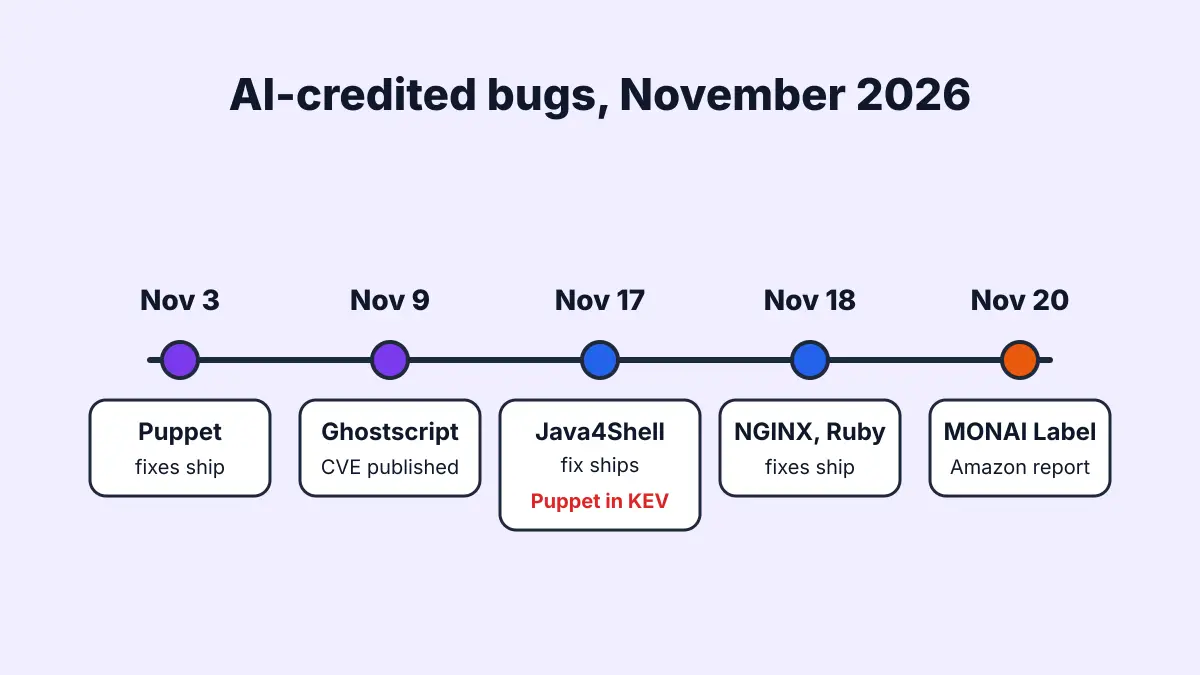
Three patterns stand out in these cases of AI finding security bugs. First, almost every credit includes a named human. Second, only Xint claims a find "without human guidance," and only for four of its five NGINX bugs. Third, Amazon is the one source that says AI agents found a bug largely on their own. Its report title says the agents found the zero-day "on their own," though a human operator still chose the targets.
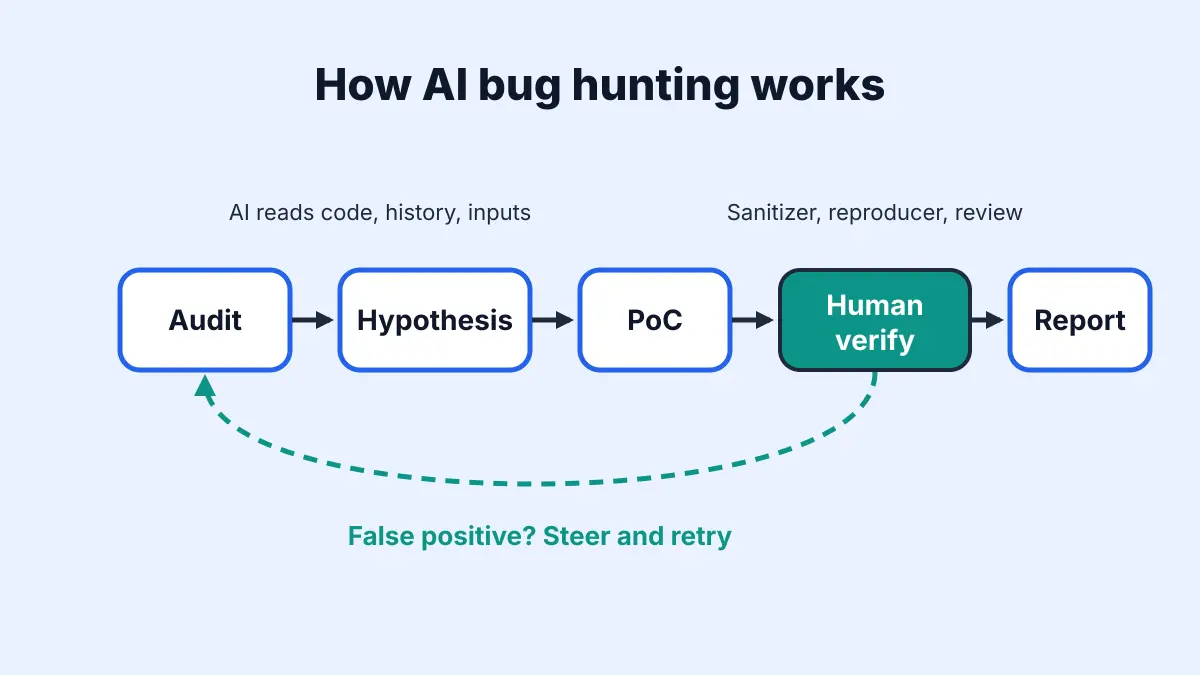
How does AI bug hunting actually work?
The published write-ups describe four techniques behind AI finding security bugs. They overlap, and most teams combine them.
1. LLM code auditing, steered by a person
Calif's write-up gives the clearest account. Luong asked Codex to audit Netty and the JVM for vulnerabilities that are easy to reach, focusing on x64 intrinsics. Intrinsics are hand-tuned machine-code paths that the JVM swaps in for common methods. Luong chose the audit areas: JIT, intrinsics, widely used APIs and cryptography. Most early results were false positives, which Calif calls "slops." Luong ignored them and kept prompting for about 20 minutes.
Neodyme describes the same pattern on Puppet. Its researchers say the "prompting effort and precise steering of the AI was crucial to the success." The model reads code at scale, and the human decides where it looks.
2. Variant analysis from code history
Models are good at the question "this was fixed here, so where else does the same mistake exist?" Anthropic's Frontier Red Team describes Claude reading Ghostscript's commit history. Claude found a commit that added bounds checking, then checked another caller of the same function that lacked the check. On OpenSC, it searched for functions that are often vulnerable and found a buffer overflow in a chain of strcat calls. Fuzzers rarely reach that code.
Google's Big Sleep used the same approach in 2024. Its team gave the agent recent SQLite commits and an earlier bug as a starting point. Project Zero reported that the agent found an exploitable stack buffer underflow before the bug reached a release. The team also says SQLite's existing fuzzing setup had not found it.
3. Reasoning about inputs, where fuzzers struggle
A fuzzer throws huge numbers of random or mutated inputs at a program and watches for crashes. Some bugs only trigger on an input with valid internal structure, and random mutation rarely produces one. In Anthropic's CGIF example, Claude understood the LZW compression format well enough to build an input that overflowed a buffer. In plain terms: the model knows the format, so it writes a valid-looking input that steers the code down the broken path.
4. Agent loops that build and test proofs of concept
An agent is a model that can run tools in a loop: read code, compile, run a test, look at the output and try again. Our explainer on how coding agents work: loop, permissions and feedback covers that loop in detail. In bug hunting, the loop ends with a crash, a sanitizer report or a working exploit. That output either confirms the bug or rules it out.
Calif says agents ran its first exploitation attempts under human direction, and that later chains were built "almost autonomously with AI." The humans still built the scaffolding. Calif wrote a heap tracer and visualizer for the agent after it got stuck on heap grooming. Heap grooming means arranging memory so that a corruption bug becomes reliable to exploit.
Where humans verify
Each credible source describes a human check before disclosure. Anthropic says it "validated every bug extensively before reporting it," using crash monitoring and address sanitizers. It also says human researchers validated each finding and wrote patches by hand. Bitcoin Core's advisory names the developer who validated the LLM scan's finding.
The research version of AI finding security bugs is DARPA's AI Cyber Challenge (AIxCC), where teams built fully automated systems to find and patch bugs. In the August 2025 final, DARPA reports that the systems found 54 of the synthetic vulnerabilities planted across 63 challenges and patched 43. They also found 18 real vulnerabilities that the organizers had not planted. That was a controlled competition. The November 2026 cases show the same methods applied to production software.
Why AI finding security bugs got cheap and fast
The most quoted figure comes from Calif, and it is Calif's own claim. The write-up says it took Luong "an hour to discover the vulnerability" and "two more hours" to build the first working exploit. It adds that "The total token cost was less than $200." Calif doesn't say whether that $200 covers discovery, exploitation or both. Nobody independent has verified the figures.
Xint's NGINX timeline shows the speed from another angle. Xint says it discovered the bugs on October 11 and reported them to F5 on October 16. The patched release shipped on November 18. Discovery took days, while the coordinated fix took about five weeks by our count. That gap is normal. Patches need review, testing and coordinated releases. But it means that once a model can find a bug quickly, the window between discovery and fix becomes the risky part.
Why old C code is a rich target
Most of the November bugs are memory-safety flaws in C or C++, or in hand-written machine-code paths:
Ghostscript, the PostScript and PDF interpreter, is written in C. Upload2Shell is a use-after-free: the code keeps using memory after freeing it.
Ruby's interpreter core is C. Its November advisory lists heap buffer overflows, a double free and out-of-bounds reads in string and regex code.
Java4Shell sits in an AVX-512 intrinsic, a CPU-specific fast path below the Java language's own safety checks. Calif says it affects OpenJDK 17.0.6 and newer on x86-64 CPUs with AVX-512 VBMI, and not ARM64.
CVE-2026-123007 in NGINX is described as "incorrect flow-control accounting leads to an invalid memory copy." The Register reports that it affects versions back to NGINX 1.9.5 from 2015.
There are two reasons this code suits AI audits. First, memory bugs are easy to confirm. A sanitizer such as AddressSanitizer flags the bad read or write, so false positives get filtered fast. Anthropic says it focused on memory corruption for this reason. Second, this code is old and has been reviewed many times. The remaining bugs tend to sit in rarely reached paths, and a model that reads every caller handles those better than random fuzzing does.
Not every case fits that pattern. Puppet's CVE-2026-115731 is a deserialization flaw in Puppet Server, which runs on the JVM. MONAI Label's bug is a path traversal in a Python web endpoint. AI audits find logic and input-handling bugs too.
When attackers' AI agents find the zero-day
AI finding security bugs is not only a defender's tool. Amazon Threat Intelligence's report on MONAI Label is the clearest public account of an attacker using AI agents to find a new bug. MONAI Label is an open-source tool that helps label medical images for AI training. Amazon "assesses with moderate confidence that this is a Chinese-nexus threat actor." It bases this on Simplified Chinese prompts, China Standard Time timestamps and the choice of university targets.
Here is the chain, as Amazon describes it:
The operator ran Cairn, an open-source autonomous penetration-testing framework. They gave it target IP addresses and a plain-language goal: "obtain shell access."
The agents found a path traversal flaw in an upload endpoint's filename parameter. Path traversal means using input like
../to write outside the intended folder.They used it to write files on the server, then got a reverse shell with root access.
The operator then gave the agents a proxy into a second university network and pointed them at more machines.
Amazon says the campaign ran for about 48 hours starting September 8, 2026. The operator left the Cairn instance on a public server without authentication, which is how its history became visible. The CVE record, published November 20, says the flaw has been exploited in the wild since September 2026 and is fixed in MONAI Label 0.8.6. The Hacker News reported on November 21 that no patched release was listed and that PyPI's latest version, 0.8.5, was affected. Check PyPI directly before you decide what to install.
Puppet shows how quickly a bug can go from disclosure to attack, whoever found it. Neodyme published its findings on November 3, the day the fixes shipped. CISA added CVE-2026-115731 to its Known Exploited Vulnerabilities (KEV) catalog on November 17, citing active exploitation. US federal civilian agencies must patch by December 1. CISA has not said who exploited it. Nothing in the sources says the attackers used AI.
Amazon's advice to defenders follows from the speed of agents. It recommends high-confidence detections that trigger automated responses, with humans overseeing outcomes instead of reviewing every alert. It also warns that an agent can exploit a zero-day in minutes, faster than many security teams can triage an alert. Neither case means attackers now win by default. Both mean the time between a fix and an attack is getting shorter.
What AI bug hunting means for open-source maintainers
The biggest strain from AI finding security bugs falls on triage. Anthropic's coordinated disclosure dashboard says that as of November 2, 2026, it had disclosed 5,087 vulnerabilities across 680 open-source projects, and that 629 had been patched as far as it knew. By our arithmetic, that is about 12%. The dashboard says it has disclosed only a subset of what its models found, because "independent human triage and review is the rate limiting step."
Low-quality reports make that worse. Anthropic's February write-up says hallucinated bugs are "placing an undue burden on open source developers," and many projects are run by small teams or volunteers. Calif called its own early false positives "slops." Neodyme warns that "unguided AI prompting keeps bringing up the same and already covered attack surface."
Duplicates are becoming common because many teams point similar models at the same popular code:
Calif says Java4Shell was not new. A user reported it publicly in June 2026, and a proposed fix was closed without merging in September.
The Register reports that researchers at Wiz, Ikotas Labs, Metnir, Rapid7 and Xint worked on the NGINX bugs independently.
Veria Labs says it found the Ruby case-conversion bug independently and was the first to show remote code execution.
That changes how embargoes work. If a bug is easy to rediscover, a long private window protects users less, because someone else may find it during the wait. Bitcoin Core's October advisory labels its LLM-found bug "easily discoverable." News reports say the project adopted a faster disclosure path on October 22, 2026, for bugs of that kind. The PHP project's experience also shows that one fix can lead to more reports. Its CVE-2026-115560 security release followed soon after the PHP2Shell emergency fixes, which news reports say AI-assisted researchers found.
Practical steps for maintainers, based on what the sources describe:
Ask for a reproducer with every report: an input file, a crash log or a sanitizer trace. Credible AI-assisted teams already send these.
Expect duplicates. Check new reports against recent fixes and public issues before treating them as new.
Plan for shorter embargoes on shallow bugs, and get release automation ready before you need it.
Run AI review on your own code first, especially recently fixed functions and their other callers.
Where AI bug hunting still falls short
The sources are open about the limits of AI finding security bugs, and those limits shape how much to trust headline claims.
Steering matters. Neodyme and Calif both say human direction decided where the model looked. Xint's "without human guidance" claim covers four NGINX bugs, but a researcher chose the target.
False positives are common. Calif's first results were mostly wrong. Teams that report good results filter them with sanitizers, reproducers and human review.
Rediscovery is not discovery. Java4Shell had been reported publicly months earlier. Calif checked Codex's tool calls and says the model had not looked up existing bug reports. Still, the bug wasn't unknown.
Severity is disputed. The Upload2Shell and Ruby CVE records score the bugs with a local attack vector. The finders argue the bugs are remotely reachable through apps. Read both sides before deciding how fast to act.
Cost figures are self-reported. "Less than $200" is Calif's figure, with no stated scope.
One claim is left out of this article. Some outlets report that Anthropic demonstrated an exploit for CVE-2026-98432. ByteMuni has not confirmed it against a primary source, so it is not included here.
A checklist for AI-era patching
AI finding security bugs faster means you need to patch faster. Start with the software from November's cases. Then work through the general steps.
| Software | Check command | Fixed in (per vendor or record) | Watch for |
|---|---|---|---|
| NGINX | nginx -v | 1.31.9 (Xint); 1.30.7 also reported by several outlets | nginx -s reload does not load a new binary; restart the service or recreate the container |
| Ruby | ruby -v | 4.0.10, 3.4.13, 3.3.14 | Apps bundle their own Ruby, such as GitLab; Ruby 3.2 and older get no fix |
| Java | java -version and grep -m1 -o avx512vbmi /proc/cpuinfo | Oracle's November 17 update | Only x86-64 CPUs with AVX-512 VBMI are affected, per Calif |
| Ghostscript | gs --version | 10.08.0 upstream; check your distro's package | Some distro packages were still unfixed on November 12, per the finder |
| Puppet | puppetserver --version | Puppet Core 9.1.3 and 8.22.2; OpenVox Server 9.2.0 and 8.18.0 | Autosign makes the RCE easier; review your CA |
| MONAI Label | pip show monailabel | 0.8.6 (CVE record) | Don't expose the server publicly |
Then the general steps:
Shorten your patch window for internet-facing services. Puppet went from fix to CISA's exploited list in 14 days. Use "days," not "next sprint," for critical web-facing fixes.
Cut exposed attack surface. Turn off features you don't use, such as HTTP/2 where it isn't needed. Keep management servers like Puppet and tools like MONAI Label off the public internet.
Restart after patching. On a VPS or Kubernetes, check that running processes picked up the new version, not just the files on disk.
Prefer memory-safe languages for new parsers and network code where practical. Most of November's bugs are memory-safety flaws that safe languages rule out by design.
Run AI review on your own code. Focus on recently patched functions, input parsers and code that handles uploads.
Keep a human in the loop. Treat AI findings as hypotheses until a test, reproducer or sanitizer confirms them.
My take on AI finding security bugs
My read is that AI finding security bugs has moved the bottleneck. Finding bugs in well-reviewed C code used to be the slow, expensive step, and these cases suggest it no longer is. Triage, patching, release and deployment are now the slow steps. Anthropic's own dashboard says human review limits how fast it can disclose.
The engineering lesson is mostly old advice that now carries a deadline. Ship patches in days, keep management planes private, restart what you patch and verify the running version. The newer lesson is to point AI at your own code before someone else does, and to have a person check every result before it goes into a report.
The bottom line on AI bug hunting
Treat AI bug hunting as normal security work, done by both sides. If you maintain a project, ask for reproducers, expect duplicates and plan for shorter embargoes. If you run software, patch internet-facing services within days and keep admin tools off the public internet. If you write code, run AI review on it and confirm every finding yourself. Don't trust "AI found it alone" unless the finder says so in writing. Most credible teams say the opposite.
Frequently asked questions
Can AI find security vulnerabilities on its own?
Sometimes, according to the finders. Xint says a fully automated scan found four NGINX bugs without human guidance, and Amazon says attackers' AI agents found a MONAI Label zero-day with little step-by-step direction. In most other November 2026 cases, the researchers say a human chose the targets and checked the results.
Which AI tools were used to find the November 2026 bugs?
Calif says it used OpenAI's Codex for Java4Shell. Paulos Yibelo credits GPT 5.6 Sol for Upload2Shell. Amazon says the attackers used Cairn, an open-source autonomous penetration-testing framework. Neodyme and Xint describe their AI tooling without naming a model in their write-ups.
Was Ruby2Shell found by AI?
Ruby's advisory credits "Stephan Lipp (Ada Logics) and Anthropic" for the underlying bug, but it never mentions AI and doesn't describe Anthropic's role. Veria Labs says it found the same bug independently and was the first to show remote code execution.
Is AI bug hunting cheaper than a manual audit?
Calif says its Java4Shell discovery took about an hour and cost less than $200 in tokens, though it doesn't say what that figure covers. These are self-reported numbers, and no independent cost comparison exists in the sources.
Why do AI tools find so many memory-safety bugs in C code?
Memory bugs are easy to confirm with tools like AddressSanitizer, so false positives can be filtered quickly. Anthropic says it focused on memory corruption for that reason. Old, widely used C projects such as Ghostscript and Ruby's core also have many rarely tested code paths.
What should maintainers do about AI-generated bug reports?
Ask for a reproducer with every report, check new reports against recent fixes for duplicates, and get release automation ready for shorter embargoes. Anthropic notes that hallucinated reports place an undue burden on open-source developers, and that human review is the step that limits how fast findings can be handled.
How we research, write and check articles