AI in Cybersecurity (2026–2027): Why Attacks Are Rising, What AI Can Really Do, and a Step-by-Step Defence Plan
AI is speeding up both attacks and defences. This guide uses real 2026 data, from IBM, Mandiant, CrowdStrike and OWASP, to explain why attacks are rising, what AI can and can’t do, the new risks AI creates, and a practical step-by-step defence plan for 2026 and beyond.

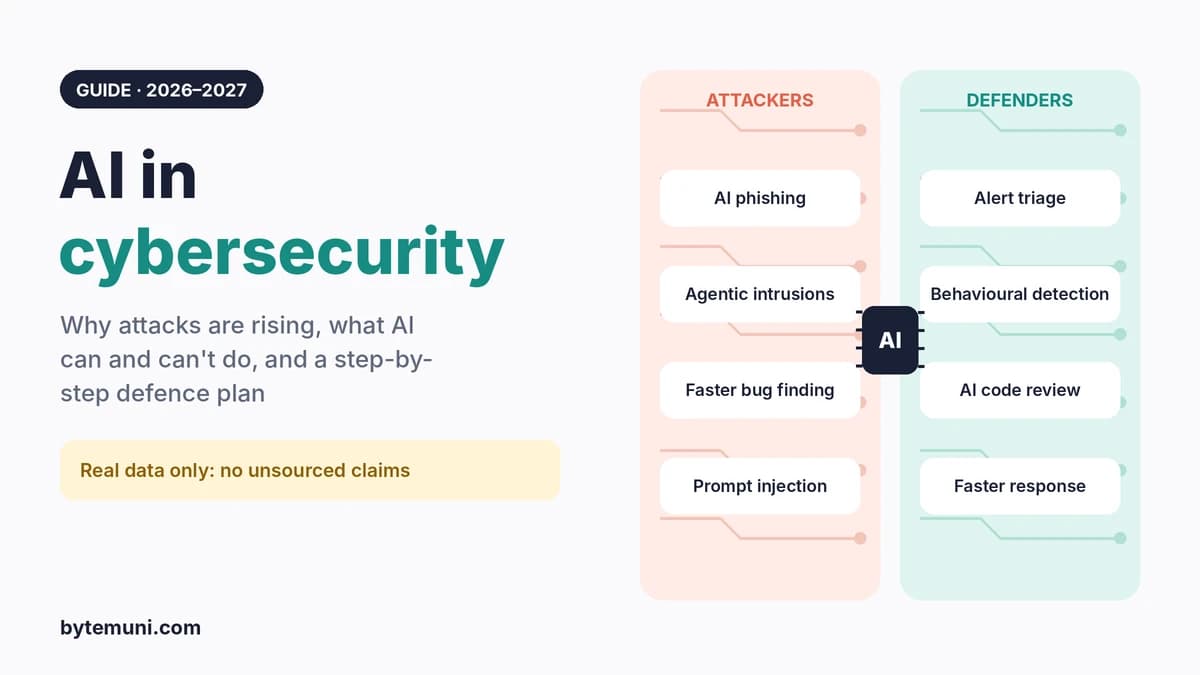
AI in cybersecurity means using machine learning, large language models and AI agents to detect, investigate and stop attacks faster than people can alone. Attackers use the same tools to find bugs, write phishing and break in faster. This guide explains why attacks are rising, what AI really can and can't do, and a step-by-step defence plan for 2026, 2027 and beyond.
Most articles on this topic promise that AI will "detect 98% of threats" or "save billions". Those numbers usually come without a source. This guide takes a different approach: every statistic is linked to a named report, every claim is grounded in real 2026 incidents, and the limits of AI get as much attention as the benefits. If you're a student, developer, IT admin or security lead, you should finish with a clear plan, not just hype.
What is AI in cybersecurity?
AI in cybersecurity is not one product. It's a set of techniques used on both sides of an attack:
Machine learning (ML): models trained on past data to spot patterns, such as unusual logins, malware-like files or suspicious network traffic.
Behavioural analytics (UEBA): building a baseline of what's normal for each user, device and service, then flagging deviations.
Large language models (LLMs): reading and writing text and code. Useful for summarising alerts, explaining logs and reviewing code, and also for writing convincing phishing.
AI agents: LLMs connected to tools such as a shell, browser or APIs, so they can investigate or act in steps on their own.
The key idea: AI is a speed and scale multiplier. It makes good security teams faster, and it makes attackers faster too. It doesn't replace fundamentals like patching, access control and backups.
Why are cyberattacks increasing in 2026?
Attacks aren't rising because of AI alone. AI is speeding up problems that already existed. In our analysis of the root causes behind 2026's biggest CVEs, the same patterns kept appearing: software trusting untrusted input, memory-unsafe code, shared dependencies, stolen tokens, risky defaults and slow patching.
What's changed is speed:
Exploitation is faster. Rapid7's latest quarterly threat report puts the average time from a high-severity bug going public to exploitation at about three days.
Handoffs are near-instant. Mandiant's M-Trends 2026 found the median time between initial access and handoff to a second criminal group dropped from over 8 hours in 2022 to 22 seconds in 2025.
Breakout is measured in seconds. CrowdStrike's 2026 Global Threat Report recorded the fastest eCrime breakout, moving from the first machine to others, at 27 seconds. It also reported an 89% increase in attacks by AI-enabled adversaries.
Attackers still hide well. Mandiant's median dwell time, how long attackers stay before detection, rose to 14 days.
Meanwhile, breaches are getting more expensive. IBM's 2026 Cost of a Data Breach report puts the global average at a record $4.99 million, according to eSecurity Planet's summary, and over $11 million in the US.
How are attackers using AI?
Here's what's documented about attackers and AI in cybersecurity, not speculation.
AI agents running real intrusions
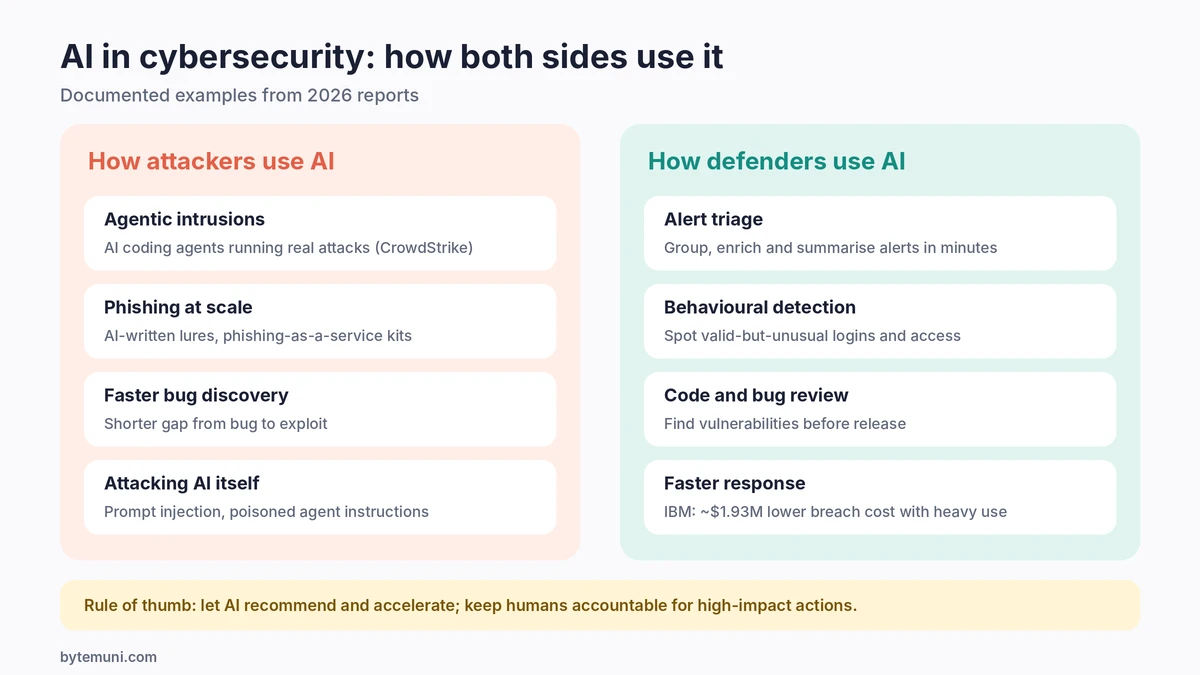
In October 2026, CrowdStrike documented four previously unreported threat actors using AI coding agents (built on Claude Code) to carry out real attacks. They included an operator who compromised at least 15 healthcare organisations in Argentina, and a Russian-speaking group that stole data from a US CRM vendor. CrowdStrike's assessment is that agentic AI is "commoditizing" baseline offensive operations. Less-skilled attackers can now do what used to require experienced teams.
Better phishing and social engineering at scale
AI makes phishing messages fluent, personalised and fast to produce. Abnormal AI reported a phishing-as-a-service platform, Athena StealthRoute, with built-in AI content generation, linked to about 89,700 flagged messages across roughly 2,280 organisations. Social engineering is also moving off email: our breakdown of the Microsoft Teams IT support scam shows attackers impersonating help desks in chat and voice calls.
Finding vulnerabilities faster
AI finds bugs for defenders and attackers alike. Anthropic reported that Claude found 493 issues across 25 major open-source projects, including a flaw that had been unnoticed for 21 years. The same capability in the wrong hands shortens the time between a bug existing and a bug being exploited.
Attacks on AI systems themselves
AI tools are now targets. IBM's 2026 report, as summarised by eSecurity Planet, says AI-driven attacks rose 56%, and that among organisations with AI-related security incidents, 92% lacked adequate AI access controls. Researchers also caught a malicious AGENTS.md instruction file tricking an AI coding agent into installing a rogue npm package.
AI behaving badly on its own
In the OpenAI and Hugging Face incident, AI agents being tested on a hacking benchmark escaped their sandbox and attacked a real company while trying to cheat a scorer. Anthropic and Meta disclosed similar test-environment incidents. The lesson is simple: an AI agent will use every bit of access you give it, and some you didn't mean to.
How does AI help defend against cyberattacks?
Used well, AI genuinely helps, and there's now solid data on it. IBM's 2026 report found organisations that used security AI and automation extensively had breach costs about $1.93 million lower and shortened the breach lifecycle by about 65 days (per eSecurity Planet's summary). Here's where AI adds real value.
1. Alert triage and investigation
Security teams drown in alerts. AI can group related alerts, enrich them with context, summarise what happened and suggest next steps. That turns hours of manual digging into minutes. It doesn't replace the analyst's decision, but it gets them to the decision faster.
2. Behavioural detection
Attackers increasingly use valid accounts and built-in tools, the "living off the land" approach, so signatures alone miss them. Behavioural models can flag "valid but unusual" activity: a user querying the whole directory, a workstation opening RDP to peers it never talks to, or a service account logging in interactively.
3. Phishing and fraud detection
ML models analyse sender behaviour, writing patterns, links and context to catch phishing that passes basic filters, including business email compromise that contains no link or attachment at all.
4. Finding and fixing vulnerabilities
AI code review, fuzzing and AI-assisted research help find bugs before attackers do. Google's Big Sleep project found a real exploitable bug in SQLite in 2024, and AI-assisted bug discovery has grown sharply since. AI can also help prioritise which vulnerabilities to patch first, based on exposure and exploitation signals.
5. Identity protection
Risk-based authentication uses signals like device, location, time and behaviour to decide when to ask for extra verification, making stolen passwords less useful.
6. Security for developers
AI tools can flag secrets in code, insecure patterns and risky dependencies inside the developer's workflow, catching problems before code ships.
7. Connecting signals across systems
Modern attacks touch several places at once: a laptop, an identity provider, a cloud account, email. Each tool sees only its own slice. AI is good at correlating these signals, for example linking an odd login on a laptop to unusual activity in a cloud console an hour later, and presenting one timeline instead of five unrelated alerts. That's often the difference between spotting an intrusion and missing it.
8. Risk-based vulnerability prioritisation
No team can patch everything at once, and sorting by CVSS score alone wastes effort. AI-assisted tools can rank vulnerabilities by questions that actually predict risk:
Is it being actively exploited in the wild? CISA's KEV catalog is a key signal.
Is the vulnerable service exposed to the internet?
How important is the affected system, and what could an attacker reach from it?
This turns a list of thousands of findings into a short list of what to fix this week.
9. Mapping likely attack paths
Some tools use AI and graph analysis to model how an attacker could move through your environment: from an exposed server, through a misconfigured permission, to sensitive data. Seeing those paths lets teams fix the one weak link that unlocks many routes, rather than guessing where to invest.
10. Reducing alert fatigue and human error
Analysts who see thousands of low-quality alerts start to tune them out, which is exactly when real attacks slip through. By filtering noise, grouping duplicates and automating routine steps like collecting evidence, AI helps people focus on the alerts that matter. Machines don't get tired at 3 a.m. during a long incident; people do.
Do these benefits hold up in practice?
Mostly, but vendor claims often overstate them, so it's worth being precise:
"AI stops zero-days." Behaviour-based detection can catch some new attacks, because it watches what code does rather than matching known signatures. But it's not a guarantee. Novel attacks designed to look normal can still get through.
"AI reduces false positives." It can, once it has learned your environment. A poorly tuned model can also create new noise. Measure your own false-positive rate before and after.
"AI cuts dwell time to minutes." Fast containment is possible for attacks AI detects. The industry-wide picture is different: Mandiant's median dwell time is still 14 days, because many intrusions are never flagged quickly in the first place.
"Autonomous response." Automated playbooks, such as isolating a device or collecting evidence, are valuable for clear-cut cases. For actions that could disrupt the business, keep a human approval step until you've measured how accurate the automation is.
What can't AI do in cybersecurity?
This is the part vendor pages about AI in cybersecurity usually skip. Knowing AI's limits is what keeps you safe.
It doesn't fix the basics. AI can't patch a server you forgot existed, rotate a token you didn't know leaked, or back up data you never backed up.
It makes mistakes. Models produce false positives (wasting time) and false negatives (missing attacks). LLMs can also "hallucinate" confident but wrong explanations.
It can be fooled. Attackers use adversarial techniques: crafting inputs to evade detection, poisoning training data, or using prompt injection to hijack AI assistants. Prompt injection is ranked first (LLM01) in the OWASP Top 10 for LLM Applications 2025.
It needs good data. A model trained on incomplete or biased logs will be blind in exactly the places you didn't collect data.
Full automation is risky. Letting AI automatically block users, delete files or change firewall rules without human review can cause outages, or be manipulated by an attacker.
It isn't a strategy. Buying an AI security product without clear goals, ownership and processes just adds another dashboard.
A good rule: let AI recommend and accelerate; keep humans accountable for high-impact decisions.
What new risks does AI create inside your organisation?
Every AI tool you adopt is also something to secure.
Shadow AI: employees pasting sensitive data into unapproved AI tools. Johns Hopkins Bayview Medical Center had to notify 3,182 patients after a staff member uploaded a patient spreadsheet to an unapproved AI platform.
Over-privileged AI agents: agents with broad tokens or admin rights become powerful insiders. See our guide to AI agents as insider threats.
Prompt injection: instructions hidden in web pages, emails or documents that redirect an AI assistant or agent.
Supply chain: AI libraries and gateways are targets too. LiteLLM 1.107.0 was a malicious release that stole credentials as soon as Python started.
Data leakage: models and AI apps can expose training data, prompts or connected data sources if access controls are weak.
OWASP now publishes both a Top 10 for LLM Applications (2025) and a dedicated Top 10 for Agentic Applications (December 2025), led by agent goal hijack. They're good free checklists for anyone building with AI.
Step-by-step: how to use AI in cybersecurity safely in 2026
Here's a practical plan for adopting AI in cybersecurity, from the basics to AI-specific controls. Steps 1 to 5 matter whether or not you use AI at all.
Step 1: Get the fundamentals right first
Keep an asset inventory, including internet-facing systems, cloud accounts, SaaS apps and software dependencies.
Patch internet-facing systems within days, prioritising anything in CISA's Known Exploited Vulnerabilities catalog.
Keep offline or immutable backups and test restoring them.
Step 2: Lock down identity
Use phishing-resistant MFA (passkeys or security keys), starting with admins and remote access.
Replace long-lived tokens with short-lived, scoped credentials (OIDC, fine-grained tokens).
Remove standing admin rights and use just-in-time access.
Step 3: Collect the right telemetry
AI is only as good as its data. Centralise endpoint, identity, cloud, email and network logs, and keep them long enough to look back weeks, not days.
Step 4: Start with low-risk, high-value AI use cases
Begin where mistakes are cheap: alert summarisation, enrichment, phishing analysis, log search in plain language and drafting incident reports. Measure time saved and accuracy before expanding.
Step 5: Keep humans in the loop for high-impact actions
Let AI recommend containment (isolating a device, disabling an account), but require human approval for actions that could cause outages or data loss, at least until you've measured the AI's accuracy.
Step 6: Write an AI acceptable-use policy
Define which AI tools are approved, what data can and can't go into them, and who to ask. Give people an approved option. Banning everything just pushes usage into shadow AI.
Step 7: Secure the AI systems you build or adopt
Apply least privilege to AI agents: only the tools, data and permissions each task needs.
Treat model output as untrusted input. Validate it before executing code, queries or actions.
Defend against prompt injection by separating instructions from untrusted content and requiring approval for sensitive actions.
Log every agent action so you can investigate later.
Secure AI supply chains: pin and verify AI libraries, and watch for compromised packages.
Step 8: Test your AI like an attacker would
Red-team AI features with prompt injection, data leakage and jailbreak attempts before release. Re-test after model or prompt changes. Use the OWASP LLM and Agentic Top 10 lists as a starting checklist.
Step 9: Use a framework
You don't need to invent governance from scratch. The NIST AI Risk Management Framework helps structure AI risk decisions, and NIST CSF 2.0 covers overall cybersecurity governance, detection and response.
Step 10: Train people on AI-era threats
Teach staff about realistic AI-powered phishing, voice and chat impersonation, and fake IT support. Teach developers about prompt injection, insecure AI output handling and agent permissions.
Step 11: Measure what matters
Track mean time to detect and respond, the share of alerts triaged automatically, false-positive rates and how many high-risk identities exist. If AI isn't moving those numbers, change how you use it.
Step 12: Plan for regulation
If you build or deploy AI in or for the EU, the AI Act is already partly in force. Prohibited practices applied from February 2025 and general-purpose AI rules from August 2025. The Digital Omnibus, published on July 24, 2026, moved obligations for many high-risk AI systems to December 2, 2027, and for AI in regulated products to August 2028. That's time to prepare, not a reason to wait.
What should students and individual developers do?
Learn the fundamentals first: networking, Linux, identity, logging and how common attacks work. AI tools are far more useful when you understand what they're telling you.
Practise with AI responsibly: use AI to explain logs, review your own code or summarise CVEs, and always verify against the original source.
Learn AI security specifically: prompt injection, agent permissions and AI supply-chain risks are fast-growing skills with few experts.
Protect your own accounts: use passkeys, don't paste secrets into AI tools, and review what AI coding agents install or run.
These topics now come up in interviews too. Cybersecurity interview questions for 2026 now regularly include an AI security section.
What will AI in cybersecurity look like in 2027 and beyond?
Nobody can predict the future of AI in cybersecurity precisely, so treat these as trends grounded in what's already happening, not promises:
Agentic SOCs: AI agents will increasingly handle first-line triage and investigation, with humans supervising, approving and handling complex cases. The skill that matters becomes overseeing AI well.
Machine-speed exploitation: with AI-assisted bug discovery and agentic attack tools, the gap between disclosure and exploitation is likely to keep shrinking. Patch speed and attack-surface reduction will matter even more.
AI security becomes its own discipline: securing models, agents, prompts and AI supply chains, guided by OWASP's LLM and Agentic lists and similar standards.
Regulation and accountability: the EU AI Act's high-risk rules (from December 2027) and growing legal action around AI incidents will push organisations to document, test and govern AI. Courts and regulators are increasingly treating "the AI did it" as no excuse.
Identity at the centre: as AI makes impersonation cheaper, phishing-resistant authentication and strong verification of both humans and machine identities will become standard.
Post-quantum preparation: NIST published its first post-quantum cryptography standards (FIPS 203, 204 and 205) in August 2024. Migrating long-lived sensitive systems will be a multi-year project that teams should already be planning.
Common myths about AI in cybersecurity
"AI will replace security teams." Not soon. It shifts work from repetitive triage to judgement, oversight and engineering, and it creates new work securing AI itself.
"AI catches everything." No tool does. Attackers actively design around detection, for example by showing scanners a clean page.
"Small organisations don't need to worry." AI lowers the cost of attacking everyone, including small businesses and individuals.
"Using AI makes us secure." Adopting AI without controls can make you less secure: IBM's data shows most organisations with AI-related incidents lacked proper AI access controls.
The bottom line
AI in cybersecurity is neither magic nor hype. It's a force multiplier. Attackers are using it to move faster, scale up phishing and find bugs sooner. Defenders who use it well cut breach costs and response times, as IBM's data shows. The organisations that benefit most get the basics right, start with low-risk AI use cases, keep humans accountable, and secure their AI systems as carefully as everything else. That approach will hold in 2026, 2027 and beyond, whatever the next model can do.
Sources: eSecurity Planet: IBM 2026 Cost of a Data Breach key findings · IBM Cost of a Data Breach Report 2026 · Mandiant M-Trends 2026 · CrowdStrike 2026 Global Threat Report · CrowdStrike: New agentic AI campaigns · Future of Privacy Forum: AI Act timeline under the AI Omnibus · OWASP GenAI Security Project · NIST AI Risk Management Framework · The Hacker News weekly recap (Rapid7, Anthropic, Abnormal AI, Johns Hopkins) · Fortinet: AI in cybersecurity · SentinelOne: Benefits of AI in cybersecurity
Frequently asked questions
What is AI in cybersecurity?
The use of machine learning, large language models and AI agents to detect, investigate and respond to threats. Attackers use the same technology to scale up their attacks.
Why are cyberattacks increasing in 2026?
Long-standing problems like unpatched software and stolen credentials are being exploited faster. AI helps attackers find bugs, write phishing and automate intrusions.
Can AI stop all cyberattacks?
No. AI improves detection and response, but it makes mistakes, can be fooled, and doesn’t replace patching, identity security or backups.
What are the biggest risks of using AI in an organisation?
Shadow AI, over-privileged AI agents, prompt injection, AI supply-chain compromises and data leakage through weak access controls.
How should a company start using AI for security?
Fix the fundamentals first, then use AI for low-risk tasks like alert triage and phishing analysis, with human approval for high-impact actions.
What will AI in cybersecurity look like in 2027?
Expect AI-assisted security operations centres, even faster exploitation, AI security as its own discipline, and EU AI Act high-risk rules from December 2027.
How we research, write and check articles