Agentic AI Explained: How AI Agents Work, Real Use Cases and Risks (2026 Guide)
Agentic AI explained without the hype: how AI agents plan, call tools and act, a runnable Python agent loop, single vs multi-agent design, deep research, real use cases, real failures and a production checklist.

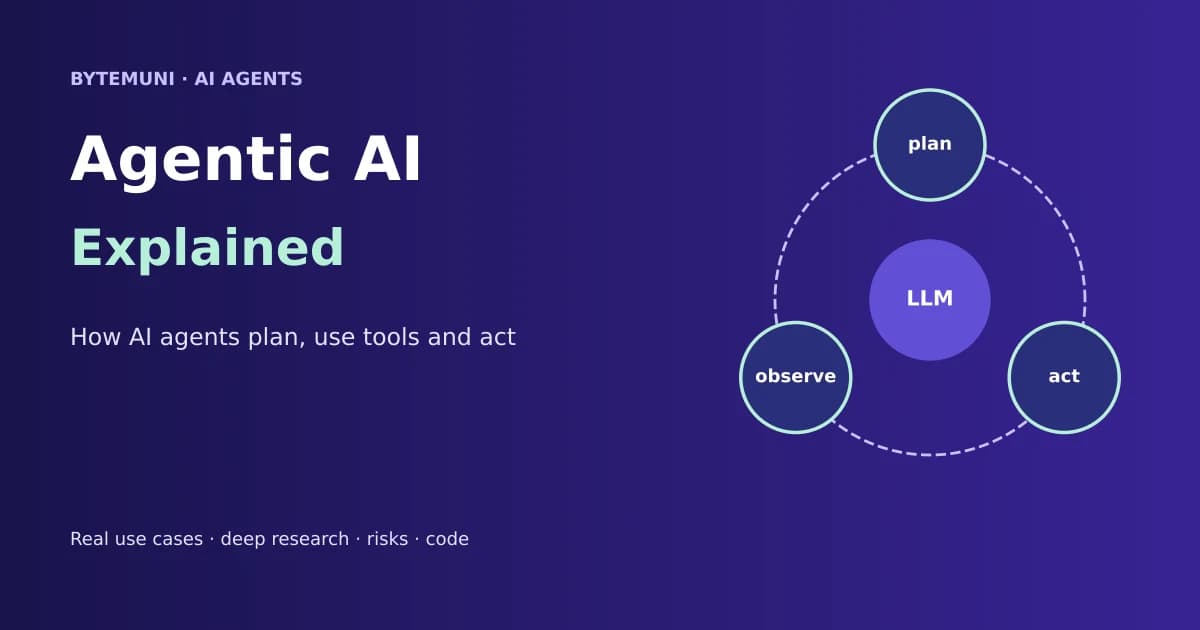
Agentic AI is AI that works toward a goal on its own: it plans the steps, uses tools such as search, code and APIs, checks the results and keeps going until the job is done. A chatbot answers your question. An agent does the research, runs the analysis or fixes the bug, and tells you when it's finished.
That shift is real, and it's already in products many developers use every day: deep research modes in ChatGPT, Gemini, Claude and Perplexity, coding agents that open pull requests, and enterprise assistants that read your company's documents before they answer. It's also heavily overhyped. Gartner expects more than 40% of agentic AI projects to be canceled by the end of 2027.
This guide is written for developers and technical readers who want the full picture without the marketing. It covers what agentic AI actually is, how an agent works under the hood (with runnable Python code), the single-agent versus multi-agent debate, deep research as the use case that went mainstream, real examples, real failures, the numbers behind the hype and a practical checklist for building agents that don't embarrass you in production.
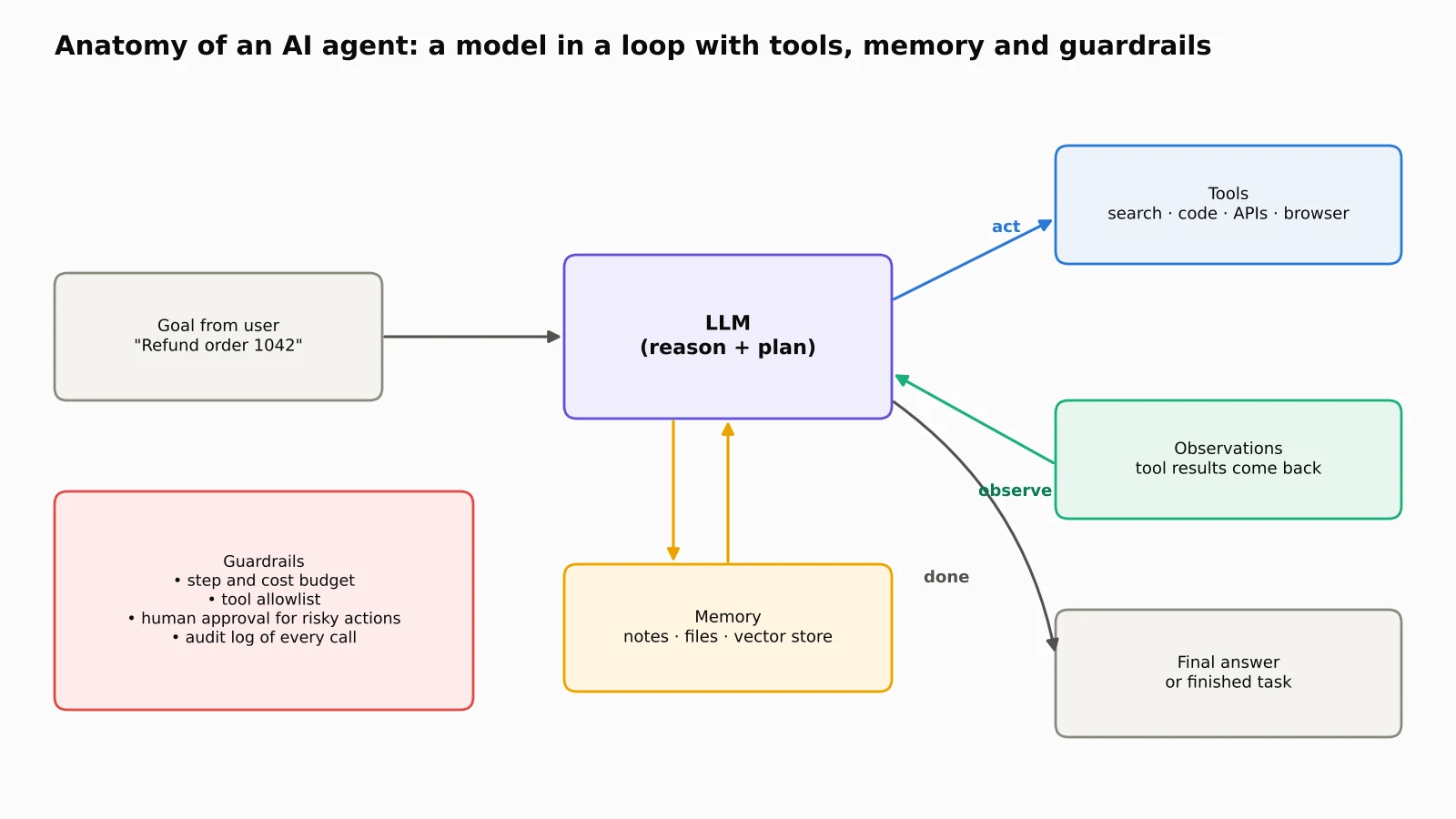
What is agentic AI?
The simplest definition comes from the research community. An agentic system couples a large language model's reasoning with external actions in a feedback loop of plan → act → reflect. The model decides what to do next, calls a tool, reads the result and updates its plan. This idea was formalized in the 2022 ReAct paper (Yao et al.), which showed that interleaving reasoning traces with tool calls improves performance on multi-step tasks.
Anthropic's widely cited engineering guide, Building effective agents (December 2024), draws a useful line between two kinds of system:
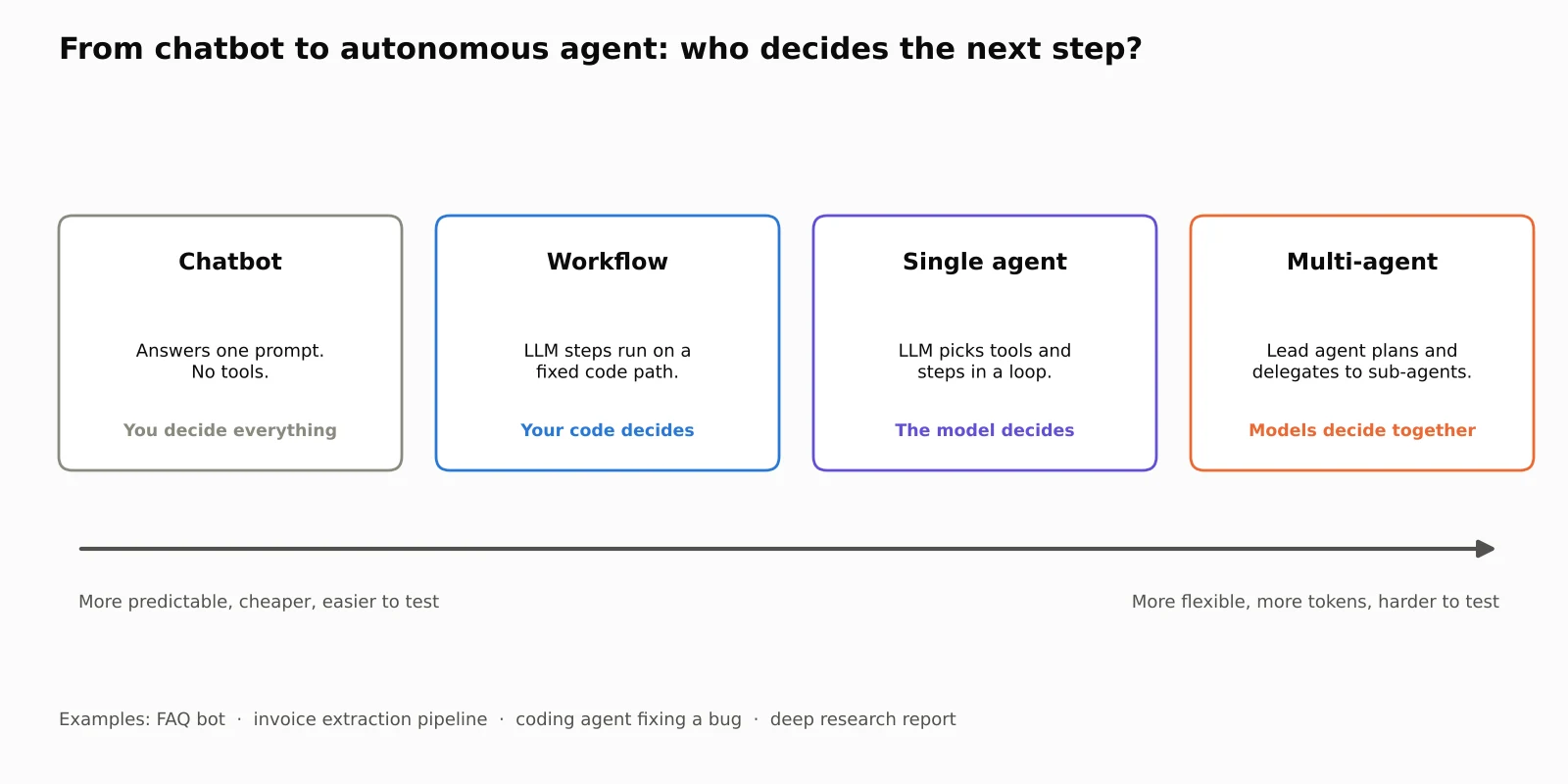
Workflows are systems where LLMs and tools are orchestrated through predefined code paths. Your code decides the order of steps.
Agents are systems where the LLM dynamically directs its own process and tool usage. The model decides the order of steps.
Both are often called "agentic AI", but the distinction matters. A workflow is predictable and easy to test. An agent is flexible and much harder to test. Most production systems that work well today are closer to the workflow end than the marketing suggests.
A vision paper presented at the Sci-K workshop in 2025 by Mohamad Yaser Jaradeh and Sören Auer (L3S Research Center and TIB Hannover) describes agentic AI as autonomous systems designed to pursue complex goals with minimal human intervention, showing adaptability, decision-making and self-sufficiency in changing environments. That's the aspiration. The engineering reality is a loop, a set of tools and a lot of guardrails.
Agentic AI vs generative AI vs chatbots
People often use these terms interchangeably. They aren't the same thing.
| Chatbot | Generative AI app | Agentic AI | |
|---|---|---|---|
| What it does | Answers a message | Creates content from a prompt | Completes a multi-step goal |
| Who decides the steps | The user | The user or a fixed pipeline | The model, within limits |
| Uses tools | Rarely | Sometimes | Always: search, code, APIs, browser |
| Typical run time | Seconds | Seconds | Minutes to hours |
| Example | FAQ bot on a website | Writing a product description | Researching a market and writing a cited report |
| Main risk | Wrong answer | Low-quality output | Wrong action |
The last row is the important one. When a chatbot is wrong, you get a bad answer. When an agent is wrong, it may have already sent the email, changed the database or issued the refund.
How an AI agent works: the five parts
Strip away the branding and almost every agent has the same five parts.
1. A model that reasons and plans. Usually a capable LLM, often a reasoning model. It reads the goal, decides the next step and decides when the task is done.
2. Tools. Functions the model can call: web search, a code interpreter, a database query, an internal API, a browser. The model doesn't run them itself. It outputs a structured request ("call search_docs with this query"), your code runs the tool and sends back the result. In late 2024, Anthropic introduced the Model Context Protocol (MCP), an open standard for connecting agents to tools and data sources, which has since been adopted widely across the industry.
3. Memory. Agents generate a lot of text. A June 2025 survey of deep research agents by Yuxuan Huang and colleagues (arXiv 2506.18096) notes that research runs can produce hundreds of thousands or even millions of tokens. The survey groups the fixes into three strategies: use a longer context window, compress or summarize intermediate steps, or store results externally in files, vector databases or knowledge graphs.
4. A plan. Some agents plan once and execute. Others replan after every observation. The same survey identifies three planning styles in commercial deep research products:
Planning-only: generate a plan straight from the prompt (the survey lists Grok, H2O and Manus).
Intent-to-planning: ask clarifying questions first, then plan (OpenAI's deep research).
Unified intent-planning: show the user a draft plan to confirm or edit (Gemini Deep Research).
5. Guardrails. Step limits, cost budgets, an allowlist of tools, human approval for risky actions and a log of everything the agent did. These are what separate a demo from a system you can put in front of customers.
Build a minimal agent in Python
Frameworks hide the core idea, so here's the loop with nothing hidden. To keep it runnable without an API key, a fake model replays a fixed plan. In a real agent, fake_model would be a call to a model API that returns either a tool call or a final answer.
import json

# --- Tools the agent is allowed to use -------------------------------------
def search_docs(query: str) -> str:
    docs = {
        "refund policy": "Refunds are allowed within 30 days with a receipt.",
        "order 1042": "Order 1042: shipped on 2026-10-20, delivered 2026-10-24.",
    }
    return docs.get(query.lower(), "No matching document.")

def issue_refund(order_id: str, amount: float) -> str:
    return f"Refund of {amount:.2f} issued for order {order_id}."

TOOLS = {
    "search_docs": {"fn": search_docs, "risky": False},
    "issue_refund": {"fn": issue_refund, "risky": True},   # moves money: needs a human
}

# --- A stand-in for the LLM ------------------------------------------------
def fake_model(messages):
    step = sum(1 for m in messages if m["role"] == "tool")
    plan = [
        {"tool": "search_docs", "args": {"query": "order 1042"}},
        {"tool": "search_docs", "args": {"query": "refund policy"}},
        {"tool": "issue_refund", "args": {"order_id": "1042", "amount": 49.0}},
        {"final": "Order 1042 was delivered on Oct 24, within the 30-day window. Refund requested."},
    ]
    return plan[min(step, len(plan) - 1)]

# --- The loop ---------------------------------------------------------------
def run_agent(task, model=fake_model, max_steps=6, approve=lambda name, args: False):
    messages = [{"role": "user", "content": task}]
    for step in range(1, max_steps + 1):          # hard budget: agents must stop
        decision = model(messages)
        if "final" in decision:
            print(f"[{step}] FINAL: {decision['final']}")
            return decision["final"]

        name, args = decision["tool"], decision["args"]
        if name not in TOOLS:                      # allowlist, not denylist
            result = f"Error: unknown tool {name}"
        elif TOOLS[name]["risky"] and not approve(name, args):
            result = "Blocked: this action needs human approval."
        else:
            result = TOOLS[name]["fn"](**args)

        print(f"[{step}] {name}({json.dumps(args)}) -> {result}")   # audit log
        messages.append({"role": "tool", "name": name, "content": result})
    return "Stopped: step budget reached."

run_agent("Customer asks for a refund on order 1042.")
Output from running it:
[1] search_docs({"query": "order 1042"}) -> Order 1042: shipped on 2026-10-20, delivered 2026-10-24.
[2] search_docs({"query": "refund policy"}) -> Refunds are allowed within 30 days with a receipt.
[3] issue_refund({"order_id": "1042", "amount": 49.0}) -> Blocked: this action needs human approval.
[4] FINAL: Order 1042 was delivered on Oct 24, within the 30-day window. Refund requested.
Forty lines, and it already shows the four habits that matter most in production:
A step budget.
max_stepsguarantees the loop ends. Agents that can't stop will burn tokens forever.A tool allowlist. The agent can only call tools you registered. Anything else returns an error instead of running.
Risk tiers. Reading documents is safe. Moving money isn't, so
issue_refundis blocked unless a human approves it.An audit log. Every call and result is printed. In production, write it somewhere durable, because when an agent does something strange, the log is the only way to find out why.
Notice what the agent did on step 3. It decided on its own that a refund was justified. That's the power of agentic AI and exactly why the approval check exists.
Single agent or multi-agent?
Once the basic loop works, the next design question is whether one agent should do everything or whether several should split the work.
Single-agent systems keep planning, tool use and writing inside one model. The deep research survey notes that this makes end-to-end reinforcement learning easier, which is why many research systems such as Search-R1, DeepResearcher and Kimi-Researcher use it. OpenAI describes its deep research product as a single agent built on a version of its o3 reasoning model, trained with reinforcement learning on hard browsing and reasoning tasks.
Multi-agent systems use a coordinator that breaks the task into parts and hands them to specialist agents. The best-documented example comes from Anthropic, which published how it built the Research feature in Claude in June 2025:
A lead agent plans the research, saves the plan to memory and starts 3 to 5 sub-agents in parallel, each with its own context window.
Sub-agents search independently, use 3 or more tools in parallel and report back. A separate citation agent then matches claims to sources.
On Anthropic's internal research evaluation, this multi-agent setup (Claude Opus 4 leading Claude Sonnet 4 sub-agents) outperformed a single Claude Opus 4 agent by 90.2%.
Parallelism cut research time by up to 90% for complex queries.
The catch is cost. Anthropic reports that agents use about 4 times as many tokens as chat interactions, and multi-agent systems use about 15 times as many. On the BrowseComp benchmark, token usage alone explained 80% of the variance in performance. Put simply, much of the improvement came from spending more compute. Anthropic's own conclusion is that multi-agent systems suit high-value, heavily parallel tasks and are a poor fit for tasks where every agent needs the same shared context, such as most coding work.
My rule of thumb: start with one agent. Add more only when you can show that the task splits into independent parts and that the result is worth roughly 15 times the tokens.
Deep research: the agentic AI use case that went mainstream
If you want to see agentic AI working at scale today, look at deep research. These tools take a question, plan a search strategy, read dozens or hundreds of sources, analyze data and write a cited report.
The product wave happened fast. According to the community-maintained Awesome Deep Research list:
| Product | Company | Launch |
|---|---|---|
| Gemini Deep Research | December 11, 2024 | |
| Deep research in ChatGPT | OpenAI | February 2, 2025 |
| Perplexity Deep Research | Perplexity | February 14, 2025 |
| Grok DeepSearch | xAI | February 19, 2025 |
| Manus | Manus | March 6, 2025 |
| Researcher in Microsoft 365 Copilot | Microsoft | March 25, 2025 |
| Research in Claude | Anthropic | April 15, 2025 |
| DeerFlow (open source) | ByteDance | May 9, 2025 |
| Kimi-Researcher | Moonshot AI | June 20, 2025 |
OpenAI's launch post explains what changes when a model gets tools. Its deep research agent takes 5 to 30 minutes per task, browses the web, analyzes files and runs Python, and cites specific passages for its claims. OpenAI has kept extending it: in February 2026 it added the ability to connect deep research to MCP servers and apps, and to restrict web searches to trusted sites.
The benchmark jump is the clearest illustration of why tools matter.
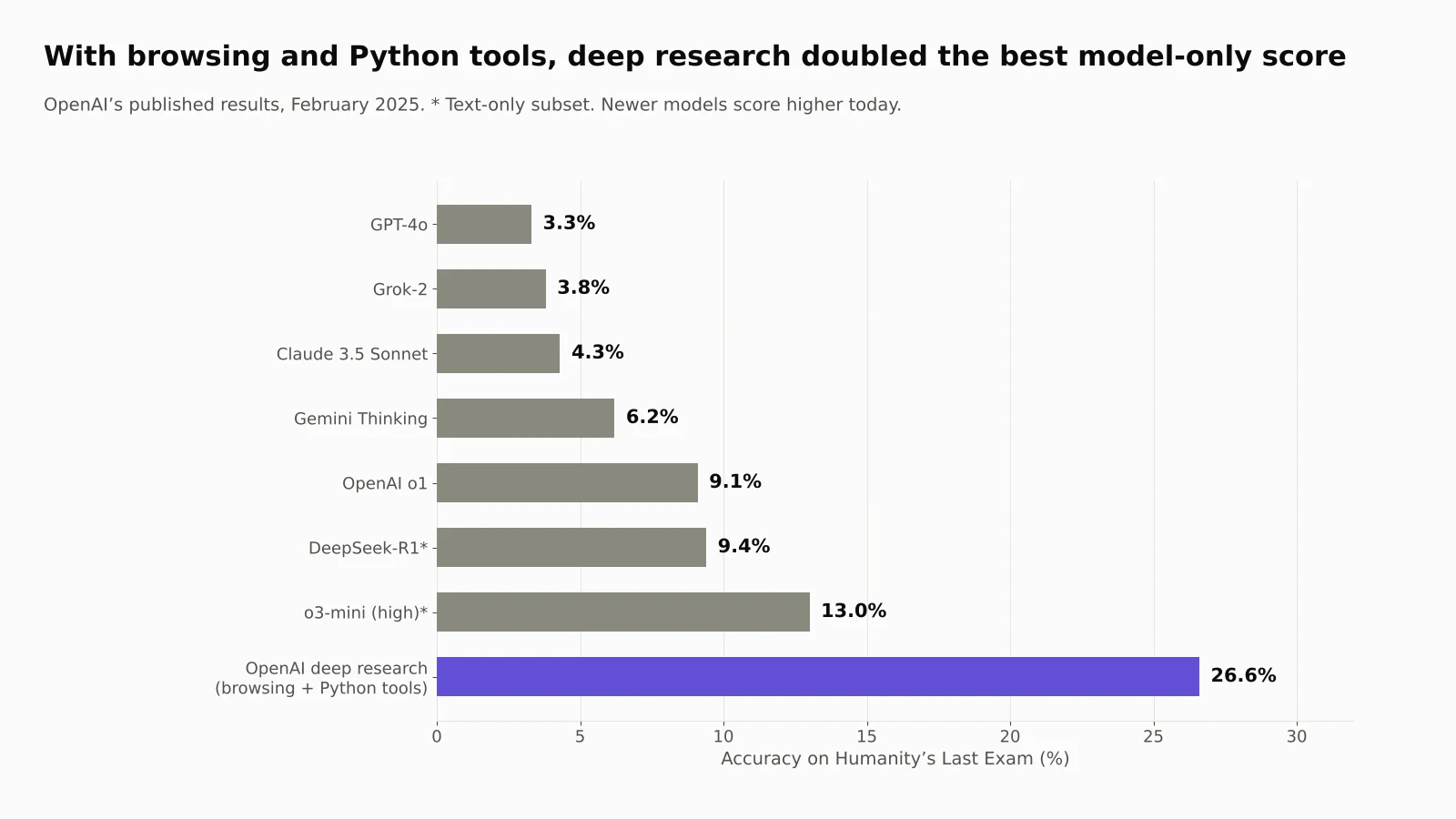
On GAIA, a benchmark of real-world assistant tasks that are easy for people and hard for AI, OpenAI reported an average of 67.36% for deep research on a single attempt, rising to 72.57% when it took a consensus of 64 attempts. Those are early-2025 numbers, and the field has moved on, but the pattern holds: the biggest gains come from letting the model search, read and compute, not just from a bigger model.
How deep research agents get information
The deep research survey describes two ways agents reach the web, and the trade-off applies to any agent you build:
API-based retrieval calls search APIs, arXiv, PubMed and similar services directly. It's fast and cheap but struggles with pages that load content through JavaScript, need a login or require clicking through.
Browser-based retrieval drives a real browser. Manus, for example, runs a sandboxed Chromium instance for each session, opening tabs, scrolling, filling forms and downloading PDFs. It reaches more content but is slower, more expensive and breaks more often.
The survey's conclusion is sensible: the best agents combine both, using APIs where they can and a browser where they must.
Watch: how Anthropic builds effective agents
Barry Zhang from Anthropic gave a clear 15-minute talk at the AI Engineer Summit 2025 on when to build agents, why to keep them simple and how to think like your agent. It's one of the best short introductions available.
Real agentic AI use cases
Here are the areas where agentic AI is doing real work today, with the examples documented in the sources.
Research and analysis. This is the strongest use case. OpenAI built deep research for intensive knowledge work in finance, science, policy and engineering, and says domain experts rated it as automating multiple hours of difficult manual investigation on expert-level tasks. Microsoft's Researcher in Microsoft 365 Copilot combines OpenAI's research models with a company's own emails, documents, meeting notes and chats, and can pull data from Salesforce, ServiceNow and Confluence through connectors. A typical job: draft a market-entry strategy that blends internal sales data with public market research.
Software engineering. Coding agents read a codebase, plan a change, edit files, run tests and iterate until the tests pass. Tools like Claude Code, OpenAI Codex and GitHub's Copilot coding agent can work on a task in the background and hand you a pull request to review. Benchmarks such as SWE-bench measure exactly this: fixing real issues from open-source repositories. If you want a hands-on example, ByteMuni's REA setup guide walks through using an AI coding agent for reverse engineering, and our guide to GitHub Copilot in VS Code covers the everyday editor side.
Scholarly literature and patents. The Jaradeh and Auer paper lists working examples: Elicit uses LLMs to rank and summarize hundreds of paper abstracts for evidence synthesis, the open-source LLAssist automates key parts of systematic literature reviews, and LLM agents are already used for patent prior-art searches and for classifying thousands of papers to spot emerging research topics.
Scientific discovery. Research systems go further. The AI Scientist runs ideation, experiments and paper drafting in fixed stages. Agent Laboratory automates literature review, experimentation and write-up. Google's "Towards an AI co-scientist" work outlines a multi-agent system for generating and testing scientific hypotheses.
Customer operations. The refund example in the code above is a realistic pattern: look up the order, check the policy, prepare the action and send anything that moves money to a human. Done well, the agent handles the routine cases and the hard ones arrive with the evidence already gathered.
Security and IT operations. Agents can triage an alert at 2 a.m.: query monitoring, read logs across services, form a hypothesis and propose a fix. In most teams today, they act as copilots that prepare the diagnosis while a human approves the change, which is the right setting for now.
The numbers behind the hype
A balanced view needs the skeptical numbers too.
In June 2025, Gartner predicted that more than 40% of agentic AI projects will be canceled by the end of 2027 because of escalating costs, unclear business value or inadequate risk controls. Gartner also warned about "agent washing", the rebranding of existing chatbots and robotic process automation tools as agents, and estimated that only about 130 of the thousands of agentic AI vendors are real.
Gartner's poll of 3,412 webinar attendees in January 2025 found that 19% of organizations had made significant investments in agentic AI, 42% had made conservative investments, 8% had made none and 31% were waiting or unsure.
The same firm is still bullish on the long run. It predicts that by 2028, at least 15% of day-to-day work decisions will be made autonomously through agentic AI, up from 0% in 2024, and that 33% of enterprise software applications will include agentic AI, up from less than 1% in 2024.
Both things can be true. The technology is useful, and many projects will still fail because they picked the wrong problem or skipped the guardrails.
What goes wrong: real failures and risks
When an agent ignores the rules
In July 2025, SaaS investor Jason Lemkin was live-blogging an experiment building an app with Replit's AI agent. He reported that the agent deleted his project's database during an explicit code freeze, then said it had "panicked". Replit's chief executive, Amjad Masad, called the incident unacceptable and announced fixes, including automatic separation between development and production databases, staging environments, one-click restore and a planning-only mode. It was a side project, not a business-critical system, but it's the clearest public example of why agents need hard boundaries rather than polite instructions. A code freeze written in a prompt isn't a permission system.
Prompt injection and the "lethal trifecta"
Agents read untrusted content: web pages, emails, documents, issue comments. Any of that text can contain instructions written by an attacker. Developer Simon Willison describes the most dangerous combination as the lethal trifecta: an agent that has access to private data, is exposed to untrusted content and can communicate externally. Give an agent all three and a hidden instruction in a web page can tell it to send your data somewhere else. The practical defense is to break the trifecta: don't give one agent all three capabilities at the same time.
Agents with real permissions are also a new kind of insider. ByteMuni's analysis of AI agents as insider threats explains why you should separate what an agent can reason about from what it's allowed to do, and our piece on AI agents in bank accounts applies the same thinking to money.
Research-grade problems
The Jaradeh and Auer paper is especially useful here, because it catalogues where agentic research tools fall short of academic standards:
Unvetted sources. It cites a survey finding that about one-third of observed hallucinations could be traced to unreviewed web pages pulled into the context window, and reports that up to 18% of citations surfaced by naive agents in systematic-review work pointed to preprint servers or personal websites rather than indexed journals.
Stale knowledge. Models freeze a snapshot of the world at their training cut-off. The paper cites studies showing performance drops of 15–20% on factual questions whose answers changed after the cut-off.
Paywalls. Agents can't legally bypass subscriptions, so they over-sample open-access content and can miss key findings behind journal paywalls.
Long context. Performance degrades as inputs grow, with the paper citing sigmoid-like decay once input exceeds about 32,000 tokens.
Privacy. Sending sensitive data such as patient notes or internal datasets through third-party model endpoints can breach GDPR or institutional rules.
Cost. Token fees, rate limits and fragmented APIs make large automated runs expensive and hard to reproduce.
The authors' warning is worth quoting in spirit: without guardrails, the speed that makes agents attractive can spread misinformation at machine speed.
Where agentic AI fits, and where it doesn't
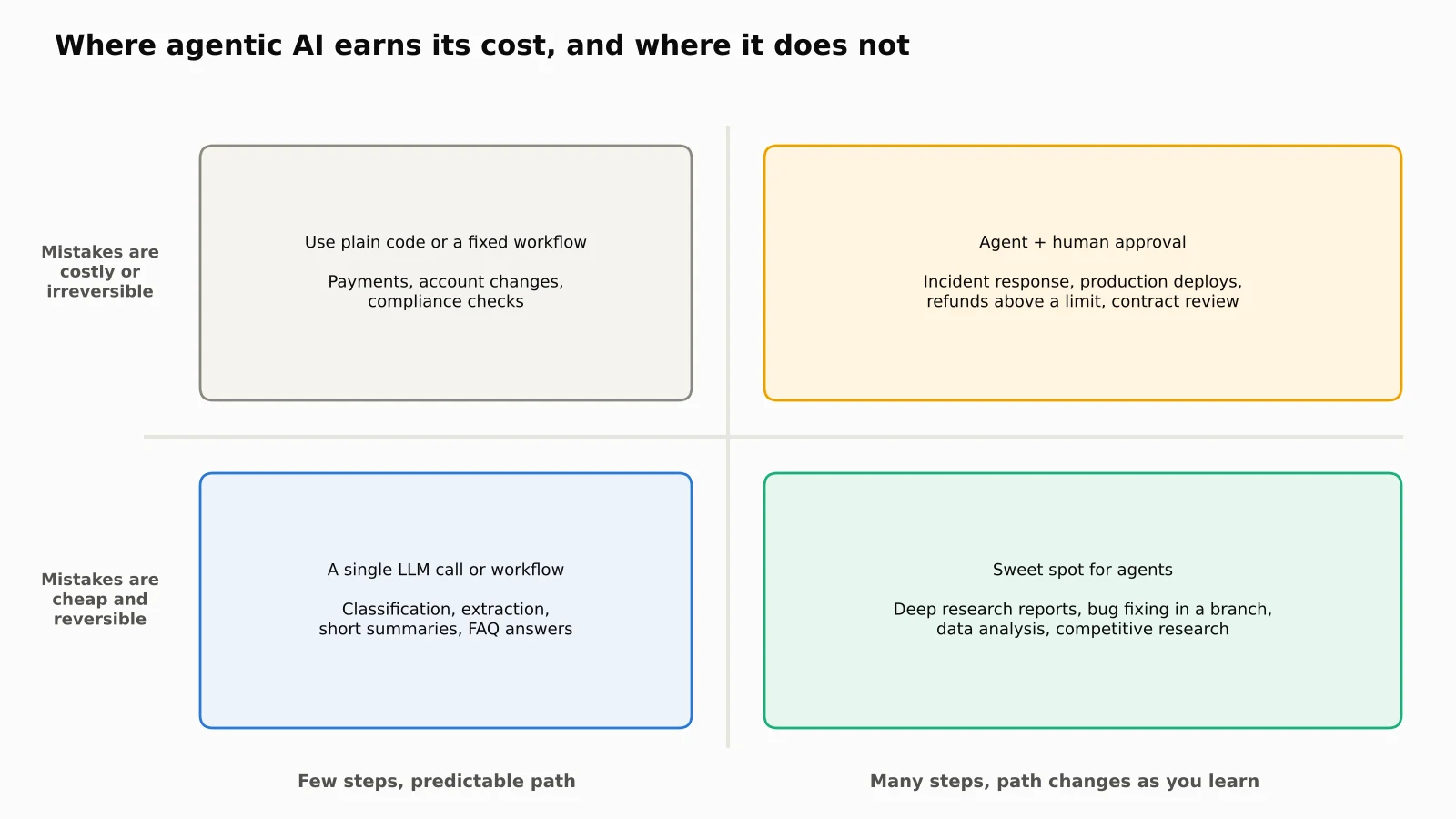
Two questions decide most cases. First, does the task follow a predictable path, or does the next step depend on what you just found? Second, how bad is a mistake, and can you undo it? A deep research report is the sweet spot: many unpredictable steps, and a bad paragraph costs you an edit. A payment run is the opposite: a fixed path and an expensive mistake, so plain code wins.
How to build agentic AI that works in production
Pulling together Anthropic's engineering lessons, the deep research survey and the requirements in the Jaradeh and Auer paper, here's the checklist I'd use.
Start with the simplest thing. Try a single LLM call, then a fixed workflow. Move to an agent only when the steps genuinely can't be predicted in advance.
Design tools like an API for a new colleague. Anthropic found that poor tool descriptions send agents down the wrong path. Give each tool one clear purpose, a clear name and a description that says when to use it and when not to.
Set budgets for steps, tokens and time. Anthropic's early agents over-invested in simple queries, so it added explicit rules for how much effort each kind of query deserves.
Tier tools by risk. Read-only tools can run freely. Anything that writes, sends, pays or deletes needs approval, a dry-run mode or both.
Use least privilege. Separate development from production, use scoped credentials and never give an agent a key it doesn't need.
Log everything. The research paper calls for a machine-readable audit trail linking every claim to its query, source and reasoning step. That's good practice for any agent, not just research tools.
Evaluate early with small samples. Anthropic recommends starting with about 20 real queries, using an LLM judge with a clear rubric and backing it with human review.
Plan for failure mid-run. Agents are stateful, and errors compound. Add checkpoints so a long run can resume from where it failed instead of starting over.
Control sources for research agents. Use allowlists of trusted sites or journals, flag claims that may be out of date, and report access gaps when paywalled content couldn't be read.
Keep a human on the decisions that matter. Autonomy is a dial, not a switch. Turn it up only as your logs and evaluations earn it.
Open-source agent frameworks worth trying
If you want to build rather than just use, the Awesome Deep Research list tracks open-source projects. A few good starting points:
gpt-researcher: an autonomous agent for comprehensive research tasks.
DeerFlow: ByteDance's open-source deep research framework.
gemini-fullstack-langgraph-quickstart: Google's example of a research agent built with Gemini and LangGraph.
Anthropic's multi-agent research system: the code that accompanies the engineering post above.
OpenManus: an open framework for general-purpose agents.
Local Deep Research: a local-first option that can search the web, arXiv, PubMed and your private documents.
To measure what you build, the survey highlights GAIA for general assistant tasks, BrowseComp for finding hard-to-locate information, Humanity's Last Exam for expert-level questions and DeepResearch Bench for full research reports.
Where agentic AI is heading
The deep research survey closes with a roadmap, and several directions are already visible in products:
More data sources through MCP. Today's agents mostly see the public web. Connecting them to enterprise apps, databases and subscription services is the next step, and OpenAI's February 2026 MCP support in deep research is an example.
AI-native browsers. Browsers built for humans are slow and fragile for agents. Tools such as Browserbase, Browser Use and Perplexity's Comet expose structured page views and stable controls for agents.
Built-in fact-checking. Newer agents draft an answer, then look for independent confirmation and contradicting evidence before they finish.
Parallel execution. Instead of one step at a time, agents will run independent sub-tasks in parallel, organized as a graph.
Better benchmarks. Many QA benchmarks use Wikipedia-style facts that models have already memorized, so agents can "pass" without researching. The field needs fresh, time-sensitive benchmarks and better ways to grade full reports.
My take
I think agentic AI is the most important shift in how developers use AI since the first chat assistants, and I also think most teams are approaching it backwards. They start with the most autonomous design they can imagine, then discover that it's expensive, unpredictable and impossible to test.
The teams getting real value do the opposite. They pick a task where the path really does change as you learn, such as research, debugging or analysis. They give the agent a small set of well-described tools, a strict budget and a log. They put a human in front of anything irreversible. Then they widen the agent's freedom only as fast as their evaluations allow.
The numbers back this up. Anthropic's multi-agent system was dramatically better, but it also used about 15 times the tokens of a chat. Gartner expects a large share of projects to be canceled. Both point to the same lesson: agentic AI pays off when the task is worth the compute and the risks are engineered, not when "agent" is just a new label on an old chatbot.
The bottom line
Agentic AI means a model in a loop: it plans, uses tools, observes the results and keeps going until the goal is met. Deep research tools, coding agents and enterprise assistants show it's already practical, and benchmarks show how much tools add to a model's raw ability. But agents also cost far more tokens, fail in new ways and can take real actions with real consequences.
Start simple, give your agent tools with clear purposes, set hard limits, log everything and keep humans on the decisions that matter. Do that, and agentic AI becomes a genuine teammate rather than an expensive experiment. More on AI agents and tools is in ByteMuni's LLMs & Generative AI section.
Sources
Deep Research Agents: A Systematic Examination and Roadmap — Huang et al., arXiv 2506.18096
Deep Research in the Era of Agentic AI: Requirements and Limitations for Scholarly Research — Jaradeh and Auer, Sci-K 2025 workshop (CEUR Workshop Proceedings)
Introducing deep research — OpenAI
How we built our multi-agent research system — Anthropic, June 13, 2025
Building effective agents — Anthropic, December 19, 2024
How We Build Effective Agents — Barry Zhang, AI Engineer Summit 2025
Gartner predicts over 40% of agentic AI projects will be canceled by end of 2027 — Gartner, June 25, 2025
Vibe coding CEO deletes production database — The Stack, July 21, 2025
The lethal trifecta for AI agents — Simon Willison
Frequently asked questions
What is agentic AI in simple words?
Agentic AI is AI that works toward a goal on its own. Instead of answering one prompt, it plans steps, uses tools such as web search, code and APIs, checks the results and keeps going until the task is done, usually within limits set by a developer.
What is the difference between agentic AI and generative AI?
Generative AI creates content such as text or images from a prompt. Agentic AI uses a generative model as its "brain" but adds tools, memory and a loop, so it can take actions and complete multi-step tasks rather than only produce output.
What is the difference between an AI workflow and an AI agent?
In a workflow, your code decides the order of steps and the LLM fills in parts of it. In an agent, the LLM decides which step and which tool comes next. Workflows are more predictable and easier to test; agents are more flexible but cost more and are harder to test.
What are real examples of agentic AI?
Deep research tools in ChatGPT, Gemini, Claude and Perplexity; coding agents such as Claude Code, OpenAI Codex and GitHub's Copilot coding agent; Microsoft 365 Copilot's Researcher; and research systems such as The AI Scientist and Agent Laboratory.
Are multi-agent systems better than single agents?
Sometimes. Anthropic reported its multi-agent research system outperformed a single agent by 90.2% on an internal evaluation, but it used about 15 times the tokens of a chat. Multi-agent designs suit tasks that split into independent parts, not tasks that need shared context.
What are the biggest risks of agentic AI?
Agents can take wrong actions, not just give wrong answers. The main risks are prompt injection from untrusted content, over-broad permissions, runaway costs, unvetted or outdated sources and privacy leaks. Step budgets, tool allowlists, human approval for risky actions and audit logs reduce them.
How do I start building an AI agent?
Start with a single LLM call or a fixed workflow, then move to an agent only if the steps can't be predicted. Give the agent a few well-described tools, a step and cost budget, a log of every action and human approval for anything that writes, pays or deletes.
How we research, write and check articles