Siemens IoT2050 attacks plant backdoors that survive reboot
Siemens IoT2050 exploitation exposes privileged Node-RED flows; check affected versions, restrict access and inspect deployed flows for command backdoors.

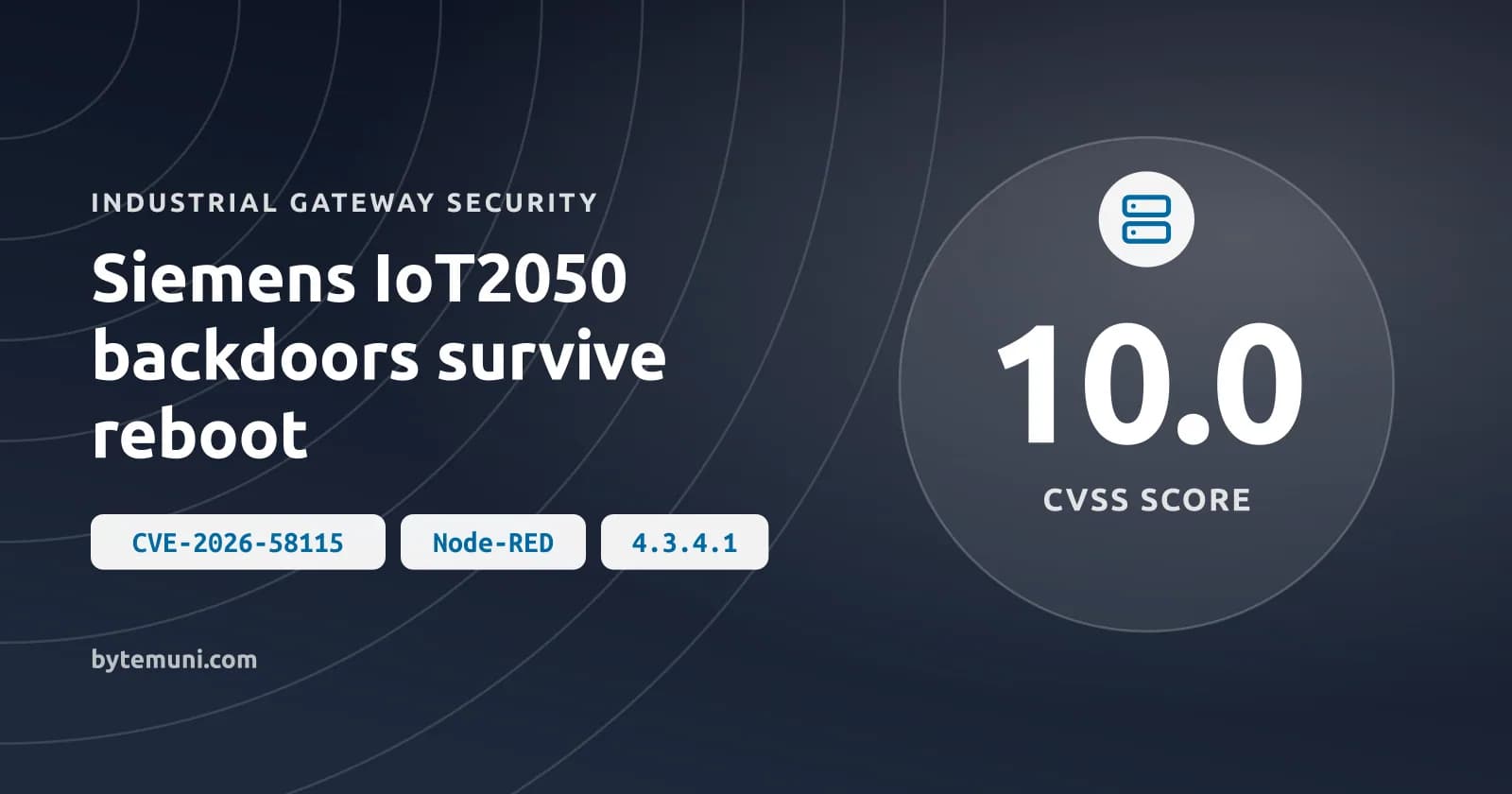
CVE-2026-58115 lets unauthenticated attackers deploy command-execution backdoors on affected Siemens SIMATIC IoT2050 Advanced industrial gateways. VulnCheck has seen exploitation attempts on its honeypots. The way in is the Node-RED HTTP interface on Industrial OS. It has no authentication. Node-RED is a flow-based automation tool, and the flows an attacker submits can run commands.
Siemens disclosed the vulnerability in August 2026, according to The Hacker News. VulnCheck observed exploitation attempts on October 30, 2026; SecurityPointBreak reports that the same source address attempted exploitation 16 times through November 1, 2026. I'd put gateways with internet-reachable Node-RED administrative interfaces first in the queue.
Which Siemens devices does CVE-2026-58115 affect?
The confirmed scope is SIMATIC IoT2050 Advanced devices running Industrial OS with Node-RED installed, before the fixed release. Siemens rates CVE-2026-58115 at CVSS 10.0. The consequence of CVE-2026-58115 is arbitrary code execution with maximum privileges.
Node-RED is built on Node.js. That does not make a Node.js runtime update the identified fix here: the affected product is Siemens' Industrial OS installation, and Siemens identifies an Industrial OS update as the remedy.
These gateways bridge plant-floor equipment and corporate networks.
Deploying a Node-RED flow gives the attacker privileged command execution
The observed CVE-2026-58115 exploit deploys a flow that triggers its own shell command. After the attacker sends the flow through the unprotected interface, it runs without any subsequent interaction.
BigGo Finance describes the built-in components behind this behavior. An inject node can emit a message on a schedule or at startup. An exec node runs shell commands. For HTTP log review, BigGo Finance reported the following delivery method and path:
POST /flowsThis is an observed request signature. It is not a complete request that can be replayed. VulnCheck researcher Patrick Garrity described the initial request as a complete exploit, with both the flow and the dropper behind three layers of encoding; SecurityPointBreak identifies base64 encoding in that dropper chain.
I'd treat permission to deploy a flow as permission to execute commands, not permission to edit a dashboard. That capability is not new. SecurityPointBreak describes cryptomining flows appearing on internet-exposed Node-RED instances in 2018 and 2019.
Node-RED downloaders and HTTP backdoors leave different traces
The observed requests used both routes. Some downloaded and executed a payload; others deployed a flow that exposed a command endpoint directly. I'd inspect both the downloaded-file indicators and the deployed flow graph, rather than use a search for a bot process as a stand-in for the whole investigation.
| Observed route | Retrieval or execution details | Review indicators |
|---|---|---|
| Initial binary download | A shell wrapper uses wget, with curl as a fallback, to fetch an AMD64 binary from 85.215.73[.]250 and execute it | /dev/shm/.b |
| Later staged download | wget retrieves another shell script from the same server | wget.sh |
| Alternate payload server | A request uses wget/curl against 45.194.90[.]57:38472 to retrieve .sys_update, save it and execute it | /tmp/.kworker |
| Flow-based command endpoint | An HTTP in node connects through a function node to an exec node with addpay enabled | /cmd or a randomly named path; commands supplied through a query parameter |
The filename /tmp/.kworker attempts to pass for a harmless kernel worker thread. The HTTP-triggered route needs no downloader at all: the malicious flow is itself a persistent backdoor. Garrity says that flow survives even when a memory-backed implant is lost on reboot. Restarting the gateway is therefore not a substitute for examining the automation deployed on it.
Secure access, then audit the flows already deployed
Siemens provides a fixed release and mitigation options for CVE-2026-58115. SecurityPointBreak also recommends checking external reachability and auditing unexpected exec nodes or HTTP endpoints.
- Inventory the affected configuration. Identify SIMATIC IoT2050 Advanced gateways running Industrial OS with Node-RED installed. Record whether each installed release is before 4.3.4.1.
- Restrict Node-RED administrative access. Check both the editor and the administrative interfaces. Confirm that neither is reachable from the internet, rather than treating a check of one interface as a check of both.
- Update Industrial OS to 4.3.4.1 or later. Install Siemens' fixed release. Restricting the interfaces is not a permanent replacement for fixing the authentication flaw in the affected Industrial OS installation.
- Audit deployed flows. Review unexpected exec nodes and HTTP endpoints. Include the HTTP-to-function-to-exec structure observed in this campaign: the deployed flow itself can supply the command endpoint, without a separate downloader.
If the update cannot proceed immediately, Siemens recommends uninstalling Node-RED or hardening the installation.
- Enable HTTPS access.
- Secure the editor and admin API with credential-based authentication or an OAuth/OpenID provider.
- Secure HTTP Nodes and the Node-RED Dashboard with basic authentication.
HTTPS protects the connection, not access to the interface. It does not replace authentication. According to SecurityPointBreak, Node-RED supports editor password protection through adminAuth; Siemens' guidance also covers HTTP nodes and the dashboard. I'd verify authentication separately for the editor/admin API and those application-facing surfaces.
Unretrieved payloads leave the malware capabilities unknown
The AMD64 filename alone does not establish a broader payload family. Nor does it prove what executed on a particular gateway. The observed activity also does not establish a targeted industrial operation: the same source address logged 125 hits against eight different CVEs across VulnCheck's wider network. VulnCheck characterized that breadth as evidence of opportunistic mass scanning, not evidence that the activity specifically targeted industrial systems.
BigGo Finance and SecurityPointBreak reported that CVE-2026-58115 was absent from CISA's Known Exploited Vulnerabilities catalog at publication, although VulnCheck had added it to its own catalog. My read is that the observed complete exploitation requests justify prioritizing exposed affected gateways without waiting for another catalog entry.
Frequently asked questions
Is enabling adminAuth enough to follow Siemens' mitigation guidance?
No. Node-RED supports editor password protection through adminAuth, but Siemens also recommends HTTPS and basic authentication for HTTP Nodes and the Node-RED Dashboard. Protecting the editor alone does not cover every surface in that guidance.
Does the AMD64 payload prove that attackers successfully infected Siemens gateways?
No. The reports establish exploitation attempts against VulnCheck honeypots and describe the requested download chain. VulnCheck did not retrieve or analyze the bot binary, so its filename does not prove successful execution on a particular gateway.
Are Emerson products that reference Node-RED confirmed affected?
No. SecurityPointBreak reports that VulnCheck found Node-RED references in Emerson documentation but had not confirmed whether those products were affected. Those references do not establish exposure to this Siemens vulnerability.
Sources: Attackers Exploit Critical Siemens IoT2050 Flaw to Plant Remote Command Backdoors, Siemens IoT2050 Gateway Flaw Rated 10.0 Exploited to Plant Persistent Linux Backdoors — BigGo Finance, Node-RED Flaw in Siemens IoT2050 Exploited (CVE-2026-58115), 11 Real Stories: How Identity Exposure Unlocks Active Attack Paths Map cross-domain privilege escalation to sever breach, Add preferred source
How we research, write and check articles