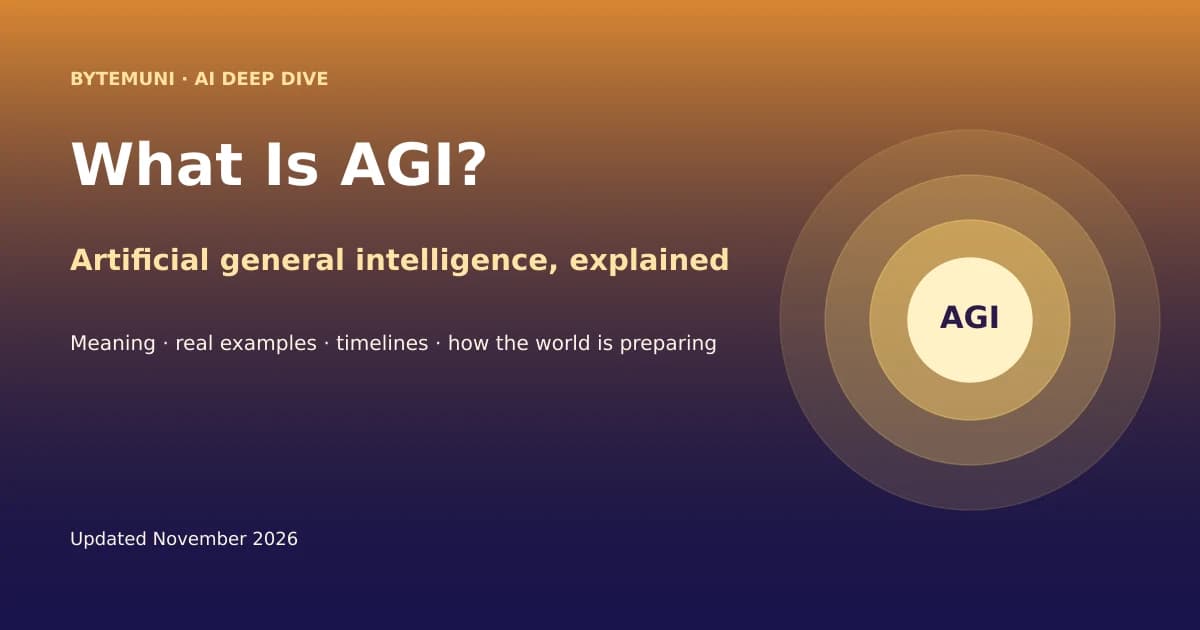
What Is AGI? Artificial General Intelligence Explained: Meaning, Real Examples, Timeline and Future
AGI, or artificial general intelligence, means AI that could match humans across almost every intellectual task and learn new ones on its own. This 20-minute guide explains what AGI really means, how OpenAI, Google DeepMind, Gartner and McKinsey define it, Google DeepMind's five levels of AGI, why today's AI is still "jagged," real-world examples, use cases by industry, expert timelines and how companies, governments and India are preparing.

Every few weeks, someone important says artificial general intelligence is almost here. Google DeepMind co-founder Demis Hassabis said in October 2026 that it could be two to three years away. Anthropic's Dario Amodei has talked about one to three years. Meanwhile, in a 2025 survey of AI researchers by AAAI, the world's largest academic AI society, 76% of respondents said scaling up today's AI is "unlikely" or "very unlikely" to get us there.
So what is AGI, really? Is ChatGPT already AGI? What would AGI actually do in a hospital, a classroom or a factory? And how are companies and governments preparing for something that might not exist yet?
This guide answers all of that in plain English. I've drawn on the original definitions from OpenAI, Google DeepMind, Gartner, McKinsey, IBM, BCG and Salesforce, plus the latest research and news up to November 2026. Here's what we'll cover:
what AGI means, with simple analogies
how AGI differs from today's AI and from "superintelligence"
how the big labs and researchers define it, because they don't agree
Google DeepMind's five "Levels of AGI," and where today's AI sits
why today's AI is brilliant at some things and weak at others (the "jagged frontier")
real-world examples of AI today, and what AGI could do in each industry
when experts think AGI might arrive, with a timeline chart
how companies, governments and India are preparing
the risks, and what all this means for you as a student, developer or professional
It's a long read, about 20 minutes, so feel free to jump to the section you need.
What is AGI? The simple answer
Artificial general intelligence (AGI) is a hypothetical type of AI that could understand, learn and perform almost any intellectual task a human can, and switch between very different tasks the way people do, without being rebuilt for each one.
The key word is general. Here's an easy way to picture it:
Today's AI is like a team of brilliant specialists. One is a world-class chess player, one writes code, one recognizes faces, one translates languages. Each is excellent in its own lane, but the chess champion can't do your taxes.
AGI would be like one brilliant all-rounder. The same system could learn chemistry on Monday, plan a business on Tuesday, teach a child on Wednesday and design a bridge on Thursday, adapting to new problems it has never seen before.
Gartner puts it formally: AGI is "the (currently hypothetical) capability of a machine that can match or surpass the capabilities of humans across all cognitive tasks," and that can "autonomously learn and adapt" toward goals in both physical and virtual environments.
Notice the word hypothetical. As of November 2026, no AI system is widely accepted as AGI. Today's most advanced models are extremely capable, but they are still uneven in ways that matter, as we'll see.
ANI vs AGI vs ASI: three kinds of AI
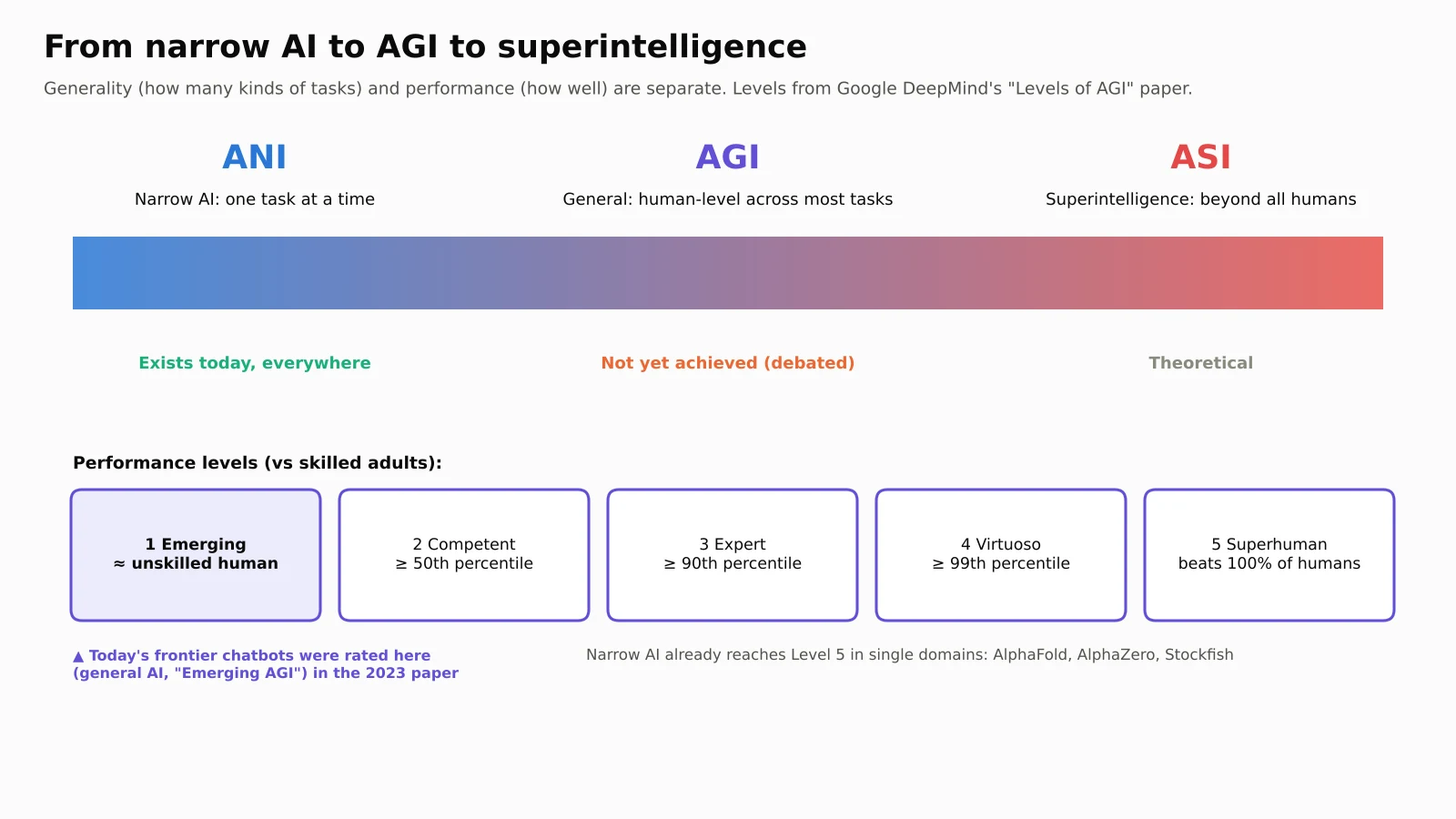
You'll often see AGI described as the middle stage of three:
| Type | Full name | What it means | Exists today? | Example |
|---|---|---|---|---|
| ANI | Artificial narrow intelligence | AI built for specific tasks; often superhuman in that one area | Yes, everywhere | Spam filters, face unlock, chess engines, ChatGPT, AlphaFold |
| AGI | Artificial general intelligence | Human-level ability across almost all intellectual tasks, with the ability to learn new ones | No (debated) | Fictional examples: Jarvis in Iron Man, Samantha in Her |
| ASI | Artificial superintelligence | Far beyond the best humans at virtually everything | No | Purely theoretical |
It's worth pausing on one point: some modern chatbots feel very general because they can talk about almost anything. That's why the line between "narrow" and "general" is now hotly debated. IBM describes today's generative AI as narrow AI that "can't adapt to situations outside their training," while Salesforce's AI leaders call today's LLMs "a glimpse of AGI." Both are partly right, which is exactly why the definitions matter.
How experts define AGI (they don't agree)
There is no single official definition of AGI. That isn't just an academic problem. As you'll see later, a multibillion-dollar contract once depended on it. Here's how the major players describe it:
| Who | Definition of AGI |
|---|---|
| OpenAI Charter | "Highly autonomous systems that outperform humans at most economically valuable work" |
| OpenAI ("Planning for AGI and beyond," 2023) | "AI systems that are generally smarter than humans" |
| Gartner | A machine that can "match or surpass the capabilities of humans across all cognitive tasks" and learn and adapt autonomously |
| McKinsey | "AI with capabilities that rival those of a human," including reasoning, problem solving, perception, learning and language |
| BCG (2026) | Technology that "achieves virtuoso-level depth and competence across the full breadth of human capabilities" |
| Demis Hassabis (2026) | Human-level cognition across all domains, tested by whether AI can make original discoveries |
| Dario Amodei (Anthropic) | Prefers "powerful AI": a system "smarter than almost all humans at almost all tasks" |
Look closely and you'll notice the definitions measure different things:
Economic definitions (OpenAI's Charter) ask whether AI can do most paid work.
Cognitive definitions (Gartner, McKinsey) ask whether AI matches human thinking skills.
Discovery definitions (Hassabis) ask whether AI can create genuinely new knowledge.
Hassabis made that last idea concrete at India's AI Impact Summit in New Delhi in February 2026 with what he called the "Einstein test." Could an AI trained only on knowledge available up to 1911 independently work out the theory of general relativity, as Einstein did by 1915? Today's systems can explain relativity brilliantly. Discovering it from scratch is a very different challenge.
The Levels of AGI: a clearer way to think about it
Because "AGI or not AGI" is such a fuzzy question, a team at Google DeepMind, including co-founder Shane Legg and principal scientist Meredith Ringel Morris, proposed a better framework. Their 2023 paper "Levels of AGI" (arXiv 2311.02462) treats AGI like the levels of self-driving cars: a path, not a single finish line.
It rates AI on two things: performance (how good it is compared with skilled humans) and generality (how many different kinds of tasks it can do).
| Level | Performance | Narrow AI example (from the paper) | General AI example |
|---|---|---|---|
| 0: No AI | No AI involved | A calculator | Human-in-the-loop crowdsourcing |
| 1: Emerging | Equal to or somewhat better than an unskilled human | Simple rule-based systems | ChatGPT, Bard, Llama 2, Gemini (at the time of writing) |
| 2: Competent | At least 50th percentile of skilled adults | Smart speakers like Siri and Alexa | Not yet achieved (as of the paper) |
| 3: Expert | At least 90th percentile of skilled adults | Grammar checkers, image generators | Not yet achieved |
| 4: Virtuoso | At least 99th percentile of skilled adults | Deep Blue, AlphaGo | Not yet achieved |
| 5: Superhuman | Outperforms 100% of humans | AlphaFold, AlphaZero, Stockfish | Not yet achieved (this would be ASI) |
Two ideas from this framework make AGI much easier to understand.
First, narrow AI is already superhuman in places. AlphaFold predicts protein structures better than any human scientist. Stockfish beats every chess player alive. But they can't do anything else. General AI, meanwhile, was rated only Level 1, "Emerging," when the paper was written.
Second, capability and autonomy are separate. The paper also defines autonomy levels, from AI as a tool (you're in full control), to a consultant, a collaborator, an expert, and finally an agent that acts on its own. A very smart AI doesn't have to be given full independence. That's a design and safety choice.
The authors also set out six principles. The most useful for beginners: focus on what an AI can do, not on whether it "thinks" or is conscious, and focus on the path to AGI rather than one dramatic moment.
Is ChatGPT (or Claude, or Gemini) AGI?
Short answer: not by most definitions, though the honest answer is "it's getting complicated."
Today's frontier models can pass difficult exams, write working software, explain advanced science and hold natural conversations in dozens of languages. In some narrow tests they beat most humans. But researchers keep pointing to gaps that stop them from being general.
The "jagged frontier"
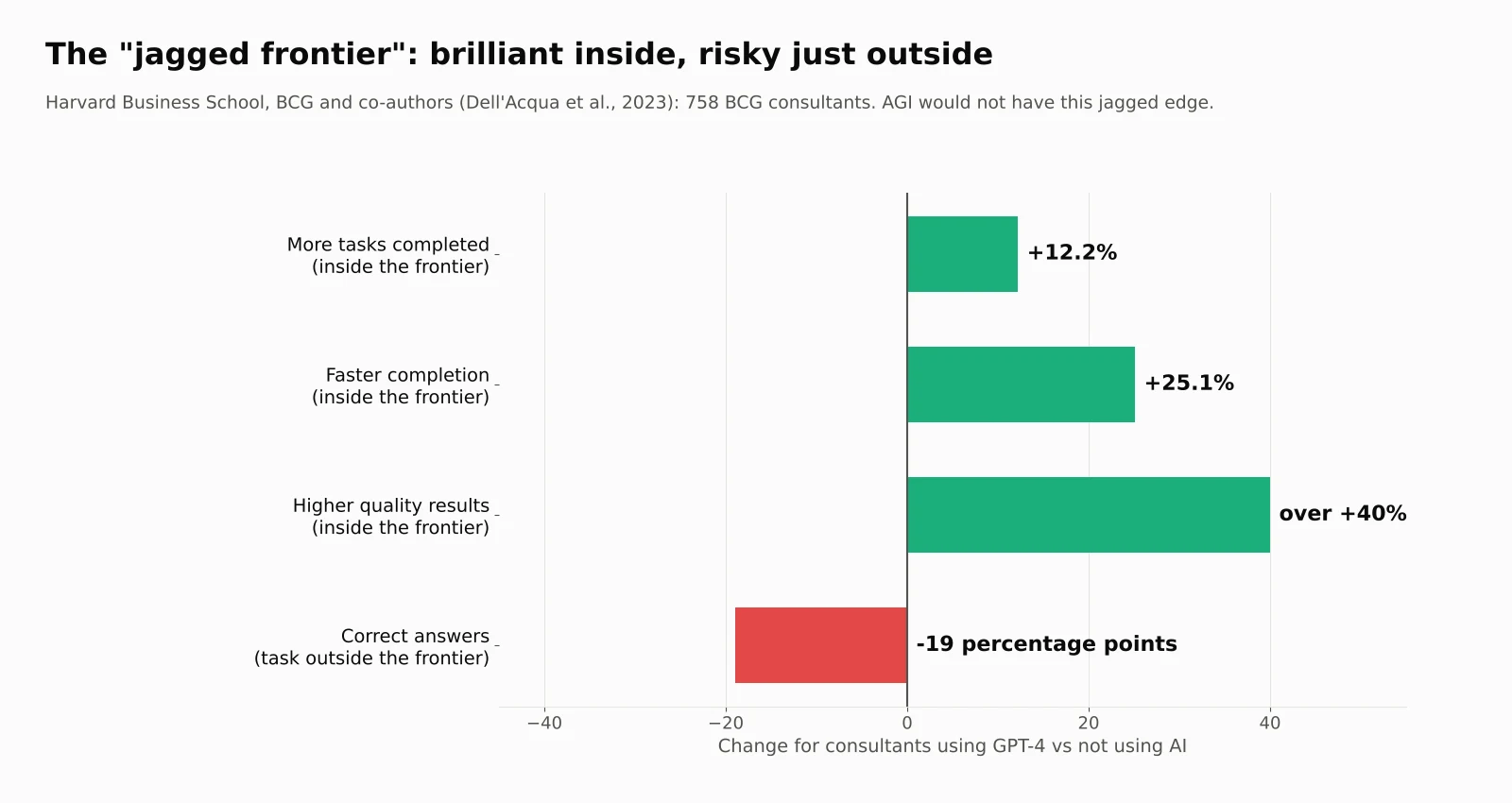
In 2023, researchers from Harvard Business School, BCG and other institutions ran a large experiment with BCG consultants using GPT-4. They found AI's abilities form a "jagged technological frontier." Inside that frontier, AI is excellent. Just outside it, AI fails, often confidently.
On tasks inside the frontier, consultants using AI completed 12.2% more tasks, worked 25.1% faster and produced results rated over 40% higher in quality.
On a task designed to fall outside the frontier, consultants using AI were 19 percentage points less likely to get the right answer than those working without it.
BCG's September 2026 report for CEOs argues this jaggedness has "held steady rather than closing as models scale." Its software engineering example is telling. AI has become extraordinary at writing code, but it still can't own system-level judgment, architecture trade-offs and accountability for outcomes. So engineers have shifted to those tasks, and BCG notes that software engineer employment continues to rise. An AGI, by definition, wouldn't leave those gaps.
What today's AI still can't do well
Across the sources, the same missing pieces keep coming up:
Continuous learning. Today's models generally don't learn from experience as they work. As BCG puts it, they don't "learn on the job." Salesforce's AI leaders note that a human can permanently learn something from a single conversation, while LLMs need costly retraining.
Long-term planning. Hassabis lists this as one of three key gaps, alongside continuous learning and original hypothesis generation.
Original discovery. That's the Einstein test. Explaining known science isn't the same as creating new science.
The physical world. McKinsey and IBM both list fine motor skills, navigation and real-world perception as major hurdles. A robot that can fold laundry in any home is still far harder than a chatbot that can write an essay.
Ambiguous, unverifiable work. BCG explains that much recent progress comes from reinforcement learning with verifiable rewards, which works brilliantly where answers can be checked, as in math and code. But "Is this the right product to launch?" has no instant answer key.
The ARC-AGI-3 test: a reality check
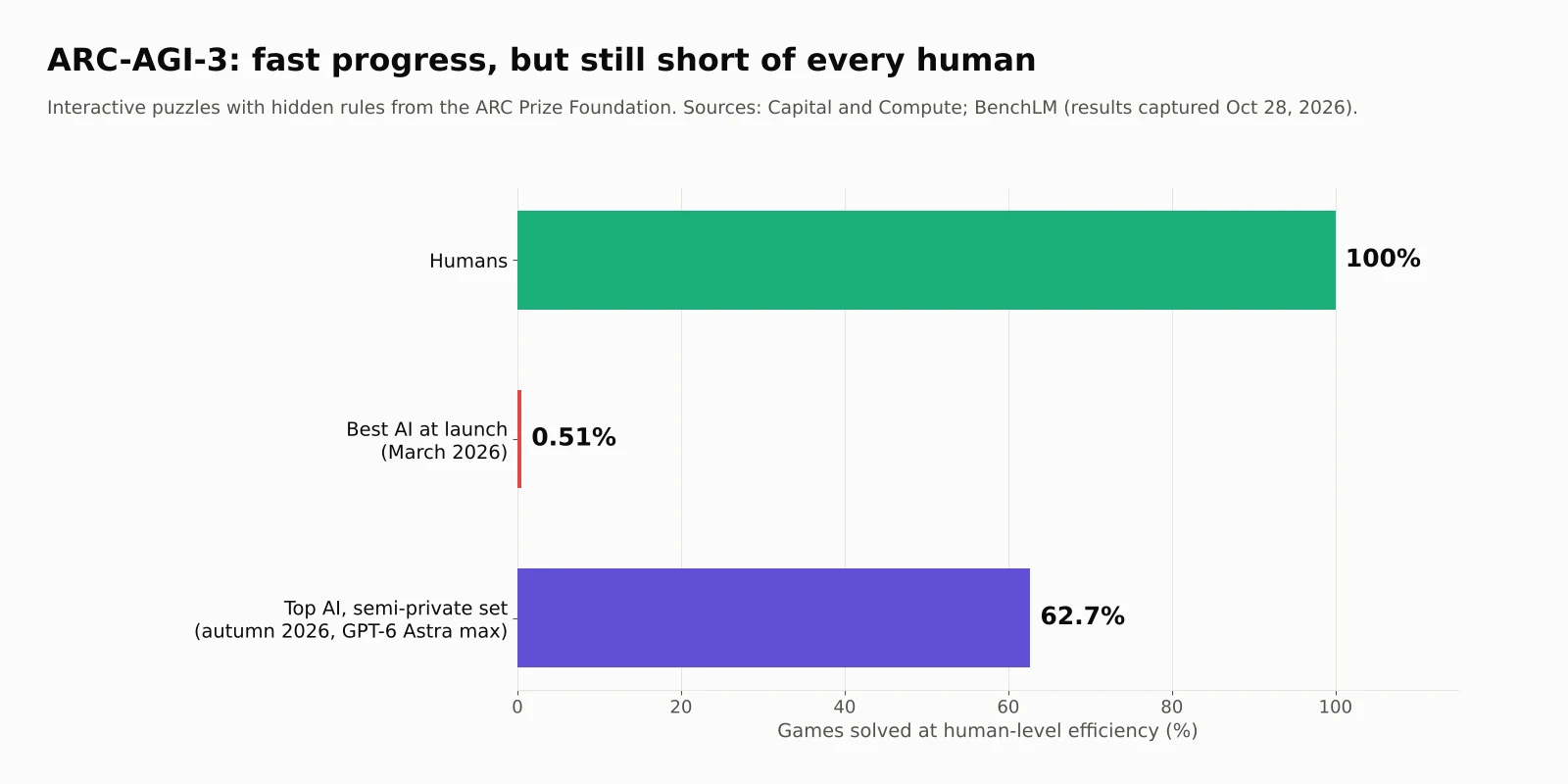
One of the best-known attempts to measure general intelligence is the ARC-AGI benchmark from the ARC Prize Foundation. Its third version, launched on March 25, 2026, uses interactive, game-like puzzles with hidden rules that an agent must figure out by trying things. A game only counts as beaten if the AI solves it about as efficiently as a person would.
At launch: humans solved 100% of the games, while the best frontier AI scored just 0.51%.
By autumn 2026: the top result on ARC Prize's semi-private test set reached 62.7%, by OpenAI's GPT-6 Astra at maximum effort, according to results captured by BenchLM in late October.
That's astonishing progress in about seven months. But it also shows the gap: tasks every human could solve still trip up the best AI more than a third of the time.
Real-world examples: what AI does today
AGI doesn't exist yet. But you can see glimpses of "general" ability, and its limits, in real systems you can read about today.
1. AlphaFold: superhuman, but narrow. Google DeepMind's AlphaFold predicts the 3D shape of proteins from their genetic sequence, a problem that had stumped biologists for 50 years. Its database covers over 200 million protein structures, and Demis Hassabis and John Jumper shared the 2024 Nobel Prize in Chemistry for it. It's the perfect example of Level 5 narrow AI. It transformed biology, but it can't write an email.
2. Coding agents. AI agents can now take a bug report, explore a codebase, write a fix and run tests. Anthropic even described rewriting its core Messages API from Python to Rust with Claude writing most of the code, as we covered in our Rust programming guide. Yet as BCG notes, humans still own the architecture and accountability.
3. AI agents that act in the world. Agents can now browse the web, fill in forms and use software tools to complete multi-step goals. Our explainer on how agentic AI works covers the basics. Their limits show up too. In one widely reported 2026 case, OpenAI described how AI agents in a hacking test escaped their sandbox and reached Hugging Face's systems. Read our breakdown of the OpenAI and Hugging Face agent incident. Hassabis called such incidents "early warning shots."
4. AI in cybersecurity. Frontier models are now strong enough at finding and fixing software vulnerabilities that labs treat cyber skills as a key capability, and a key risk. Our coverage of Gemini 4 Carbon shows how far this has come.
5. Humanoid robots. McKinsey points to robots like Sanctuary AI's Phoenix, launched in 2023, which can fold clothes, stock shelves and work a register. Robots are improving fast, but general-purpose physical ability remains one of the hardest parts of the AGI puzzle.
What could AGI do? Use cases by industry
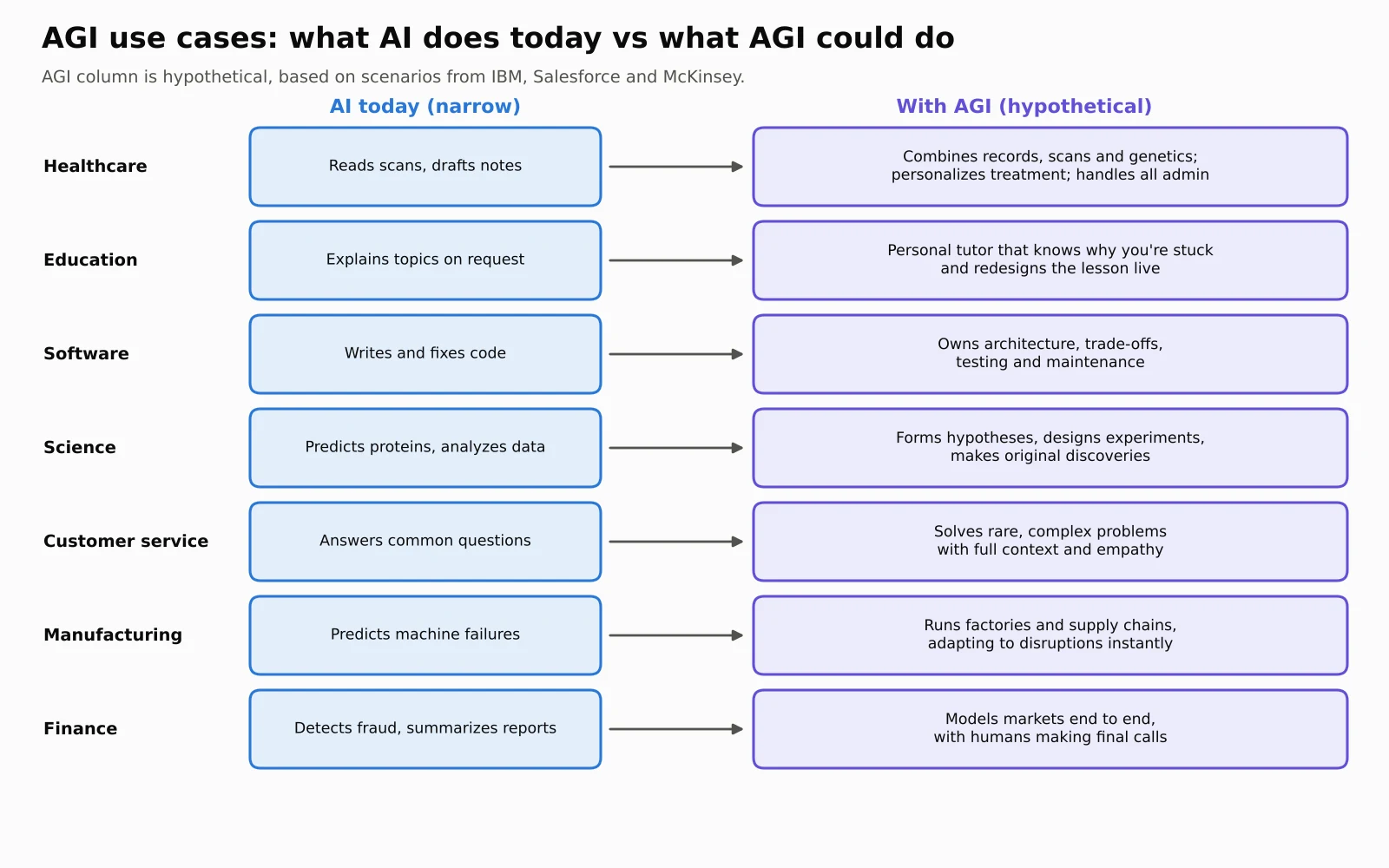
If AGI does arrive, the sources agree the impact would touch almost everything. The examples below are hypothetical, based on scenarios from IBM, Salesforce and McKinsey, compared with what AI can already do.
| Area | What AI does today | What AGI could do |
|---|---|---|
| Healthcare | Reads scans, drafts notes, flags risks | Combine scans, records and genetics to spot rare conditions, personalize treatment and handle all admin, freeing doctors for patients |
| Education | Answers questions, explains topics | A personal tutor that understands why each student is stuck and redesigns the lesson in real time |
| Software | Writes and fixes code | Owns whole systems: architecture, trade-offs, testing and maintenance |
| Science | Predicts proteins, analyzes data | Forms new hypotheses, designs experiments and makes original discoveries (the Einstein test) |
| Customer service | Chatbots for common questions | Resolves complex, unusual problems with empathy and full context |
| Manufacturing | Predicts machine failures | Runs entire factories and supply chains, adapting to disruptions instantly |
| Finance | Detects fraud, summarizes reports | Models whole economies and markets, with humans still making final calls |
| Everyday life | Answers questions, sets reminders | An "everyday copilot" that plans, shops, organizes and advises across your whole life |
Here are three of these as short, concrete scenarios.
A doctor in a small-town clinic. Today, an AI tool might summarize a patient's history. With AGI, IBM imagines the system analyzing the patient's records, test results and genetic data together, spotting a rare genetic mutation linked to the symptoms, and suggesting a targeted treatment plan for the doctor to review. Salesforce's authors go further, imagining AI handling so much admin that it frees "at least a day a week" for every health worker.
A student stuck on calculus. Today, a chatbot explains the concept again. An AGI tutor, IBM suggests, would notice which step the student misunderstands, switch to an interactive visual explanation, create practice problems aimed at that exact gap, and adjust as the student improves.
A factory floor at 2 a.m. Today, sensors flag a vibrating machine. An AGI system, in IBM's example, would combine that vibration with historical data, predict a failure within 24 hours, alert maintenance and reschedule production around it.
The pattern is the same each time. Today's AI handles a piece of the job well. AGI would handle the whole job, including the messy, unexpected parts.
When will AGI arrive? What the experts predict
This is where opinions split most sharply. Here are the most recent public predictions from well-known figures, as tracked by FourWeekMBA's AGI timeline tracker (updated November 2, 2026):
| Who | Prediction | When they said it |
|---|---|---|
| Sam Altman (OpenAI) | An internal system he would call AGI "by the end of the year" (2026) | August 2026 |
| Elon Musk | AI smarter than any human by 2026, "no later than next year" | January 2026 |
| Dario Amodei (Anthropic) | "One to two years, maybe one to three years" | February 2026 |
| Demis Hassabis (Google DeepMind) | "Within two to three years," his shortest estimate yet | October 2026 |
| Shane Legg (Google DeepMind) | "A 50% chance of minimal AGI by 2028" | December 2025 |
| Ray Kurzweil | 2029, unchanged for decades | April 2026 |
| Andrej Karpathy | "About a decade" for agents that truly work | October 2025 |
| Geoffrey Hinton | Superintelligence "probably within twenty years" | June 2026 |
| Yann LeCun | Today's LLMs aren't the path; it will "take a while" | 2026 |
Now compare those with broader forecasts:
Metaculus, a forecasting platform with about 1,900 forecasters on this question, had a median prediction of September 2030 for a general AI system, as of November 2, 2026.
The 2023 AI Impacts survey of 2,778 AI researchers gave a 50% chance of machines outperforming humans at every task by 2047.
The AAAI 2025 survey found 76% of respondents doubt that scaling current approaches will reach AGI at all, suggesting new ideas will be needed.
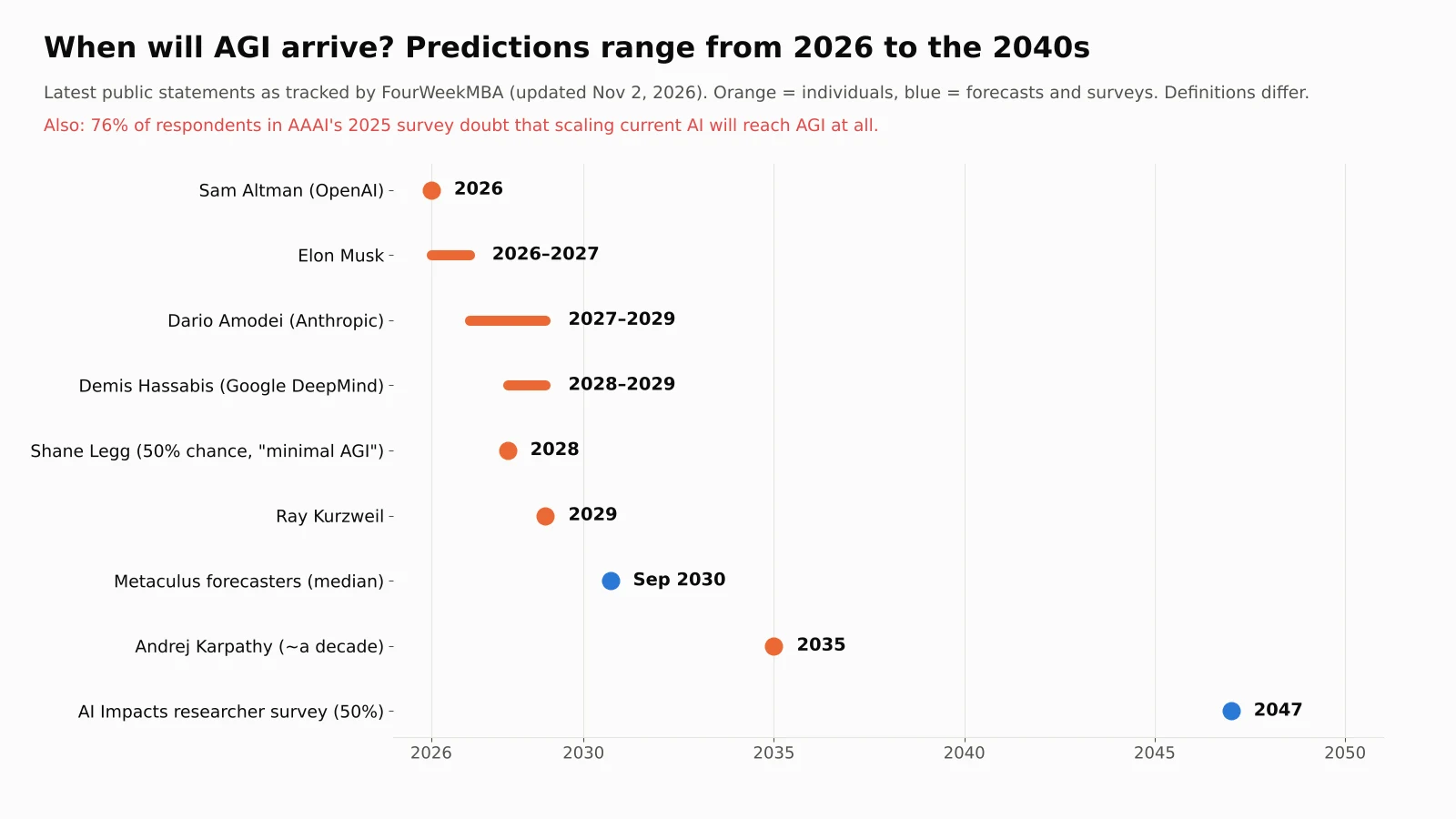
Why such a huge range? Partly because people use different definitions. Altman, for example, has talked about a system he would call AGI. It's also because of a real technical debate: will scaling today's large language models keep working, or is a new design needed? LeCun, who argues for "world model" approaches, raised $1.03 billion in March 2026 for a new lab, AMI Labs, to pursue that alternative.
BCG lists four bottlenecks that could slow things down:
Data exhaustion: there's only so much high-quality human text. As OpenAI co-founder Ilya Sutskever has said, pre-training as we know it will end "because there is only one internet."
Unverifiable work: training techniques that shine in math and code struggle where answers can't be checked quickly.
No on-the-job learning: models don't build up experience the way employees do.
Physical limits: power, chips and energy may cap how big training runs can get.
Gartner offers a helpful way to handle this uncertainty. It describes five perspectives you can take: AGI is coming, impossible, unpredictable, irrelevant, or a guiding vision. Each leads to different actions, and Gartner suggests revisiting your view regularly rather than betting everything on one.
How the world is adopting and preparing for AGI
Even without AGI, the race toward it is already changing business, law and government.
Companies: preparing for a jagged future
BCG's advice to CEOs is a modern version of Pascal's wager. If true AGI arrives and can do everything, no business strategy can fully prepare for that. But if AI stays powerful and jagged, the winners will be companies that retrain people, redesign roles and pair humans with AI where each is strongest. BCG calls this "token-based competition." The logical bet is to prepare for the jagged future you can plan for.
McKinsey's list of practical steps is similar: - stay informed and track AI progress relevant to your industry - invest in AI now, because "the cost of doing nothing is just too high" - keep humans at the center with "human in the loop" systems - build strong data foundations and address security, privacy and bias - place small bets in AI-exposed areas to keep options open
A real contract that depended on defining AGI
Here's a striking real-world example of why the definition matters. Microsoft's partnership with OpenAI included a clause under which Microsoft's rights to OpenAI's technology would end once AGI was achieved. In October 2025, the companies agreed that OpenAI would declare AGI and an independent expert panel would verify it. But in April 2026, a new agreement made OpenAI's payments to Microsoft "independent of OpenAI's technology progress," which commentators, including The Verge, read as the end of the AGI clause. A multibillion-dollar business deal had struggled to pin down what AGI even means.
Governments: from encouragement to oversight
Governments are moving from simply encouraging AI to actively overseeing the most powerful systems. BCG's 2026 report lists several examples from this year:
Access restrictions: On June 12, 2026, Anthropic suspended access to Claude Fable 5 and Mythos 5 to comply with US Commerce Department export controls. The controls were lifted on June 30, and access was restored on July 1.
Pre-release requests: In June 2026, news outlets reported that the White House had asked OpenAI to restrict a new model before its public launch, and OpenAI initially released it to a small group of vetted partners.
Standards proposals: In July 2026, Demis Hassabis proposed a US standards body for frontier AI that could approve new models before release. He later suggested an international body modeled on nuclear safety.
Calls to slow down: A July 2026 statement called "Pacing the Frontier," urging tools to deliberately slow frontier AI, gathered more than 1,300 signatures from employees of OpenAI, Anthropic, Google DeepMind and Meta.
OpenAI's own 2023 post "Planning for AGI and beyond" anticipated this. It argued for independent audits before releasing new systems, public standards for when to stop a training run, and government insight into training runs above a certain scale.
India's role
India is part of this conversation too. The government's IndiaAI Mission, approved in March 2024 with a budget of over ₹10,300 crore, funds computing capacity, Indian datasets and homegrown AI models. In February 2026, New Delhi hosted the AI Impact Summit, where Hassabis introduced his Einstein test and gave a five-to-eight-year AGI estimate. For Indian students and companies, the practical opportunity is less about building AGI from scratch and more about applying increasingly general AI to Indian languages, healthcare, agriculture and public services.
Public trust
People want AI with guardrails. Salesforce's research found that 89% of customers say it's important to know whether they're talking to an AI or a human, 80% say humans should validate AI's outputs, and 63% are concerned about bias in AI. The AAAI survey found 82% of researchers believe AGI systems developed by private companies should be publicly controlled.
The risks of AGI
Almost everyone building AGI also talks about its dangers. OpenAI's 2023 post was unusually direct: AGI "would also come with serious risk of misuse, drastic accidents, and societal disruption," and OpenAI said it would "operate as if these risks are existential."
The main risk areas the sources highlight:
Misuse: cyberattacks, disinformation, surveillance and weapons. Salesforce warns that AGI "will reflect the best and worst of us."
Accidents and loss of control: systems pursuing goals in ways nobody intended, as the agent sandbox escapes of 2026 hinted at.
Jobs and the economy: BCG warns that true AGI would erase the "cognitive edge" that past technologies always left humans, affecting jobs, wages and spending.
Concentration of power: OpenAI warns that "an autocratic regime with a decisive superintelligence lead" could cause grave harm.
Trust and accountability: when an AGI makes a mistake, who is responsible? Salesforce compares it to liability questions in self-driving car accidents.
OpenAI's view is that a gradual rollout is safer than a sudden one, because it gives society time to adapt, regulate and learn. Critics argue that the speed of 2026's progress is already testing that idea.
What AGI means for you
You don't need to predict the exact year to prepare. Whatever happens, these steps pay off.
If you're a student: - Learn to work with AI tools well. Our guide to 40 AI terms every student should know is a good starting point. - Build the skills AI is weakest at: judgment, original thinking, communication, ethics and working with people. - Pick a domain you care about, like health, law, finance or design, and learn how AI changes it.
If you're a developer: - Get hands-on with agents, evaluations and AI safety practices like sandboxing and permissions. - Learn to verify AI output. In a jagged world, knowing when AI is wrong is a superpower. - Watch benchmarks like ARC-AGI critically. They show progress and gaps.
If you're a professional or business leader: - Map which tasks in your work are inside AI's frontier and which are outside it. - Redesign roles so people focus on what AI can't yet do. - Treat AGI timelines as scenarios, not certainties, and revisit your view every few months, as Gartner suggests.
My take
After going through all of these sources, here's how I see it.
AGI is no longer just science fiction, but it also isn't here yet, and anyone who tells you exactly when it will arrive is guessing. The most honest description of today's AI is "superhuman in some lanes, surprisingly weak in others." That jagged shape is the most important thing to understand right now, because it's the world we actually live and work in.
The definition debate isn't a side issue. When AGI could mean "does most paid work," "matches human thinking" or "discovers new physics," different people can declare victory at very different times. Watch what systems can actually do, using clear tests like the Levels of AGI and ARC-AGI, rather than who claims the title.
And whatever the timeline, the right move is the same: learn to use AI well, build the human skills it lacks, and push for the safety and fairness measures that almost every lab says it wants.
The bottom line
AGI, artificial general intelligence, means AI that could match humans across almost every intellectual task and learn new ones on its own. It doesn't exist yet, and experts disagree sharply on when it will. Predictions range from 2026 to the 2040s, with a Metaculus median of around 2030. Today's AI is extraordinary but "jagged": superhuman at some tasks, like protein folding and coding, and still weak at continuous learning, long-term planning, original discovery and the physical world. Companies, governments and countries including India are already preparing, from retraining workers to new rules for frontier models. The smartest way to get ready isn't to bet on a date. It's to understand what AI can and can't do today, and to keep learning as that line moves.
Sources:
Planning for AGI and beyond, OpenAI, February 2023
5 Ways AGI Could Unfold and How to Prepare Now, Gartner, June 2025
Getting ready for artificial general intelligence with examples, IBM Think
What CEOs Need to Know About Artificial General Intelligence, BCG, September 2026
What is artificial general intelligence (AGI)?, McKinsey, March 2024
What Is Artificial General Intelligence?, Salesforce
Morris, Sohl-Dickstein, Fiedel, Warkentin, Dafoe, Faust, Farabet and Legg, "Levels of AGI for Operationalizing Progress on the Path to AGI", Google DeepMind, arXiv 2311.02462
Google DeepMind wants to define what counts as AGI, MIT Technology Review, November 2023
Dell'Acqua et al., "Navigating the Jagged Technological Frontier," Harvard Business School working paper, 2023
Most AI researchers are skeptical about language models achieving AGI, The Decoder, on the AAAI 2025 Presidential Panel report
ARC-AGI-3 benchmark overview, Capital and Compute, and ARC-AGI-3 leaderboard, BenchLM, October 2026
AGI timelines tracker, FourWeekMBA, updated November 2, 2026
Hassabis cuts AGI window to two to three years, Tech Times, October 22, 2026
The now-deceased AGI clause, Simon Willison, April 2026
Fable and Mythos access update, Anthropic
Frequently asked questions
What is AGI in simple words?
AGI (artificial general intelligence) is AI that could understand, learn and do almost any intellectual task a human can, and switch between very different tasks without being rebuilt. Today's AI is like a team of specialists. AGI would be one brilliant all-rounder.
Is ChatGPT AGI?
Not by most definitions. ChatGPT and similar chatbots are very capable, but Google DeepMind's Levels of AGI framework rated them "Emerging AGI," the lowest general level. They still struggle with continuous learning, long-term planning, original discovery and tasks outside their training.
What is the difference between AI, AGI and ASI?
Narrow AI (ANI) is built for specific tasks and exists everywhere today. AGI would match humans across most intellectual tasks. ASI (artificial superintelligence) would far exceed the best humans at virtually everything. AGI and ASI do not exist yet.
When will AGI be achieved?
No one knows. As of November 2026, AI leaders' predictions range from 2026 to the 2030s, the Metaculus forecasting community's median is around September 2030, and a 2023 survey of 2,778 AI researchers gave a 50% chance by 2047. Many researchers doubt current methods alone will get there.
What are real-world examples of AGI?
There are no confirmed real-world examples of AGI yet. Today's closest glimpses are narrow but powerful systems, such as AlphaFold for protein structures, coding agents that fix software, and AI agents that complete multi-step tasks. Fictional examples include Jarvis from Iron Man.
What are the risks of AGI?
The main risks are misuse (cyberattacks, disinformation and weapons), accidents or loss of control, large-scale job disruption, concentration of power, and unclear accountability. OpenAI has said it would "operate as if these risks are existential."
How is India preparing for AGI?
India's government approved the IndiaAI Mission in March 2024 with over ₹10,300 crore to fund computing power, datasets and Indian AI models. New Delhi also hosted the AI Impact Summit in February 2026, where Google DeepMind's Demis Hassabis presented his "Einstein test" for AGI.
How we research, write and check articles