China's AI Bubble Has Burst: Why $480 Billion Vanished From the STAR 50
China's AI stock bubble has burst. A sourced breakdown of the STAR 50's 40% fall, the IPO frenzy behind it, Beijing's failed 'slow bull', and whether US AI stocks are next.

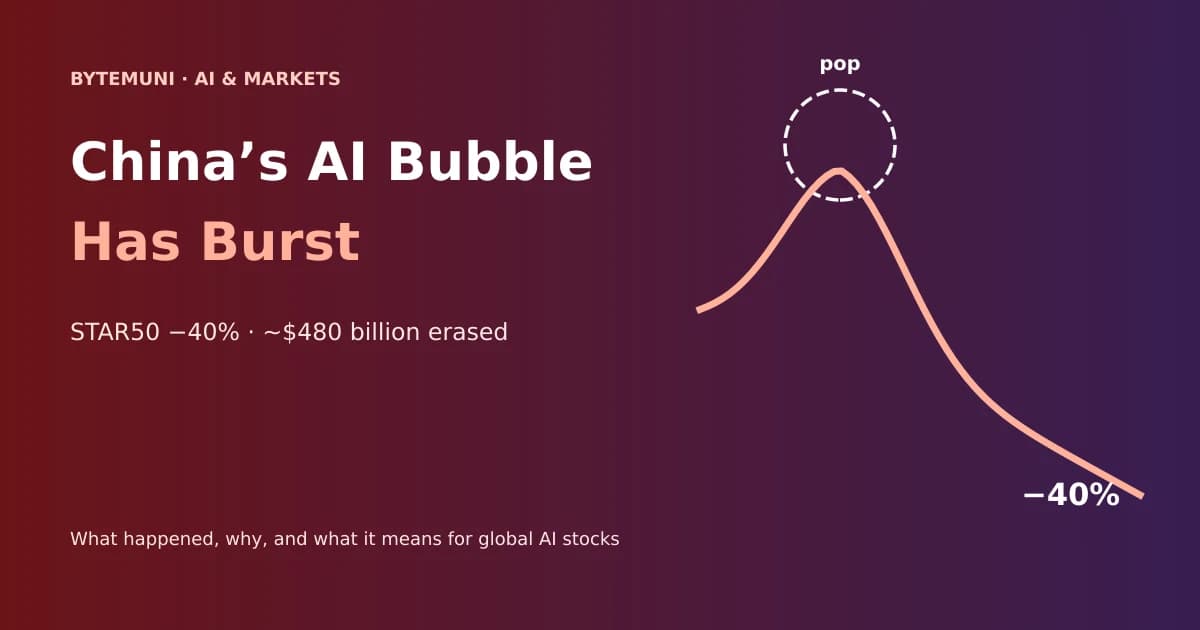
The China AI bubble has burst, at least in its stock market. The STAR 50 index of Chinese AI and chip leaders has fallen about 40% from its July high in under four months, erasing roughly $480 billion in market value, Reuters reported on October 26. The broader CSI 300 is down about 20% from its June peak. Wall Street, by comparison, has barely flinched.
The selloff didn't stop with that report. On Tuesday, October 27, the STAR 50 dropped another 4.8% in a single session to its lowest level since March, and the CSI semiconductor index fell 5.8%.
Below is what actually happened in the China AI bubble, why it happened, who's hurting, what the bulls and bears are saying, and whether it's a warning for AI stocks in the US and the rest of the world. Every number is sourced. Where something is opinion or a forecast, I say so.
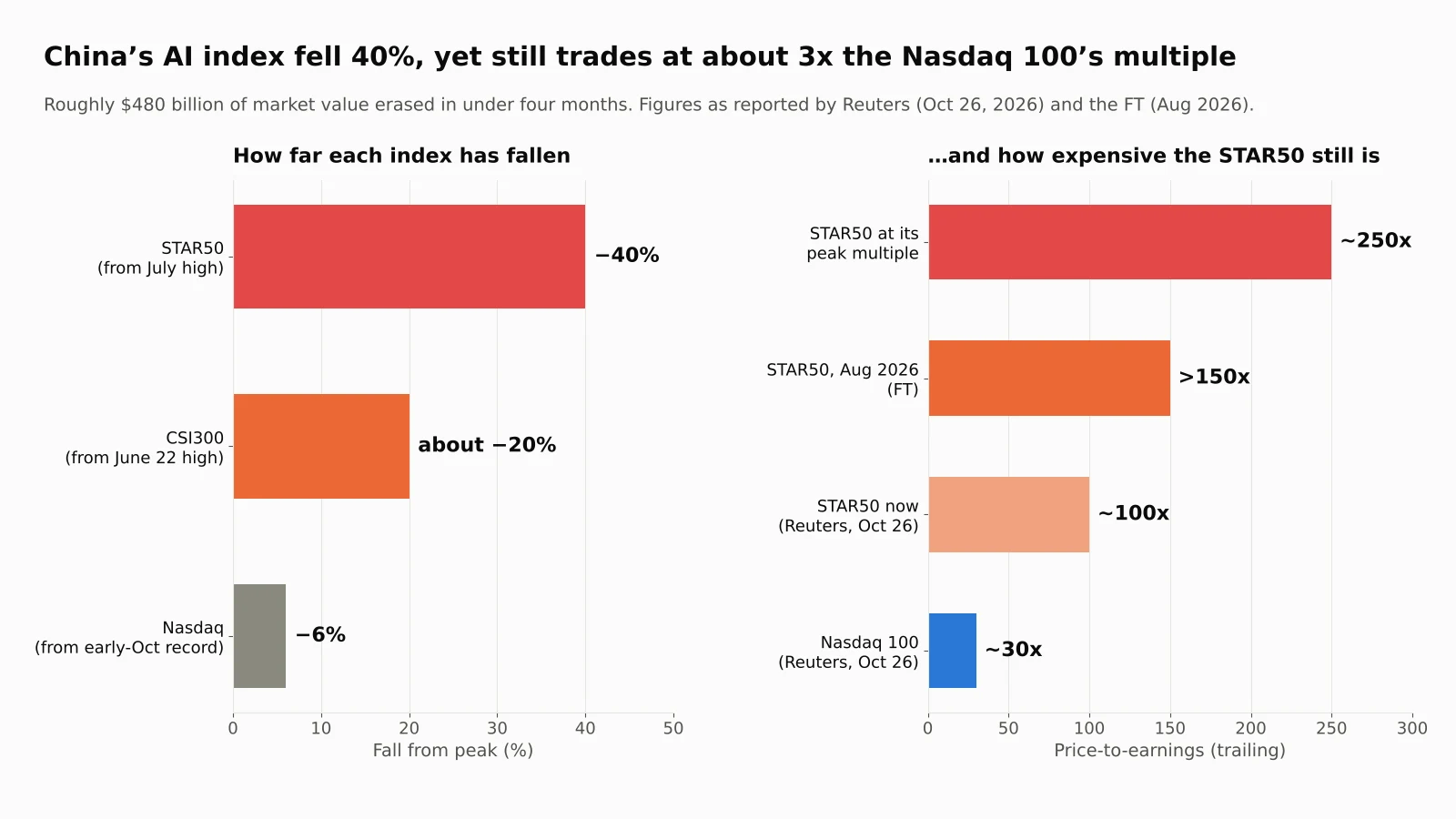
China's AI index has fallen almost seven times as far as the Nasdaq, yet it is still priced at around 100 times earnings, more than three times the Nasdaq 100's multiple.
China AI bubble: the key numbers
Measure Figure Source STAR 50 fall from July 2026 high About 40%, in under four months Reuters, Oct 26 Market value erased About $480 billion Reuters, Oct 26 CSI 300 fall from June 22 high About 20% (bear-market territory)Reuters CSI 300 weekly losing streak 11 weeks to Oct 23, longest since the index began in 2005 Reuters via Business Recorder Nasdaq fall from early-October record About 6%Reuters, Oct 26 STAR 50 valuation now About 100x trailing earnings (peak near 250x) Reuters Nasdaq 100 valuation About 30x trailing earnings Reuters AI stocks' share of China's market 42% of market cap, 57% of turnover Goldman Sachs, via Reuters
Two of those numbers explain most of the story. The 42% and 57% figures show how concentrated China's market had become in one theme: AI wasn't a corner of the market, it was the market. And even after a 40% fall, a price-to-earnings ratio around 100 means investors are still paying roughly $100 for every $1 of annual profit.
How the China AI bubble was built
To understand the crash, start with the climb.
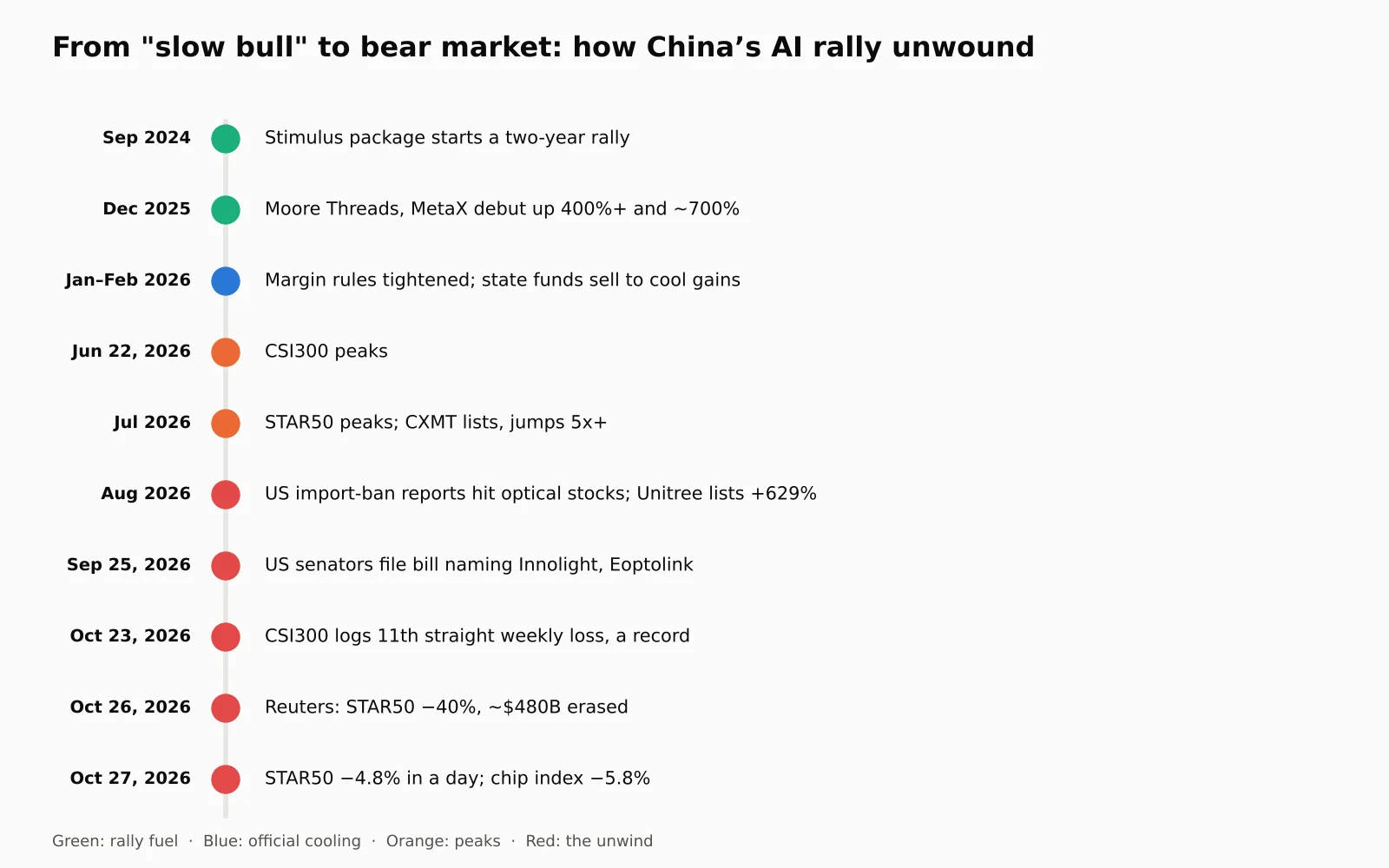
Two years from stimulus to selloff. Beijing tried to cool the rally early in 2026, but the AI listings kept the frenzy going into the summer.
Stimulus lit the fuse. In late September 2024, Beijing announced a package of economic support measures, and Chinese stocks started a rally that ran for two years.
AI became national policy and a national trade. Beijing wants its own chips, robots and AI models, partly because US export controls limit access to top Nvidia hardware. Investors read that as a promise: back the companies the state backs. The listings that followed turned that belief into a frenzy:
Moore Threads, a GPU designer, debuted in Shanghai on December 5, 2025 and more than quintupled from its issue price, according to Yicai Global.
MetaX, another GPU maker, closed its first day on December 17, 2025 up 693%.
CXMT, a memory chip maker, jumped more than five fold on its July 27, 2026 debut and briefly became mainland China's largest listed company by market value, Nikkei Asia reported.
Unitree Robotics, the humanoid-robot maker, priced its IPO at 150.8 yuan to raise about 6.1 billion yuan (roughly $900 million). Retail investors oversubscribed the offer more than 8,000 times, a STAR Market record, and only about 0.018% of orders got shares (The Next Web). It then rose 629% on its first trading day in August (The Asset).
By August 13, the combined value of China's chip-related companies had reached 14.15 trillion yuan (about $2.1 trillion), nearly three times its level a year earlier and roughly equal to the entire banking sector, according to Nikkei Asia. The FT reported in mid-August that the STAR 50 was up 29% for the year and trading above 150 times earnings.
Beijing tried to stop exactly this
Here's the twist that makes China's case unusual: the government saw the danger and tried to slow the rally down.
Officials wanted a "slow bull", a market that rises steadily for years instead of China's old boom-and-bust pattern. The goal is practical. According to the WSJ, stocks make up just 11% of Chinese household assets versus 32% in the US, and Beijing wants savers to move money from property and bank deposits into shares. That gives companies equity funding and households retirement income, but only if people don't get burned.
So in early 2026, regulators leaned against the boom:
Margin rules were tightened, with margin requirements raised to 100% in January (Nikkei Asia), so investors had to put up the full value of trades.
High-frequency traders lost some access to exchange data, and stock-picking influencers were reined in.
Exchanges handled more than 2,000 irregular trading cases in a single month, a record, Reuters reported in February.
The "national team" sold. State-backed funds, usually seen as market rescuers, trimmed holdings. Central Huijin, the sovereign fund unit that steers markets through ETFs, saw net outflows above 700 billion yuan in January, according to Z-Ben Advisors.
When markets wobbled in July, state-backed investors switched to buying: China Reform Holdings and China Chengtong deployed 60 billion yuan through a central bank relending facility, and ETFs tracking the STAR 50 and ChiNext saw a record 73.7 billion yuan of net buying that month (Nikkei Asia). It didn't hold. When the bubble finally deflated, it did so despite these measures, which tells you how much speculative money had piled in.
What popped the China AI bubble?
Traders told Reuters there was no single obvious trigger. Instead, several pressures hit at once:
1. Prices were priced for perfection. At 250 times earnings, a stock needs decades of flawless growth to justify its price. When enough investors started doubting that, selling fed on itself.
2. Washington turned on the optical suppliers. Zhongji Innolight and Eoptolink make optical transceivers, the components that move data between AI servers over fibre, and they sell heavily into US data centres. In early August, reports of a proposed US import ban sent the stocks sliding, Bloomberg reported. On September 25, a bipartisan group of US senators (John Cornyn, Dave McCormick, John Fetterman and Ruben Gallego) introduced a bill that would bar the federal government from using the two companies' transceivers in sensitive systems, according to Benzinga. The bill has been introduced, not passed. But the market got the message: global revenue that looked secure might shrink to China-only revenue.
3. Tax bills. Some traders pointed to tax payments falling due, which forced selling.
4. Crowded positions. When 57% of trading is in one theme, everyone is on the same side of the boat. Sinolink Securities said this week that a lasting recovery may need more deleveraging because some crowded positions still haven't been cleared.
Reuters financial journalist Tom West brook put the shift neatly in a video on the selloff: money is rotating away from the "nuts and bolts" suppliers of the AI boom as fund managers try to work out where AI's real profits will land.
Retail investors took the hardest hit
Individuals account for about 60% of daily trading in China's stock market, according to the WSJ, so when the China AI bubble broke, ordinary savers felt it most.
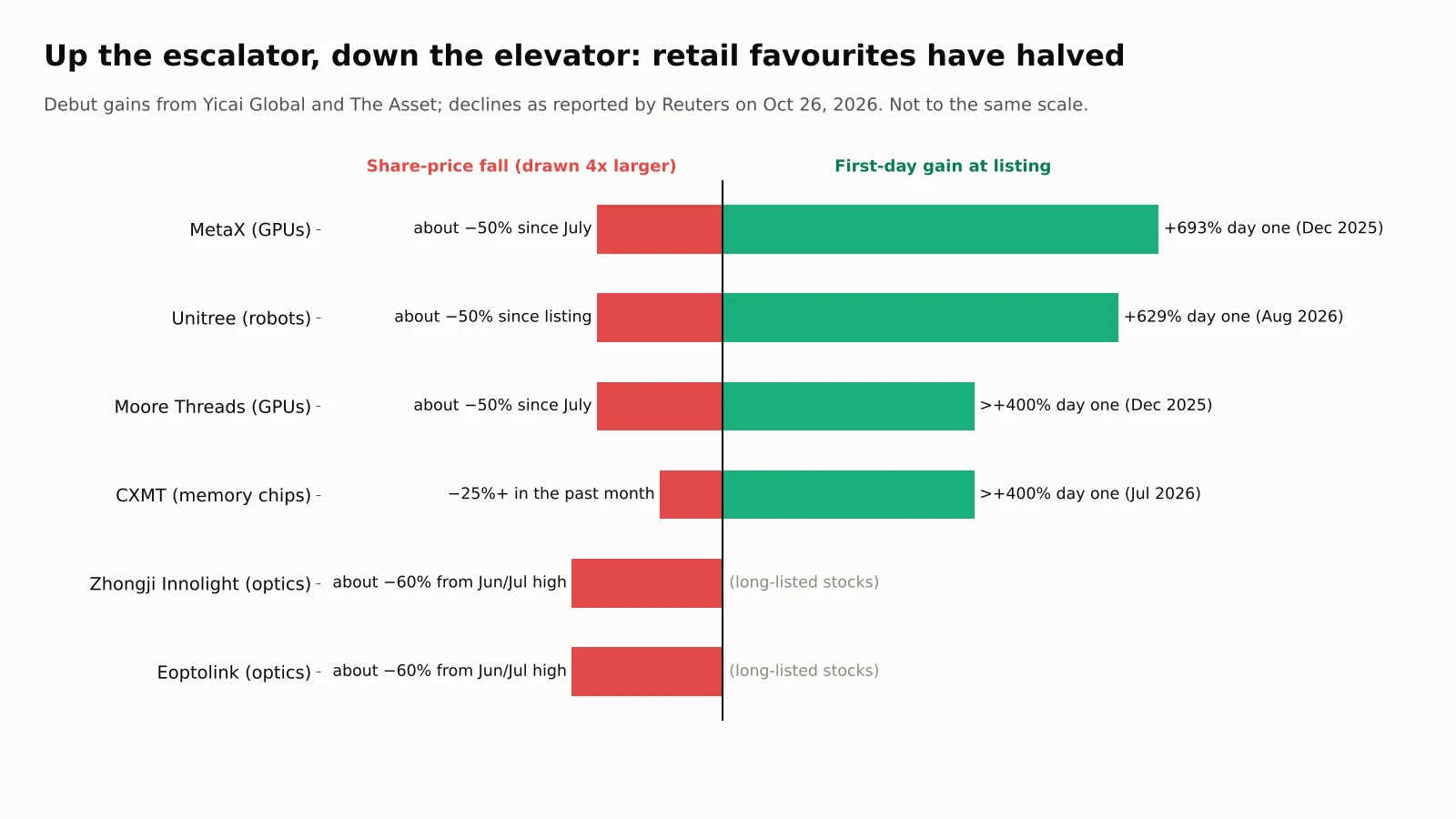
Spectacular first days, painful months after. Investors who bought after the debut pop are sitting on heavy losses.
As of Reuters' October 26 report:
Unitree has halved since it started trading in August.
MetaX and Moore Threads have each halved since July.
CXMT lost more than a quarter of its value in a month.
Zhongji Innolight and Eoptolink are down roughly 60% from their June and July highs.
Reuters spoke to Chen Wensheng, a small business owner from Hainan, who said he bought in because Unitree counted state-backed funds among its investors and that felt like official support. He and his friends are now nursing losses. That's the uncomfortable lesson of this episode: a government backing an industry is not the same as a government guaranteeing a share price. Policy can make a sector important. It can't make a stock cheap.
Is the China AI bubble a warning for US and global AI stocks?
This is the question everyone is asking, and the honest answer is: not yet, and maybe not in the same way.
The contrast with the US is stark. The Nasdaq had pulled back only about 6% from its record when Reuters published, and US AI stocks rallied again this week. Anthropic's IPO filing, which showed first-half revenue up about 1,300% year on year, lifted tech shares, as did Broadcom's $63 billion financing deal with Citi, Blackstone and Morgan Stanley to build capacity for Anthropic, news.com.au reported. (If you're new to Anthropic's products, our explainer on Claude Duet, Anthropic's proactive agent app is a good starting point.) South Korea's SK hynix, which supplies high-bandwidth memory to Nvidia, reported third-quarter operating profit up 632% year on year to 83.33 trillion won.
Three differences matter:
China AI stocks US AI stocks Valuation STAR 50 ~100x earnings, after falling from ~250x Nasdaq 100 ~30x Who's trading Retail-dominated, ~60% of daily trades Institutions dominate Earnings Many young, thinly profitable listings Giants with large, growing AI revenue Policy risk US restrictions can cut off export markets Mostly domestic demand, plus export curbs on China
None of this makes the US immune. Worries about AI spending, power shortages for data centres, debt-funded capital spending and how long AI chips stay useful are all live debates in America, and tech shares were under pressure just last week on fears that huge AI investments might not pay off. But those are different mechanisms from what hit China. China's crash is mostly about extreme valuations, a retail crowd and trade restrictions. A US reckoning, if it comes, would more likely be about whether AI revenue grows fast enough to justify the spending.
The fair reading: the China AI bubble shows how fast a policy-fuelled AI trade can reverse. It doesn't prove the global AI boom is over.
How the China AI bubble compares with past bubbles
China 2015. The closest parallel is China's own crash in the summer of 2015, when the Shanghai Composite fell more than 40% in a matter of months after a margin-fuelled retail boom, and the government had to step in with massive buying. The difference this time is that leverage was deliberately reined in early, so the damage has been concentrated in one theme rather than the whole market.
Dot-com, 2000–2002. The Nasdaq lost nearly 80% from its March 2000 peak. The internet turned out to be real and world-changing, but many of the companies that rode the hype didn't survive. That's the pattern bears see in China's AI chip and robot names today: a real technology, paired with prices that ran far ahead of profits.
The bull and bear case from here
The bears:
"Just like all other Chinese manufacturers, (chipmakers and AI suppliers) will eventually end up in a price war," Wang Zhuo of Shanghai Zhuozhu Investment Management told Reuters. "All bubbles inevitably burst."
Hong Hao of Lotus Asset Management expects the slump to halt many companies' plans to list, which would slow fundraising for Chinese tech.
At ~100x earnings, the STAR 50 still has a long way to fall before it looks cheap by global standards.
The bulls:
Goldman Sachs put Innolight and CXMT on a revamped list of recommended Chinese AI stocks this month.
BNP Paribas Securities strategist William Bratton has said the market offers buying opportunities for careful investors.
HSBC research shows Asia funds remain overweight China overall, even after three months of selling.
Policymakers are stepping in at the edges. This week the People's Bank of China set up a swap facility to give emergency liquidity to non-bank financial firms facing large redemptions.
On Wednesday, October 28, Chinese stocks bounced in early trading as Asian tech rallied on SK hynix's results. Whether that's a floor or a pause, nobody knows yet.
What the China AI bubble means for the tech industry
For engineers and companies that build with AI hardware, three practical effects are worth watching:
Funding for Chinese AI chip makers gets harder. Young GPU and robot companies were planning to raise money through listings. A frozen IPO window slows their road maps.
Supplier risk for data centres goes up. If US restrictions on Chinese optical modules move forward, buyers will need alternative suppliers, and switching takes time.
Price wars are a possibility. If Wang Zhuo is right, a squeeze on Chinese chip and AI component makers could mean cheaper hardware, though that's a forecast, not something that's happened yet.
The deeper lesson is about separating the technology from the trade. Chinese AI labs are still shipping competitive models and tools; ByteMuni recently covered DeepSeek's open-source DeepInfer tool, which aims to cut the cost of running AI models. A stock collapse doesn't erase that engineering. It just re-prices what investors are willing to pay for it. You'll find more of that engineering-side coverage in ByteMuni's AI & Machine Learning section.
What investors can take from this
This isn't investment advice, but a few lessons apply to any market, including India's:
"The government supports this sector" is not a valuation. It tells you a sector matters, not what a share is worth.
Huge IPO over subscription is a warning, not a guarantee. When an IPO is 8,000 times oversubscribed, most buyers end up purchasing on the open market after the pop, at the worst possible price.
Concentration cuts both ways. When one theme is more than half of all trading, it can lift the whole market and then sink it.
Price-to-earnings still matters. A great company can be a terrible investment at the wrong price.
The bottom line
The China AI bubble has burst in its stock market: about 40% off the STAR 50, roughly $480 billion erased and a CSI 300 bear market, driven by sky-high valuations, crowded retail positioning and US moves against Chinese suppliers. Wall Street hasn't followed so far, thanks to lower valuations, stronger earnings and a different investor base. Whether China is an early warning or a one-off depends on what happens to AI earnings over the next year, not on headlines this week. For now, the safest conclusion is the one Beijing itself was trying to teach: slow bulls last, and crazy bulls don't.
This article is for information only and is not financial advice. Markets are moving quickly; figures are as reported on the dates given.
Sources
In China, the AI bubble has already burst — Reuters, Oct 26, 2026
The AI bubble has 'already burst' in China — news.com.au, Oct 28, 2026
China stocks fall as tech shares extend slide — Reuters via Business Recorder, Oct 28, 2026
China stocks rebound on ETF buying — Reuters via Business Recorder, Oct 24, 2026
Bipartisan lawmakers seek to bar a Chinese AI data center component — Benzinga, Sep 26, 2026
Chinese optical stocks slide on report of proposed US import ban — Bloomberg, Aug 5, 2026
China's national team battles AI stock rollercoaster — Nikkei Asia via KR Asia, Aug 18, 2026
China deploys a 'national team' of investors to keep AI stock boom in check — WSJ via Tiger Brokers
China tightens market oversight to create 'slow bull' — Reuters via Global Banking & Finance, Feb 2026
Unitree lists in Shanghai after record demand — The Next Web
Unitree Robotics soars 629% on trading debut — The Asset
Chinese GPU maker MetaX surges nearly 700% on trading debut — Yicai Global
STAR 50 up 29% in 2026 with P/E above 150 — FT via AI Weekly, Aug 16, 2026
Frequently asked questions
Has the China AI bubble really burst?
In the stock market, yes. Reuters reported on October 26, 2026 that the STAR 50 index of AI and chip leaders had fallen about 40% from its July high in under four months, erasing about $480 billion, and the broader CSI300 entered bear-market territory. That's a market repricing, not proof that Chinese AI technology has failed.
What is the STAR 50 index?
The STAR 50 tracks the 50 largest and most liquid companies on Shanghai's STAR Market, a tech-focused board launched in 2019. It is heavily weighted towards semiconductors, AI hardware and other strategic technology companies.
Why did Chinese AI stocks crash?
Traders cited no single trigger. Valuations had reached nearly 250 times earnings, US lawmakers moved against Chinese optical suppliers to data centres, tax bills fell due, and positions were crowded, with AI stocks making up 57% of trading according to Goldman Sachs.
Will the China AI bubble spread to US stocks?
Not so far. The Nasdaq was only about 6% below its record when Reuters reported the crash, and US AI stocks rallied after Anthropic's IPO filing and strong SK hynix results. US stocks trade at much lower valuations, but debates over AI spending and returns remain open.
Which Chinese AI stocks fell the most?
According to Reuters, optical component makers Zhongji Innolight and Eoptolink fell about 60% from their June and July highs, while Unitree, MetaX and Moore Threads roughly halved. Memory chipmaker CXMT lost more than a quarter of its value in a month.
Did the Chinese government try to stop the bubble?
Yes. Regulators tightened margin requirements to 100% in January 2026, curbed high-frequency trading and cracked down on irregular trading, and state-backed funds sold into rallies to aim for a steady "slow bull" market. The bubble deflated anyway.
How this article was made: researched and edited by Deepak Kumar, drafted with help from AI tools.