Top 25 Generative AI Interview Questions for 2026 (With Answers)
GenAI interviews in 2026 test whether you can build, evaluate and run LLM systems, not just define them. Here are 25 generative AI interview questions with strong answers and common mistakes, from attention and RAG to LoRA, KV cache, agents and guardrails.

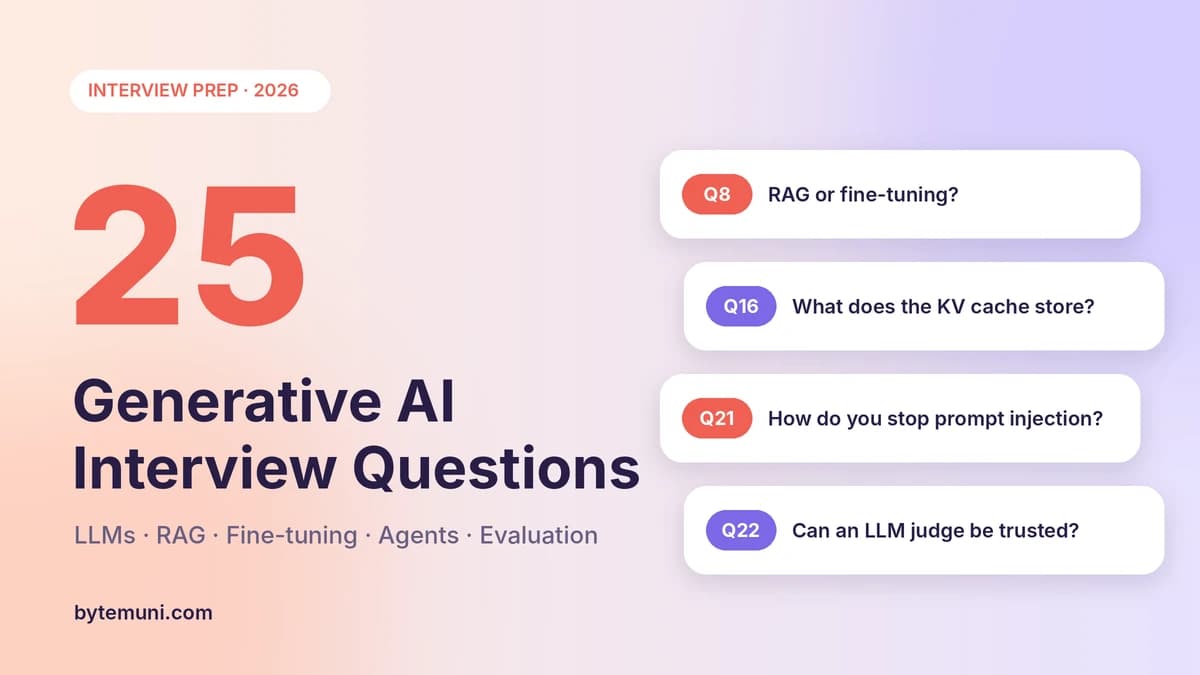
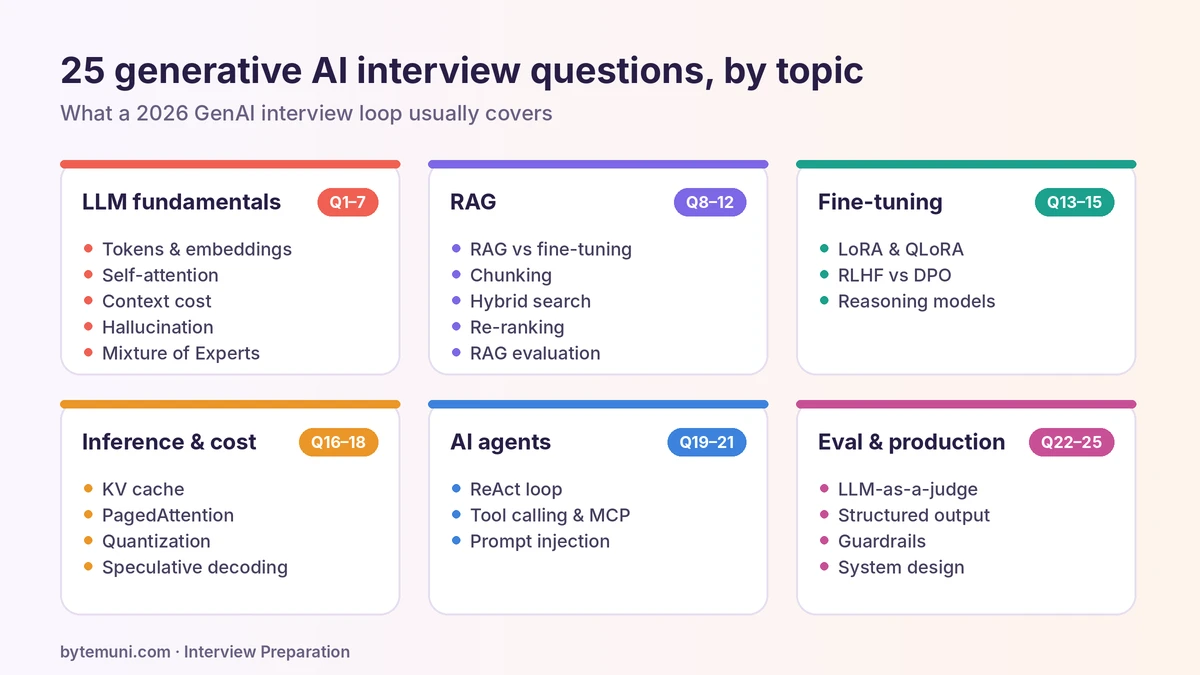
These 25 generative AI interview questions are the ones most likely to come up for AI engineer, ML engineer and LLM application roles in 2026. They cover how LLMs work, RAG, fine-tuning, inference cost, AI agents, evaluation and safety. Each of these generative AI interview questions includes what a strong answer covers, plus the common mistake that gives away shallow knowledge.
The focus of GenAI interviews has shifted. Knowing what a large language model is no longer stands out. Interviewers want to know whether you can build, evaluate and run LLM systems in production: choosing between RAG and fine-tuning, cutting inference cost, measuring quality, and keeping agents safe. That's what these questions test.
How should you answer generative AI interview questions?
Most generative AI interview questions reward the same answer structure:
One-line definition, so the interviewer knows you know it.
How it works, at the level of detail the role needs.
A trade-off or limitation, which is what separates engineers from people who memorised a glossary.
A real example from your own work, if you have one.
If you don't know something, say what you do know and how you'd find out. Confidently wrong answers about LLMs are a bigger red flag than honest gaps. For design rounds, our guide to structured interview techniques covers the same thinking-out-loud approach.
LLM fundamentals: generative AI interview questions 1–7
Most generative AI interview questions start here, and even senior interviews open with fundamentals. The follow-ups are where they find out whether you really understand them.
1. What are tokens and embeddings, and why do they matter in practice?
Strong answer: a token is the unit of text a model processes. It's often a word piece rather than a whole word, produced by a tokenizer such as byte-pair encoding (BPE). An embedding is the vector the model uses to represent each token, learned so that related meanings end up close together in vector space.
Why it matters in practice:
Context limits and API pricing are counted in tokens, not words.
The same text can cost a different number of tokens in different languages; many non-English scripts use more tokens per word.
Odd behaviour with spelling, counting letters or arithmetic is often a tokenization artifact.
2. Explain self-attention. Why is it divided by √dk?
Strong answer: self-attention lets every token weigh every other token when building its representation. Each token is projected into a query, key and value. Attention weights come from query–key similarity, normalised with softmax, and are used to mix the values:
Attention(Q, K, V) = softmax(Q·Kᵀ / √d_k) · VDividing by √dk (the key dimension) keeps dot products from growing large as dimensions increase. Large values would push softmax into very peaked outputs with tiny gradients, making training unstable. Multi-head attention runs several attention operations in parallel, so different heads can capture different relationships, then combines them.
3. Decoder-only vs encoder-only vs encoder-decoder: when would you use each?
Strong answer:
Encoder-only (e.g. BERT): bidirectional attention, where each token sees both left and right context. Strong for classification, named-entity recognition and producing embeddings.
Decoder-only (e.g. the GPT family): causal attention, where each token sees only earlier tokens. Trained to predict the next token, which makes it the standard design for text generation and chat models.
Encoder-decoder (e.g. T5): an encoder reads the input and a decoder generates output while attending to it. A natural fit for translation and summarisation.
Add a practical point: most modern chat LLMs are decoder-only, while many embedding models used in RAG are encoder-based.
4. Why are long context windows expensive?
Strong answer: standard self-attention compares every token with every other token, so its compute and memory grow quadratically with sequence length. Doubling the context roughly quadruples the attention work. At inference time there's a second cost: the KV cache (see Q16) grows with every token in the context.
Mention the quality issue too. Research such as "Lost in the Middle" (Liu et al., 2023) found that models often use information at the start and end of a long context better than information in the middle. So "just put everything in the prompt" isn't free or reliable.
5. How do temperature, top-k and top-p affect generation?
Strong answer: the model outputs a probability distribution over the next token, and these settings control how you sample from it.
Temperature rescales the distribution. Lower values make output more deterministic; higher values make it more varied.
Top-k samples only from the k most likely tokens.
Top-p (nucleus sampling) samples from the smallest set of tokens whose combined probability reaches p.
Practical guidance: use low temperature for extraction, classification and code; higher for brainstorming. Point out that low temperature reduces randomness but doesn't make a model factually correct. It can be confidently wrong at temperature 0.
6. Why do LLMs hallucinate, and how do you reduce it?
Strong answer: LLMs generate statistically likely text, not verified facts. Hallucinations come from gaps or errors in training data, outdated knowledge, ambiguous prompts, and the model's tendency to produce a fluent answer rather than say "I don't know."
Ways to reduce it:
Ground answers in retrieved sources (RAG) and require citations.
Instruct the model, and design the system, to say when the context doesn't contain the answer.
Use structured outputs and validation for anything machine-readable.
Add verification steps, such as checking claims against sources, and evaluate hallucination rates on a test set.
Red flag: claiming any technique eliminates hallucination entirely.
7. What is a Mixture of Experts (MoE) model?
Strong answer: an MoE model replaces some dense layers with many "expert" sub-networks plus a router that sends each token to only a few of them. The model can therefore have a large total parameter count while using only a fraction of it per token. Mixtral 8x7B is a well-documented example: about 47 billion total parameters, but roughly 13 billion active per token, because each token is routed to 2 of 8 experts.
Trade-offs: lower compute per token than a dense model of the same total size, but all parameters still have to fit in memory, and training needs care so the router uses its experts evenly (load balancing).
RAG interview questions (8–12)
Retrieval-augmented generation is behind a large share of production LLM apps, so RAG makes up a large share of generative AI interview questions for application roles.
8. RAG vs fine-tuning: how do you choose?
Strong answer:
RAG retrieves relevant documents at query time and passes them to the model. Use it when knowledge changes often, is private, or needs citations, such as policies, product docs or support articles. Updating knowledge means updating the index, not retraining.
Fine-tuning changes the model's weights. Use it to teach behaviour: a consistent format or tone, a domain style, or a narrow task that prompting doesn't handle reliably.
Good candidates add that they're often combined, and that the cheapest option should come first: try prompting, then RAG, and fine-tune only when evaluation shows the gap is about behaviour rather than missing knowledge.
9. Walk me through building a production RAG pipeline.
Strong answer:
Ingest and parse documents, preserving structure such as headings and tables.
Chunk them (see Q10) and attach metadata: source, date, access permissions.
Embed chunks and store them in a vector index.
Retrieve with hybrid search, then re-rank (see Q11).
Generate with a prompt that tells the model to answer only from the provided context and to cite sources.
Evaluate and monitor retrieval quality and answer quality continuously (see Q12).
Bonus points for access control: filter retrieval by the user's permissions, so the model can't leak documents the user shouldn't see.
10. How do you choose a chunking strategy?
Strong answer: chunk size is a trade-off. Small chunks match queries precisely but lose context; large chunks keep context but add noise and cost. Options include:
Fixed-size with overlap: simple baseline.
Recursive or structure-aware splitting: split on headings, paragraphs, then sentences, so units stay intact.
Parent–child (small-to-big): retrieve using small chunks, but pass the larger parent section to the model.
Layout-aware parsing for PDFs, tables and code, which naive splitting breaks.
The key line: "I'd pick a strategy by measuring retrieval quality on real questions, not by guessing a number."
11. Bi-encoders vs cross-encoders: why use both?
Strong answer: a bi-encoder embeds the query and documents separately. Document vectors can be pre-computed, so search over millions of chunks is fast, but the query and document never interact during scoring. A cross-encoder reads the query and a document together, which captures fine-grained relevance much better but is too slow to run over a whole corpus.
So production systems use both:
Retrieve candidates quickly with a bi-encoder, often combined with keyword search such as BM25 (hybrid search, which catches exact terms like product codes that embeddings can miss).
Re-rank the top results with a cross-encoder.
12. How do you evaluate a RAG system?
Strong answer: evaluate retrieval and generation separately, because a bad answer can come from either.
Retrieval: did the right documents come back? Metrics such as recall@k, precision and MRR on a labelled set of questions.
Generation: is the answer faithful (supported by the retrieved context) and relevant to the question?
Frameworks such as Ragas package metrics like faithfulness, answer relevance, context precision and context recall. Note that some of these, such as context recall, need reference answers, so you still need a curated test set. Combine automated metrics with human review on a sample.
Fine-tuning and alignment interview questions (13–15)
These generative AI interview questions show up most for ML engineer and research-adjacent roles, where you may customise models rather than only call APIs.
13. How do LoRA and QLoRA work?
Strong answer: LoRA (Low-Rank Adaptation, Hu et al., 2021) freezes the original weights and learns a small low-rank update instead. For a weight matrix W, it learns two small matrices B and A, and the layer computes W·x + B·A·x. Because the rank r is small, only a tiny fraction of parameters is trained. The adapters are small files, and one base model can serve several of them.
QLoRA (Dettmers et al., 2023) goes further: it stores the frozen base model in 4-bit precision (the NF4 format), trains LoRA adapters on top, and adds double quantization and paged optimizers to save memory. That made fine-tuning large models possible on far less GPU memory.
Trade-off to mention: parameter-efficient methods may not match full fine-tuning on every task, so evaluate before choosing.
14. RLHF vs DPO: what's the difference?
Strong answer: both align a model with human preferences, using data where people chose the better of two responses.
RLHF trains a separate reward model on those preferences, then optimises the LLM against it with reinforcement learning, classically PPO, usually with a penalty that keeps it close to the original model. It's powerful but complex, compute-heavy and sensitive to tuning, and the model can learn to exploit flaws in the reward model ("reward hacking").
DPO (Direct Preference Optimization, Rafailov et al., 2023) shows that the same goal can be optimised directly on preference pairs with a simple classification-style loss. No separate reward model and no RL loop, which makes it simpler and more stable to run.
Our explainer on how training rewards shape model behaviour is useful background for the reward-hacking follow-up.
15. What are reasoning models, and how are they different from standard LLMs?
Strong answer: reasoning models spend extra computation at inference time: they generate intermediate reasoning (chain of thought) before the final answer. They're typically trained with reinforcement learning to make that reasoning useful. DeepSeek-R1 (January 2025) is a well-documented open example; its paper describes using large-scale reinforcement learning to develop reasoning behaviour.
Trade-offs: better on multi-step maths, coding and logic, but slower and more expensive per request because they generate more tokens. Choosing when to use a reasoning model versus a faster standard model is a cost and latency decision interviewers like to hear you reason about.
Inference and cost optimisation interview questions (16–18)
Running LLMs is expensive, and teams want engineers who can make it cheaper and faster. Expect these generative AI interview questions for any role that serves models in production.
16. What is the KV cache, and how does PagedAttention help?
Strong answer: when a decoder generates text token by token, each new token attends to all earlier tokens. The KV cache stores the keys and values already computed for earlier tokens, so they aren't recomputed at every step. That makes generation much faster, but the cache uses a lot of GPU memory, growing with sequence length, batch size and model size.
PagedAttention, introduced with vLLM (Kwon et al., 2023), manages the KV cache in fixed-size blocks, like virtual-memory pages, instead of one large contiguous slice per request. That reduces wasted memory from fragmentation and over-allocation, so more requests fit on the same GPU.
Common mistake: confusing this with FlashAttention. FlashAttention (Dao et al., 2022) is an IO-aware way of computing exact attention that avoids writing the full attention matrix to slow GPU memory. It speeds up attention, but it isn't a KV-cache memory manager.
17. How does quantization work, and what does it cost you?
Strong answer: quantization stores weights (and sometimes activations) in lower precision, such as 8-bit or 4-bit integers instead of 16-bit floats. That cuts memory and can speed up inference, because generation is often limited by memory bandwidth. Common approaches:
GPTQ: post-training quantization that uses approximate second-order information to minimise error, layer by layer.
AWQ: uses activation statistics to find the most important weight channels and protects them through scaling.
GGUF: a file format used by llama.cpp, popular for running quantized models on laptops and CPUs.
The cost: some accuracy loss, which grows at lower bit widths and varies by task. Always evaluate the quantized model on your own use case.
18. How would you reduce latency and cost for a high-traffic LLM service?
Strong answer: work from the cheapest wins upward:
Right-size the model: use a smaller model for simple requests and route only hard ones to a bigger model.
Prompt and response length: shorter prompts and output limits directly cut cost.
Caching: reuse responses for repeated requests, and use prompt (prefix) caching where your provider or server supports it.
Continuous batching: add new requests to a running batch as others finish, instead of waiting for the whole batch, to keep the GPU busy.
Speculative decoding: a small draft model proposes several tokens and the large model verifies them in one pass. It speeds up generation without changing the large model's output distribution.
Quantization and streaming of responses to improve perceived latency.
Mention that serving engines such as vLLM implement several of these, and that you'd measure cost per request and p95 latency before and after each change.
AI agent interview questions (19–21)
Agents are the fastest-growing area of generative AI interview questions in 2026, because more teams are moving from chat features to systems that take actions.
19. What's the difference between a chatbot and an AI agent?
Strong answer: a chatbot responds to messages. An agent pursues a goal: it plans, calls tools (APIs, code execution, search, databases), observes the results and decides what to do next, in a loop. A widely cited pattern is ReAct (Yao et al., 2022), which interleaves reasoning steps with actions.
Add the engineering reality: agents add failure modes such as wrong tool choices, loops, compounding errors and cost blow-ups. So you need step limits, timeouts, good tool descriptions, logging, and evaluation of complete task success, not just individual answers. For where agent products are heading, see our piece on proactive AI agent apps.
20. How does tool (function) calling work, and what is MCP?
Strong answer: with tool calling, you describe available functions to the model, usually as JSON schemas. The model returns a structured request to call one with specific arguments. Your code executes it and passes the result back. The model never runs the tool itself.
The Model Context Protocol (MCP), introduced by Anthropic in November 2024, is an open standard for connecting AI applications to tools and data sources through a common interface. Instead of a custom integration for every model and tool pair, a tool exposed as an MCP server can work with any MCP-compatible client.
Key safety point: always validate tool arguments, because they come from a model that may have been manipulated.
21. How do you secure an AI agent against prompt injection?
Strong answer: prompt injection is LLM01 in the OWASP Top 10 for LLM Applications (2025). An attacker's instructions, typed directly or hidden in a web page, email or document the agent reads, can redirect the agent. There's no complete fix, because models don't reliably separate instructions from data. So you limit the damage:
Least privilege: give the agent only the tools and permissions the task needs.
Human approval for high-impact actions such as payments, deletions or external emails.
Treat model output as untrusted, and validate it before acting on it (OWASP's "Improper Output Handling").
Keep untrusted content clearly separated, sandbox code execution, and log every action.
OWASP also publishes a dedicated Top 10 for Agentic Applications (December 2025), led by Agent Goal Hijack. Our article on AI agents as insider threats shows why this matters in practice.
Evaluation and production interview questions (22–25)
Evaluation is where many candidates are weakest, which is why interviewers use these generative AI interview questions to separate demo builders from production engineers.
22. How do you evaluate an LLM application? What are LLM-as-a-judge's weaknesses?
Why it's asked: it's one of the generative AI interview questions that reveals real production experience.
Strong answer: start with a test set of realistic inputs and expected behaviour, built from real user queries if possible. Use:
Deterministic checks where possible: valid JSON, required fields, exact-match answers, passing unit tests for generated code.
LLM-as-a-judge for open-ended quality: a strong model scores outputs against a written rubric.
Human review on a sample, to calibrate the judge.
Known weaknesses of LLM judges, documented in research such as Zheng et al. (2023):
Position bias: favouring the first or second answer in a pair.
Verbosity bias: favouring longer answers.
Self-preference: favouring outputs from its own model family.
Mitigate by swapping answer order, using clear rubrics, and checking agreement with human ratings. Mention that classic overlap metrics like BLEU and ROUGE correlate poorly with quality for open-ended generation.
23. How do you get reliable structured output from an LLM?
Strong answer: use the provider's structured output or JSON-schema mode, or constrained decoding in open-source servers, so the output is guaranteed to match a schema. Then still validate the result (for example with Pydantic or JSON Schema), because valid JSON can still contain wrong values. Plan for retries or a fallback when validation fails, and keep schemas simple: deeply nested, ambiguous schemas cause more errors.
24. How would you add guardrails to a customer-facing LLM app?
Strong answer: layer controls around the model, not just inside the prompt:
Input checks: detect prompt injection attempts and off-topic or abusive requests, and redact sensitive data such as personal information before it reaches the model.
Output checks: moderation classifiers (for example, Meta's Llama Guard models classify prompts and responses against a safety taxonomy), PII leakage checks, and grounding checks for factual claims.
Policy frameworks such as NVIDIA's NeMo Guardrails to keep conversations on allowed topics and flows.
Monitoring and escalation: log, review flagged conversations, and hand off to a human when needed.
Make the point that guardrails reduce risk but add latency and can produce false positives, so they need evaluation like everything else.
25. Design a support chatbot that answers from company documentation.
Why it's asked: it's one of the most common system design rounds among generative AI interview questions, because it pulls everything above together.
Strong answer outline:
Clarify requirements: traffic, latency target, languages, which documents, how often they change, who can see what, and what "correct" means.
RAG pipeline: structure-aware chunking, permission metadata, hybrid search plus re-ranking, and answers with citations (Q9–Q11).
Model choice: start with a capable general model; route simple FAQs to a smaller, cheaper model (Q18).
Safety: input and output guardrails, refusal when the docs don't contain the answer, and human handoff (Q24).
Evaluation: a test set of real tickets, with retrieval and answer metrics tracked before each release (Q12, Q22).
Operations: logging, cost and latency dashboards, a feedback button, and a pipeline that re-indexes documents when they change.
Close with trade-offs you'd revisit at scale, such as caching, fine-tuning for tone, or moving to a self-hosted model for cost or data-residency reasons.
How should you prepare for generative AI interview questions?
Reading lists of generative AI interview questions helps, but interviewers probe beyond the first answer. These habits prepare you for the follow-ups.
Build one end-to-end project (most generative AI interview questions get easier when you can point to your own system), such as a RAG app over real documents with an evaluation set, and be ready to explain every design decision and what you'd change.
Read a few original papers rather than only summaries: Attention Is All You Need, LoRA, DPO, ReAct and Lost in the Middle are short, readable and come up often.
Practise with numbers: rough token counts, cost per request and latency budgets. Interviewers trust candidates who think in costs.
Know the safety basics: prompt injection, data leakage and agent permissions now come up even in non-security interviews.
Be honest about limits: saying "this reduces hallucination, it doesn't eliminate it" is a mark of experience.
Practise these generative AI interview questions out loud, not just by reading them; explaining a trade-off clearly is the skill being tested.
Applying for security-adjacent AI roles too? Our list of cybersecurity interview questions for 2026 includes a full AI security section.
Key papers referenced: Vaswani et al., Attention Is All You Need (2017) · Lewis et al., Retrieval-Augmented Generation (2020) · Hu et al., LoRA (2021) · Dettmers et al., QLoRA (2023) · Rafailov et al., Direct Preference Optimization (2023) · Dao et al., FlashAttention (2022) · Kwon et al., PagedAttention / vLLM (2023) · Yao et al., ReAct (2022) · Liu et al., Lost in the Middle (2023) · Zheng et al., Judging LLM-as-a-Judge (2023) · DeepSeek-AI, DeepSeek-R1 (2025) · Jiang et al., Mixtral of Experts (2024) · OWASP GenAI Security Project
Frequently asked questions
What are the most common generative AI interview questions in 2026?
RAG vs fine-tuning, how attention works, the KV cache and inference cost, LoRA/QLoRA, evaluating LLM apps, and securing AI agents against prompt injection.
Do I need to know the maths for GenAI interviews?
You should be able to explain attention, embeddings and LoRA conceptually, including the attention formula. Deep derivations are mostly asked for research roles.
Is RAG or fine-tuning asked more often?
Both come up, but RAG appears in almost every application-focused interview because so many production LLM apps use it.
What projects help most in a generative AI interview?
An end-to-end RAG or agent project with an evaluation set, where you can explain each design choice and its trade-offs.
Are classic machine learning questions still asked?
Yes, for ML engineer roles. Expect topics such as overfitting, evaluation metrics and data leakage alongside the LLM questions.
Which papers should I read before a GenAI interview?
Attention Is All You Need, LoRA, DPO, ReAct and Lost in the Middle. They’re short and come up often.