Top 25 Cybersecurity Interview Questions for Mid-Level Roles (2026)
The 25 cybersecurity interview questions mid-level candidates face in 2026, from TLS 1.3 and OWASP Top 10:2025 to cloud incidents, supply chain and AI security, with answers that impress.

These 25 cybersecurity interview questions are the ones mid-level candidates are most likely to face in 2026. They cover the fundamentals interviewers still probe, plus the areas hiring managers now care about most: cloud and identity, software supply chain, incident response, and AI security. Each question includes why it's asked, what a strong answer covers, and the mistakes that cost candidates the offer.
The market has shifted. A Barracuda Research survey of 2,000 IT and security decision-makers, published on October 21, 2026, found that 94% report cybersecurity skills gaps. The most-cited gaps were AI risks (68%) and advanced identity and phishing threats (67%). The same survey found 79% say AI is already affecting security roles or headcount. Mid-level cybersecurity interview questions reflect that: fewer "define a firewall" questions, more "walk me through what you'd do" scenarios.
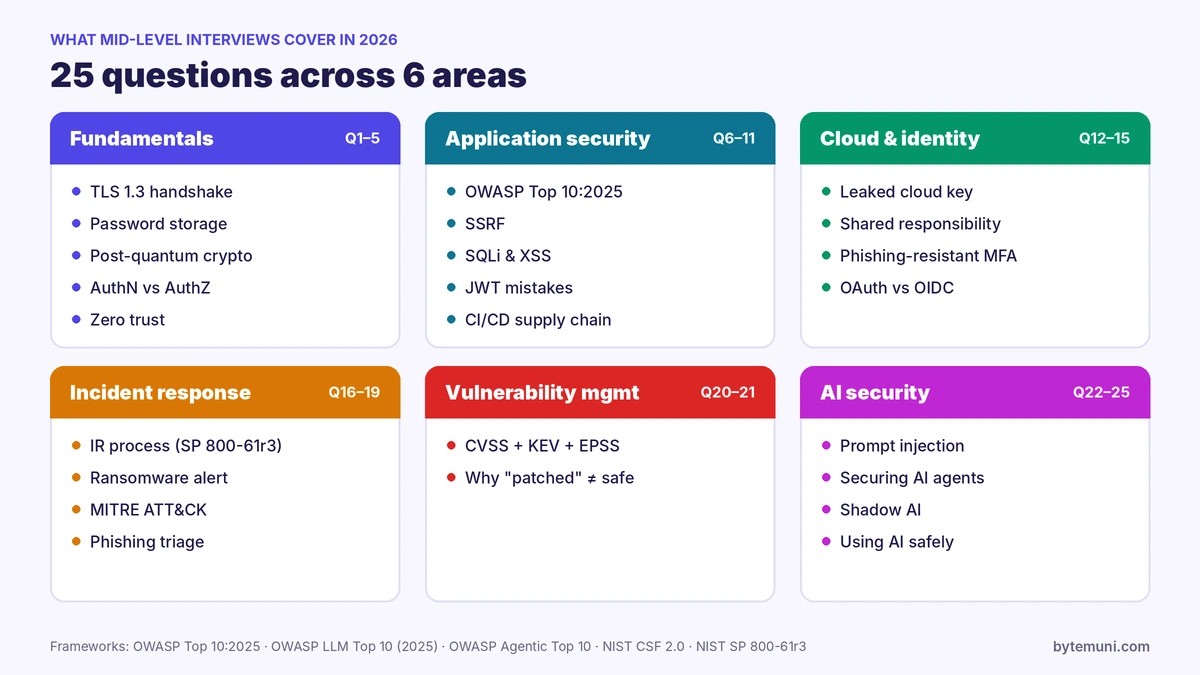
The 25 cybersecurity interview questions in this guide, grouped by area.
How are mid-level cybersecurity interview questions different?
Entry-level cybersecurity interview questions test whether you know the definitions. Mid-level interviews test whether you can apply them under pressure. Expect three kinds of questions:
"Explain it properly": fundamentals, but with follow-ups that expose shallow answers. For example: "Why does TLS 1.3 give forward secrecy?"
"What would you do?": scenarios such as a leaked cloud key, a ransomware alert or a critical CVE dropping on a Friday.
"What's changed?": current frameworks and threats, especially AI. Interviewers want to see you keep up.
A useful habit for all cybersecurity interview questions: state the core idea in one sentence, give a concrete example, then mention a trade-off or limitation. That pattern signals experience. Our guide to structured interview techniques covers the same approach for design rounds.
Fundamental cybersecurity interview questions (1–5)
Fundamentals still open most interviews. At mid-level, these cybersecurity interview questions come with follow-ups that test whether you understand how things work, not just what they're called.
1. Walk me through a TLS 1.3 handshake. Why is it more secure than older versions?
Why it's asked: almost everyone can say "TLS encrypts traffic." This question checks whether you understand how.
Strong answer:
The client sends a ClientHello with supported cipher suites and a key share for an ephemeral key exchange (typically ECDHE).
The server replies with a ServerHello and its own key share. Both sides derive the session keys, and the rest of the handshake is encrypted.
The server sends its certificate and proves it holds the private key. The client validates the certificate chain and checks that the hostname matches.
A full handshake takes one round trip (1-RTT), down from two in TLS 1.2.
On security: TLS 1.3 removed static RSA key exchange and requires ephemeral key exchange, so every session has forward secrecy. Stealing the server's private key later doesn't decrypt recorded traffic. It also dropped weak algorithms and encrypts more of the handshake, including the certificate.
Red flag: saying "SSL" as if it's current, or getting the direction wrong. The server presents a certificate; in normal HTTPS the browser doesn't.
2. How should an application store passwords?
Strong answer: never encrypt passwords (encryption is reversible) and never use a fast hash like plain SHA-256. Use a slow, salted, memory-hard password hashing function. The OWASP Password Storage Cheat Sheet recommends Argon2id, with scrypt or bcrypt as alternatives. Explain the key concepts:
Salt: a unique random value per password, so identical passwords produce different hashes and precomputed tables don't work.
Work factor: deliberately slow hashing, tuned so that offline brute force becomes expensive.
Pepper (optional): a secret kept outside the database for extra protection if the database alone leaks.
Follow-up to expect: "Hashing vs encryption vs encoding?" Hashing is one-way, encryption is reversible with a key, and encoding (such as Base64) is reversible by anyone and provides no security.
3. Symmetric vs asymmetric encryption, and what does post-quantum cryptography change?
Strong answer: symmetric encryption (for example AES) uses one shared key and is fast. Asymmetric encryption uses a public/private key pair, which solves key distribution but is slower. Real systems combine them: an asymmetric or key-agreement step establishes a shared secret, and symmetric encryption protects the data, as in TLS.
The 2026 add-on: large quantum computers would break today's widely used public-key algorithms such as RSA and elliptic-curve cryptography. In August 2024, NIST published its first post-quantum standards: FIPS 203 (ML-KEM) for key establishment, and FIPS 204 (ML-DSA) and FIPS 205 (SLH-DSA) for digital signatures. Mention "harvest now, decrypt later" (attackers recording encrypted traffic today to decrypt in the future) as the reason organisations are starting crypto inventories and migration planning now.
4. What's the difference between authentication and authorization? Give an example of each failing.
Strong answer: authentication answers "who are you?" and authorization answers "what are you allowed to do?"
Authentication failure example: credential stuffing against a login with no rate limiting or MFA.
Authorization failure example: an IDOR (insecure direct object reference), where changing
/invoices/1001to/invoices/1002shows another customer's invoice because the server never checks ownership.
Point out that broken access control is A01 in the OWASP Top 10:2025, the most significant web application risk in that list.
5. What does "zero trust" actually mean in practice?
Strong answer: zero trust means no user, device or network location is trusted by default. Every request is authenticated, authorized and evaluated in context. NIST describes the model in SP 800-207. In practice that means:
strong identity verification, including phishing-resistant MFA
device posture checks
least-privilege, per-application access instead of broad network access
micro-segmentation so one compromised system can't reach everything
continuous monitoring and re-evaluation
Red flag: describing zero trust as a product you buy. It's an architecture and an approach.
Application security interview questions (6–11)
Application security comes up in almost every role that touches software. These cybersecurity interview questions focus on how real web apps get broken and fixed.
6. What changed in the OWASP Top 10:2025?
Why it's asked: it quickly separates candidates who keep up from those reciting the 2021 list.
Strong answer: the 2025 edition was announced in November 2025. Key changes:
A01 Broken Access Control stays first and now absorbs Server-Side Request Forgery (SSRF), which was its own category in 2021.
A02 Security Misconfiguration moved up from fifth.
A03 Software Supply Chain Failures is new. It expands the old "Vulnerable and Outdated Components" to cover the whole build, distribution and update process.
A10 Mishandling of Exceptional Conditions is new, focusing on how software handles errors and unusual states.
Cryptographic Failures (A04), Injection (A05) and Insecure Design (A06) moved down. Authentication Failures (A07), Software or Data Integrity Failures (A08) and Logging & Alerting Failures (A09) round out the list.
7. How do you prevent Server-Side Request Forgery (SSRF)?
Strong answer: SSRF happens when an attacker makes your server send requests to destinations of their choosing, often internal services or cloud metadata endpoints. Defences:
Allowlist the destinations the feature genuinely needs, rather than trying to blocklist bad ones.
Block internal and link-local ranges, including the cloud metadata address
169.254.169.254, and on AWS require IMDSv2, which needs a session token.Resolve the hostname, validate the resulting IP, and connect to that same IP, which protects against DNS rebinding.
Disable unneeded URL schemes and redirects, and run the fetcher with minimal network access.
Bonus point: features that fetch user-supplied URLs also expose your HTTP client's parsing code. This month's HTTP2Shell Brotli bug was reachable through exactly that path.
8. How do you prevent SQL injection and XSS, and why isn't input validation alone enough?
Strong answer:
SQL injection: use parameterized queries or prepared statements so data is never interpreted as code. Add least-privilege database accounts to limit damage.
XSS: use context-aware output encoding (HTML, attribute, JavaScript and URL contexts differ). Rely on frameworks that escape by default, avoid raw HTML sinks, and add a Content Security Policy as defence in depth.
Input validation helps, but the core defence is handling data correctly at the point where it's used. Validation rules miss edge cases, and the same input can be safe in one context and dangerous in another.
9. What are the common security mistakes with JWTs?
Strong answer:
Accepting the
nonealgorithm, or letting the token choose its own algorithm (algorithm confusion). Pin the expected algorithm on the server.Not validating
exp,issandaudclaims.Weak HMAC secrets that can be brute-forced offline.
Putting sensitive data in the payload. A standard signed JWT is only Base64URL-encoded, not encrypted, so anyone can read it.
Long-lived tokens with no revocation strategy. Prefer short-lived access tokens with refresh tokens.
10. How would you secure a CI/CD pipeline against supply chain attacks?
Why it's asked: supply chain failures are now A03 in the OWASP Top 10:2025, and recent incidents show attackers target build systems and maintainers' accounts directly.
Strong answer:
Pin dependencies with lock files, and pin third-party CI actions to commit hashes rather than mutable tags.
Give pipelines least-privilege, short-lived credentials (for example OIDC federation to the cloud instead of long-lived keys).
Generate an SBOM so you can answer "do we use this component?" quickly when a CVE drops.
Sign build artifacts and verify signatures before deployment.
Protect maintainer and CI accounts with phishing-resistant MFA, and require reviews for workflow changes.
Our coverage of GhostAction's phishing and OAuth attacks is a good real-world example of why account security belongs in supply chain answers.
11. A pentest finds a critical issue the week before launch. How do you handle it?
Strong answer: this tests judgment more than knowledge.
Validate and reproduce the finding.
Assess real-world impact and exploitability in your environment.
Identify a fix or a compensating control, such as a WAF rule, a feature flag or restricted access.
Present options to stakeholders in business terms: the risk of launching versus the cost of delay.
Document the decision, including who accepted any remaining risk.
Red flag: "I'd block the launch," with no assessment or alternatives. Interviewers want someone who can balance security against delivery.
Cloud and identity interview questions (12–15)
Most organisations now run critical systems in the cloud, so cloud and identity cybersecurity interview questions are standard even for roles that aren't labelled "cloud security."
12. An AWS access key is found in a public GitHub repo. What do you do in the first hour?
Strong answer (order matters):
Contain: deactivate the key immediately. Don't just delete the commit, because the key is already exposed and Git history keeps it.
Investigate: check CloudTrail for activity by that key. What was called, from where, and when?
Look for persistence: new IAM users, access keys, roles, policies, Lambda functions or unusual compute such as crypto-mining instances.
Eradicate: remove anything the attacker created, rotate related secrets, and issue a new key with least privilege.
Prevent: add secret scanning in CI and pre-commit hooks, and prefer short-lived credentials over long-lived keys.
13. Explain the shared responsibility model. Where do most cloud breaches come from?
Strong answer: the cloud provider secures the underlying infrastructure; the customer secures what they put in it and how they configure it. The split shifts with the service type: you manage more with IaaS than with SaaS. Most cloud incidents trace back to the customer side: misconfiguration (now A02 in the OWASP Top 10:2025), over-privileged identities, exposed credentials and publicly accessible storage. Mention tools like cloud security posture management and infrastructure-as-code scanning as ways to catch misconfigurations before deployment.
14. What is MFA fatigue, and what is phishing-resistant MFA?
Strong answer: MFA fatigue (push bombing) is when an attacker with a stolen password triggers repeated push prompts until the user approves one. Defences include number matching, rate-limiting prompts and alerting on repeated denials.
Phishing-resistant MFA, such as FIDO2/WebAuthn security keys and passkeys, binds the login to the real website's domain using public-key cryptography. A fake site can't capture and replay it the way it can with SMS codes or push approvals. CISA recommends phishing-resistant MFA, especially for privileged accounts. Mention it: identity threats were among the most-cited skills gaps in the Barracuda survey.
15. What's the difference between OAuth 2.0 and OpenID Connect?
Strong answer: OAuth 2.0 is an authorization framework: it lets an app get limited access to an API on a user's behalf, using access tokens. OpenID Connect (OIDC) is an authentication layer built on OAuth 2.0: it adds an ID token so the app learns who the user is. Common follow-ups:
Use the authorization code flow with PKCE for browser and mobile apps.
Validate redirect URIs exactly.
Don't use an access token as proof of identity.
Be wary of over-broad scopes granted to third-party apps (consent phishing).
Incident response interview questions (16–19)
Scenario-based cybersecurity interview questions about incidents show how you think under pressure. Interviewers listen for order of operations as much as technical detail.
16. Walk me through how you'd handle a security incident.
Strong answer: describe a structured process: preparation, detection and analysis, containment, eradication, recovery, and a post-incident review that feeds improvements back in.
The 2026 detail that impresses interviewers: NIST updated its incident response guidance in SP 800-61 Revision 3 (April 2025), which supersedes Rev. 2. It frames incident response as part of overall risk management and maps it to the six functions of the NIST Cybersecurity Framework 2.0: Govern, Identify, Protect, Detect, Respond and Recover. Saying that shows you know incident response isn't only the SOC's job.
17. You get an EDR alert showing ransomware-like behaviour on one server. What do you do?
Strong answer:
Isolate the host from the network (EDR network containment) while keeping it powered on to preserve memory evidence.
Scope: check for the same indicators and lateral movement on other hosts, and look for compromised accounts.
Protect backups: confirm they're isolated and intact. Attackers often target backups first.
Escalate according to the IR plan, including legal and communications if data theft is possible. Many ransomware groups steal data before encrypting.
Eradicate and recover from known-good backups, then reset credentials the attacker may have accessed.
18. How do you use MITRE ATT&CK in your day-to-day work?
Strong answer: ATT&CK is a knowledge base of real-world adversary tactics and techniques. Practical uses:
mapping detections to techniques to find coverage gaps
structuring threat hunts
describing incidents in a shared language
planning red-team or purple-team exercises
Give a concrete example, such as building a detection for a specific credential-dumping technique and testing it. For AI systems, mention MITRE ATLAS, a companion knowledge base of adversarial techniques against machine learning systems.
19. A user reports a suspicious email. How do you triage it?
Strong answer:
Check the headers: sender, reply-to and SPF/DKIM/DMARC results.
Analyse links and attachments safely in a sandbox.
Search for the same message across other mailboxes and remove it.
Check whether anyone clicked or entered credentials, and if so reset passwords, revoke sessions and review sign-in logs.
Block the indicators and thank the reporter. Encouraging reporting is part of the defence.
Mention that AI-generated phishing makes grammar-based red flags less reliable, so process and technical checks matter more than spotting typos.
Vulnerability management interview questions (20–21)
With thousands of new CVEs every year, these cybersecurity interview questions test whether you can prioritise.
20. A critical CVE drops on Friday. How do you decide what to patch first?
Why it's asked: mid-level engineers are expected to prioritise, not just patch everything.
Strong answer: combine several signals rather than relying on CVSS alone:
CVSS (now version 4.0) describes how severe a vulnerability could be.
CISA's Known Exploited Vulnerabilities (KEV) catalog tells you whether attackers are actually using it.
EPSS, from FIRST, estimates how likely it is to be exploited soon.
Your context: is the affected component present, reachable from the internet, and handling untrusted input? What's the asset's business value?
Then patch exposed, reachable, high-value systems first, apply compensating controls where you can't patch, and confirm the fix is running, not just installed. Our explainer on how the CISA KEV catalog works uses this month's real examples.
21. Why can a "patched" system still be vulnerable?
Strong answer: a great mid-level question because the answers come from experience.
The running process still uses the old binary or library until it's restarted.
Container images and serverless layers keep old versions until they're rebuilt.
Applications can bundle their own private copy of a vulnerable library, so a system update doesn't reach it.
End-of-life software doesn't receive patches at all.
An attacker may have already planted persistence before the patch.
This month's Node.js Brotli bug showed most of these at once: old binaries kept running, images went unrebuilt, and copies of the library were bundled inside other software.
AI security interview questions (22–25)
AI security is the fastest-growing area in 2026 hiring. Expect at least one of these cybersecurity interview questions in almost any mid-level interview.
22. What is prompt injection, and how do you defend against it?
Strong answer: prompt injection is LLM01 in the OWASP Top 10 for LLM Applications (2025). An attacker crafts input that makes the model ignore its instructions.
Direct: the user types malicious instructions.
Indirect: the instructions are hidden in content the model reads, such as a web page, email or document.
Be honest that there's no complete fix, because models don't reliably separate instructions from data. Defence is layered:
least-privilege access for the model
human approval for sensitive actions
treating model output as untrusted (LLM05 Improper Output Handling)
separating trusted from untrusted content
monitoring and testing with adversarial prompts
23. How would you secure an AI agent that can use tools and take actions?
Why it's asked: agents that call APIs, run code or act on a user's behalf are moving into production, and OWASP published a dedicated Top 10 for Agentic Applications in December 2025.
Strong answer: that list covers risks such as Agent Goal Hijack (ASI01), Tool Misuse & Exploitation (ASI02), and Identity & Privilege Abuse (ASI03). Practical controls:
Give each agent its own identity with least privilege, never a shared admin credential.
Scope tools narrowly and validate their inputs.
Require human approval for high-impact actions such as payments, deletions or sending external messages.
Sandbox any code the agent runs.
Log every action for audit, and set rate and spending limits.
Our piece on AI agents as insider threats covers why this matters.
24. Employees are pasting company data into public AI tools. What do you do?
Strong answer: this is "shadow AI," and banning it outright usually just drives it underground. A balanced answer:
Find out what's being used and why.
Provide an approved alternative with appropriate data protection terms.
Set a clear policy on what data can go where.
Use data loss prevention controls for sensitive categories.
Train staff on the risks, such as sensitive information disclosure (LLM02 in the OWASP LLM Top 10).
This links to AI governance, which 61% of respondents in the Barracuda survey grouped under strategic leadership skills they need.
25. How do you use AI in your own security work, and where don't you trust it?
Why it's asked: interviewers want to know whether you'll be faster with AI without being careless.
Strong answer:
Good uses: summarising alerts and logs, drafting detection rules or scripts for review, explaining unfamiliar code or malware behaviour, and speeding up documentation.
Where you're careful: AI can produce confident but wrong answers, so you verify its output against primary sources before acting. You keep humans responsible for containment and other high-impact decisions. You don't paste sensitive data into unapproved tools.
The Barracuda survey found that 69% of organisations already use a shared incident-response model where AI supports analysis and people keep the final judgment. Describing that balance in your own words is a strong answer.
How should you prepare for cybersecurity interview questions?
Knowing the answers to these cybersecurity interview questions is only half the job. Here's how to make them land.
Prepare three real stories: an incident you handled, a vulnerability you prioritised or fixed, and a time you pushed back on (or accepted) a risk. Use situation, action and result, with numbers where possible.
Practise out loud. Scenario answers fall apart when you've only read them.
Know current events. Be ready to discuss a recent vulnerability, such as PHP2Shell or this month's Brotli bug, and what you'd have done.
Build something small: a home lab, a detection rule, or a test of an LLM app against prompt injection. Interviewers remember hands-on examples.
Ask good questions back: "How is the team using AI today?" or "What's your biggest identity risk?" shows you think about the job, not just the interview.
The best preparation for cybersecurity interview questions is the same as the best preparation for the job: keep learning, stay current, and practise explaining your reasoning clearly. Good luck.
Sources: Barracuda Research survey (October 21, 2026) · OWASP Top 10:2025 · Fastly: what changed in the OWASP Top 10:2025 · OWASP Top 10 for LLM Applications 2025 (via HackerOne) · OWASP Top 10 for Agentic Applications (via Cycode) · NIST: SP 800-61 Rev. 3 · CSA: NIST FIPS 203, 204 and 205 finalized
Frequently asked questions
What cybersecurity interview questions are asked at mid-level?
Mid-level interviews mix deeper fundamentals, such as the TLS 1.3 handshake and password storage, with scenarios: a leaked cloud key, a ransomware alert or a critical CVE. Increasingly, they also cover AI security topics like prompt injection.
What is new in the OWASP Top 10:2025?
It adds Software Supply Chain Failures (A03) and Mishandling of Exceptional Conditions (A10). It also merges SSRF into Broken Access Control, which stays at A01, and moves Security Misconfiguration up to A02.
Are AI security questions common in cybersecurity interviews now?
Yes. A Barracuda survey from October 2026 found 68% of organisations report skills gaps around AI risks. Expect questions on prompt injection, securing AI agents and shadow AI.
How should I answer scenario-based security interview questions?
Give a clear order of actions: contain, investigate, eradicate, recover and prevent. Explain why each step comes when it does, and mention who you’d involve, such as legal or communications teams.
What is phishing-resistant MFA?
It’s MFA such as FIDO2/WebAuthn security keys and passkeys. It binds the login to the real website’s domain, so a fake site can’t capture and replay it the way it can with SMS codes or push approvals.
How do I prioritise vulnerabilities in an interview answer?
Combine CVSS for severity, CISA’s KEV catalog for known exploitation, EPSS for exploitation likelihood, and your own context: whether the system is reachable, exposed and business-critical.