The Google Interview Process Has Changed: How AI-Era Tech Interviews Work and How Students Should Prepare (2026)
Google is piloting a new interview round in which candidates work with Gemini inside an unfamiliar codebase, and it now requires AI fluency for software engineering roles. This guide explains what has changed in the Google interview process, how Meta, Canva, Anthropic and McKinsey handle AI in hiring, what has not changed, and gives students an eight-week plan with a hands-on code comprehension exercise.

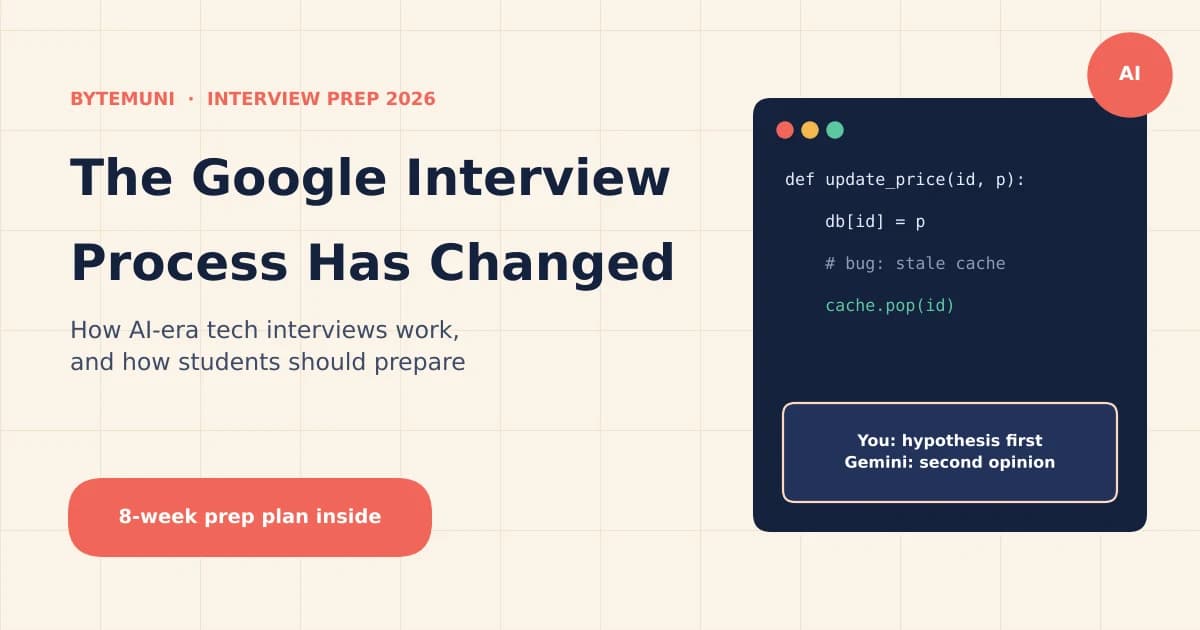
The coding interview that a whole generation of engineers prepared for is quietly being rewritten. For more than a decade, the Google interview process looked roughly the same: solve an algorithm problem on a whiteboard or in a shared doc, talk through your complexity, repeat four or five times. In 2026, that model started to crack. Google is now piloting a round where candidates work with Gemini inside an unfamiliar codebase, and it has told staff that AI fluency is a requirement for software engineering roles.
Google is not alone. Meta has run an AI-assisted coding round since late 2025, Canva expects candidates to use AI tools in interviews, and some companies are going the other way, bringing back in-person rounds so they can check the fundamentals without any AI in the room.
If you are a student or a fresher preparing for placements or your first big-tech interview, this is confusing. Should you still grind LeetCode? Should you practise with AI, or will that get you rejected? This guide explains exactly what has changed in the Google interview process, what other companies are doing, what has not changed at all, and a practical eight-week plan to prepare for the new kind of interview.
Quick note on sources. Google has confirmed the pilot and the AI-fluency requirement through a spokesperson, but it has not published a detailed public guide to the new round. Where details come from candidate reports or interview-prep companies rather than Google, this article says so.
What changed in the Google interview process in 2026?
Here is the short version of what has been reported and confirmed so far.
| Date | What happened | Source type |
|---|---|---|
| August 2025 | Sundar Pichai said Google would bring back at least one in-person interview round to make sure candidates have "the fundamentals" | Pichai on the Lex Fridman podcast, reported by Entrepreneur |
| May 2026 | Google began piloting an updated software engineering interview for entry-level and mid-level roles on select US teams, described as "human-led, AI-assisted" | Asia Economy and other reports |
| April 2026 | Google said about 75% of its new code is AI-generated and reviewed by engineers | Google statement, widely reported |
| October 20, 2026 | Business Insider, citing internal documents, reported that the new formats have spread beyond the first test groups, and that AI fluency is now a requirement for all software engineering roles | Business Insider, with comment from Google |
Google's VP of recruiting, Brian Ong, described the change this way, as reported by Business Insider: Google is "piloting updates to our interview process for software engineers, including evaluating for AI fluency."
According to Business Insider's reporting, AI fluency is now a requirement for all software engineering positions at Google.
The important word is still pilot. Google describes the changes as part of a pilot programme, even though internal documents suggest the formats have spread beyond the first test groups. As of early November 2026, not every Google team uses the new format, and not every candidate will see it. But the direction is clear, and because Google's hiring style tends to be copied across the industry, it matters even if you never apply to Google.
The new code comprehension round, explained
The biggest change in the Google interview process is a round built around reading and fixing existing code instead of writing a fresh algorithm from scratch.
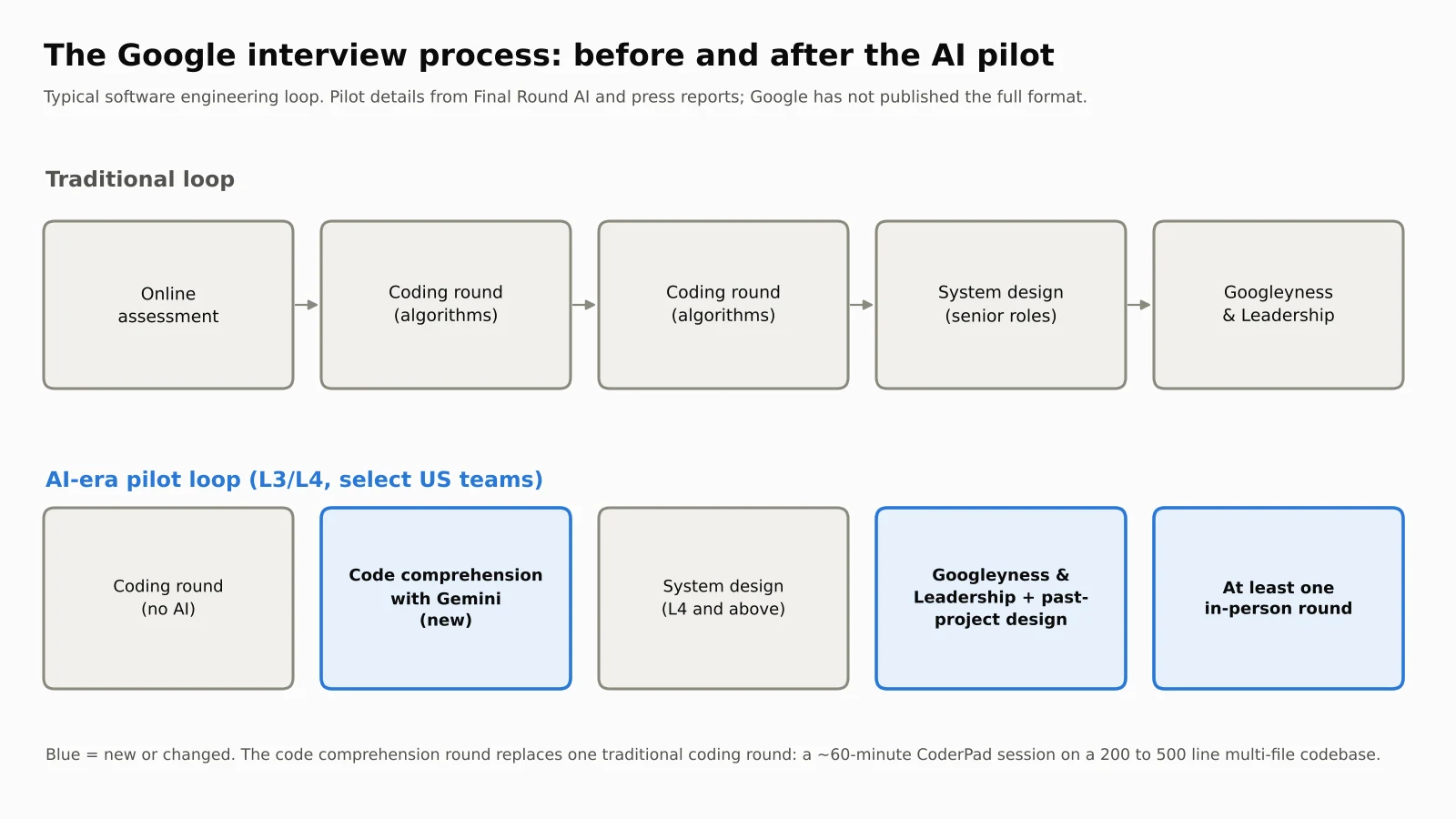
Google has confirmed the round exists and uses Gemini. The finer details below come from Final Round AI, an interview-prep company (its guide was last updated in August 2026). Google has not confirmed them, so treat them as a good guide rather than an official rulebook.
Format: a roughly 60-minute session in CoderPad with Gemini available in a side panel.
The code: a small multi-file project of about 200 to 500 lines with deliberately planted problems.
The tasks: typically fixing a bug, adding a feature and improving performance, in stages.
Who sees it: reportedly L3 and L4 (entry and mid-level) roles in the US, starting with teams in Google Cloud and Platforms & Devices.
What it replaces: one traditional coding round. Another coding round without AI, system design (for L4 and above) and the Googleyness and Leadership round reportedly remain.
Rollout: Final Round AI expects a full rollout across teams to take 12 to 18 months.
What interviewers are really looking for
This is the part most students miss. Having Gemini in the room does not mean the AI does the work. Final Round AI says that a candidate who turns to Gemini to find the bug before forming their own hypothesis is showing that they "cannot debug independently," a signal interviewers "will note negatively." Reports of the pilot say interviewers assess prompt-writing, the quality of the AI output the candidate accepts, and debugging skill.
The skills being tested are the ones a working engineer uses every day in 2026:
Code reading. Can you find your way around files you have never seen, follow the data and understand what the code is supposed to do?
Debugging. Can you form a hypothesis ("the cache isn't being cleared after a write"), test it and confirm it?
Using AI with judgement. Do you give the model a clear, specific prompt, and do you check its answer instead of pasting it in blindly?
Communication. Can you explain what you're doing and why while you do it?
Think of Gemini as a very fast junior colleague. You are still the engineer responsible for the result.
AI on the interviewer's side too
AI is changing the interviewer's side as well. According to Business Insider, one internal document describes a pilot of AI-assisted transcription and note-taking during some job interviews held on Google Meet. At the same time, Google has told employees not to build their own AI tools for hiring: "Do not use GenAI or LLMs to create your own standalone solutions or agents for hiring or interviewing use cases." In other words, a human still makes the hiring decision.
Why are companies changing technical interviews now?
Three forces are pushing the change.
1. The job itself changed. When a large share of new code is AI-generated (Google says about 75% of its new code), the hard part of engineering shifts from typing code to reviewing, debugging and integrating it. An interview that only tests writing a binary search from memory measures less of the real job than it used to.
2. Classic online assessments became easy to cheat. AI tools can solve most standard LeetCode-style problems in seconds, and some tools are marketed specifically to help candidates during live interviews. Companies have responded in two ways: let AI in openly and test how candidates use it, or keep AI out and verify skills in person.
3. Companies want "AI-native" freshers. In India, Infosys said it plans to hire 20,000 freshers in FY27, including a target of about 6,000 "frontier engineers," and CEO Salil Parekh said, "Over the next few years, AI-native talent will increasingly become the norm" (People Matters, July 2026). An opinion piece in The Week by Abhishek Agarwal of The Judge Group, a talent-services firm, cited Deloitte's Campus Workforce Trends 2026 survey: 85% of Indian companies say AI is reshaping how they hire graduates, but only 35% say it has created new entry-level roles or changed role requirements (up from 21% in FY25).
How other companies handle AI in interviews
There is no single industry rule yet. Policies range from "AI encouraged" to "AI banned unless we say otherwise," which is exactly why you must read each company's instructions.
| Company | AI in the interview? | What's reported |
|---|---|---|
| Yes, in the pilot round | Code comprehension round with Gemini; a traditional no-AI coding round reportedly remains; at least one in-person round reintroduced | |
| Meta | Yes, in one round | AI-assisted coding round piloted since October 2025, replacing one onsite coding round; a 60-minute CoderPad session with a choice of models such as GPT-5, Claude Sonnet 4.5 and Gemini 2.5 Pro; Meta's prep materials call AI use "optional" (interviewing.io) |
| Canva | Yes, expected | Candidates for ML, front-end and back-end roles are expected to use tools like Cursor, Copilot or Claude. "We want to see how well candidates collaborate with AI to solve problems" (Simon Newton, Information Age) |
| Anthropic | No, unless stated | AI encouraged for preparation and for refining an application you drafted yourself; no AI in take-homes or live interviews unless explicitly allowed (Anthropic candidate guidance) |
| McKinsey | In-person check | Requires an in-person meeting before making offers (Entrepreneur, 2025) |
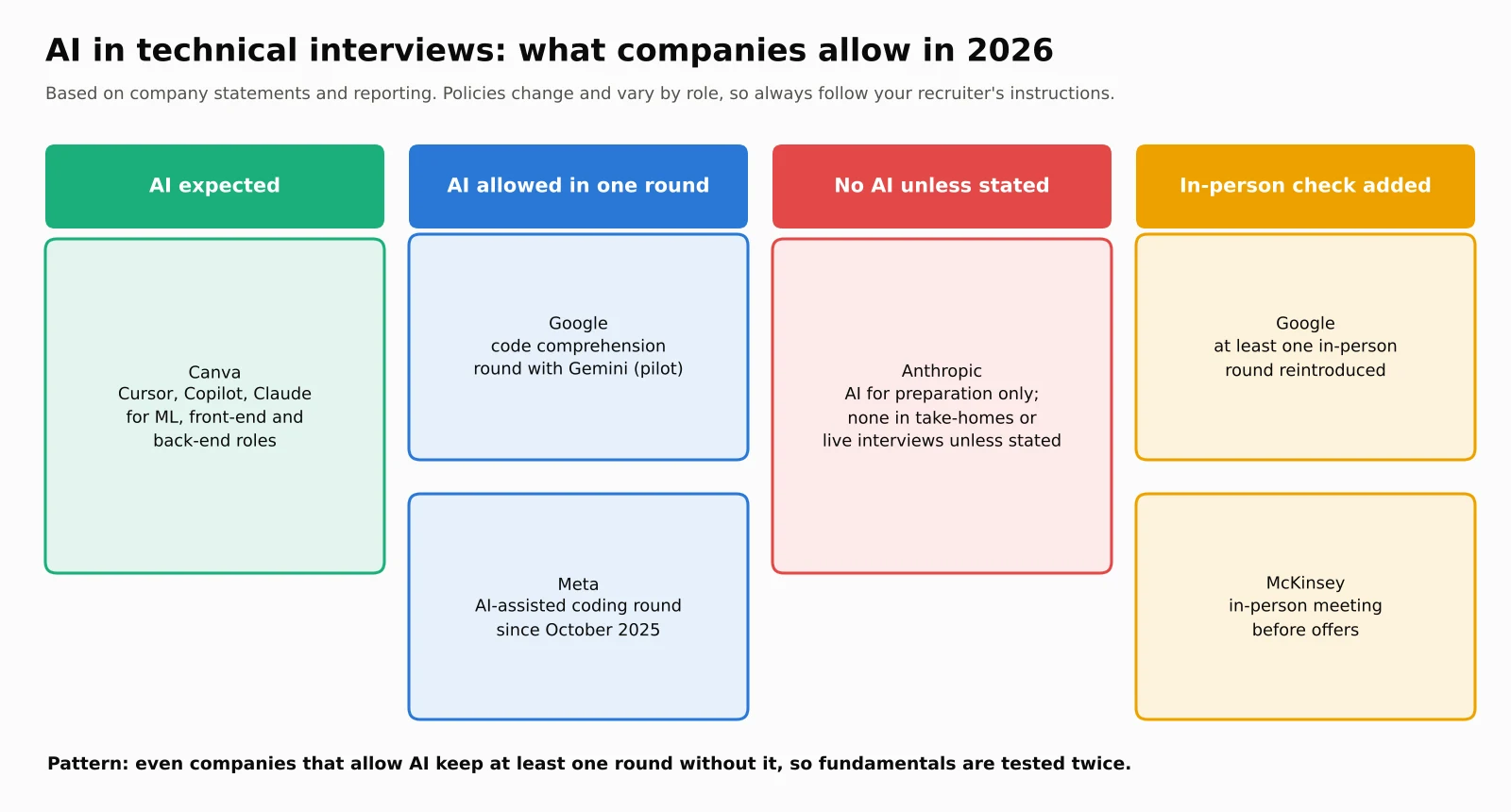
The pattern is worth noticing: even the companies that allow AI keep at least one round where you work without it. The fundamentals are now tested twice: once directly, and once through how well you supervise an AI.
What has not changed in the Google interview process
It is tempting to read the headlines and decide that data structures and algorithms (DSA) no longer matter. That would be a mistake.
DSA still matters. Google reportedly keeps a traditional coding round without AI, Pichai explicitly talked about checking "the fundamentals" in person, and most Indian campus drives still begin with an online coding test. You also cannot judge whether an AI's solution is O(n) or O(n²) if you don't understand complexity yourself.
System design still matters for mid-level and senior roles.
Behavioural rounds still matter. According to Final Round AI, Google's Googleyness and Leadership round in the pilot now includes a technical design conversation about your past work, so you need real projects you can explain in depth.
Honesty matters more than ever. Using a hidden AI tool when the rules forbid it can get you disqualified, and companies are actively looking for it.
Old vs new: how the Google interview process and tech interviews are changing
| Traditional coding interview | AI-era interview | |
|---|---|---|
| Starting point | Blank editor | Existing, unfamiliar codebase |
| Main skill tested | Writing an algorithm from memory | Reading, debugging and extending code |
| AI tools | Forbidden | Allowed in specific rounds, and use is evaluated |
| Size of problem | One function, 20 to 50 lines | Multi-file project, a few hundred lines |
| What "good" looks like | Optimal solution, clean code | Clear hypotheses, verified fixes, sensible AI use |
| Communication | Explain your approach | Explain your approach and why you trust (or reject) the AI's output |
| Fundamentals | Tested directly | Tested directly and through how you review AI code |
How students should prepare for the new Google interview process: an eight-week plan
This plan assumes you already know one programming language reasonably well (Python, Java, C++ or JavaScript). Spend about two hours a day; adjust if you have more or less time. It prepares you for both kinds of rounds, because you will almost certainly face both.
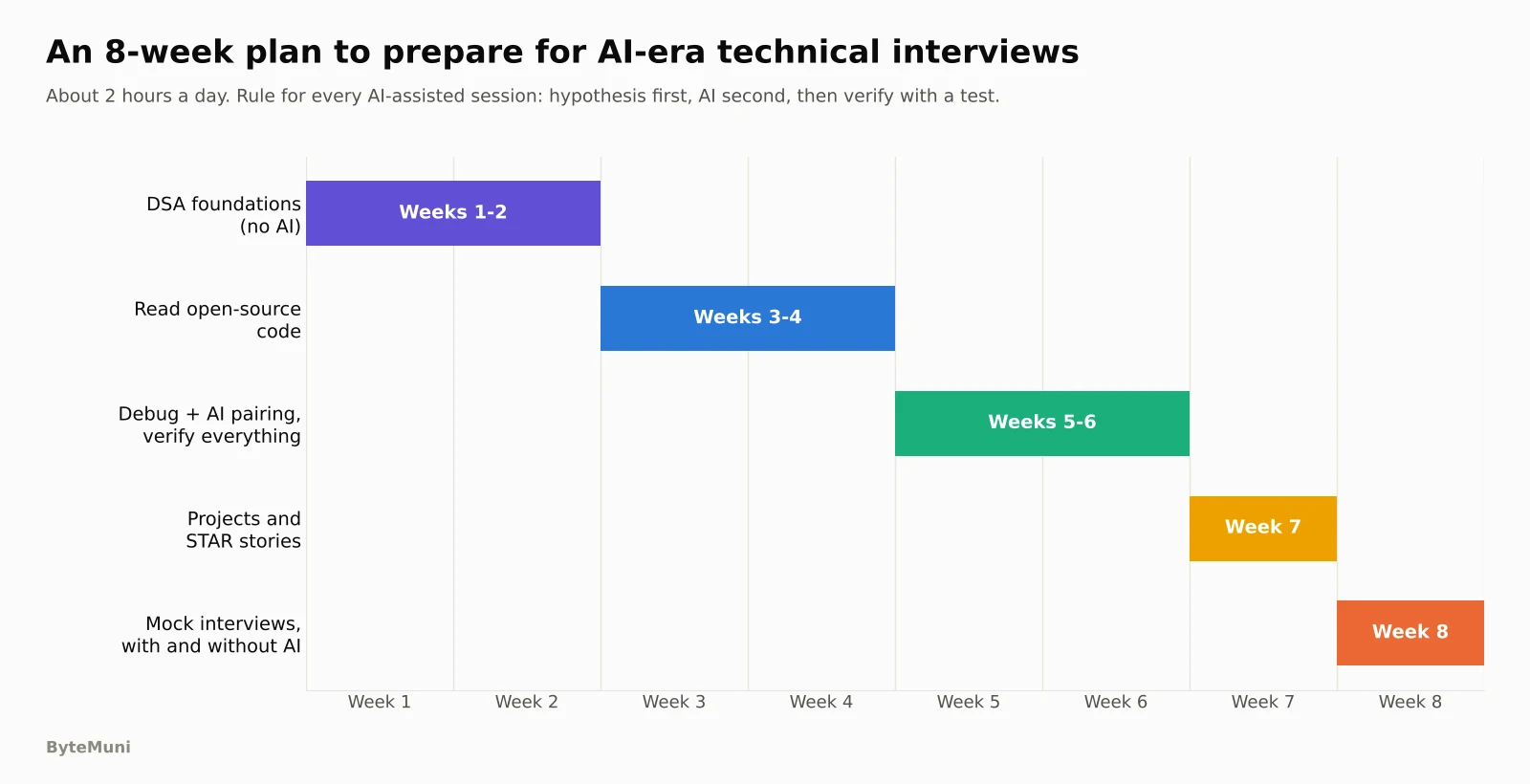
Weeks 1–2: Rebuild your DSA foundations (no AI)
Revise arrays, strings, hash maps, two pointers, sliding window, stacks, queues, trees, graphs (BFS and DFS), heaps and basic dynamic programming.
Solve 3 to 4 problems a day without any AI help, then compare your solution with others.
For every problem, say the time and space complexity out loud. This is the skill that lets you catch an AI's inefficient code later.
Weeks 3–4: Learn to read code you didn't write
This is the new muscle, and most college courses never train it.
Pick a small, active open-source project in your language (a CLI tool, a small web framework or a library with good tests).
Clone it, run the tests and draw a quick map: what are the main files, where does a request or input enter, where does data get stored?
Read three or four closed issues and the pull requests that fixed them. Try to predict the fix before you read it.
Practise explaining a file to a friend in two minutes: "This module does X, it is called by Y, and its tricky part is Z."
Weeks 5–6: Debug, then pair-program with AI (and verify everything)
Practise debugging with a method: reproduce the bug, form a hypothesis, add a print or a breakpoint, confirm, fix, then add a test.
Now bring in an AI assistant (Gemini, Copilot, Claude or similar). Use the rule "hypothesis first, AI second": write down what you think is wrong before you ask the model.
Prompt specifically. Compare "fix this" with "In
update_price, I think the cached value isn't invalidated after the database write. Can you confirm and suggest a minimal fix?"Always verify: run the code, write a test, check the edge cases. Count how often the AI is wrong or overcomplicates the fix. That number teaches you more than any tutorial.
Week 7: Projects and stories
Choose two projects you built and prepare to discuss their design: why you chose that database, what you would change now and what broke.
Prepare four or five STAR stories (Situation, Task, Action, Result) on teamwork, a mistake you fixed, a disagreement and learning something fast.
Be ready to explain how you used AI in your projects and where you didn't trust it. Interviewers increasingly ask this.
Week 8: Mock interviews in both formats
Do at least two timed mock interviews without AI, solving DSA problems while talking aloud.
Do at least two timed mock AI-assisted sessions: have a friend give you a small unfamiliar repo with a planted bug, set a 60-minute timer and use an AI assistant while narrating your reasoning.
Record yourself. Most people discover they go silent for long stretches. Practise saying what you're checking and why.
Try it yourself: a mini code comprehension exercise
Here is the kind of problem you might see, scaled down. A small service caches product prices. Users report that they sometimes see an old price for up to a minute after the price is updated. Read the code and find the bug before reading the answer.
import time

class PriceCache:
    def __init__(self, ttl_seconds=60):
        self.ttl = ttl_seconds
        self._data = {}  # product_id -> (price, stored_at)

    def get(self, product_id, loader):
        hit = self._data.get(product_id)
        if hit and time.time() - hit[1] < self.ttl:
            return hit[0]
        price = loader(product_id)
        self._data[product_id] = (price, time.time())
        return price

    def update_price(self, product_id, new_price, db):
        db[product_id] = new_price
The bug: update_price writes the new price to the database but never removes the old entry from the cache. Every reader keeps getting the stale cached price until the 60-second time-to-live (TTL) runs out.
A minimal fix: invalidate the cache entry after the write.
    def update_price(self, product_id, new_price, db):
        db[product_id] = new_price
        self._data.pop(product_id, None)  # invalidate after the write
We ran both versions. The original returned the stale price (10) after an update to 12; the fixed version returned 12 immediately while still serving repeated reads from the cache.
How a strong candidate talks through this: "The symptom is stale data for up to a minute, and the TTL is 60 seconds, so I suspect the cache. get only reloads after expiry, and update_price never touches _data. My hypothesis is missing invalidation. I'll confirm with a quick test, then fix it. A follow-up question I'd raise is whether multiple servers share this cache, because then we'd need a shared cache or an invalidation message."
Notice what impresses an interviewer here: linking the symptom (one minute) to the cause (60-second TTL), a testable hypothesis, a minimal fix and a sensible follow-up question. An AI could have spotted the bug, but you need to be able to recognise when it is right.
Common mistakes in AI-assisted interviews
Prompting before thinking. Asking the AI to "find the bug" in the first minute signals that you can't do it yourself.
Pasting without reading. If the AI's change breaks another file, it's your mistake, not the model's.
Going silent. Interviewers can't grade reasoning they can't hear.
Rewriting everything. In an existing codebase, small, safe, tested changes usually beat a clever rewrite.
Ignoring the rules. Some rounds allow AI, many don't. Using AI where it is forbidden is cheating, and can get you rejected even if you solve the problem.
A note for Indian students and freshers
Most Indian campus hiring still starts with an aptitude test and an online coding round, and those rounds usually ban AI and increasingly use proctoring. So, for placements in 2026 and 2027, strong DSA and core subjects (operating systems, DBMS, computer networks and OOP) remain your entry ticket.
What is changing is what happens after that. Product companies and global capability centres are adding project discussions, debugging tasks and questions about how you use AI tools, and large IT services firms are creating higher-paid tracks for AI-skilled freshers. Infosys's "frontier engineer" target is one example. A GitHub profile showing that you can read, fix and improve real code, plus honest notes on how you used AI, is becoming a real differentiator.
To brush up on the vocabulary interviewers now expect, start with ByteMuni's guide to AI terms every student should know and our list of AI interview questions and answers for 2026. If you're targeting AI roles specifically, practise with our generative AI interview questions. To get comfortable pair-programming with an assistant, our walkthrough of GitHub Copilot in VS Code is a good place to start, and our explainer on how AI agents work covers the agent concepts that come up in AI-fluency questions.
Our take
The headline "Google lets candidates use AI in interviews" makes it sound as if the Google interview process is getting easier. It isn't. They are getting closer to the real job. The candidates who will do best are not the ones who memorised the most problems or the ones who prompt the fastest, but the ones who can open an unfamiliar codebase, think clearly, use AI as a tool and stand behind every line they submit.
For students, the good news is that these skills are learnable and cheap to practise: a laptop, a few open-source repos and an AI assistant are enough. Keep your fundamentals sharp, learn to read code, and treat AI as a colleague you check, not an answer key you copy.
Sources
Yahoo Finance: Google will let candidates use AI in interviews
Final Round AI: Google code comprehension interview guide (third-party, updated August 17, 2026)
interviewing.io: How to use AI in Meta's AI-assisted coding interview
Information Age: Canva insists job applicants use AI coding in interviews (2025)
Entrepreneur: Google and McKinsey bring back in-person job interviews (August 2025)
People Matters: Infosys reaffirms plan to hire 20,000 freshers in FY27
Frequently asked questions
Has the Google interview process changed for all candidates?
No. As of November 2026, the code comprehension round with Gemini is still a pilot that has spread across teams in phases, and many candidates still get the traditional format. Business Insider reports that AI fluency is now required for all of Google's software engineering roles.
Can I use AI in a Google interview?
Only in rounds where Google explicitly allows it, such as the code comprehension round in the pilot. Other rounds, including at least one traditional coding round, are reportedly done without AI. Always follow your recruiter's instructions.
Is LeetCode still useful in 2026?
Yes. Traditional coding rounds still exist at Google, Meta and most Indian campus drives, and you need DSA knowledge to judge whether AI-generated code is correct and efficient. Balance it with practice reading and debugging real codebases.
What does "AI fluency" mean in an interview?
It means using AI tools effectively and responsibly: writing clear prompts, breaking problems into steps, checking the output, spotting mistakes and knowing when not to rely on AI. It does not mean letting the AI solve the problem for you.
How should a fresher prepare for an AI-assisted coding interview?
Strengthen DSA without AI, practise reading open-source code, learn a structured debugging method, then practise with an AI assistant using a "hypothesis first, AI second" rule. Finish with timed mock interviews both with and without AI while explaining your reasoning aloud.
Will AI interviews make it easier to get hired?
Not necessarily. The bar moves rather than drops. You are judged on judgement and communication as well as code, and some companies have added in-person rounds to confirm candidates' fundamentals.
How we research, write and check articles