Quantum Computing Explained: How It Works, Real Use Cases and the Latest News (2026)
Quantum computing isn't a faster laptop, and it doesn't try every answer at once. This deep but easy guide explains qubits, superposition, entanglement and interference with a hands-on simulation. It then covers real use cases with an honest status for each, what the new 22,593-qubit RSA-2048 estimate and NIST's final 2030–2035 deadlines mean for encryption, and the latest quantum news from October 2026.

Quantum computing gets described in two ways that are both wrong. One version says it's a magic machine that tries every answer at once and will soon replace your laptop. The other says it's permanent hype that never ships anything. The truth sits in an interesting middle: quantum computers are real, they're improving quickly, and they're useful today only for a narrow set of scientific problems. Within a few years, they could break the encryption that protects most of the internet.
This guide explains quantum computing from the ground up, in plain language, and then goes deeper than most explainers do. I built a tiny quantum simulator to show the key ideas with real numbers, and I've pulled together the most important news up to October 30, 2026. Here's what we'll cover:
what a qubit is, and the four ideas that make quantum computers different
the biggest myth about quantum computing, tested with code
why errors are the whole game, and how error correction changes it
real use cases, with an honest status for each one
what quantum means for encryption, including this week's RSA-2048 estimate and NIST's final deadlines
the latest news, and how a developer can start learning today
What is quantum computing?
IBM defines quantum computing as "an emergent field of computer science and engineering that harnesses the unique qualities of quantum mechanics to solve problems beyond the ability of even the most powerful classical computers."
The important word there is certain. A quantum computer isn't a faster version of a normal computer. It's a different kind of machine that's dramatically better at a small family of problems and worse at almost everything else. NIST puts it clearly: quantum computers "will not replace our familiar 'classical' computers." The two will work together, with the quantum machine acting more like a specialist co-processor, the way a GPU handles graphics or AI work today.
IBM says quantum computers are expected to be useful for two broad kinds of tasks: modeling physical systems (molecules, materials, chemical reactions) and finding patterns and structure in information. Everything else in this guide flows from those two ideas.
Bits vs qubits: the easy explanation
Every normal computer, from your phone to the biggest supercomputer, stores information in bits. A bit is either 0 or 1, like a light switch that's either off or on. NIST notes that a computer usually stores the letter "A" as the bit string 01000001.
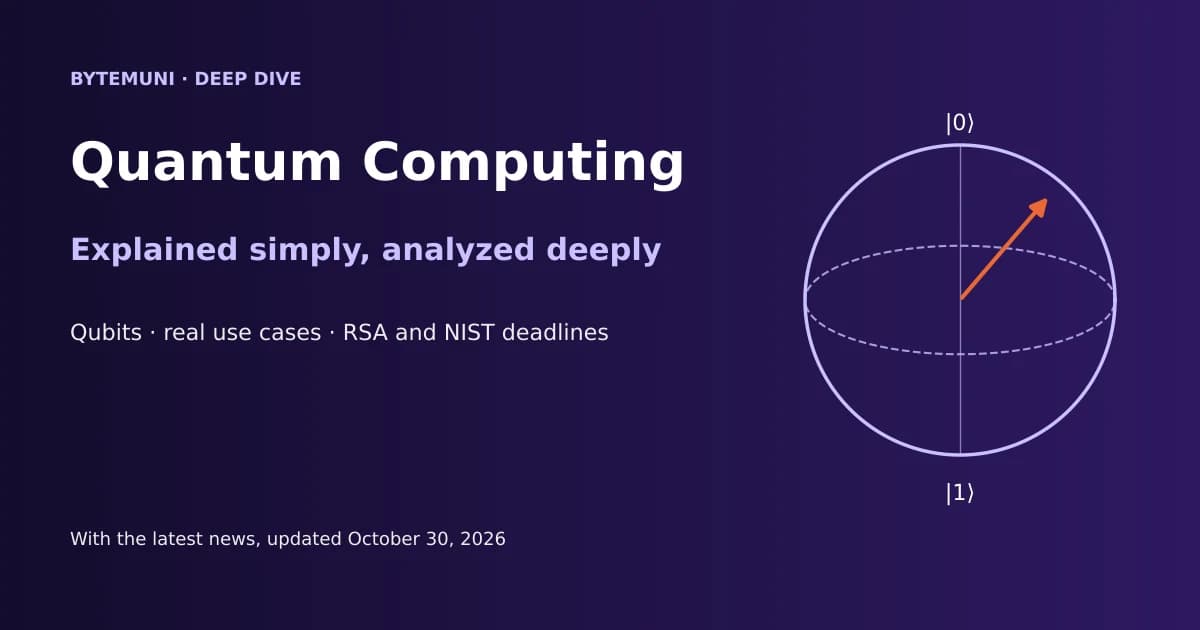
A qubit (quantum bit) can be 0, 1, or a weighted mix of both at the same time. NIST uses a nice analogy. Picture a person on a ladder: they stand on exactly one rung. A tiny object like an atom can behave as if it's on the lowest and highest rungs at once. That mixed state is called superposition. When you measure the qubit, it "collapses" to a plain 0 or 1, at random, with probabilities set by that mix.
Here's where the scale gets interesting. Two qubits can hold a superposition of all four combinations (00, 01, 10, 11). Three qubits hold eight. Each extra qubit doubles the count, so 100 qubits describe about 1.3 × 10^30 combinations, a number with 31 digits. That exponential growth is the raw material of quantum computing.
The four ideas you need
IBM lists four principles that explain how quantum computers work. Here they are without the jargon:
| Principle | Plain-English meaning | Everyday comparison |
|---|---|---|
| Superposition | A qubit can hold a mix of 0 and 1 until it's measured | A spinning coin that's neither heads nor tails until it lands |
| Entanglement | Qubits can be linked so their results are correlated, however far apart | Two "magic coins" that always land showing opposite faces |
| Interference | Possible outcomes act like waves that can strengthen or cancel each other | Noise-cancelling headphones removing sound you don't want |
| Decoherence | Outside noise destroys the quantum state and turns qubits into ordinary bits | A soap bubble popping when anything touches it |
IBM calls interference "the engine of quantum computing." That's the idea most explainers skip, and it's the key to the biggest myth.
The biggest myth: "it tries every answer at once"
You'll often read that a quantum computer checks every possible answer in parallel. It doesn't, at least not in any useful sense. Stephen Jordan, a Google quantum computing researcher and longtime NIST staff member, explained it to NIST like this:
"Different computations can indeed be done in superposition, achieving a kind of parallel computing. But contrary to popular belief, this doesn't allow quantum computers to do an efficient 'brute force' search over all the potential solutions."
The catch is measurement. When you read the qubits at the end, you get just one result. If every answer were equally likely, you'd get a random guess. Jordan says the real skill is to "design the measurement so that it extracts useful information about the whole set of results." Quantum algorithms do that with interference: they make wrong answers cancel out and the right answer grow louder before you measure.
I tested it with a tiny simulator
To make this concrete, I wrote a small quantum simulator in Python with NumPy (no quantum hardware or special library needed) and ran two classic experiments.
Experiment 1: an entangled pair. I put one qubit in superposition and entangled it with a second qubit, which creates what physicists call a Bell state. Then I measured the pair 10,000 times. The result: 00 came up 4,983 times, 11 came up 5,017 times, and 01 and 10 never appeared. Each qubit on its own looked like a fair coin flip, but the two always agreed. That's entanglement in action.
Experiment 2: Grover's search. Grover's algorithm finds one marked item in an unsorted list. I hid one "answer" among 8 possibilities (3 qubits) and among 1,024 possibilities (10 qubits). Each round of the algorithm does two things: an "oracle" flips the sign of the right answer, and a "diffusion" step reflects every amplitude around the average. That combination is interference doing the work.
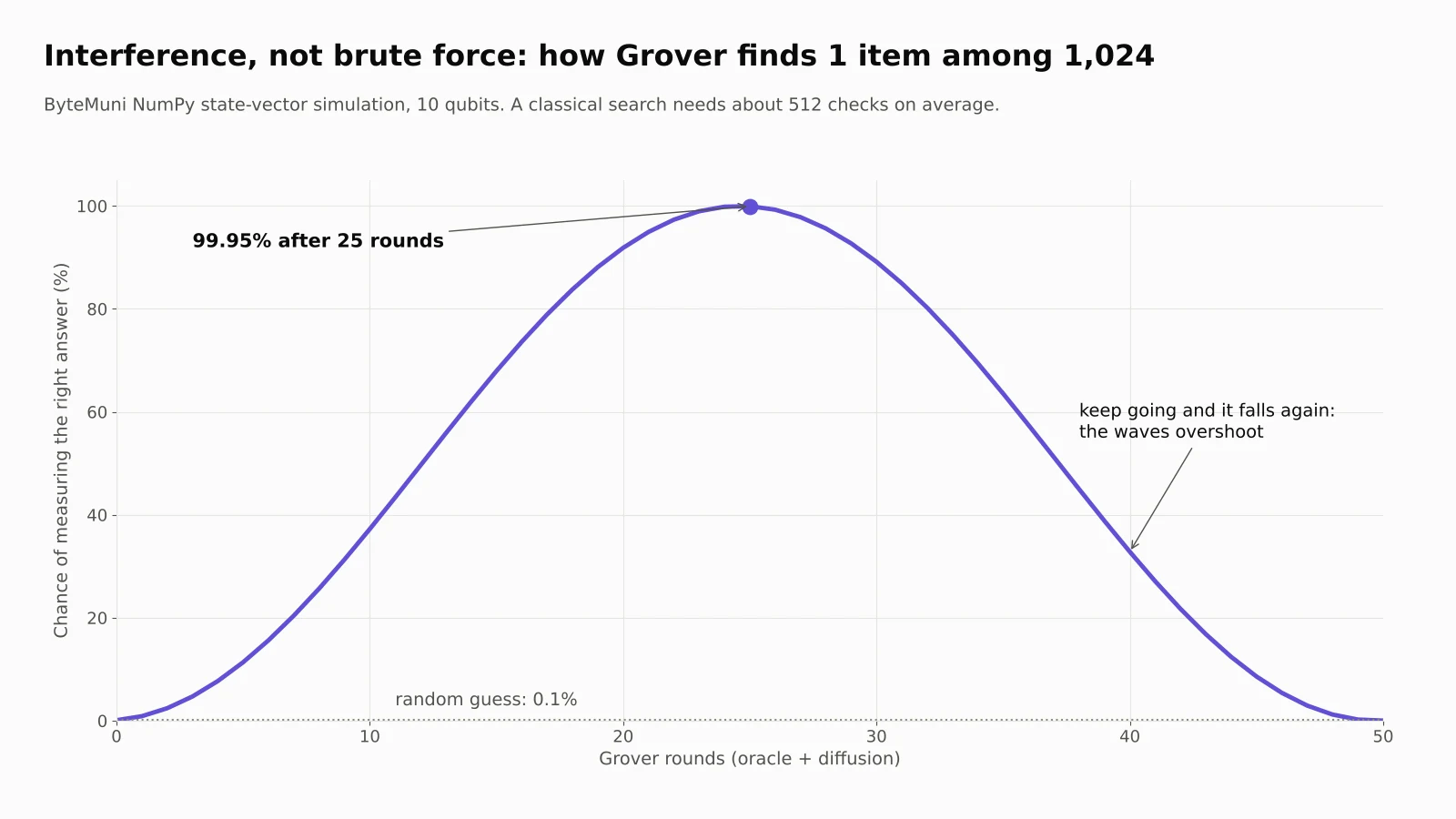
Here's what came out:
With 8 items, the chance of measuring the right answer started at 12.5% (a random guess), rose to 78.1% after one round and 94.5% after two.
With 1,024 items, it started at about 0.1% and peaked at 99.95% after 25 rounds, matching the theoretical optimum of about 25. A classical search would need about 512 checks on average.
The most surprising part: if you keep going, it gets worse. With 8 items, the third round dropped the chance to 33%. The waves overshoot, so the algorithm has to stop at the right moment.
That last point shows why quantum computing isn't magic parallelism. It's a carefully choreographed wave pattern. Grover gives a square-root speedup (about 25 steps instead of 512 here), which helps but isn't exponential. The truly dramatic speedups, like Shor's algorithm for factoring, exist only for problems with special mathematical structure.
Why normal computers can't just fake it
If I can simulate qubits on my laptop, why build quantum computers at all? Because simulating them gets impossibly expensive, fast.
A full simulation stores one complex number for every possible combination of the qubits. At 16 bytes per number, my 10-qubit Grover run needed just 16 KB. Here's what happens as you add qubits:
| Qubits | Memory to store the full quantum state |
|---|---|
| 10 | 16 KB |
| 20 | 16 MB |
| 30 | 16 GB (a gaming laptop) |
| 40 | 16 TB (a server rack) |
| 50 | 16 PB (beyond almost any supercomputer's memory) |
| 60 | 16 EB (more than any machine on Earth) |
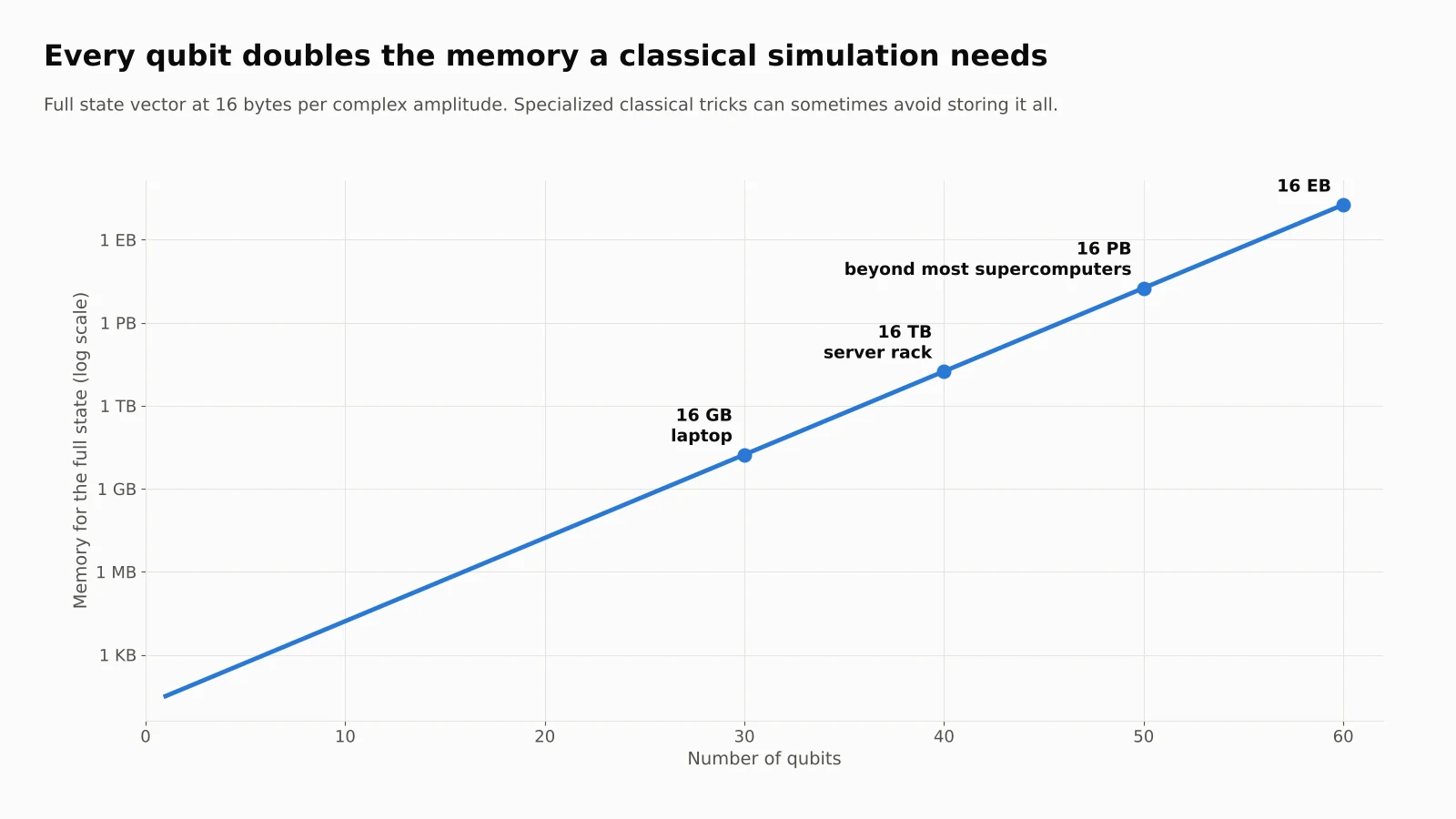
Every added qubit doubles the memory. This is why physicist Richard Feynman, in a 1981 talk on "simulating physics with computers" that's often credited with launching the field, pointed toward computers built from quantum parts themselves. As IBM puts it, a quantum computer "doesn't need to crunch the numbers. It can mimic the molecular system directly."
One honest caveat: clever classical methods can sometimes simulate specific quantum circuits without storing the full state. That's why several past "quantum advantage" claims were later matched by classical computers, as NIST physicist Scott Glancy notes.
How a quantum computer is actually built
There's no single way to make a qubit. NIST lists several leading approaches, each with trade-offs:
| Qubit type | How it works | Strength | Weakness | Who's using it |
|---|---|---|---|---|
| Superconducting | Tiny circuits cooled near absolute zero | Fast, built with chip-making methods | Fragile, short-lived states | IBM, Google, Rigetti, Alice & Bob |
| Trapped ion | Charged atoms held by electromagnetic fields | Long-lived states, high accuracy | Slower operations | Quantinuum, IonQ |
| Neutral atom | Uncharged atoms held by laser light | Large arrays of qubits | Still maturing | QuEra, Pasqal, Atom Computing |
| Photonic | Particles of light | Works for networking, near room temperature parts | Hard to make photons interact | PsiQuantum, Xanadu |
| Semiconductor spin | Electrons trapped in silicon | Could reuse chip factories | Early stage | Diraq, Intel |
| Topological | Information stored in "braided" quasiparticles | Built-in error protection, in theory | NIST says not yet definitively created | Microsoft |
The superconducting machines are extreme. IBM says its processors run at roughly a hundredth of a degree above absolute zero, colder than outer space, and the full system with cooling and control electronics is about the size of a car. That's why nearly everyone uses quantum computers through the cloud.
Errors are the whole game
This is the single most important thing to understand about quantum computing in 2026. According to NIST, today's best quantum computers have hundreds of qubits and make an error roughly once in every thousand operations. A classical computer makes about one error per quintillion (10^18) operations.
Useful algorithms need millions or billions of operations. So the real race isn't about qubit counts. It's about quantum error correction: spreading one reliable "logical qubit" across many noisy physical qubits, so errors can be detected and fixed faster than they pile up.
Error correction only helps once hardware is good enough, a point called "below threshold." Above it, adding qubits adds more errors than it fixes. Below it, bigger codes make the logical qubit more reliable. Google reported crossing that line in December 2024 with its 105-qubit Willow chip, a result widely seen as a turning point.
The pace since then has been fast:
Google, October 15, 2026: In a paper in Science, Google reported "magic state cultivation" on Willow. Magic states are special ingredients that error-corrected computers need for a full set of operations, and making them was expected to eat much of a future machine's resources. Google reported a 40-fold error reduction and a state fidelity of at least 99.99%, while keeping 8% of attempts.
IBM, November 2025 onward: IBM introduced Loon, an experimental chip for testing its qLDPC error-correction approach, and reported decoding errors in real time in under 480 nanoseconds. In August 2026 it connected two cryogenic modules, a step toward Starling, its planned fault-tolerant machine with 200 logical qubits and 100 million operations by 2029.
Microsoft, June 2026: Microsoft reported an improved topological qubit design it calls Majorana 2, with a 20-second parity lifetime, up from milliseconds on Majorana 1. Microsoft says it used its own AI tool to help find the materials. These are company-reported results, and the topological approach remains debated among physicists.
Quantum utility vs quantum advantage
You'll see these terms in every headline, and they mean different things:
Quantum utility (IBM's term): A quantum computer gives reliable answers to problems beyond brute-force classical simulation. It doesn't have to beat every classical method. IBM says it first showed utility in 2023.
Quantum advantage: A quantum computer solves a problem "better, faster, or cheaper" than all known classical methods. IBM has said it expects the first advantages by the end of 2026.
Quantum economic advantage (MIT's term): The quantum computer must beat a comparably priced classical computer. This is the one businesses should care about.
That MIT idea comes from the paper "The Quantum Tortoise and the Classical Hare" by Neil Thompson, Sukwoong Choi and William S. Moses. Classical computers (the hare) run each step far faster. Quantum computers (the tortoise) are slower per step but can take a shorter route through some problems. "If the race is short, it might not be worth investing in better route planning," Thompson said. "For it to be worth it, it has to be a longer race." Their conclusion is blunt: small and medium problems, which are most business problems, won't benefit. "Quantum computing is not going to be better for everything, just for some things."
Where advantage claims stand right now
Google, October 2025: Google's "Quantum Echoes" result in Nature ran a calculation on 65 of Willow's qubits about 13,000 times faster than the Frontier supercomputer, by Google's estimate. MIT's Aram Harrow and UT Austin's Scott Aaronson, who weren't involved, gave it cautious credit. Aaronson called it "a decent candidate" for verifiable advantage, but noted it can only be checked efficiently by another quantum computer.
IBM, July 2026: IBM said it ran three quantum advantage demonstrations with partners, including the University of Chicago, Algorithmiq and Qedma, and posted circuits to an open Quantum Advantage Tracker. As of late October, the tracker still lists them as candidates needing more benchmarking.
BlueQubit, October 28, 2026: BlueQubit, working with EPFL and the XPRIZE Foundation, reported quantum advantage in random circuit sampling using 61 qubits on IBM hardware.
My read: advantage claims are now arriving regularly, but none is yet both community-confirmed and commercially useful. That's the milestone to watch for.
Real use cases, with an honest status
Here's where quantum computing is expected to help, and where each area actually stands in late 2026.
| Use case | Why quantum helps | Real example | Status |
|---|---|---|---|
| Chemistry and materials | Molecules follow quantum rules, so quantum hardware can model them directly | Quantinuum and GE Vernova are using the Helios system to model high-temperature superconductivity (October 2026) | Research stage; the most promising near-term area |
| Drug discovery | Simulating how drug molecules bind to proteins | Google's Quantum Echoes preprint measured molecular structure, matching lab NMR but not yet beating classical methods | Early research |
| Optimization | Finding the best route, schedule or grid layout among huge numbers of options | EPB and IonQ ran hybrid algorithms for power grid optimization, funded by a $4 million NIST grant | Pilots; classical methods are still very strong |
| Finance | Risk modeling, portfolio optimization, fraud patterns | Banks run pilots; Gartner expects banking to overtake the public sector in quantum spending in 2028 | Experiments |
| AI and machine learning | Possibly new ways to find structure in data | A 39-author white paper (arXiv 2505.23860) maps the research agenda | Mostly theoretical |
| Breaking encryption | Shor's algorithm factors large numbers exponentially faster | Resource estimates keep shrinking (see below) | Not possible yet; the migration is urgent |
| Quantum networks | Physics-based secure key exchange | IonQ linked Geneva and Seoul with a network combining quantum key distribution and post-quantum cryptography (October 2026) | Early deployments |
The US government is betting on the science side. In October 2026, the White House highlighted the Department of Energy's Quantum Genesis Priority Applications: eight scientific problems in chemistry, materials, plasma physics and high-energy physics. The stated goal is fault-tolerant, scientifically relevant quantum computers by 2028.
Quantum computing and AI: a two-way street
The arXiv paper you'll see cited most often on this topic is "Quantum computing and artificial intelligence: status and perspectives" (arXiv 2505.23860), a white paper by 39 researchers, including Jens Eisert, Florian Marquardt and Frank K. Wilhelm. It contains no new experiments. Its value is the map. It looks at the relationship in both directions:
Quantum for AI: whether quantum computers could support new AI methods. This is still mostly theoretical, and the paper treats it as a long-term research agenda rather than a near-term product.
AI for quantum: using classical AI to build better quantum computers and quantum sensors. This is already happening.
The second direction is the practical one in 2026. Error correction needs a fast "decoder" that reads error signals and decides what to fix within microseconds, and AI models are increasingly doing that job. Late October news alone included a Mamba-based decoder from Yonsei University and a graph neural network decoder from the University of Gothenburg and Chalmers. Microsoft says AI helped it find materials for Majorana 2. The paper also recommends counting energy use in resource estimates and treating "quantum AI" as an emerging hybrid software engineering discipline.
If you're following how AI is reshaping engineering more broadly, our explainer on how agentic AI works covers the same trend from the software side.
What quantum computing means for encryption
This is the use case that turned quantum computing into a national security issue. In 1994, Peter Shor showed that a large enough quantum computer could factor huge numbers quickly. RSA and elliptic-curve cryptography, which protect HTTPS, banking, email and digital signatures, depend on that being hard. If you want to see how a different kind of cryptography works, our guide to SHA-256 and how hashing works is a good companion. Hash functions like SHA-256 are far less exposed to Shor's algorithm than RSA is.
The scary part isn't the machine that exists today. It's how fast the estimate of the required machine keeps falling:
2019: Craig Gidney and Martin Ekerå estimated about 20 million noisy qubits to factor RSA-2048 in about eight hours.
May 2025: Gidney, at Google Quantum AI, cut that to fewer than one million noisy qubits in under a week, about 95% fewer.
October 28, 2026: Alice & Bob researchers estimated 22,593 cat qubits could factor RSA-2048 in 3.14 days, in a paper on the IACR ePrint archive.
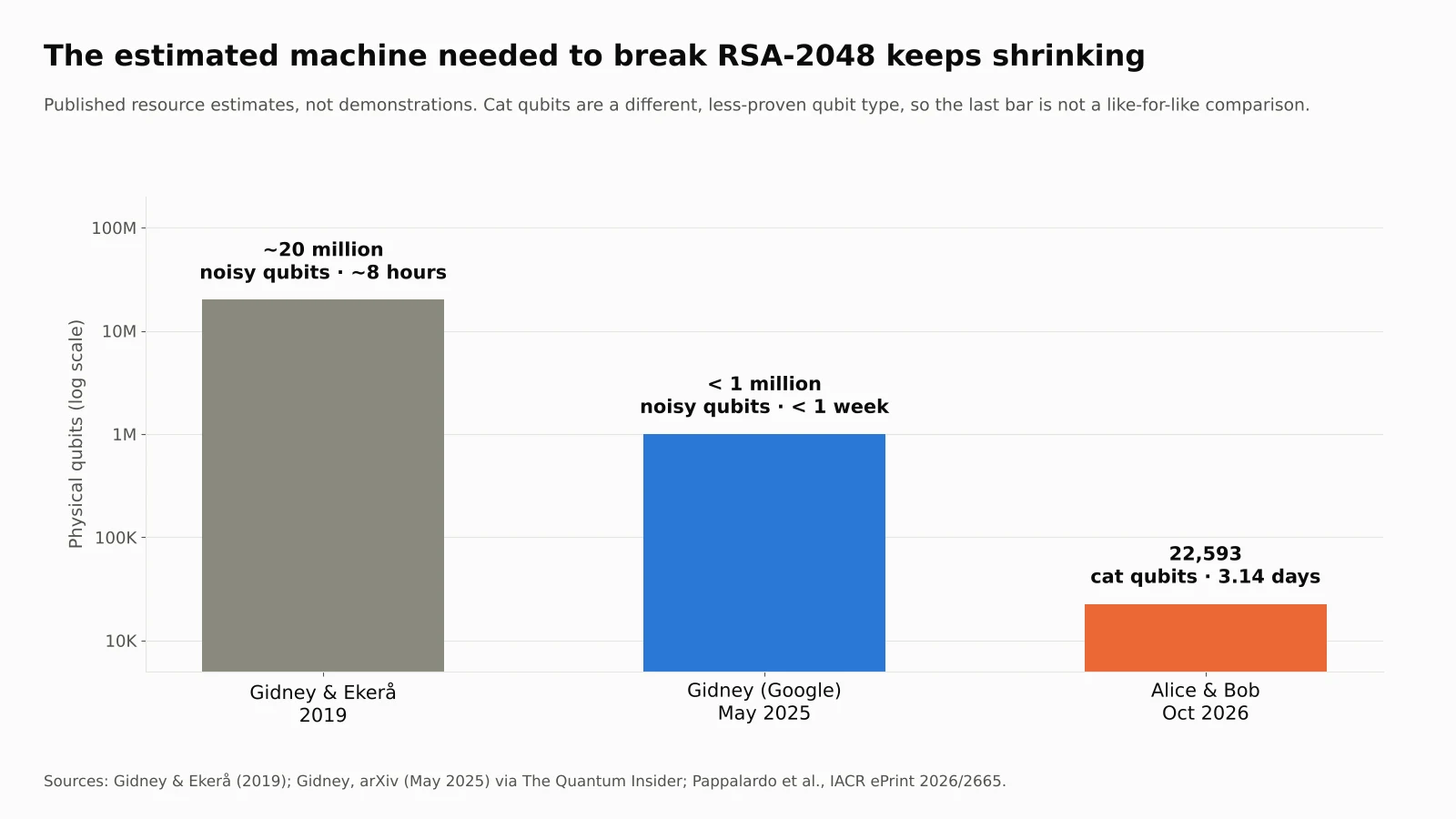
That last number needs careful reading, and it's not an apples-to-apples comparison. Cat qubits are a special superconducting design where one kind of error (bit-flips) is strongly suppressed. The estimate assumes no bit-flips during the whole computation, about a 100-year bit-flip time per qubit, plus a phase-flip probability of 5×10⁻⁴ per operation and a 1-microsecond error-correction cycle. None of that has been demonstrated at scale. TrickyWorld has a detailed breakdown of why the 22,593-qubit RSA-2048 estimate isn't a break, including the hardware gap and the Bitcoin key estimate.
The same paper estimates at most 30,000 cat qubits and about an hour to recover a Bitcoin-style elliptic-curve private key from its public key. Again, that's a projection on hardware that doesn't exist yet.
Harvest now, decrypt later
Why worry before the machine exists? Because attackers can record encrypted traffic today and decrypt it once a capable quantum computer arrives. Anything that must stay secret for 10 or more years, such as health records, state secrets or long-term financial data, is already at risk.
NIST just set the deadlines
On October 27, 2026, NIST released the final version of NIST IR 8547, "Transition to Post-Quantum Cryptography Standards." According to Quantum Computing Report's summary:
December 31, 2030: US federal high-value and high-impact systems must move key establishment to post-quantum cryptography.
December 31, 2031: the same systems must move digital signatures.
December 31, 2035: RSA, Diffie-Hellman, ECDH, ECDSA and EdDSA become disallowed.
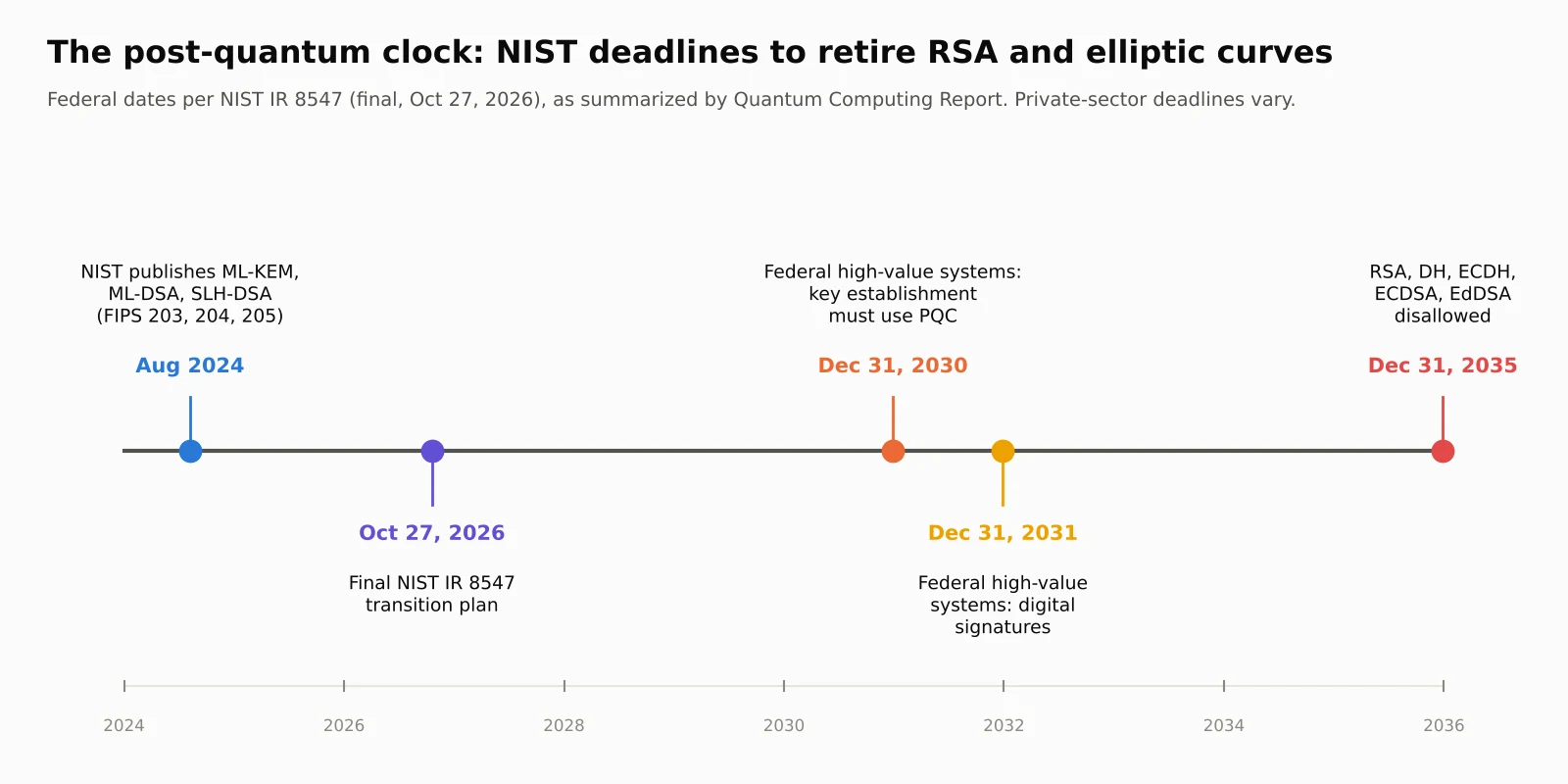
The replacements are already standardized: ML-KEM (FIPS 203) for key exchange, with ML-KEM-768 as the default, plus ML-DSA (FIPS 204) and SLH-DSA (FIPS 205) for signatures. AES and SHA-2 remain approved. A US GAO report in October found federal agencies haven't fully prepared, which tells you how big this migration is.
What developers should do now
You don't need to understand qubits to act on this. You need to know where your cryptography lives:
Inventory it. Find every place your systems use RSA or elliptic-curve keys: TLS, VPNs, SSH, code signing, JWTs, payment integrations.
Prioritize by lifetime. Data that must stay secret for years, and signatures that must stay trustworthy for years, go first.
Use hybrid modes. Modern TLS libraries and browsers already support hybrid key exchange that combines a classical algorithm with ML-KEM.
Build crypto-agility. Make algorithms configurable so the next change doesn't need a rewrite.
Regulated industries will feel this first. Our look at AI adoption in regulated systems covers the same compliance pressures banks and healthcare teams face.
Latest quantum computing news (October 2026)
A quick roundup of the developments that matter, newest first:
October 28: Alice & Bob published its 22,593-cat-qubit RSA-2048 estimate. BlueQubit reported a 61-qubit random circuit sampling advantage on IBM hardware. PsiQuantum unveiled an 8×8 optical switch for AI cluster interconnects, built from its quantum photonics work.
October 27: NIST finalized IR 8547 with its 2030, 2031 and 2035 deadlines. IBM showed meter-scale "L-couplers" linking two 120-qubit processors at 99% state-transfer fidelity. IonQ linked Geneva and Seoul with a hybrid QKD and post-quantum network.
October 15: Google published its magic state cultivation result on Willow in Science.
Early October: DARPA's Quantum Benchmarking Initiative moved Atom Computing, Diraq, IBM and IonQ to Stage C, its final verification phase, joining Microsoft and PsiQuantum. Neutral-atom startup Oratomic raised $475 million at a $5.4 billion valuation, per the Wall Street Journal.
October 8: Gartner projected global quantum computing revenue rising from about $870 million in 2026 to $1.1 billion in 2027, and warned that more than half of startups may exit by 2030 if they don't reach fault tolerance.
That Gartner number is worth comparing with IBM's own estimate that quantum could become a $1.3 trillion industry by 2035. The gap between today's roughly $1 billion in revenue and those long-range forecasts is a good measure of how much is still a bet.
How developers can start learning quantum computing
You don't need a physics degree or a lab:
Learn the math basics: vectors, complex numbers and matrix multiplication cover most of what beginner quantum algorithms need.
Simulate first: a short NumPy script like mine runs Bell states and Grover's search on any laptop. It's the fastest way to build intuition.
Use an SDK: IBM's open-source Qiskit is the most widely used, and IBM says it has over 600,000 registered users. Google's Cirq and Amazon Braket are alternatives.
Run on real hardware: IBM, Amazon, Microsoft and others offer cloud access to real quantum processors, and some offer a limited free tier for beginners.
Learn post-quantum crypto: for most working developers, this is the quantum skill that pays off first.
My take
After going through all of this, here's how I'd sum it up for a developer or tech leader.
Quantum computing is no longer a question of "if." Error correction now works below threshold, companies are posting advantage candidates for public scrutiny, and governments are funding it seriously. But useful quantum computing will arrive one narrow problem at a time, mostly in chemistry and materials science, and almost always alongside classical supercomputers. Most business problems will stay on normal computers for the foreseeable future, exactly as the MIT framework predicts.
The one part that can't wait is cryptography. You don't need to predict the year a quantum computer breaks RSA. You only need to notice two things: the estimates keep falling, and replacing cryptography across an organization takes years. NIST has now put dates on the calendar. Start the inventory.
The bottom line
Quantum computing uses superposition, entanglement and interference to solve certain problems that normal computers can't handle in any reasonable time. It isn't a faster laptop, it doesn't try every answer at once, and today's machines still make far too many errors for most real work. The field is moving fast, though, from Google's 99.99% magic states to IBM's 2029 fault-tolerance target. The clearest action for anyone in tech right now is to begin the post-quantum cryptography migration while there's still time to do it calmly.
Sources:
What is quantum computing?, IBM Think, updated April 2, 2026
Quantum computing: What leaders need to know now, MIT Sloan, January 11, 2024
Quantum computing and artificial intelligence: status and perspectives, arXiv 2505.23860, 2025
Shor's algorithm compiled on cat qubits: 22 593 qubits for RSA-2048 in 3.14 days, IACR ePrint 2026/2665, October 28, 2026
RSA-2048 quantum estimate: 22,593 qubits, not a break, TrickyWorld, October 30, 2026
NIST releases final IR 8547, Quantum Computing Report, October 27, 2026
NIST report provides guidelines for transition to post-quantum cryptography standards, The Quantum Insider
Google researcher lowers quantum bar to crack RSA encryption, The Quantum Insider, May 24, 2025
Google shows magic state cultivation on Willow, Quantum Timeline, citing Science, October 15, 2026
Quantum "echoes" reveal the potential of Google's quantum computer, Science News, October 22, 2025
IBM unveils Nighthawk and Loon, PostQuantum
IBM quantum scorecard: Q3 2026, The Quantum Investor's Notebook
Microsoft announces an improved Majorana qubit design, via Quantum Computing Report, June 2, 2026
Quantum Computing Report news, October 26–28, 2026
Quantum Computing Weekly Round-Up: week ending October 10, 2026, The Qubit Report
Frequently asked questions
What is quantum computing in simple words?
Quantum computing is a way of processing information using qubits, which can hold a mix of 0 and 1 at the same time and can be linked through entanglement. By making wrong answers cancel out through interference, quantum computers can solve certain problems, like simulating molecules or factoring large numbers, far faster than normal computers.
Will quantum computers replace normal computers?
No. NIST says quantum computers "will not replace our familiar 'classical' computers." They'll act as specialist co-processors, usually accessed through the cloud, working with classical supercomputers on a narrow set of hard problems.
What is quantum computing used for today?
Mostly research: simulating molecules and materials, testing optimization methods for things like power grids, and developing error correction. In October 2026, for example, Quantinuum and GE Vernova began modeling high-temperature superconductivity on the Helios system. No use case yet has community-confirmed, commercially useful quantum advantage.
Can quantum computers break RSA encryption?
Not yet. No quantum computer today can factor RSA-2048. However, published estimates of the machine needed keep shrinking, most recently to 22,593 cat qubits in 3.14 days in an Alice & Bob paper from October 28, 2026, under hardware assumptions not yet demonstrated. Because attackers can record data now and decrypt it later, migration to post-quantum cryptography should start now.
What are the NIST post-quantum deadlines?
Under the final NIST IR 8547 (October 27, 2026), US federal high-value and high-impact systems must move key establishment to post-quantum cryptography by December 31, 2030, and digital signatures by December 31, 2031. RSA, Diffie-Hellman, ECDH, ECDSA and EdDSA become disallowed after December 31, 2035.
How can a developer start learning quantum computing?
Start with linear algebra basics, simulate small circuits in Python, then use an SDK such as IBM's Qiskit, Google's Cirq or Amazon Braket, and try real hardware through the cloud. For most developers, learning post-quantum cryptography is the quantum skill that pays off first.
How we research, write and check articles