Stolen Fireworks AI Key Led to Cursor Breach and a Trojanized Claude Code Extension
A Cursor-issued key exposed at Fireworks AI let an attacker copy coding agent traces, find unredacted credentials and push a backdoored Claude Code extension through Cursor’s marketplace for about 11 hours. Here’s what happened, who’s affected and what to check.

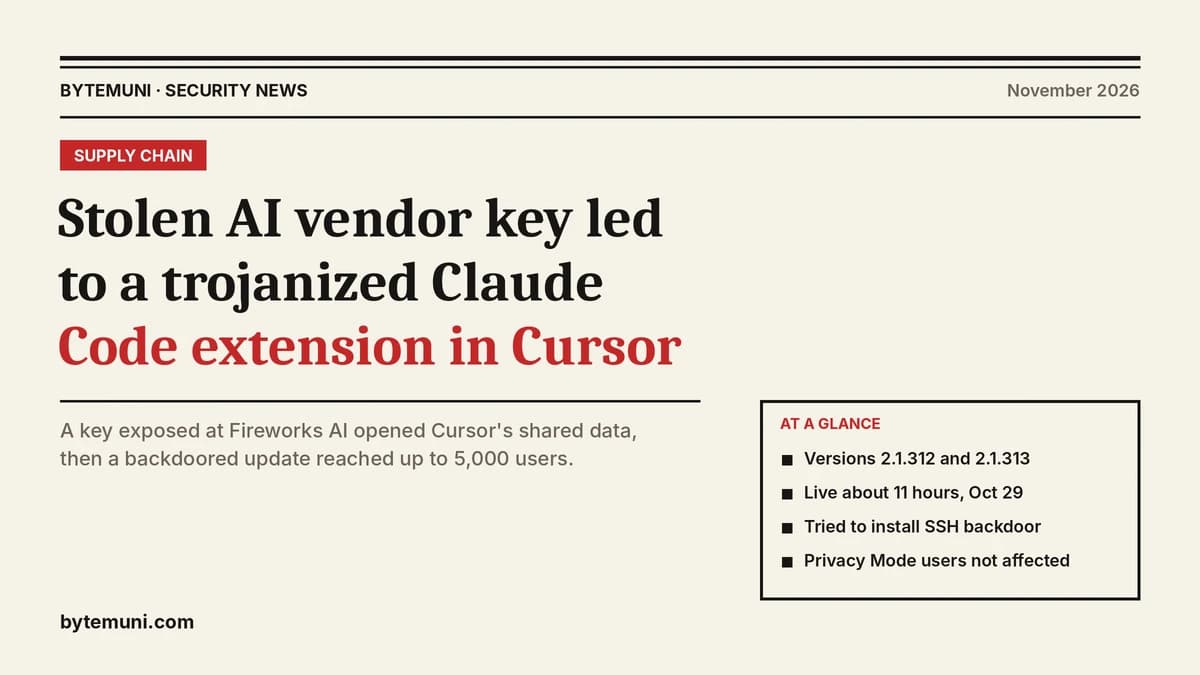
A Cursor-issued access key stolen from AI inference provider Fireworks AI let an attacker break into parts of Cursor and push a trojanized version of the Claude Code extension through Cursor's extension marketplace. The malicious build, versions 2.1.312 and 2.1.313, was live for about 11 hours on October 29 and may have reached up to 5,000 users.
Cursor, the AI code editor, disclosed the incident in a security update reported by The Hacker News on November 15, 2026. It's one of the clearest examples yet of how a breach at one AI vendor can travel down the supply chain to developers' own machines.
How did the stolen Fireworks AI key reach Cursor?
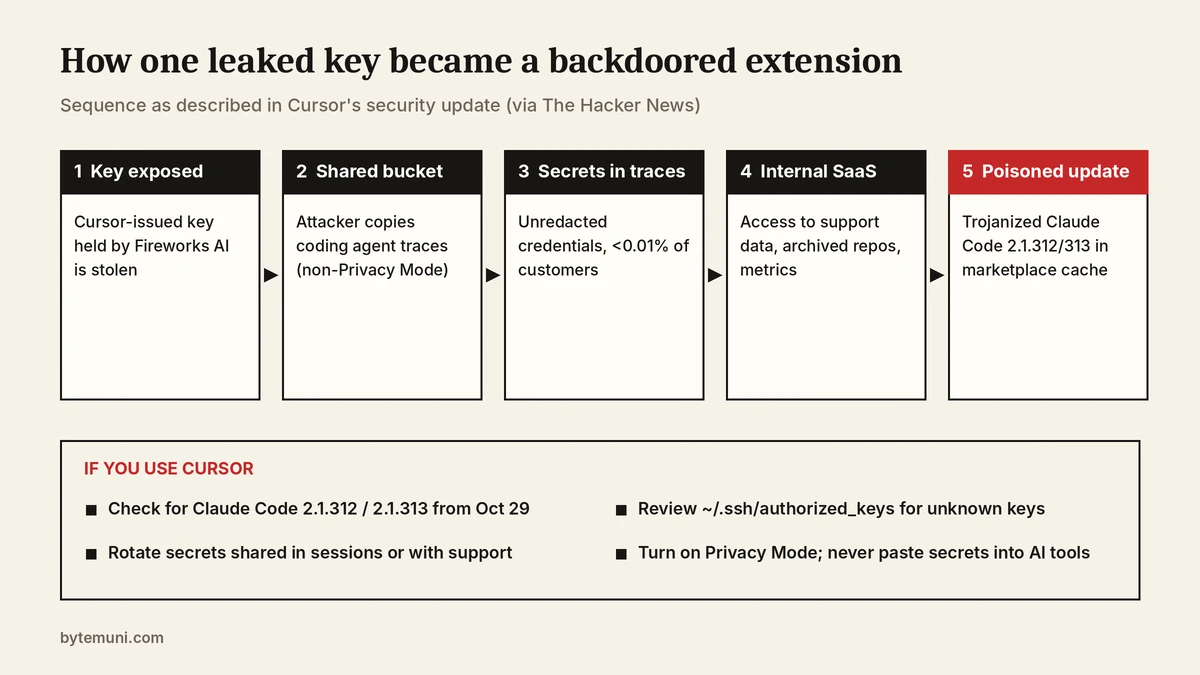
Cursor used Fireworks AI for model inference and shared some data with it through a read-only storage bucket. According to Cursor, an attacker "obtained an access key we had issued to Fireworks", a key Cursor says Fireworks exposed. With it, the attacker copied data from that shared bucket.
The bucket held a limited set of coding agent session traces, mostly from 2025, from sessions that were not in Cursor's Privacy Mode and were allowed for model training. Some of those traces contained credentials that had not been redacted. Cursor says this exposed API credentials belonging to fewer than 0.01% of its customers.
The attacker then used credentials found in the traces to reach some of the SaaS tools Cursor uses internally. From there, they accessed:
archived, non-production Cursor source code repositories, some containing business contact details;
limited customer support data and email conversations;
product usage metrics and contact information;
summaries of some coding agent conversations;
some credentials users had sent to Cursor support.
What happened with the Claude Code extension?
On October 29, the attacker used a stolen credential to place a trojanized copy of Anthropic's Claude Code extension in the cache that serves Cursor's extension marketplace. To users, it looked like a normal update.
Affected versions: Claude Code extension 2.1.312 and 2.1.313, as distributed through Cursor's marketplace.
Exposure window: about 11 hours on October 29, before Cursor removed it.
Reach: "at most 5,000 users" who requested those cached versions during the window may have received the malicious build. That's an upper limit, not a confirmed count.
What it did: it attempted to install a persistent SSH backdoor on affected machines. Cursor hasn't published further technical detail or indicators of compromise.
Cursor says it worked with the cloud provider hosting the attacker's server to take it down, and has notified users who installed the affected versions.
What does Cursor say was not affected?
According to Cursor, there's no evidence the incident affected:
users with Privacy Mode enabled;
customer code repositories;
Cursor's production environment;
the Cursor app itself or its official updates;
other extensions on Cursor's marketplace.
Cursor deactivated the Fireworks key, rotated credentials, briefly disabled some internal and product services while containing the intrusion, took the extension marketplace offline, and moved all inference traffic off Fireworks. It says it hasn't seen malicious activity since November 1.
What happened at Fireworks AI?
Fireworks AI has published its own security bulletins. It first disclosed an incident on October 9, 2026, in which attackers accessed secrets stored on its platform. It linked that activity to a financially motivated group that sells stolen access to large language models, a practice known as "LLMjacking".
In a later update, Fireworks said a third-party cloud provider hosting its R&D machines had its own security incident on October 23. The attacker used that access to reach Fireworks development machines the next day. Fireworks says the exposed data included resource metadata, billing information, and, for some customers, secrets, datasets and incomplete model weights. It says payment card numbers weren't stored, and that it hasn't detected impact on its Inference, Training SDK or Nexus products. Fireworks has brought in Palo Alto Networks' Unit 42 to investigate.
Other companies have reported knock-on effects. Notion has said customer AI chat transcripts were exposed through the Fireworks breach. Uber disclosed that an unnamed service provider's credentials were used to access its data. TechCrunch reported that provider was Fireworks, but Uber's filing doesn't name it.
What should Cursor users do now?
If you use Cursor, especially if you installed or updated the Claude Code extension around October 29:
Check your extension version. If you had 2.1.312 or 2.1.313 from Cursor's marketplace, follow Cursor's notification and treat the machine as possibly compromised.
Look for an SSH backdoor. Review
~/.ssh/authorized_keysfor keys you don't recognise, and check whether an SSH server or new startup service was added that you didn't set up.Rotate credentials that were on that machine, and any API keys or secrets you ever pasted into Cursor support or shared in coding sessions outside Privacy Mode.
Turn on Privacy Mode if you don't want your sessions used for model training. Cursor says Privacy Mode users weren't affected.
Stop pasting secrets into AI tools. This incident started with credentials sitting in stored session traces.
Steps 2 and 5 are general good practice rather than official Cursor instructions, since Cursor hasn't published detailed detection steps.
Why this incident matters
This chain shows how connected the AI tooling world has become. A key held by an AI vendor led to traces stored for model training. Those traces held credentials, the credentials opened internal tools, and that access put a backdoored extension in front of developers. No zero-day was needed, just a leaked key and secrets sitting where they shouldn't have been.
It's the same pattern behind many of this year's incidents, from stolen GitHub tokens dumping CI secrets to the wider root causes of cyberattacks we've covered. The lessons for any team using AI vendors:
Scope vendor keys tightly and monitor how they're used.
Strip secrets from logs, traces and datasets before storing or sharing them.
Treat extension updates as code you're running. Pin versions for critical tools and watch for unexpected updates.
Sources: The Hacker News · Cursor security incident update · Fireworks AI security bulletin · BleepingComputer · eSecurity Planet on Notion · Aviatrix Threat Research Cente
Frequently asked questions
What happened in the Cursor security incident?
An attacker used a Cursor-issued key exposed at Fireworks AI to copy coding agent traces, used credentials found in them to reach internal tools, and pushed a trojanized Claude Code extension.
Which Claude Code extension versions were malicious?
Versions 2.1.312 and 2.1.313, distributed through Cursor’s extension marketplace for about 11 hours on October 29, 2026.
How many users were affected?
Cursor says at most 5,000 users may have received the malicious build. Exposed API credentials affected fewer than 0.01% of customers.
What did the malicious extension do?
It attempted to install a persistent SSH backdoor on affected machines. Cursor hasn’t published further technical details.
Were Privacy Mode users affected?
Cursor says there’s no evidence that Privacy Mode users, customer code repositories, its production environment or the Cursor app were affected.
What should Cursor users do?
Check whether you installed the affected versions, review SSH authorized keys, rotate credentials shared in sessions or with support, and enable Privacy Mode.
Concepts in this article
- Artificial intelligence
- Computer systems that perform tasks that normally need human intelligence.
- Claude
- Anthropic's family of AI models and assistants.
- AI security
- Protecting AI systems and agents from misuse, data leaks and prompt attacks.
- Coding agents
- AI agents that read, write and run code in a repository.
- Large language models (LLMs)
- Transformer models trained on large amounts of text to predict the next token.
- SSH
- The protocol for secure remote login and command execution.
- Software supply chain attacks
- Attacks that compromise a dependency, build system or update to reach its users.
How we research, write and check articles