Tor Network Hit by DDoS Attack: Emergency 0.4.9.17 Update Released for Relays
The Tor network is under an ongoing DDoS attack that has affected most relay operators. On 13 November, the Tor Project released emergency version 0.4.9.17 to harden relay defences around IPv6. This piece covers what Tor said, how the attack built up over months, what it means for Tor users, and what relay operators should do now.

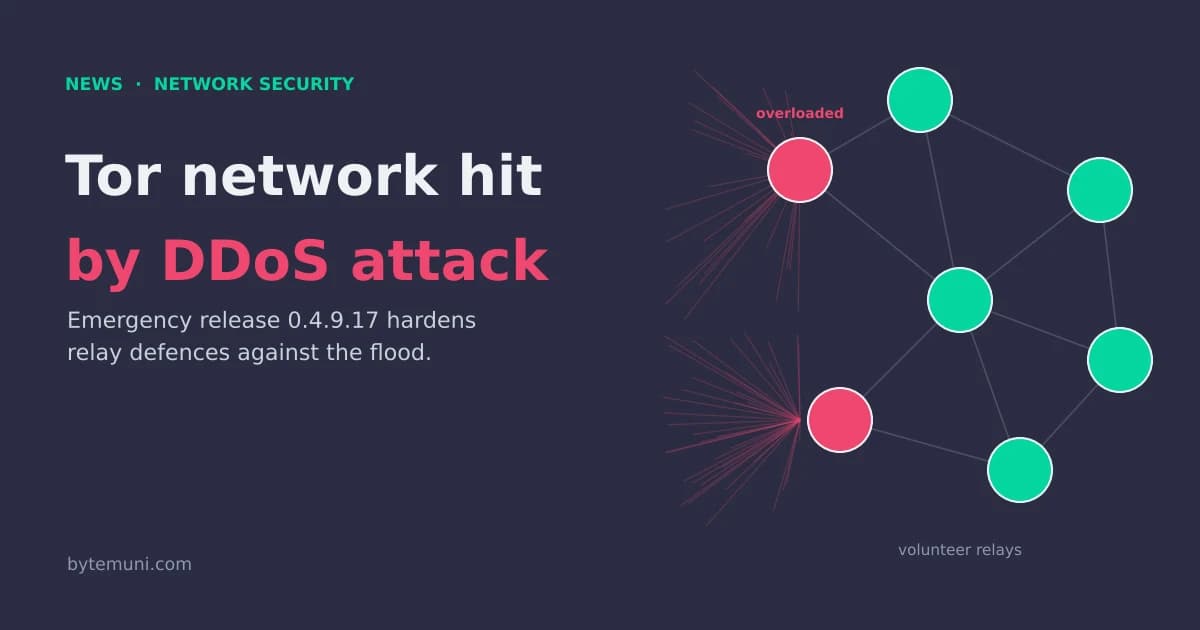
The Tor network is under an ongoing distributed denial-of-service (DDoS) attack. On Friday, 13 November, the Tor Project rushed out an emergency security release, Tor 0.4.9.17, to help the volunteer-run relays that carry Tor traffic survive it.
In its release announcement, the Tor Project said the attack has affected most relay operators, with relays being overwhelmed by a flood of client circuits. The most important fix in the new version strengthens relay DoS defences around IPv6. Tor's network team said it is evaluating more defences and expects further releases soon.
Here's what we know about the Tor DDoS attack so far, how it has unfolded over the past few weeks, and what relay operators and ordinary Tor users should do.
Key facts at a glance (as of 16 November) - What: an ongoing DDoS attack flooding Tor relays with client circuits. - Fix: Tor 0.4.9.17, a stable security release published on 13 November. - Main change: improved relay DoS defences for IPv6 handling. - Who must act: relay operators. Tor says to upgrade "as soon as possible," with no other action needed. - Regular users: Tor hasn't asked Tor Browser users to do anything beyond keeping their software updated. - Attacker: not identified. Tor hasn't published traffic volumes or a motive.
What the Tor Project said
The release was announced on the Tor Project's forum by network team developer David Goulet. He described 0.4.9.17 as a stable release with several security fixes, rushed out because of the ongoing attack.
The key points of the announcement:
The attack: an ongoing DDoS that has affected most relay operators, with relays overwhelmed by a flood of client circuits. A circuit is the encrypted path through three relays that Tor builds for each connection.
The fix that matters most: Tor singled out one change as "especially important for relay DoS defenses related to IPv6 handling."
What to do: "If you run a relay, please upgrade as soon as possible." Tor said no further action is needed after upgrading.
What's next: the team is evaluating more defences and expects more releases soon.
Goulet also thanked relay operators, especially those sharing data on the tor-relays mailing list, which has been the main place for tracking the attack.
The IPv6 fix, explained
The Tor Project's announcement doesn't explain the technical details of the IPv6 change, and Tor hasn't published a CVE or a detailed write-up. According to RuntimeWire's summary of the release, the update makes relays count IPv6 clients by /64 prefix rather than by individual address.
To see why that matters, you need to know how IPv6 addresses are handed out:
The problem: an ISP or hosting provider typically gives a single customer or server an entire /64 block. That's 2⁶⁴ addresses, more than 18 quintillion. Tor relays limit how many connections and circuits each client can open. But if a relay counts every IPv6 address separately, one attacker can rotate through endless addresses in their block, and every new address looks like a brand-new client with a fresh allowance.
The fix: counting by /64 prefix treats the whole block as one client. Rotating addresses inside it no longer resets the limits.
This is a common DoS-defence technique for IPv6 in general, not something unique to Tor. We couldn't confirm the code change ourselves, because Tor's public code mirror we checked hadn't been updated with the 0.4.9 branch. So treat the /64 detail as reported, not independently verified.
Not the first wave: how the attack unfolded
The 13 November release is the latest step in a pressure campaign that relay operators have been reporting for months. Here's the timeline from the Tor Project's own posts and the tor-relays mailing list.
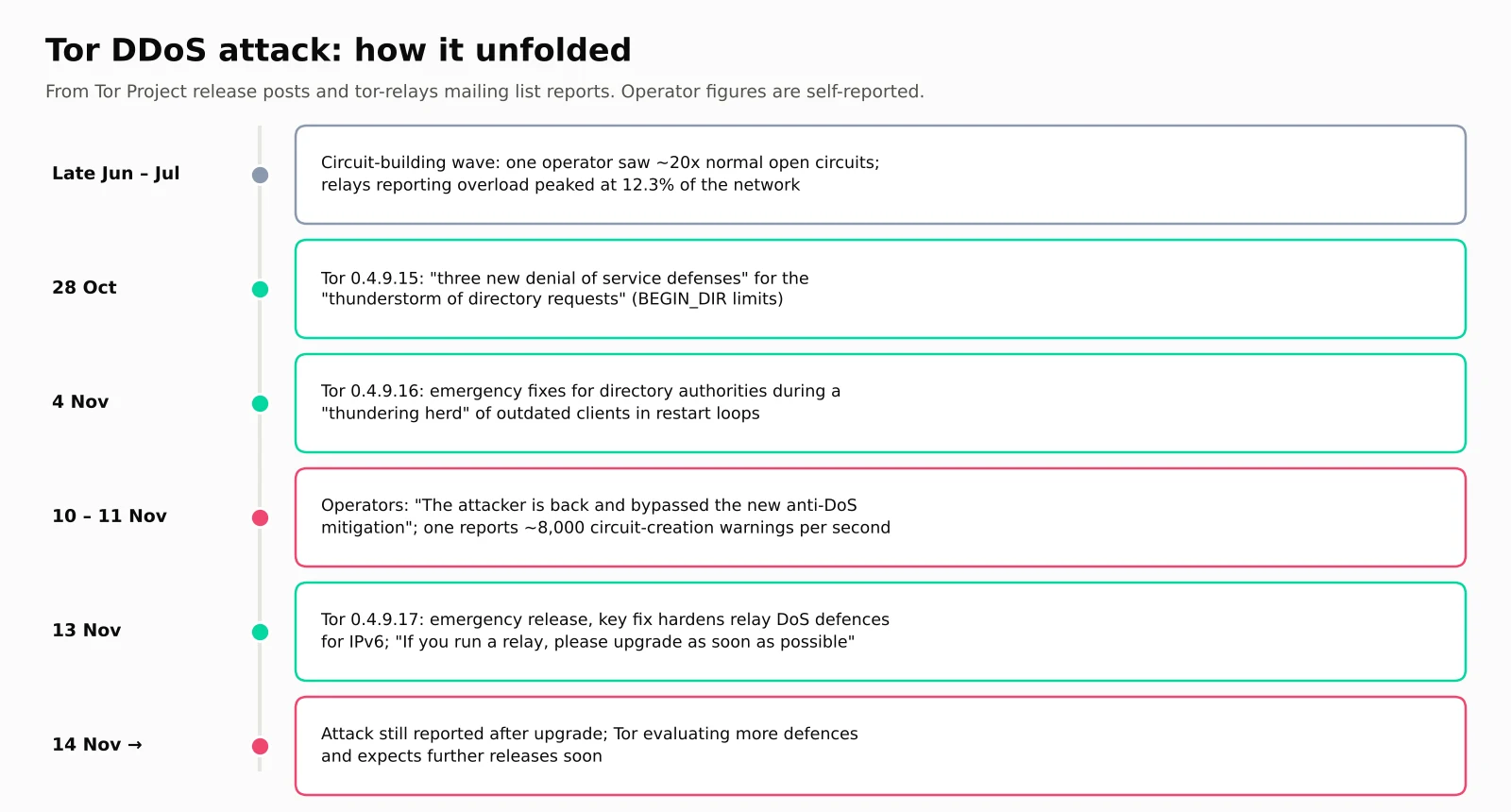
Late June to July: a circuit-building wave.
The overload: independent relay operator 1AEO reported on the mailing list that open circuits on its guard relays hit about 20 times their normal level at peak and stayed around 8 times higher. The load began on 25 June.
Bandwidth: it barely moved, rising only about 20%. That points to an attack that exhausts relay CPU and memory rather than raw bandwidth.
Network-wide signals: 1AEO's later analysis of Tor's public data found that the share of relays reporting overload peaked at 12.3% on 12 July, against a normal 1.5–3.3%.
28 October: Tor 0.4.9.15 with "three new denial of service defenses." Tor's release post linked the new defences to "the thunderstorm of directory requests the network is currently seeing." It urged everyone to upgrade, "especially if you run a relay or a bridge." According to the tor-relays mailing list, the new defences include:
rate limits on BEGIN_DIR requests, which clients use to fetch network directory information through a relay;
an option to allow only one such request per circuit;
changes so relays keep their HSDir flag more reliably under load.
4 November: Tor 0.4.9.16, an emergency fix for directory authorities. The directory authorities are the small set of trusted servers that publish the list of relays. Tor described a "thundering herd situation": many outdated clients stuck in restart loops were repeatedly requesting directory information, straining the fallback directories and the authorities. Tor said there was no urgency for operators who don't run a directory authority.
10–11 November: "The attacker is back." Posts on the tor-relays list reported that the attacker had bypassed the new anti-DoS mitigation:
one operator reported circuit-creation warnings at roughly 8,000 per second;
another said a guard relay wasn't protected by either 0.4.9.15 or 0.4.9.16;
operators also reported relays losing their HSDir flag after the attacker returned.
These are individual operators' reports, not official Tor figures.
13 November: Tor 0.4.9.17, the emergency IPv6 release.
14 November onward: still under pressure. A day after the release, one operator posted an update describing several types of attack traffic still hitting their relay after upgrading. They asked for attacker IP logging and an official warning to operators. Tor hasn't declared the attack over.
How the attack affects Tor users
Tor hasn't published figures on how many users were affected. But the way Tor works tells us what to expect.
Every Tor connection passes through three relays: a guard, a middle relay and an exit. When relays are overloaded, users can see:
slower page loads;
more failed or timed-out connections;
Tor Browser taking longer to connect.
Onion services (.onion sites) also rely on relays. One of the reported effects, relays losing their HSDir flag, matters here: HSDir relays store the information clients use to find onion services.
It's important to keep this in proportion. Nothing in the Tor Project's announcements suggests the attack has broken Tor's encryption or exposed users' identities. This is an availability attack, meant to make the network slow or unreliable, not a reported compromise of anonymity.
What relay operators should do
If you run a Tor relay or bridge:
Upgrade to Tor 0.4.9.17 now. Tarballs are on dist.torproject.org, and packages are available through Tor's repositories. Tor says no configuration changes are needed after upgrading.
Watch your relay's health. Check CPU, memory and circuit counts. Tor's MetricsPort and the overload indicators in relay descriptors make this easier.
Follow the tor-relays mailing list. That's where Tor's team and other operators are sharing what they see and what works. Tor expects more releases soon.
Share data carefully. Operators' reports have helped shape the fixes so far. Avoid publishing anything that could identify Tor users.
What regular Tor users should do
If you use Tor Browser or another Tor app:
Keep your app updated. Tor Browser updates itself, and Tor hasn't announced a Tor Browser release tied to 0.4.9.17. The fix mainly targets relay software.
Expect some slowness while the attack continues. If a site won't load, try a new circuit or reconnect.
Download Tor only from official sources. Attackers often exploit news like this to push fake "emergency updates." The only safe source is the Tor Project's own website or your platform's official app store.
Why Tor keeps getting attacked
DDoS attacks against Tor aren't new:
Onion services: Tor's Mike Perry wrote in 2023 that the network had seen floods targeting onion services roughly once a year for several years.
Relays and directory authorities: attacks on specific relays and on the directory authorities had also grown.
Tor's response: in August 2023, Tor 0.4.8 introduced a proof-of-work defence for onion services. Under attack, clients must solve a small computational puzzle, which makes mass flooding expensive.
Tor's design makes defence harder than for an ordinary website:
Anonymity: clients are anonymous, so relays can't easily tell a real user from an attacker.
Few blocklists: the Tor Project has said it avoids IP blacklists and reputation systems because they hurt legitimate users. It prefers cryptographic rate-limiting approaches.
Volunteers: the network runs on volunteers. In July, around 9,800 relays were typically running, according to 1AEO's analysis of Tor's public data. Every operator has to upgrade by hand, and some may give up under sustained pressure.
Who is behind this attack, and why, is unknown. The Tor Project hasn't attributed it to anyone, so be wary of claims that name a culprit without evidence.
What happens next
The Tor DDoS attack isn't over yet. The Tor Project says it is evaluating additional defences and expects more releases soon. Until then, the outcome depends on how quickly the relay network upgrades, and on whether the attacker adapts again, as operators reported after 0.4.9.15. We'll update this article as the Tor Project publishes new information.
Overload attacks like this often snowball, because recovering systems get hit by a rush of reconnections. We explain that pattern in our analysis of the recent Microsoft 365 outage. For another side of network security, see our guide to AI agents as insider threats.
Sources
Tor Project Forum, Security Release 0.4.9.17 (13 November)
Tor Project Forum, Security Release 0.4.9.16 (4 November)
Tor Project Forum, Security Release 0.4.9.15 (28 October)
tor-relays mailing list, Circuit-building DoS wave: 20x peak, 8x sustained circuits on guard relays since Jun 25 (10 July)
1AEO, The Tor network's circuit-building DoS wave in June–July
tor-relays mailing list, November threads on the attack
Cyber Security News, Tor releases emergency security update as ongoing DDoS attack overwhelms network relays (16 November)
RuntimeWire, Tor Project ships emergency IPv6 fix as DDoS flood overwhelms relays (15 November)
Tor Project Blog, Introducing proof-of-work defense for onion services (23 August 2023)
Tor Project Forum, Tor's history of D/DoS attacks; strategy for mitigation (2023)
Frequently asked questions
Is Tor under attack right now?
Yes. As of 16 November, the Tor Project describes an ongoing DDoS attack that has affected most relay operators, with relays overwhelmed by a flood of client circuits. It released Tor 0.4.9.17 on 13 November and expects more releases soon.
What is Tor 0.4.9.17?
Tor 0.4.9.17 is a stable security release of Tor's core software, published on 13 November. Its most important change strengthens relay DoS defences related to IPv6 handling. RuntimeWire reports that relays now count IPv6 clients by /64 prefix, so attackers can't evade limits by rotating addresses.
Do Tor Browser users need to do anything?
Tor's announcement asks relay operators to upgrade. It doesn't ask Tor Browser users to take any special action. Keep Tor Browser updated as usual, expect some slowness while the attack continues, and only download Tor from the official Tor Project website.
Does the Tor DDoS attack break anonymity?
There's no indication of that. The Tor Project describes an availability attack that floods relays to make the network slow or unreliable. It hasn't reported any compromise of Tor's encryption or of users' identities.
Who is behind the Tor DDoS attack?
Nobody knows publicly. The Tor Project hasn't identified the attacker or a motive, and it hasn't published traffic volumes.
Concepts in this article
- DDoS attacks
- Overwhelming a service with traffic from many sources so it cannot respond.
- Tor
- An anonymity network that routes traffic through volunteer relays.
- Patch management
- Testing and rolling out security updates in priority order.
How we research, write and check articles