Google Finds Hackers Using an AI Exploit Framework That Turns Patches Into Exploits Without Human Help
Google’s Threat Intelligence Group found “exploit_agent”, an attacker tool that diffs patches, writes exploits and runs them without human approval. It’s part of a wider shift to agentic hacking frameworks, stolen AI access and AI phishing kits. Here’s what’s confirmed and what defenders should do.

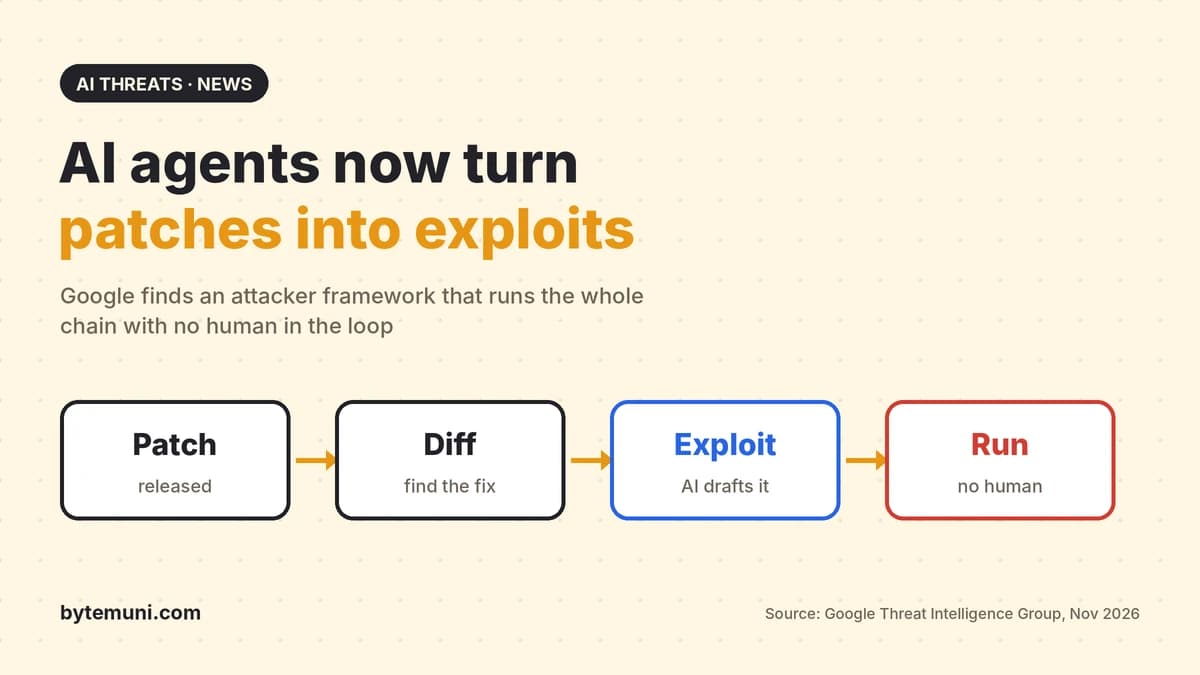
Google says attackers have built an AI exploit framework that reads software patches, works out what was fixed, writes an exploit and runs it, with no human in the loop. Google's Threat Intelligence Group (GTIG) calls it the first time it has seen this fully automated. The tool, named "exploit_agent" in its own configuration file, was found on an exposed attacker server.
The finding comes from a GTIG report disclosed on November 16, 2026, covered by VentureBeat and The Hacker News. Google says adversarial use of AI agents has "crossed a significant threshold": attackers are no longer just prompting chatbots for help, they're running multi-agent systems during real intrusions.
What is exploit_agent, the AI exploit framework Google found?
According to VentureBeat's account of Google's report, exploit_agent is an AI exploit framework that:
connects several frontier and locally hosted large language models;
continuously compares code before and after software patches;
identifies the vulnerability each patch fixes;
drafts an exploit for it;
and executes that exploit, all without a person approving each step.
Google says earlier reports had documented only partially automated scanning and exploitation. This is the first time it has seen attackers use LLM frameworks to fully automate vulnerability discovery and exploitation "without a human in the loop."
Where was it found, and who built it?
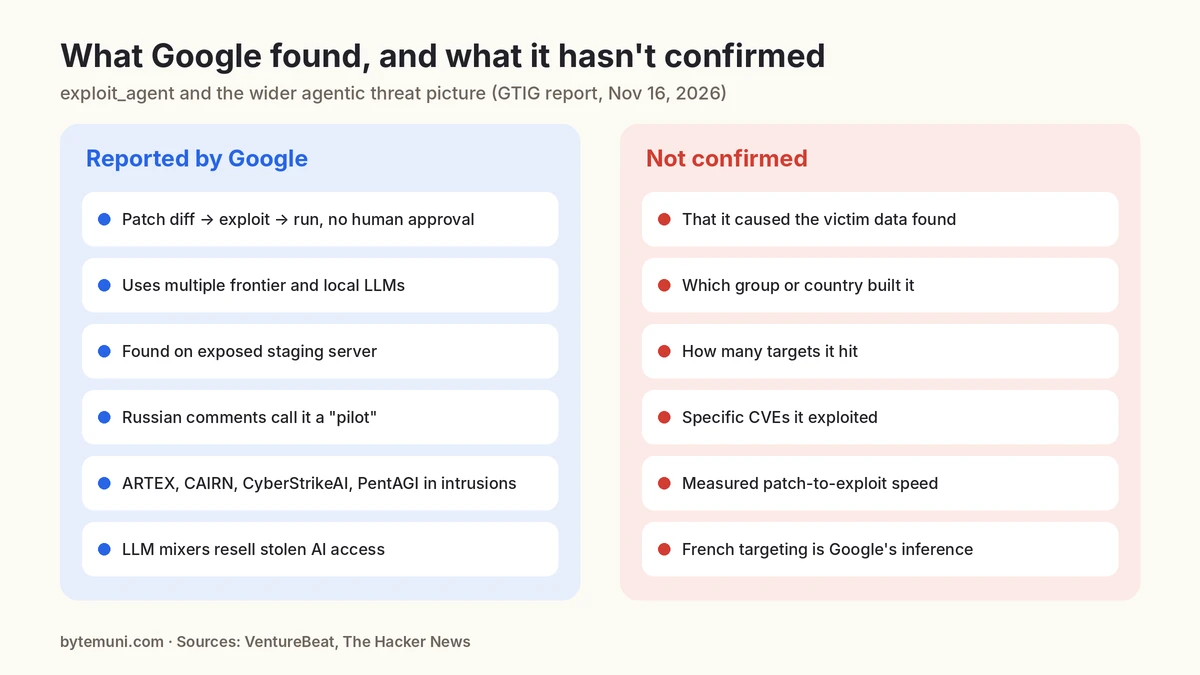
Google found the AI exploit framework on an exposed staging server, alongside stolen victim data and post-compromise scripts. Important caveats, according to VentureBeat:
Google's report does not establish that exploit_agent caused those compromises.
The configuration file contains Russian-language comments describing the tool as a "pilot" and telling the operator to paste LLM API keys directly into the file.
Google does not attribute the framework to any specific group or country.
Victim data suggests the operator was interested in French media, entertainment and education websites. That is Google's inference.
Google also published a code excerpt showing the framework examining access controls in version 2.19.25 of the Spectra WordPress plugin, but didn't tie that to a successful exploit. No victim count, CVE list or measured patch-to-exploit time has been published.
What else did Google find?
exploit_agent is one part of a wider picture in the report, as described by The Hacker News.
Agentic hacking frameworks in live intrusions
GTIG says threat actors are using autonomous, multi-agent offensive frameworks, naming ARTEX, CAIRN, CyberStrikeAI and PentAGI, to run multi-stage intrusions. Many of these started as open-source penetration-testing tools. GTIG says attackers use them to "automate discrete phases and specific operational tasks during live intrusions." The report also mentions Agent Zero, an open-source agent framework with autonomous code execution, and ZeroHollow, an inference service used for exploit development and routing between models.
Patch diffing goes on autopilot
GTIG says financially motivated actors and suspected China-aligned espionage actors have experimented with using LLMs to reverse-engineer patches, comparing source versions, release notes, security research and proof-of-concept code. GTIG notes attackers may find it more efficient to "rapidly weaponize patched n-day vulnerabilities" than to hunt for new zero-days. The report cites the weaponisation of PaperCut NG/MF flaws in early September 2026 as an example.
LLMjacking and "LLM mixers"
Attackers are stealing LLM credentials and cloud resources from compromised companies and reselling access through underground proxy services GTIG calls "LLM mixers", naming APIMart and JetNight. In other words, victims' AI accounts can end up paying for attackers' AI.
AI-powered phishing kits
GTIG describes a Chinese-language phishing-as-a-service platform, Jieyou, that added an LLM chatbot so customers can build phishing pages and edit templates in plain language. GTIG calls LLM use by phishing-kit providers "a modular force multiplier."
Why does an AI exploit framework for patches matter?
When a vendor releases a patch, the fix itself reveals where the bug was. Skilled researchers have always been able to "diff" a patch and work backwards to an exploit, but it took time and expertise. That delay was defenders' window to patch.
Automation shrinks that window. As security adviser Merritt Baer, former Deputy CISO at AWS, told VentureBeat: "Attackers didn't invent a new kind of bug." What changed is that reading the patch, finding the fix and writing the exploit can now happen automatically. A skilled person might need days, while "an agent does it while its operator sleeps."
That fits what other data already shows. Rapid7's latest quarterly report puts the average time from a high-severity bug going public to exploitation at about three days. In October, CrowdStrike documented four threat actors using AI coding agents in real intrusions. And Fireworks AI linked its own breach this autumn to a group that sells stolen LLM access, the same LLMjacking economy GTIG describes.
Is this the "fully autonomous AI attack" everyone feared?
Not quite, and it's worth being precise.
What's new: an AI exploit framework that, by Google's account, automates the full chain from patch to exploit execution without human approval.
What isn't proven: that it successfully compromised the victims whose data sat on the same server, how many targets it hit, or how fast it works in practice.
What it's called by its own operator: a "pilot", an experiment rather than a polished weapon. The operator was also careless enough to leave it on an exposed server.
The bigger story is the direction. The pieces attackers need, including agentic frameworks, cheap or stolen model access and AI-assisted phishing kits, now exist and are being combined. Expect more automation, not less.
What should defenders do?
Google's findings don't call for a new kind of defence. They make the existing basics more urgent:
Patch internet-facing systems within days, not weeks. If exploits can be generated from patches automatically, the safe window after a release keeps shrinking. Prioritise anything in CISA's Known Exploited Vulnerabilities catalog.
Know what you expose. Keep an inventory of internet-facing apps, plugins and services, including WordPress plugins like the one in Google's excerpt.
Watch for exploitation, not just vulnerabilities. Monitor for unusual behaviour on exposed systems so you catch attacks you didn't patch in time.
Protect your AI credentials. Treat LLM API keys like cloud keys: scope them, rotate them, monitor usage and billing for spikes, and never hardcode them in files.
Use virtual patching (WAF rules, temporary mitigations) when you can't patch immediately.
As Baer put it: "Attackers bring speed; defenders have to bring knowledge of their own environment."
We've traced the same patterns behind this year's major incidents in our analysis of the root causes of cyberattacks, and in the OpenAI and Hugging Face incident, where AI agents in a test environment attacked a real company. For how organisations can control their own agents, see our guide to AI agents as insider threats.
Sources: VentureBeat · The Hacker News · Google Threat Intelligence Group report · The New Stack · Aviatrix Threat Research Center
Frequently asked questions
What is exploit_agent?
An attacker framework found by Google that uses multiple LLMs to compare code before and after patches, find the fixed bug, write an exploit and run it without human approval.
Who created exploit_agent?
Google hasn’t attributed it to any group or country. Its configuration file contains Russian-language comments calling it a pilot.
Has exploit_agent been used in successful attacks?
It was found on a server with stolen victim data, but Google’s report doesn’t establish that the framework caused those compromises.
Why is automated patch diffing dangerous?
Patches reveal where bugs were. Automating the path from patch to exploit shrinks the time defenders have to update before attacks start.
What is an LLM mixer?
Google’s term for underground proxy services, such as APIMart and JetNight, that resell AI model access often obtained with stolen credentials.
How can organisations defend against AI-driven exploits?
Patch exposed systems within days, maintain an asset inventory, monitor for exploitation, use virtual patching, and secure and monitor AI API keys.
Concepts in this article
- Artificial intelligence
- Computer systems that perform tasks that normally need human intelligence.
- AI agents
- Systems where a model plans and takes actions with tools in a loop toward a goal.
- CISA KEV catalog
- The US list of vulnerabilities known to be exploited in the wild.
- Coding agents
- AI agents that read, write and run code in a repository.
- Hugging Face
- A hub and set of libraries for sharing and running machine-learning models.
- Large language models (LLMs)
- Transformer models trained on large amounts of text to predict the next token.
- Phishing
- Fake messages that trick people into giving credentials or running malware.
- Threat intelligence
- Information about attackers, their tools and their targets, used to prioritise defence.
How we research, write and check articles