Java Security Update: How to Check and Patch Your JDK
Oracle's November 17, 2026 release patches 11 Java SE flaws, all reachable over a network without credentials. This guide covers which builds are affected, what the scores mean, how to find every JVM you run, and how to patch Oracle JDK, OpenJDK builds and containers.

New to this? Read first: Threat modelling, Web application security
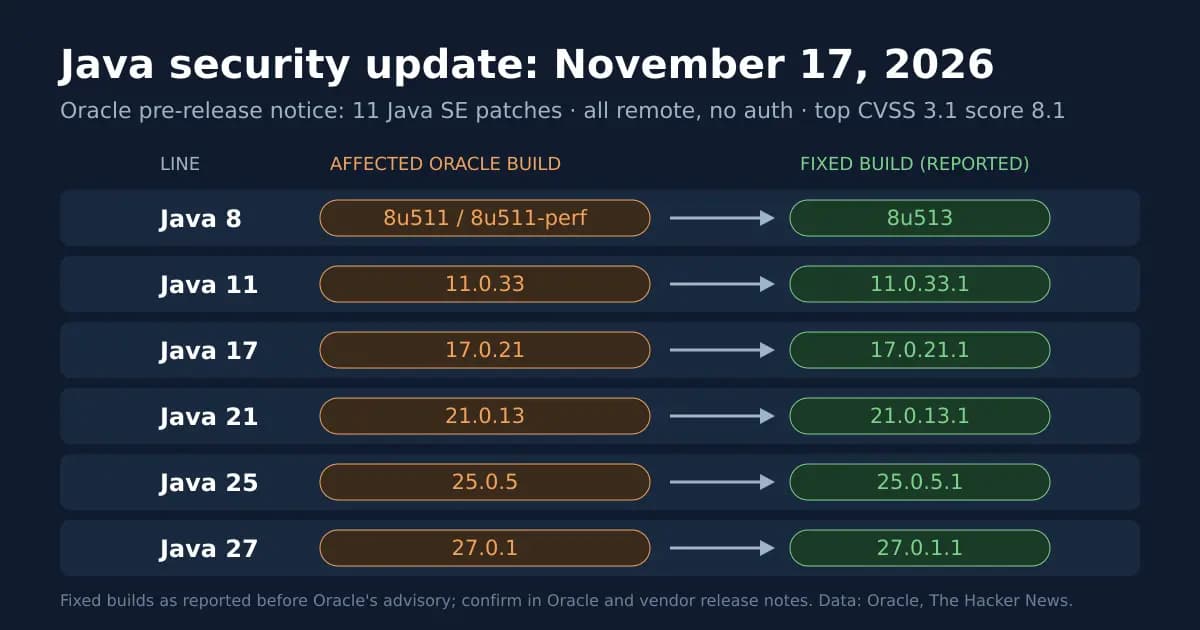
A Java security update is a new JDK build that fixes vulnerabilities, and Oracle's November 17, 2026 release patches 11 flaws in Java SE across the 8, 11, 17, 21, 25 and 27 lines. Oracle's pre-release notice says all 11 may be exploited over a network without credentials. If you run any of those lines, install the fixed build and restart every JVM that uses it.
This guide covers what Oracle has confirmed so far and which versions are affected. It also covers how to read the severity numbers, what is known about the separate "Java4Shell" report, how to check the Java you actually run, and how to update Oracle JDK and OpenJDK builds on servers and in containers.
What is in Oracle's November 2026 Java security update?
Oracle announced the release in advance on its November 2026 Critical Security Patch Update pre-release page. A Critical Security Patch Update (CSPU) is Oracle's monthly security-only release that sits between its quarterly patch updates. For Java SE, the notice lists 11 new security patches. All 11 may be remotely exploitable without authentication, and the highest CVSS v3.1 base score is 8.1.
Java is a small slice of this release. By Oracle's count, the full CSPU carries 652 new security patches across its product line, including Database Server, Fusion Middleware, MySQL and VirtualBox. The Hacker News reported the upcoming Java fixes on November 17, alongside early reports of a separate OpenJDK flaw covered later in this guide.
The pre-release page has no CVE IDs, components or per-flaw scores. Oracle publishes those only in the final advisory, and it warns that pre-release details may change. Oracle's page gives no release time. Cyber Kendra, citing Korean-language reports, puts disclosure at 1 p.m. PT on November 17, which is 2:30 a.m. IST on November 18. Only that one outlet reports the time.
How Java security patches ship now
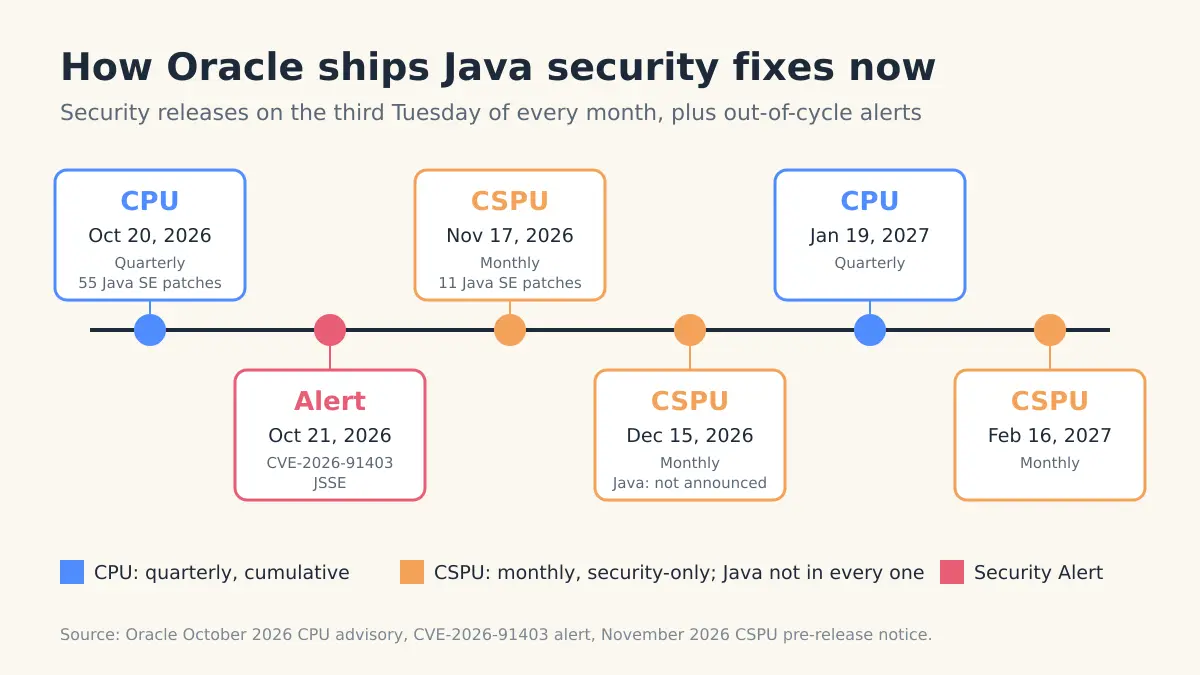
For about twelve years, Java security fixes arrived four times a year. In mid-2026, Oracle's Java team said in a blog post on more frequent security updates that it would move Java toward a monthly cadence focused on security and stability fixes, with the first Java CSPU on August 18, 2026. Azul, which ships the Zulu builds of OpenJDK, announced the same monthly model for its builds.
| Release type | When it ships | What it contains | Recent Java example |
|---|---|---|---|
| Critical Patch Update (CPU) | Third Tuesday of January, April, July and October | Cumulative security fixes, plus bug fixes in the regular update train | October 20, 2026: 55 Java SE patches |
| Critical Security Patch Update (CSPU) | Third Tuesday of the other months, when needed | Security and stability fixes only, on top of the last CPU | September 2026: 3 Java SE patches; November 17, 2026: 11 |
| Security Alert | Any day, out of cycle | One critical flaw, plus closely related ones | CVE-2026-91403, October 21, 2026 |
Oracle's October 2026 CPU advisory lists the next security release dates as December 15, 2026 (CSPU), January 19, 2027 (CPU) and February 16, 2027 (CSPU). Java does not get fixes in every CSPU. Oracle's wording, as quoted by foojay, is that Java updates ship as part of "(some)" monthly CSPUs. Plans also shift. Foojay wrote in July that no Java CSPU was planned for September, yet Oracle's September 2026 CSPU did include 3 Java SE patches.
The October Security Alert shows why an out-of-cycle release can matter. Oracle's alert for CVE-2026-91403 covers JSSE, the Java Secure Socket Extension that handles TLS. It scores 9.1 under CVSS 3.1, and the fixed builds distrust a set of intermediate CA certificates related to eMudhra, an Indian certificate authority. Faster release cycles are one response to the steady stream of new CVEs described in our piece on why CVEs keep coming.
Which Java SE versions are affected, and which builds fix them?
Oracle's notice for this Java security update lists seven Oracle Java SE builds as affected. These are the latest builds from October, so anything older on the same line is also behind. In its October alert, Oracle says it patches only versions under Premier or Extended Support, that earlier releases are likely affected too, and that it recommends upgrading to a supported version.
| Java line | Affected Oracle builds (pre-release list) | Fixed build (reported, not yet confirmed by Oracle) | Oracle JDK license for updates |
|---|---|---|---|
| Java 8 (LTS) | 8u511, 8u511-perf | 8u513 | OTN (paid for most production use) |
| Java 11 (LTS) | 11.0.33 | 11.0.33.1 | OTN |
| Java 17 (LTS) | 17.0.21; GraalVM for JDK 17.0.21 | 17.0.21.1 | OTN |
| Java 21 (LTS) | 21.0.13; GraalVM for JDK 21.0.13; JavaFX 21.0.13 | 21.0.13.1 | OTN since 21.0.13 |
| Java 25 (LTS) | 25.0.5; JavaFX 25.0.5 | 25.0.5.1 | NFTC (free) until September 2028 |
| Java 27 | 27.0.1; JavaFX 27.0.1 | 27.0.1.1 | NFTC for its six-month life |
| GraalVM Enterprise Edition | 21.3.20.0.3 | Not reported | Oracle subscription |
The fixed build numbers come from The Hacker News and from Adoptium's November CSPU release checklist on GitHub, which lists the same six target versions. Oracle confirms fixed builds only in its advisory and release notes, so check those before you pin a version. Java 26, a short-term release, appeared in October's affected list but not in November's. Teams still on 26 should move to 27 or to an LTS line.
The license column matters for Indian teams that use Oracle JDK without a subscription. Oracle's Java SE licensing FAQ says updates for Java 8, 11 and 17 are under the OTN license. That license is free for personal use, development and testing, but most production use needs a paid subscription. Oracle's JDK 21.0.13 release notes say 21.0.13 is the first JDK 21 update under OTN. JDK 25 stays under the free No-Fee Terms and Conditions (NFTC) until September 2028, according to Oracle's download page.
How serious are the 11 flaws? CVSS and remote exploitation explained
Oracle publishes a risk matrix with every Java security update. It has one row per CVE and columns for the component, the protocol, "Remote Exploit without Auth.?" and the CVSS 3.1 base score with its vector. The November matrix was not public at the time of writing. Until it is, the summary numbers are all anyone has: 11 flaws, all network-reachable without credentials, top score 8.1.
"Remotely exploitable without authentication" does not mean every flaw allows remote code execution. The Hacker News points this out directly. Oracle's CVE text often adds conditions. Its record for CVE-2026-47058, a July Java flaw, describes a "difficult to exploit vulnerability" reachable by an unauthenticated attacker over the network. A high attack complexity pulls a network flaw's score down, which is one way a remote, no-login bug ends up at 8.1 rather than 9.8.
Oracle's Java SE notes also say where a flaw can be triggered. In the CVE-2026-91403 alert, Oracle says the flaw can be exploited through the affected APIs, for example by a web service that supplies data to them. It also applies to sandboxed Java Web Start applications and applets that run untrusted code. A server that parses data from the network is in scope, not only desktop Java.
When the matrix goes live, work through it like this:
Open the advisory from Oracle's security alerts page and jump to the "Oracle Java SE Risk Matrix" section.
Sort the rows by base score and note any with "Yes" in the remote, no-authentication column. Oracle's notice says that will be all 11 this time.
Read the component column. Components such as JSSE, Networking, Libraries or Hotspot touch most servers. Client-side components matter more on desktops.
Check the "Supported Versions Affected" column against the inventory you build in the next section.
Search the CISA Known Exploited Vulnerabilities catalog for each CVE. A listing there means confirmed attacks, as in our coverage of CISA KEV additions for Collabora and VeloCloud.
As of November 17, no vendor, government agency or researcher had reported in-the-wild exploitation of the 11 flaws, according to Cyber Kendra and the security firm Aikido. Aikido warns that this could change once fixed builds ship, because attackers can compare patched and unpatched code.
Is the "Java4Shell" flaw, CVE-2026-114938, part of this update?
Nobody has confirmed that yet. Early reports describe CVE-2026-114938 as an unauthenticated remote code execution flaw in OpenJDK 17.0.6 and later, rated 9.2 under CVSS 4.0. Cyber Kendra and Aikido attribute the first warning to an advisory from South Korea's National Cyber Security Center dated November 16. WatchTowr, a security firm, acknowledged the reports but called the details unconfirmed, according to Cyber Kendra.
Technical details come from Oligo Security, a runtime security vendor. According to a summary of Oligo's write-up by the threat-intelligence site Mallory, the bug sits in OpenJDK's hardware-accelerated Base64 decoder. A crafted 65-byte input triggers an integer underflow in padding handling and a 62-byte heap buffer overflow. Exposure reportedly depends on whether the AVX-512 decoding path exists and is enabled on the x86 CPU, and whether attacker-controlled data reaches the decoder. OpenJDK added that AVX-512 Base64 decoding path in 2021 under JDK-8268276, but no source has tied the new flaw to that specific change.
Several facts are still open:
As of November 17, Oracle had not confirmed the CVE ID or mapped any of its 11 patches to it, according to Aikido.
The CVE record was reserved with no public description, and no fixed build had been announced.
Cyber Kendra and Aikido both reported no public proof-of-concept and no CISA KEV listing as of November 17.
Oracle scores Java flaws under CVSS 3.1, while the 9.2 figure is CVSS 4.0. The two scales are not directly comparable, so the 9.2 report and Oracle's 8.1 top score may describe different bugs.
Oligo describes limiting AVX use or disabling Base64 intrinsics as temporary measures. A JVM intrinsic is a hand-tuned machine-code version of a Java method. These are not substitutes for patching, and JVM flags that change CPU code paths can affect performance. Wait for your JDK vendor's guidance before you change them in production.
How to check which Java version you are running
Before you install any Java security update, find out what you run. The Java on your PATH is often not the Java your service uses. App servers, IDEs, build agents and Docker images frequently bundle their own runtime. Check all of them, not only the terminal default.
Check the default Java. Run the command below and read the version string and vendor name. The output goes to stderr, which is why later commands redirect it.
java -versionFind the vendor and install path. This prints JVM properties, including
java.version,java.vendorandjava.home.java -XshowSettings:properties -version 2>&1 | grep -E 'java\.(version|vendor|home) 'Read the release file of a specific JDK. Every modern JDK has a plain-text
releasefile in its root folder withJAVA_VERSIONandIMPLEMENTORlines.cat "$JAVA_HOME/release"Check the JVMs that are running now. A running process keeps the old build in memory even after you upgrade the files. Aikido suggests these commands on Linux.
jcmdships with the JDK, not the JRE.ps -eo pid,args | grep '[j]ava' for pid in $(pgrep java); do readlink -f /proc/$pid/exe; jcmd $pid VM.version; doneCheck containers and pods. Run the check inside the image, not on the host.
docker exec my-app java -version
kubectl exec -n my-namespace my-pod -c my-container -- java -version
Replace
my-app,my-namespace,my-podandmy-containerwith your own names.
Compare what you find against the affected list above. Oracle's release notes point to its Security Baseline page, which shows the latest secure version for each Java release family.
How to install the Java security update on Oracle JDK and OpenJDK builds
How you get a Java security update depends on who built your JDK, not on the Java version number. OpenJDK is the open-source code base. Oracle JDK, Eclipse Temurin, Amazon Corretto, Azul Zulu and Linux distribution packages are separate builds of it, each with its own release date and version labels.
Oracle JDK
Oracle JDK 25 and 27 updates are on Oracle's Java downloads page. Subscribers get Java 8, 11, 17 and 21 updates through My Oracle Support, where each advisory links a Patch Availability Document. Install the new build, point JAVA_HOME and your service files at it, and remove the old one only after the service passes its checks.
Eclipse Temurin
Adoptium's November checklist lists 27.0.1.1, 25.0.5.1, 21.0.13.1, 17.0.21.1, 11.0.33.1 and 8u513, with a target date of November 17. The issue says it was created from a draft template, so treat those as planned until the Adoptium news page announces them. Version labels can differ from Oracle's. Per endoflife.date, Temurin's latest Java 8 build on November 4 was 8u512-b09, while Oracle's list shows 8u511.
Amazon Corretto, Azul Zulu and Linux packages
Azul shipped CSPU builds of Zulu for Java 26, 25, 21, 17, 11 and 8 in August, according to its August release announcement on NLJUG. The most recent Corretto release we could confirm was its October 22 quarterly update. Check each vendor's release notes for a November build, and don't assume it matches Oracle's number. On Linux, distribution packages come from your distro's security team and may land days later. These are the standard upgrade commands:
# Ubuntu / Debian
sudo apt update
sudo apt install --only-upgrade openjdk-17-jdk openjdk-17-jre-headless

# RHEL / Rocky / AlmaLinux / Fedora
sudo dnf upgrade 'java-17-openjdk*'

# Amazon Linux 2 with Corretto 8
sudo yum update java-1.8.0-amazon-corretto

# SDKMAN on a developer machine
sdk upgrade java
Change the package names to the Java line you run. After the upgrade, run java -version again and confirm the build number has moved.
Docker images and Kubernetes
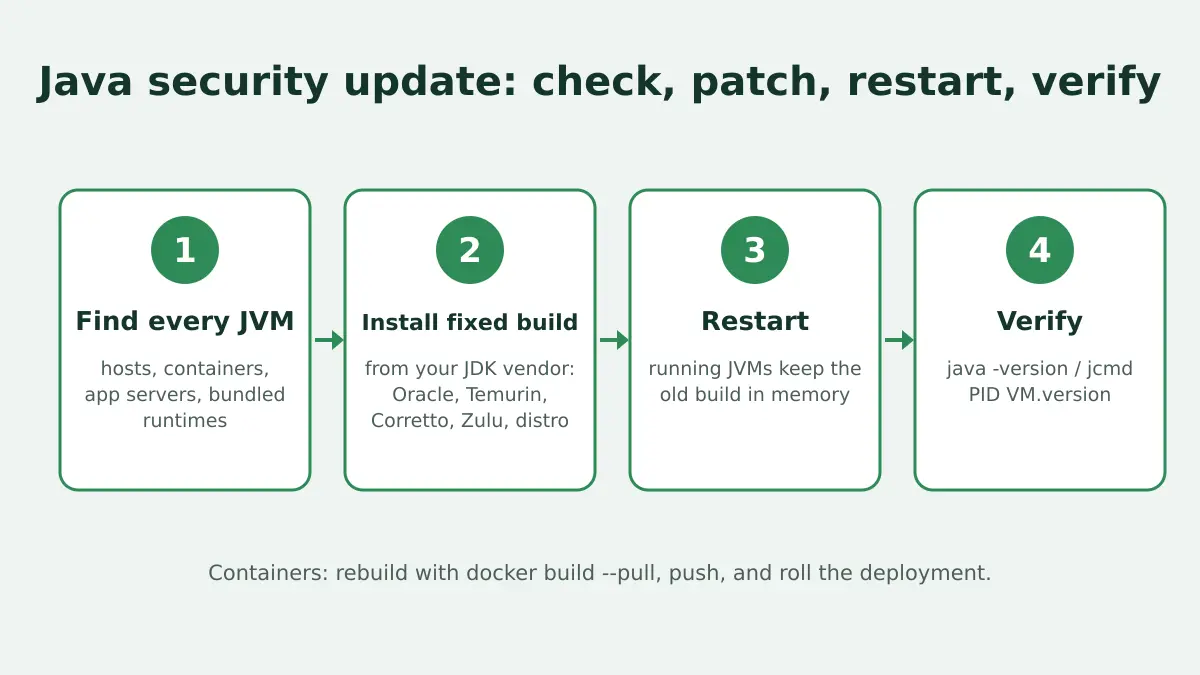
Containers don't pick up a Java security update on their own. Rebuild on a fresh base image, push, and roll the deployment.
docker build --pull -t my-app:java-patched .
docker push my-app:java-patched
kubectl set image deployment/my-app my-container=my-app:java-patched
kubectl rollout status deployment/my-app
The --pull flag makes Docker fetch the newest base image instead of using a cached one. Pin your base image to the fixed version tag once your vendor publishes it, so later builds can't silently fall back. Our Docker update and rollout checks for PHP2Shell walk through the same rebuild-and-verify loop for another runtime.
Java security update checklist for servers and containers
List every JVM: hosts, containers, app servers, build agents, and runtimes bundled inside vendor software.
Record vendor, version and install path for each one, using
java -XshowSettings:properties -versionor thereleasefile.Read Oracle's Java SE risk matrix once it's published, and note the components and CVSS vectors.
Check each CVE against the CISA KEV catalog before you set the patching order.
Install your vendor's fixed build. Oracle's build numbers don't carry over to Temurin, Corretto, Zulu or distro packages.
Rebuild container images with
--pulland redeploy them.Restart every Java process. Replacing files does not change a running JVM.
Verify the live version with
jcmd <pid> VM.versionorjava -versioninside the container.Until patched, limit network access to Java services with firewalls, security groups or IP allowlists. Aikido notes this lowers risk but does not replace patching.
Add the third Tuesday of every month to your patch calendar. If Oracle releases in the US afternoon, as reported this month, the advisory reaches India in the early hours of Wednesday.
My take on Oracle's monthly Java patches
My read is that the bigger change here is the calendar, not the 11 flaws. Teams that applied a Java security update four times a year now need a pipeline that can rebuild, test and roll out a JDK every month without a war room. That is mostly automation work: a JVM inventory, base images rebuilt on schedule, and a smoke test that runs on the new runtime.
On Java4Shell, I'd treat the reports as a reason to finish your inventory today, not as proof of a 9.2 bug in your stack. Until Oracle or an OpenJDK vendor confirms it, the facts are a reserved CVE, a vendor write-up and no public exploit. Students preparing for security roles will find this a good practice case in reading pre-disclosure reports carefully, a skill that comes up in cybersecurity interview questions.
The bottom line on this Java security update
If you run Java 8, 11, 17, 21, 25 or 27 in production, schedule this update now rather than waiting for the January CPU. Oracle says all 11 flaws are reachable over the network without credentials. Build your JVM inventory before the advisory lands, install your vendor's fixed build when it ships, and restart every process. If you are on Java 26 or another unsupported line, move to a supported line at the same time, because a patch won't reach you.
Frequently asked questions
When will Oracle publish the CVE IDs for the November 2026 Java flaws?
Oracle publishes CVE IDs, components and per-flaw scores only in the final advisory, not in the pre-release notice. The release is dated Tuesday, November 17, 2026. One outlet, Cyber Kendra, reports a 1 p.m. PT release time, which is 2:30 a.m. IST on November 18.
Is OpenJDK affected, or only Oracle JDK?
Oracle's notice names Oracle Java SE, GraalVM and JavaFX builds, not OpenJDK by name. Oracle JDK and most OpenJDK distributions share the same code base, so Aikido advises treating every Java line in use as in scope until Oracle's risk matrix maps patches to CVEs.
Does "remotely exploitable without authentication" mean an attacker can run code on my server?
Not necessarily. It means an attacker does not need a login and can reach the flaw over a network. The impact could be data exposure, tampering or a crash, and Oracle's risk matrix gives the confidentiality, integrity and availability impact for each CVE.
Is Java 26 still getting security fixes?
Java 26 appeared in Oracle's October 2026 affected list but is not in the November 2026 list. Oracle's licensing FAQ says non-LTS releases are supported for six months, so Java 26 users should move to Java 27 or to an LTS line such as 21 or 25.
Do I need to pay to get Oracle JDK updates?
Under Oracle's licensing FAQ, Java 8, 11 and 17 updates use the OTN license, which is free for personal use, development and testing but generally needs a subscription for production use. Oracle's release notes say 21.0.13 is the first JDK 21 update under OTN, while JDK 25 stays under the free NFTC until September 2028. This is general information about Oracle's published terms, not legal advice.
Will updating the JDK files patch my running application?
No. A running JVM keeps the old build in memory until the process restarts. After upgrading, restart each Java service or redeploy each container, then confirm the live build with jcmd <pid> VM.version or java -version inside the container.
Concepts in this article
- Secure coding
- Writing code that validates input, handles secrets safely and avoids common vulnerability patterns.
- CISA KEV catalog
- The US list of vulnerabilities known to be exploited in the wild.
- CVE
- The public identifier system for disclosed security vulnerabilities.
- Components and composition
- Building a UI from small reusable pieces and combining them.
- Docker
- A tool for packaging and running applications in containers.
- Numbers
- Floating-point numbers, BigInt, NaN and precision pitfalls.
- Remote code execution (RCE)
- A flaw that lets an attacker run their own code on a system over the network.
- Vulnerability management
- Finding, ranking and fixing vulnerabilities across systems.
How we research, write and check articles