TraderTraitor attribution puts DevOps access under scrutiny
TraderTraitor's Binance attribution shifts attention to developer access, malicious recruitment tasks and the difference between frozen funds and restored services.

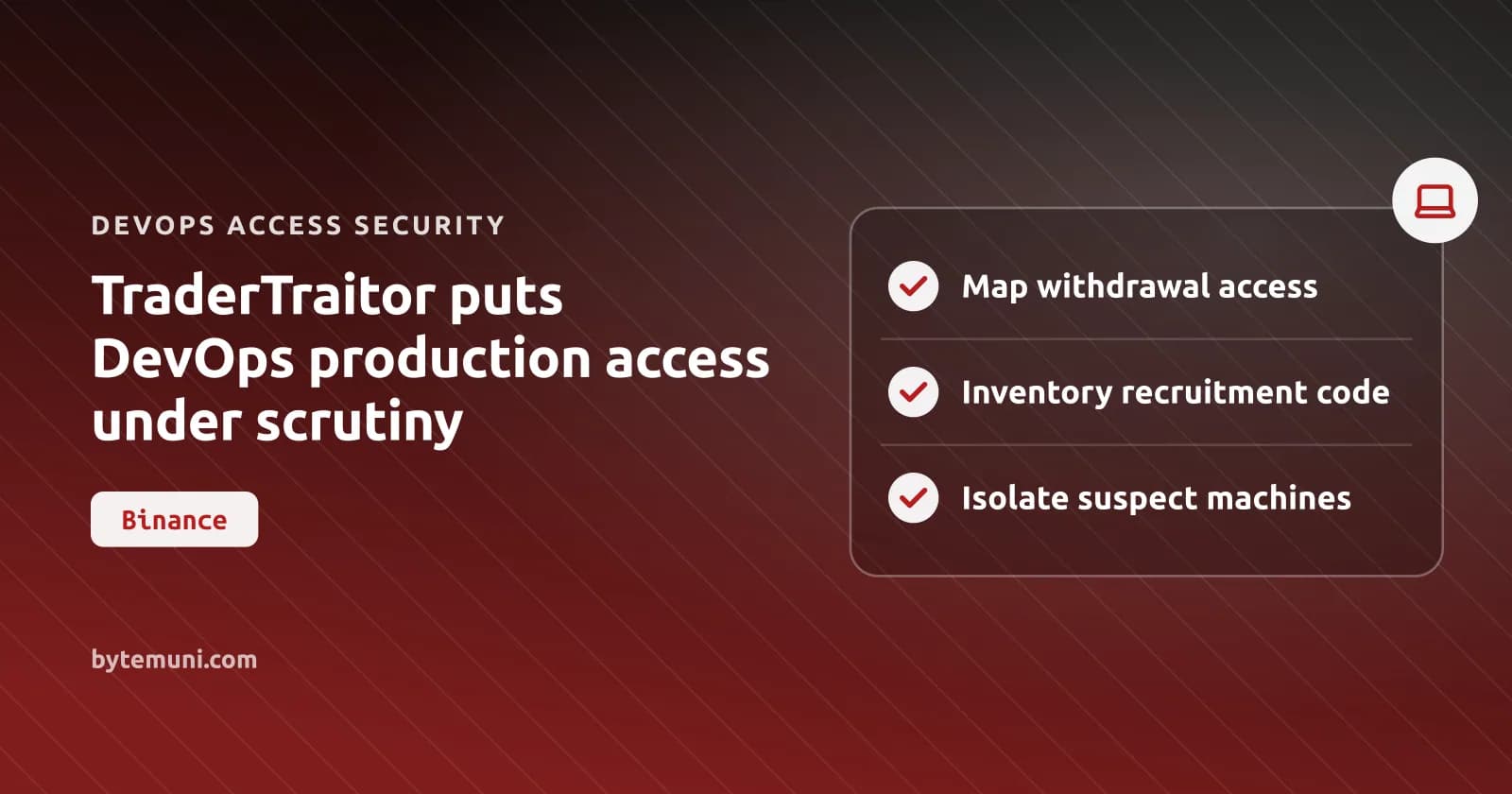
A compromised DevOps laptop is the reported route into the Binance theft. The FBI has attributed the theft to TraderTraitor, according to The Hacker News; BleepingComputer reports that Binance traced the breach to that laptop, which allowed access to a service container and unauthorised withdrawals. I'd start with that access path: a developer's machine reaching transaction systems.
What does the TraderTraitor attribution establish?
North Korea is responsible for the theft, and TraderTraitor is the actor, in the FBI's formal attribution. It is not a complete public reconstruction of the initial compromise, and I would not read it as one.
On or about October 29, 2026 is the date of the theft in the FBI alert quoted by BleepingComputer. The Hacker News lists several tracking names for TraderTraitor, including Jade Sleet. It says TraderTraitor has operated since at least 2020 and has targeted cryptocurrency businesses with malware-laced applications.
There is a counterpoint in the public accounts. I'd keep it separate from the technical evidence. Associated Press reporting carried by ABC News records President Donald Trump expressing uncertainty about North Korean involvement, a position that differs from the FBI's formal attribution.
Working with the U.S. Secret Service and IRS Criminal Investigation, the bureau reports observing stolen assets being converted primarily into Ethereum.
The reported laptop breach does not prove a Terraform entry point
BleepingComputer describes a Binance-specific path: a compromised DevOps engineer's laptop, access to a service container, then unauthorised withdrawal submissions.
An endpoint compromise is one checkpoint. Permission to submit withdrawals is another. I want an answer at each: what executed on the machine, and what production authority became reachable from it afterward?
NBC News describes an attack on the people and systems controlling wallets as a possible familiar playbook.
Trojanized providers are a documented group tactic
Research from SentinelOne, Zscaler ThreatLabz and Microsoft, cited by The Hacker News, describes trojanized Terraform providers and recruitment-themed targeting. Those are documented TraderTraitor tactics. A documented TraderTraitor tactic does not fill that gap on its own.
| Component | Reported behaviour |
|---|---|
| Trojanized Terraform provider | Delivers a Bash loader. |
| Bash loader | Selects and downloads malware tailored to the victim's operating system. |
| FLATROOF | A cross-platform implant that siphons sensitive data using a Python-based information stealer. |
| ROOFDECK | A backdoor dropped later to obtain complete remote control. |
macOS, Linux and Windows are all covered by the reported targeting. I'd draw the boundary at execution of attacker-controlled development tooling, not at the choice of desktop operating system.
Recruitment credibility is part of the attack
Microsoft describes recruiters impersonating an AI-powered blockchain intelligence company. Tailored domains, social profiles and industry knowledge support the impersonation; the identity is not just a company name in a message. Microsoft also reports similar TraderTraitor targeting through two additional front companies. The broader TraderTraitor activity targets people working in cybersecurity, AI, blockchain and talent recruitment businesses.
My concern is the next request: what does the recruiter ask someone to execute once that credibility is in place? Neither establishes that an exercise is safe to run on a machine with production access, however credible the recruitment conversation may appear.
The DMM Bitcoin attack offers a concrete precedent in BleepingComputer's account. An attacker impersonated a recruiter on LinkedIn and persuaded a Ginco employee to run malicious Python presented as a pre-employment test. That's a reason I'd scrutinise recruitment-related execution. It is not a reason to treat every Python exercise, or every Terraform provider, as malicious.
Checking developer access to withdrawal-capable services
These are defensive recommendations based on that access path. They are not remediation steps published by Binance, and I would not present them as the company's account of its response:
- Map workstation access to withdrawal-related services. Identify the developer machines and identities that can reach service containers involved in withdrawals, then record the authority exposed by each path. I'd treat this as a device-to-server access review, with the exposed authority recorded alongside the connection.
- Inventory recruitment-related code execution on those machines. Look for interview repositories, newly introduced Terraform providers, Bash loaders and Python exercises associated with unsolicited outreach. Tie the execution history to the particular device and its production access. That's the record I want to examine.
- Isolate a credibly suspected workstation. Preserve the material needed to determine what ran and when it ran. Receiving a recruitment message alone does not prove infection. Executing a suspicious exercise on a machine connected to production gives a different basis for a response. I'd keep those situations distinct: collapsing them into one loses the difference between a message received and code actually executed.
- Revoke affected production access. Start with the identities and access material reachable from the suspected machine. Verify its effect: access that previously worked from the affected environment should no longer succeed. That is the concrete check I'd use, because recording that access was revoked is not the same as checking that the affected environment can no longer use it.
- Review withdrawal submissions from the related services. Where records exist, reconcile those submissions against authorised activity during the suspected exposure period. Workstation restoration answers a different question, and I'd keep it separate from this review.
This is not a version-specific web-server patch rollout. I wouldn't invent a one-line command to fill the space.
The theft estimates remain inconsistent across reports
More than $6 billion was stolen, according to all the reports. The exact total is disputed across the accounts, as is the number of blockchains involved. I'd leave those differences visible.
| Publisher | Reported stolen amount | Reported blockchain coverage |
|---|---|---|
| Associated Press, carried by ABC News | $6.3 billion | Not specified |
| BleepingComputer, detailed account | Approximately $6.36 billion | Ten blockchains |
| The Hacker News | $6.43 billion | 11 blockchains |
Most of the funds moved in just 20 minutes, BleepingComputer says. The Hacker News reports that 82% of the stolen funds were on Ethereum and Bitcoin.
Tether, Circle, Ripple, Arbitrum and Optimism froze $2.85 billion of the assets on-chain, The Hacker News also reports. The reported freeze does not mean that the same amount has been returned to Binance, and I would not describe that figure as returned funds on the strength of this account.
I'd keep the theft estimate, the frozen-asset amount and Binance's replacement backing in separate columns. Adding them together is not justified; neither is subtracting one from another and labelling the result a recovered balance.
Binance withdrawal restoration is not a complete recovery statement
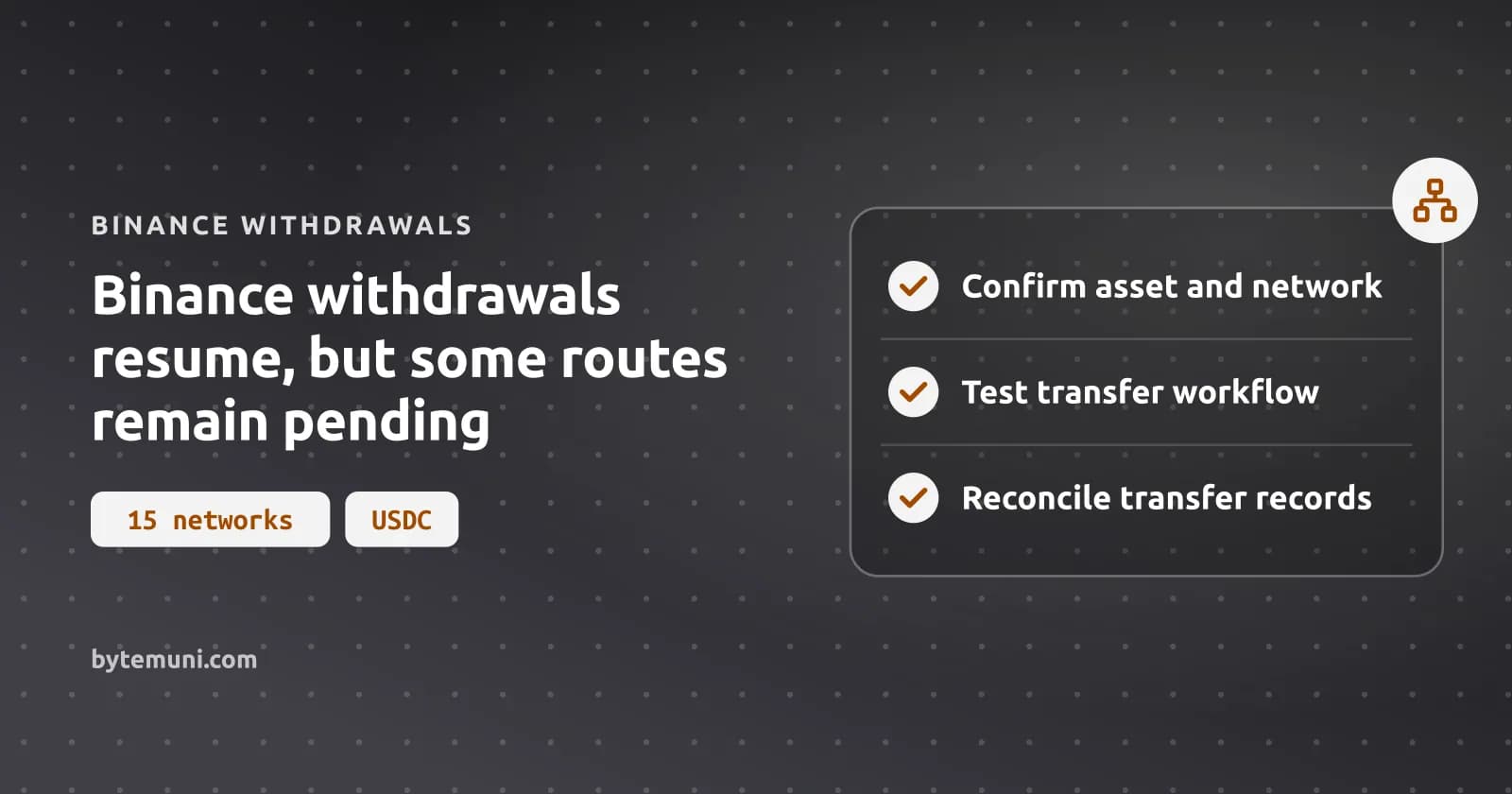
As of November 2, 2026, The Hacker News' updated report says Binance has resumed withdrawals for all 15 networks. Restoration began in phases at 6 a.m. UTC on November 1, 2026. Reported reopening has now superseded the plan; I'd use the updated account when describing withdrawal availability.
Between 06:00 and 15:30 UTC on November 1, Binance said it processed $4.649 billion in withdrawals and $1.01 billion in deposits. I'd keep both figures out of the theft total rather than mix post-reopening activity with the amount reported lost in the intrusion.
The backing statements changed too. Associated Press reported that Binance had set aside matching digital assets for 90% of the missing assets; BleepingComputer later reported approximately 95% coverage. In BleepingComputer's account, the remaining 5% consisted of less-liquid tokens being purchased through market and over-the-counter channels.
BTC, ETH, USDT, BNB, SOL, USDC, XRP, USD1, RLUSD and ZEC balances were fully backed, Binance told BleepingComputer. The company also said it would bear the financial impact instead of passing losses to users. I'd read those statements for what they address: balance backing and who bears the loss. They are company statements, not independent confirmation that the stolen assets have been recovered.
Deposit services remained unaffected, according to Binance. There is still a narrower readiness question in the updated reporting: it says all 15 networks reopened, yet also quotes Binance as saying it continued testing remaining networks and assets. I'd leave that ambiguity explicit.
Before retrying an operational withdrawal, I'd check availability for the intended asset and network.
Blocking laundering addresses is the exchange-side action
Cryptocurrency exchanges, blockchain operators and other virtual asset service providers are being asked by the FBI to block transactions linked to the published laundering addresses.
BleepingComputer reports 628 cryptocurrency addresses: 608 Ethereum addresses, 19 Bitcoin addresses and one Solana address. Implementing the request requires the actual agency-published addresses, not addresses guessed from the asset names or inferred from the totals.
I'd keep TraderTraitor's observed conversion into Ethereum separate from predictions about the next moves. The FBI expects TraderTraitor's use of DeFi and instant swap services. In the Associated Press account, TRM Labs chief policy officer Ari Redbord separately expects the assets to be broken into smaller pieces and moved through smaller exchanges, potentially over months.
Frequently asked questions
Does using Terraform mean my workstation is compromised?
No. The Hacker News describes trojanized Terraform providers used in TraderTraitor campaigns, not a compromise of every Terraform installation. The reports do not identify a specific poisoned provider for the Binance breach.
Can the frozen $2.85 billion be counted as funds returned to Binance?
No. The Hacker News reports an on-chain freeze. That does not establish that the assets have been returned to Binance, and it should not be treated as the same measure as Binance's replacement backing.
Does Binance's approximately 95% backing figure mean customers must absorb the remainder?
That is not what Binance said. BleepingComputer reports that the remaining 5% involved less-liquid tokens still being purchased, while Binance stated that it would bear the financial impact and would not pass the losses to users.
Sources: FBI Links North Korea's TraderTraitor to Record $6.43 Billion Binance Crypto Heist, FBI blames North Korea for stolen billions from Binance in biggest hack in history - ABC News, Binance hack: How North Korea’s TraderTraitor steals crypto, FBI links $6.3 billion Binance crypto heist to North Korean hackers
How we research, write and check articles