Google's November 2026 Core Update: How to Read Your Traffic
Google's November 2026 core update started on 10 November and is still rolling out. Here's what Google has and hasn't said, how long past updates took, and how to read Search Console without mistaking Diwali, Black Friday or a logging bug for a ranking change.

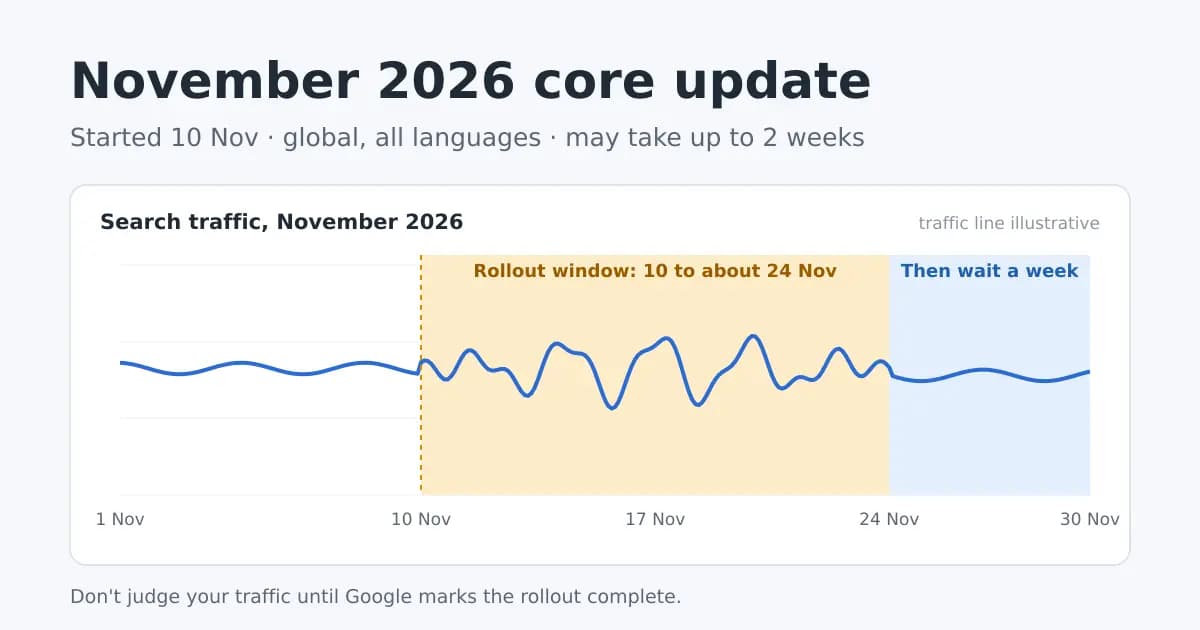
The November 2026 core update is a broad change to how Google ranks pages in Search. It started on 10 November 2026, applies worldwide in every language, and is still rolling out as of 18 November. Until Google marks it complete, any rise or fall in your Search Console numbers may not be the final result.
This article covers what Google has confirmed and what it hasn't, why a drop is not a penalty, and how long past core updates ran. It then walks through reading your traffic without being fooled by Diwali, Black Friday or a Search Console logging bug, and what to check if you did lose traffic.
What Google released on 10 November 2026
Google announced the update on its Search Status Dashboard, the page where it logs ranking updates and Search outages. The rollout began at 10:06 am US Pacific time on 10 November 2026. By our conversion, that is 11:36 pm the same day in India.
The dashboard entry says the update "applies globally and to all languages" and that the rollout may take up to two weeks. Two weeks from the start lands on 24 November, by our count. Treat that as an estimate, not a deadline: the last two November core updates took more than three weeks (see the table below).
As of 18 November, the entry has a single update, posted at 10:07 am Pacific on 10 November, and no completion note. Google's own advice is to confirm on that dashboard that a rollout has finished before you judge its effect. Some third-party trackers show "complete" and "in progress" fields side by side, so check Google's page itself.
By the dashboard's history, this is Google's third core update of 2026, after March and May. It follows three spam updates in June, August and September. Semrush and Search Engine Roundtable were among the outlets that covered the launch on the day.
What Google has said about this update, and what it hasn't
Beyond the dashboard line, Google's only description is a short Search Central post on LinkedIn. As quoted by Search Engine Journal, it reads: "This is a regular update designed to better surface relevant, satisfying content for searchers from all types of sites." Search Engine Journal notes that Google used the same sentence for its March 2026 core update.
Just as useful is the list of things Google has not said:
No list of changes. Neither the dashboard entry nor the LinkedIn post names a ranking system, content type or query category, according to coverage from Search Engine Journal and others.
No blog post. The Search Central blog had no post about the update at launch.
Nothing about AI Overviews or AI Mode. These are Google's AI-written answer features in Search. Neither announcement mentions them, so any claim about how this update changes AI answers is a guess.
No list of affected industries. Google hasn't named any sector, and as of 18 November we found no named data source showing which industries gained or lost.
If a blog post or video tells you this update "targets" a certain kind of site, check whether Google said so. For this update, Google hasn't.
What ranking trackers are showing so far
Search Engine Roundtable, which tracks several third-party volatility tools, reported on 16 November that talk about this update had been "more muted than most." Both the tools and community chatter rose on Saturday, 14 November. The site's read was that the update may have started to show three to four days after launch. That is an industry observation, not Google data.
Some trackers also reported ranking movement before 10 November. Google has said it announces core and spam updates shortly after they begin rather than days later, as Search Engine Roundtable reported in August 2026. Google's documentation also says it makes smaller, unannounced core updates. Movement before 10 November may have other causes, so don't blame it on this update by default.
Is a core update a penalty?
No. What people call a Google "penalty" is usually a manual action: a human reviewer at Google decides that a site breaks its spam policies, and some or all of the site is ranked lower or left out of results. Google tells you about it in the Manual Actions report and the Search Console message center. You fix the problem and then select Request Review.
A core update is a different thing. Google's core updates documentation says these changes are not aimed at particular sites or pages. Google re-assesses content across the web, so when your pages fall, other pages may simply look like better answers now. Google also says a site that drops isn't necessarily a bad site. There is no reviewer to appeal to and no review to request.
| Manual action | Core update | |
|---|---|---|
| Who decides | A human reviewer at Google | Google's automated ranking systems, for all sites |
| Cause | A spam policy violation | A broad re-assessment, not aimed at specific sites |
| How you find out | Manual Actions report and a Search Console message | No message to you; only the public dashboard entry |
| What you do | Fix the issue, then Request Review | Assess your content after the rollout ends; no review exists |
| Recovery | After Google revokes the action | Possibly days, possibly months or the next core update |
Ruling out a manual action takes a minute. In Search Console, open Security & Manual Actions → Manual actions. If there is nothing against your site, Google shows a green check mark. If you are new to the tool, our Google Search Console guide for students covers setting up a property and finding these reports.
How long do Google core updates take?
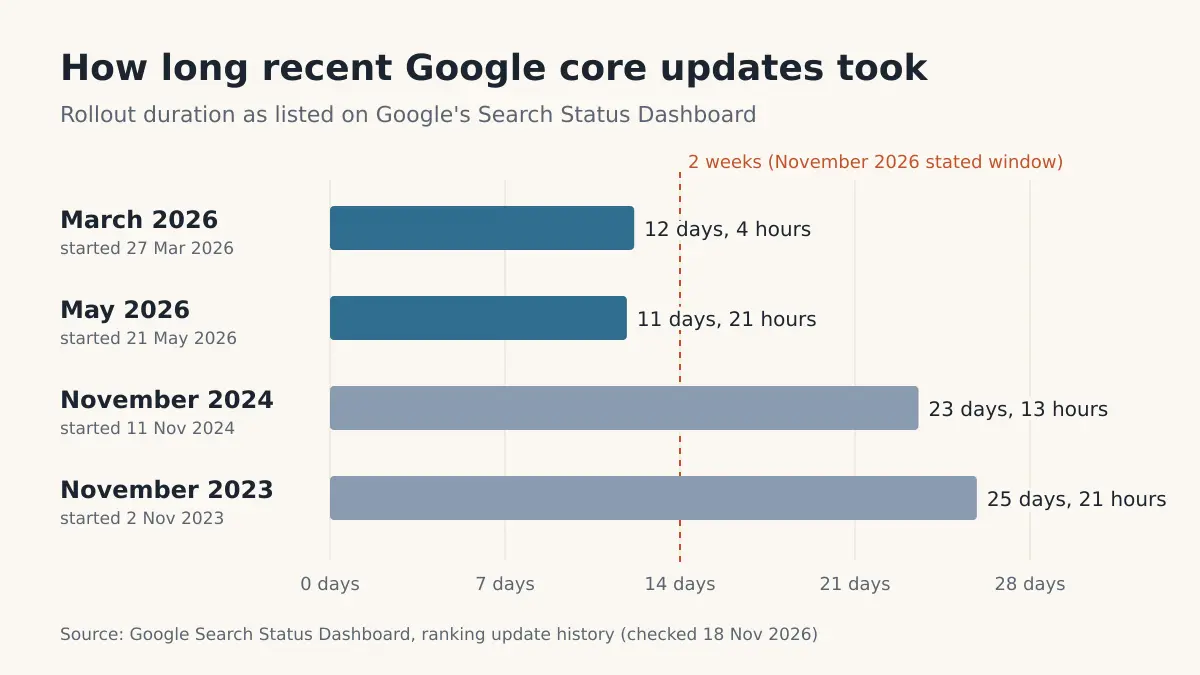
The dashboard lists each update's start date and how long it ran. Here are the four most useful comparisons for this rollout.
| Core update | Started | Duration (as listed by Google) | Finished (approx.) |
|---|---|---|---|
| November 2026 | 10 Nov 2026 | Still rolling out; "up to 2 weeks" | Not yet |
| May 2026 | 21 May 2026 | 11 days, 21 hours | 2 Jun 2026 |
| March 2026 | 27 Mar 2026 | 12 days, 4 hours | 8 Apr 2026 |
| November 2024 | 11 Nov 2024 | 23 days, 13 hours | 4–5 Dec 2024 (by our count) |
| November 2023 | 2 Nov 2023 | 25 days, 21 hours | 27–28 Nov 2023 (by our count) |
Start dates and durations come from Google's ranking update history. The page doesn't show start times, so our end dates are start plus duration and may be off by a day.
Both 2026 core updates finished in about 12 days. The last two November core updates took more than three weeks, and the March 2024 core update ran 45 days. Applying the recent range to 10 November gives a finish anywhere from about 22 November to early December, by our count.
How should you read Search Console during a core update?
Watch and take notes, but don't change anything yet. Google's guidance is to confirm the rollout is finished and then wait: "We recommend waiting at least a full week after a core update completes before analyzing your site in Search Console." Ranking changes in the middle of a rollout can reverse before it ends.
For Indian sites, the calendar around this update adds two traps and a known data bug. Here is the order to work in.
Confirm the rollout has finished. Check the Search Status Dashboard entry for a completion note. Until it appears, the rollout is still running.
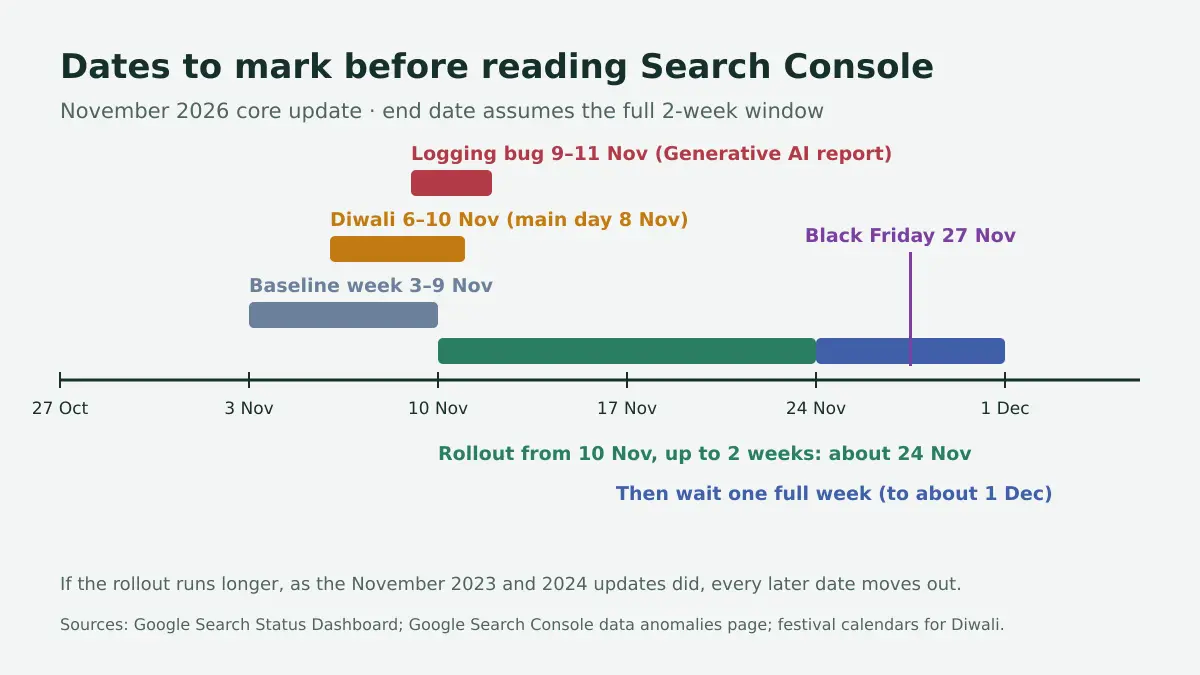
Wait seven full days after the completion date. If the update ends on 24 November, the first clean week runs to about 1 December, by our count.
Pick a matching comparison week. Google suggests comparing that week with a week before the rollout began. In the Performance report, use the date filter's Compare tab and choose two custom ranges of the same length that start on the same weekday.
Allow for Diwali in your baseline. The main day of Diwali fell on Sunday, 8 November 2026, and the five-day festival ran from 6 to 10 November, according to festival calendars. The obvious "week before" baseline, 3–9 November, contains it. Searches can rise or dip around a major festival, so check a second, earlier week too, such as 27 October to 2 November, or compare with last year.
Allow for Black Friday in the week after. Black Friday falls on 27 November 2026. If the rollout ends near 24 November, the first week after it includes Black Friday, so shopping and deals pages may move for reasons unrelated to ranking. Filter the report by country to separate Indian traffic from US traffic.
Ignore the 9–11 November dip in the Generative AI report. Google's data anomalies page says a logging error lowered impressions in the Generative AI performance report in Search for 9–11 November 2026, and that it affects data logging only. A dip on those days is a reporting gap, not lost visibility, and the dates sit in your baseline and on launch day. Leave them out of any comparison.
Look at pages and queries, not just the total. Google suggests reviewing your top pages and queries. Check whether the change hits a few pages or the whole site, and whether average position fell or only impressions fell. A fall in impressions with steady position often means lower demand, not a ranking loss.
It helps to know what else can look like a core update hit:
| What you see | Possible cause other than the update | How to check |
|---|---|---|
| Dip in Generative AI impressions on 9–11 Nov | Google's logging error | Data anomalies page; exclude those dates |
| High or low baseline week of 3–9 Nov | Diwali, 6–10 Nov | Compare with an earlier week or last year |
| Spike or drop in the last week of November | Black Friday, 27 Nov | Filter by country and by shopping pages |
| Movement before 10 Nov | Other changes, including smaller unannounced core updates | Note the dates; don't attribute them to this update |
| Whole site gone for some queries | A manual action | Manual Actions report |
What to do if your traffic fell after the update
Start with the size of the drop. For a small decline, Google's core updates page says there's no need for drastic action. For a large, lasting drop, it points to its guide to creating helpful, people-first content, which includes a self-assessment. Apply it first to the pages that lost the most.
Here are those questions, condensed into a checklist you can run on each affected page:
Does the page give original information, reporting, research or analysis, or does it mostly rewrite other sources?
Does it offer insight beyond the obvious, and cover the topic fully?
Does the title describe the content accurately, without exaggeration or shock?
Would someone bookmark it, share it or recommend it?
Is it clear who wrote it, with a byline where readers expect one and a way to learn about the author?
Does it cite its sources clearly, and is it free of easily checked factual errors?
Was it written mainly to draw search visits, or because a topic was trending?
Are you publishing on many unrelated topics in the hope that some rank?
Have you changed dates to look fresh when the content hasn't really changed?
Are you writing to a word count because you heard Google prefers one?
If you use automation or AI to produce content, is that clear to readers where they would expect to know?
After reading, would someone feel they learned enough to reach their goal, or would they search again?
Avoid quick fixes. Google's core updates guidance warns against them and calls deleting content a last resort. Rewriting dates, mass-deleting posts or adding keywords won't answer the questions above.
Recovery takes time, and nothing guarantees it. Google says some changes can show within days, but its systems may take several months to confirm that a site keeps producing helpful content. If nothing changes after a few months, recovery may have to wait for the next core update. Google also says smaller core updates, which it doesn't announce, can bring gains in between.
My take on the November 2026 core update
My read is that the costliest mistake this week isn't the update itself but reacting to it before it ends. Indian sites have it harder than usual: Diwali sits in the natural baseline week, a logging bug sits on launch day, and Black Friday may fall in the first clean week after. I'd note daily numbers now, mark those dates on a calendar, and make no structural changes until the dashboard says complete and a week has passed.
If the drop turns out to be large and lasting, the helpful-content questions are the honest place to start. They are slower to answer than any tweak, which is the point. A site that answers them well is building for the next core update too, not just this one.
The bottom line on the November 2026 core update
Until Google's dashboard marks the rollout complete, don't change anything because of rankings. Once it is done, wait seven days, compare against a baseline that avoids Diwali and the 9–11 November logging gap, and rule out a manual action. Only then decide whether you have a content problem, using Google's own questions rather than anyone's guess about what this update targets.
Frequently asked questions
When will the November 2026 core update finish?
Google said the rollout may take up to two weeks from 10 November, which points to about 24 November. It isn't a fixed date: the November 2023 and November 2024 core updates each ran for more than three weeks. The only reliable signal is a completion note on Google's Search Status Dashboard.
Is the November 2026 core update finished yet?
As of 18 November 2026, Google's Search Status Dashboard has no completion note for it, so it is still rolling out. Some third-party trackers display status labels that are easy to misread, so check Google's dashboard directly.
How do I know if my site got a manual action instead?
Open Search Console and go to Security & Manual Actions, then Manual actions. A green check mark means there are no manual actions against your site. Google also sends a Search Console message when it applies one.
Should I update or delete old posts while the update rolls out?
Google advises against quick fixes and calls deleting content a last resort. Its guidance is to wait at least a full week after the rollout finishes before analyzing your site, so making big changes mid-rollout mixes your own edits with Google's changes.
Why did my Generative AI impressions drop on 9–11 November?
Google's Search Console data anomalies page lists a logging error that lowered impressions in the Generative AI performance report in Search for 9–11 November 2026. Google says it affects data logging only, so the dip doesn't reflect lost visibility.
How long does recovery from a core update take?
Google says some changes can show within days, but its systems may take several months to confirm that a site consistently produces helpful content. Sometimes that means waiting for the next core update, although smaller unannounced core updates can also bring gains. Nothing guarantees recovery.
Concepts in this article
- Artificial intelligence
- Computer systems that perform tasks that normally need human intelligence.
- Generative AI
- Models that produce new text, images, audio or code.
- Google Search Console
- Google's tool for seeing how a site appears and performs in Search.
- Numbers
- Floating-point numbers, BigInt, NaN and precision pitfalls.
How we research, write and check articles