OpenRouter Pulls 125 Endpoints From Zero Data Retention After Leaks
OpenRouter removed three unnamed inference providers and pulled 125 endpoints from zero data retention after Dragos canary research showed prompts being read downstream. Here is what ZDR covers, what Together AI, Phala and Novita have confirmed, and the settings and rotations developers should do now.

Status: OpenRouter zero data retention was pulled from 125 endpoints, and three inference providers were removed, on November 22, 2026, after Dragos research found prompts being read by parties downstream. OpenRouter has not named the three providers; this article will be updated as more providers disclose.
OpenRouter zero data retention no longer applies to 125 endpoints after the AI gateway removed three inference providers on November 22, 2026, OpenRouter said in an announcement. The move follows research by the security firm Dragos that showed seeded prompts being read after inference. OpenRouter says the findings "did not show any breach or unauthorized access of OpenRouter."
This report covers what OpenRouter changed, what ZDR promises, how Dragos tested it, what three providers have confirmed, and what developers should change now. The story was first reported by The Hacker News.
What OpenRouter changed on November 22
OpenRouter is a gateway. A developer holds one OpenRouter API key, names a model, and OpenRouter forwards the request to a third-party inference provider hosting that model.
According to OpenRouter, three providers were off-boarded. The 125 endpoints that lost ZDR eligibility include ones the researchers flagged plus others removed as a precaution. OpenRouter says it notified every potentially affected customer. It will now run the researchers' test method continuously, verify network paths to catch forwarding to third parties, and require validation before restoring ZDR.
The announcement links to statements from Novita, Phala and Together as providers that published incident notices. It does not say these are the three removed providers, and it notes that not every affected provider has posted publicly.
What does OpenRouter zero data retention actually promise?
OpenRouter's ZDR documentation defines it as "no routine storage of prompts or responses after processing," with an exception for child sexual abuse material (CSAM) review. The same page lists gaps:
In-memory caching at a provider is not counted as retention.
Plugins and tools such as web search follow their own retention rules.
Safety Retention endpoints may keep prompts to detect abuse and don't meet strict ZDR.
Resellers are not mentioned.
OpenRouter's data processing agreement adds that its ZDR list reflects each provider's published or stated policy, not a guarantee that the provider complies. So OpenRouter zero data retention is a routing filter built on what providers declare. It cannot see inside their servers.
How did Dragos find prompts being read downstream?
HD Moore, Chief Research Officer at Dragos, published the research on November 19, 2026. From July to November his team sent about two million prompts, each carrying unique canary tokens: URLs, DNS names and AWS keys tied to empty, monitored accounts. They traced about two thousand routes.
A canary exists only inside one prompt and has no legitimate use. If anyone fetches that URL or tries that key, some person or system on the route read the prompt.
The limit: Phala's report notes that canary tests don't see every request or every data-access event. The tests sampled traffic, so a provider with no canary hits has not been proven clean.
What providers have confirmed so far
| Provider | What happened | Window | Confirmed vs precautionary | Source |
|---|---|---|---|---|
| Together AI | A leaked credential let an unauthorized party download stored prompt samples | Samples mainly from June 24 and July 4, 8, 14 | Confirmed; personal data review not finished | Together, Nov 21 |
| Phala | Attacker took over a GPU inference VM serving DeepSeek V4 Flash 0731 via OpenRouter | Oct 21, 00:00 UTC to Nov 8, 05:35 UTC | Misuse confirmed for Oct 21–22; rest precautionary | Phala, Nov 10 |
| Novita | Routing config sent some MiniMax requests to MiniMax's official API | May 28 to Nov 11 | Misrouting confirmed; URL access seen, no AWS key use seen | Novita, Nov 22 |
Together AI says the samples came from its serverless MiniMax M3, GLM-5.2 and Kimi K2.6 models. Its notice says "an AI coding agent committed a credential that provided access to the private Hugging Face repository" during work on its public xorl repo. Five credentials the attacker tested were Dragos canaries. ByteMuni has covered keeping Claude Code secrets out of GitHub with approval rules.
Phala says an attacker chained an old internet-facing service with management interfaces that trusted loopback calls without authenticating them. For requests in its window, it tells users to "treat request contents as exposed."
Novita says a forwarding path meant for specific customers applied more broadly, including to requests from OpenRouter. It told affected users "your request contents may have been accessed or retained by a third party."
Dragos reports more that no provider has confirmed. It says data from at least three providers was exposed. Individual sellers on an inference marketplace logged prompts and used the secrets within days, including SSH root login attempts. A Chinese AI lab's systems fetched secret URLs from over half the prompts sent to its models, including about two-thirds of requests marked for ZDR or no data collection.
Why a privacy flag binds only the first hop
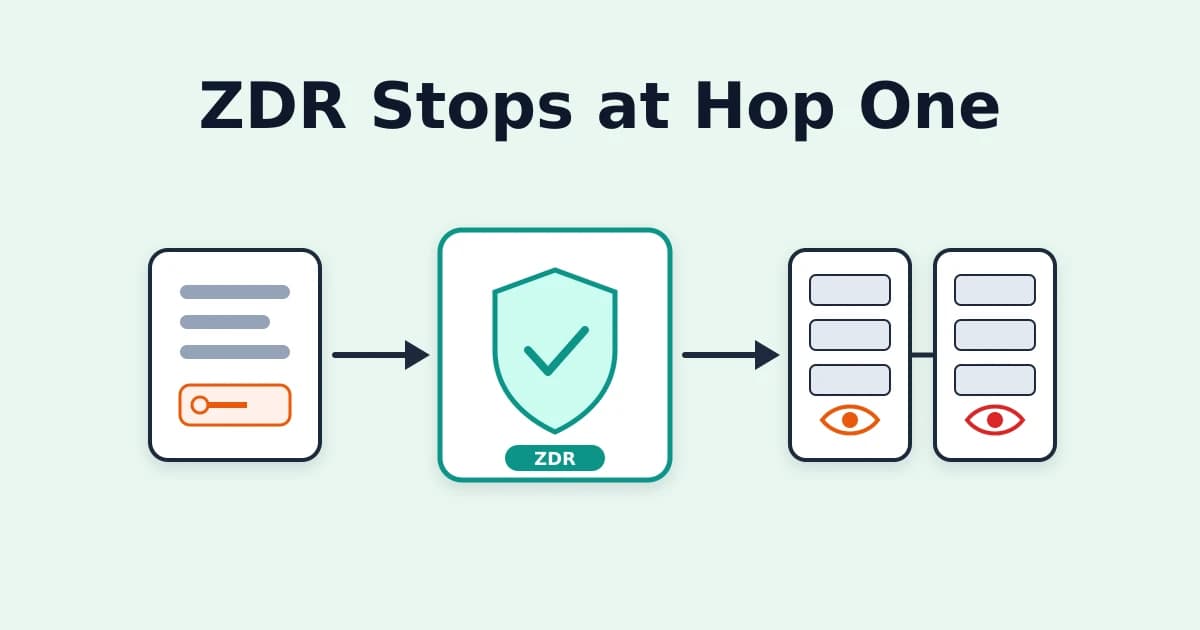
Your app calls the gateway. The gateway picks an endpoint whose declared policy matches your flag. That provider may run the model or forward the call to a reseller or the model maker's API, as in Novita's case. Dragos notes every hop sees the full prompt and response.
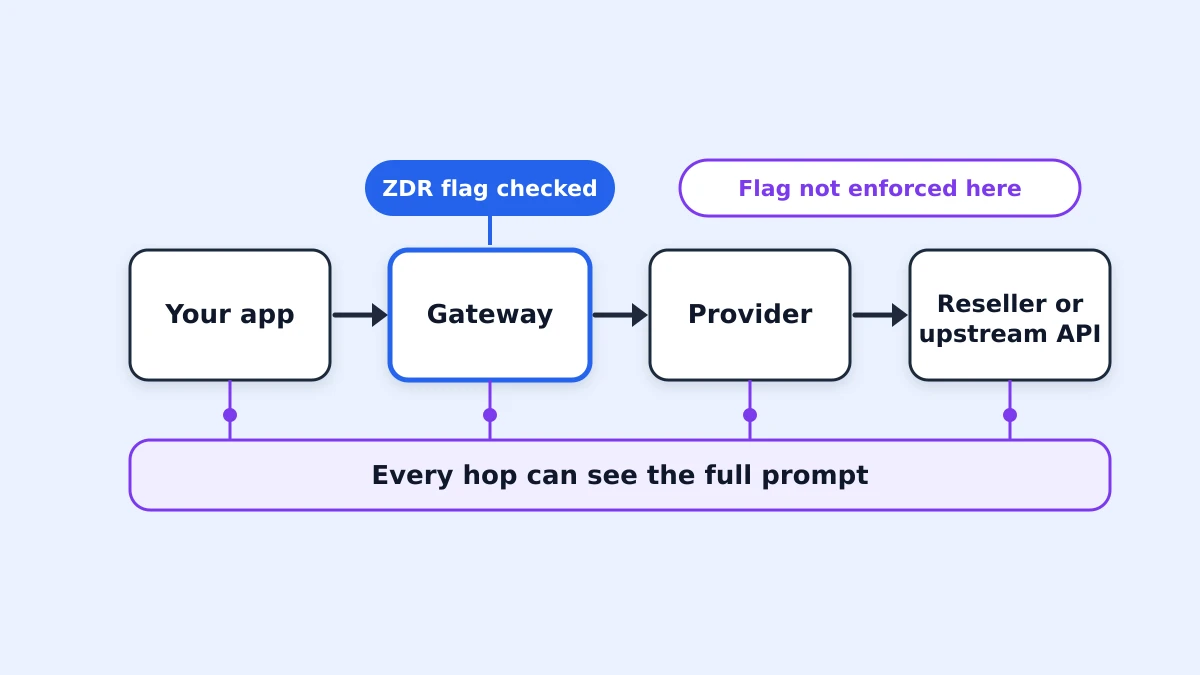
The flag shapes the gateway's choice. It is not enforced at the next hop, and a storage policy does nothing against an attacker reading live traffic. Moore put it this way: "A privacy flag doesn't help when the attacker is already inside." For where the gateway sits among agents, tools and models, see how the AI agent stack fits together.
Who needs to act first
Apps sending customer personal data, credentials or source code to hosted models through a gateway or reseller.
Users of the specific models and windows in the table above.
Agents that put API keys or tokens into system prompts, RAG context or tool output.
In India, section 8 of the DPDP Act, 2023 requires a Data Fiduciary to protect personal data with reasonable security safeguards, including processing by its Data Processor, and to report a breach to the Data Protection Board and each affected person. This is general information, not legal advice.
How to lock down OpenRouter routing and check for misuse
Rotate secrets. Treat any key that ever sat in a prompt, system prompt, RAG document or tool output as seen. Phala and Novita both advise rotation.
Keep secrets out of prompts. Let a server-side tool hold the credential and return only results. Dragos also suggests provider-side secret filtering, noting it misses data that doesn't look like a key.
Pin providers and disable fallbacks with OpenRouter's provider routing fields, shown below.
Require OpenRouter zero data retention, but don't treat it as a security boundary. Use privacy settings,
provider.zdr, or guardrail fields such asenforce_zdr_other.Seed canaries in the context your agents send, and treat any use as an incident, as Dragos recommends.
Self-host where you can. Dragos calls it the only option that keeps prompts from third parties, while noting the hardware cost. A direct contract with one first-tier provider is its middle path.
This request runs only on the named provider, never falls back, skips providers that may store data, and needs a ZDR endpoint. Set MODEL and PROVIDER_SLUG from the model's OpenRouter page:
curl https://openrouter.ai/api/v1/chat/completions \
  -H "Authorization: Bearer $OPENROUTER_API_KEY" \
  -H "Content-Type: application/json" \
  -d '{
    "model": "'"$MODEL"'",
    "messages": [{"role": "user", "content": "ping"}],
    "provider": {
      "only": ["'"$PROVIDER_SLUG"'"],
      "allow_fallbacks": false,
      "data_collection": "deny",
      "zdr": true
    }
  }'
The trade-off: with fallbacks off, a provider outage means failed requests rather than a quiet switch to another host.
Dragos published the user agents artex-agent and artex-judge-r121, plus Kali and ARTEX strings in AWS CloudTrail, but no IPs or hashes. To search NGINX logs and recent CloudTrail events:
zgrep -hE 'artex-agent|artex-judge-r121' /var/log/nginx/access.log*

aws cloudtrail lookup-events \
  --start-time 2026-05-28T00:00:00Z \
  --query 'Events[].CloudTrailEvent' --output text \
  | grep -iE 'artex|kali'
No output does not prove safety: lookup-events covers only 90 days of management events. A hit means a credential from your traffic is being tested.
Timeline of the OpenRouter prompt exposure
| Date (2026) | Event | Source |
|---|---|---|
| May 28 | Novita misrouting window begins | Novita |
| June 24 – July 14 | Dates of most leaked Together prompt samples | Together AI |
| July | Dragos starts canary prompts; sees an unnamed provider breach mid-month | Dragos |
| Oct 21 | Phala exposure window opens | Phala |
| Late October | Seeded AWS keys stolen from two providers | Dragos |
| Nov 5–8 | Phala detects the intrusion and completes containment | Phala |
| Nov 10 | Phala preliminary report | Phala |
| Nov 11 | Novita misrouting window ends | Novita |
| Nov 19 | Dragos publishes its research | Dragos |
| Nov 21 | Together AI notice | Together AI |
| Nov 22 | Novita notice; OpenRouter removes three providers, pulls 125 endpoints from ZDR | Novita, OpenRouter |
No CISA or CERT-In advisory on this was found when ByteMuni checked on November 22, 2026.
My take on OpenRouter zero data retention
My read is that OpenRouter zero data retention worked as written and still missed what users assumed. It is a storage label checked at one hop, and the leaks happened at hops it never reached. The fixes teams control are plain: no secrets in prompts, a pinned provider, and a canary that tells you when someone is reading. Together's root cause also shows coding agents need the same secret scanning as people.
Frequently asked questions
Was OpenRouter itself hacked?
No. OpenRouter says the findings did not show any breach or unauthorized access of its own systems. The exposures Dragos found happened at providers and other parties downstream of the gateway.
Which three providers did OpenRouter remove?
OpenRouter has not named them. Its announcement links to notices from Novita, Phala and Together AI as providers that published statements, but it does not say those are the providers it removed.
Does turning on ZDR mean nobody can read my prompts?
No. OpenRouter defines ZDR as no routine storage of prompts or responses after processing, based on what providers declare. It does not stop a compromised provider, a reseller or an upstream API from reading the prompt while it is processed.
How do I stop OpenRouter from sending my request to a different provider?
Set provider.only to the provider slugs you trust and provider.allow_fallbacks to false. Add data_collection: "deny" and zdr: true to skip endpoints that may store data. With fallbacks off, a provider outage means failed requests.
What is a canary token and how did Dragos use one?
A canary token is a fake secret, such as a unique URL or an AWS key for an empty monitored account, that has no legitimate use. Dragos put unique canaries into about two million prompts, so any use of one showed that someone on that route had read the prompt.
Do Indian companies have legal duties if prompts held customer data?
Under section 8 of India's DPDP Act, 2023, a Data Fiduciary must use reasonable security safeguards, including for processing done by its Data Processor, and must report a personal data breach to the Data Protection Board and to affected people. This is general information, not legal advice.
Concepts in this article
- AI agents
- Systems where a model plans and takes actions with tools in a loop toward a goal.
- Artificial intelligence
- Computer systems that perform tasks that normally need human intelligence.
- Claude
- Anthropic's family of AI models and assistants.
- Coding agents
- AI agents that read, write and run code in a repository.
- Events and event handling
- Reacting to things that happen: DOM events, Node's EventEmitter and React event handlers.
- Hugging Face
- A hub and set of libraries for sharing and running machine-learning models.
- Retrieval-augmented generation (RAG)
- Fetching relevant passages from your documents and giving them to the model with the question.
How we research, write and check articles