nginx2root (CVE-2026-123007): Check, Patch and Mitigate NGINX
A 10-year-old HTTP/2 bug in NGINX can lead to code execution in the worker process, and Ubuntu, Debian trixie and Alpine 3.24 now ship fixed packages. Here's how to confirm your server is really patched, and what to do on Debian bookworm or RHEL, which have no fix yet.


Update (November 19, 2026): Distro fixes for nginx2root CVE-2026-123007 are shipping. Ubuntu has fixed nginx in all supported releases (20.04 and older through Ubuntu Pro), and Debian has fixed trixie and sid. Debian bookworm and forky are still vulnerable as of today. Fixed upstream versions 1.31.9 and 1.30.7 were released on November 18, 2026.
nginx2root CVE-2026-123007 is a memory-corruption bug in how NGINX handles HTTP/2 flow control, and it has been in the code since NGINX 1.9.5, released in September 2015. If your server speaks HTTP/2, install your distro's fixed package or upgrade to 1.31.9 or 1.30.7. Then fully restart NGINX.
This guide explains how the bug works and which versions and setups are affected. It also covers which Linux distributions have shipped fixed packages, how hard real exploitation is, how to check your own server, and how to patch or work around the bug. Each workaround comes with what it leaves open.
What is nginx2root CVE-2026-123007, and which NGINX versions are affected?
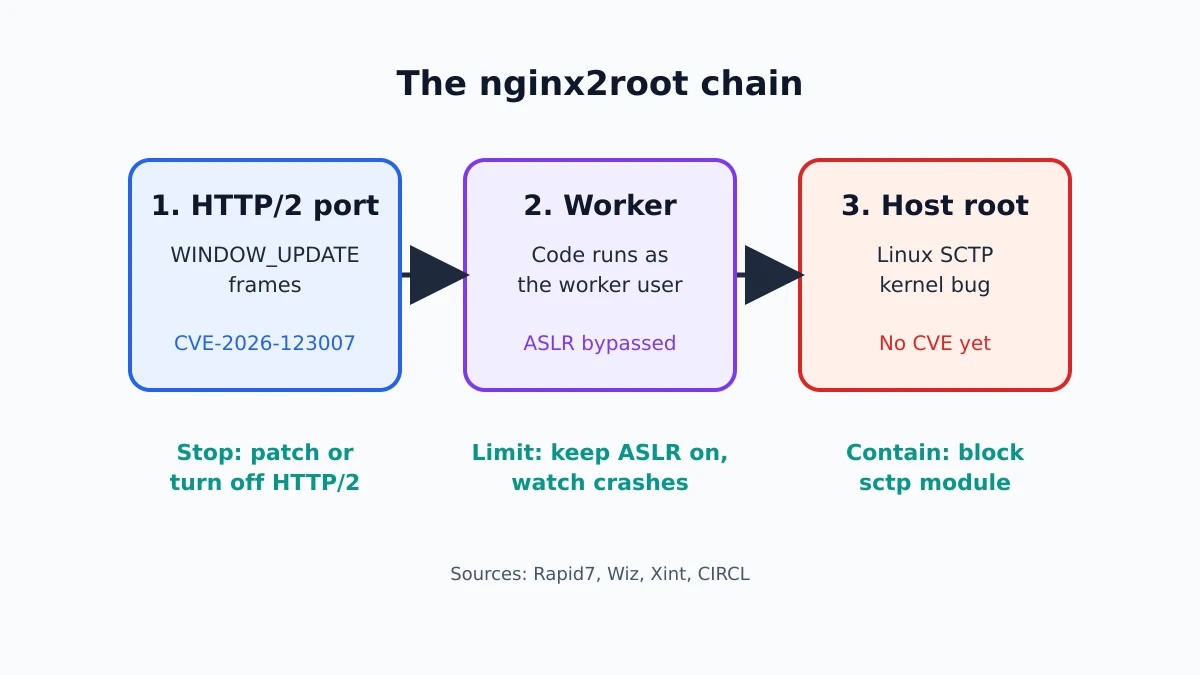
NGINX is the open-source web server and reverse proxy that sits in front of a large share of PHP, Node.js and container workloads. "nginx2root" is the name the security firm Xint gave to a set of bugs it reported. In Xint's write-up, the name covers five NGINX CVEs plus a separate Linux kernel flaw that turns a worker compromise into root. Most coverage uses the name for the headline bug, CVE-2026-123007.
The official 1.31.9 changelog describes it as a flow control window overflow in HTTP/2 that can crash a worker process "or might have potential other impact". The nginx.org advisory page rates it "major" and lists 1.9.5 through 1.31.8 as vulnerable.
| Product and branch | Vulnerable versions | Fixed version |
|---|---|---|
| NGINX Open Source, mainline | 1.31.0 – 1.31.8 | 1.31.9 |
| NGINX Open Source, stable and older | 1.9.5 – 1.30.6 | 1.30.7 |
| NGINX Plus 37.1 / 37.2 line | 37.1.0 – 37.2.0.1 | 37.3.0.1 |
| NGINX Plus 37.0 line | 37.0.0 – 37.0.7.1 | 37.0.8.1 |
| NGINX Plus R34 – R36 | Affected | No fix listed |
Open Source ranges come from nginx.org. NGINX Plus rows follow F5's advisory as reproduced by Rapid7 and The Hacker News. Per that summary, 37.3.0.1 and 37.0.8.1 fix four of the five CVEs; the fix for CVE-2026-123633 had already shipped in 37.2.0.1 and 37.0.7.1.
How each organization rates CVE-2026-123007
The severity depends on who you ask and which scoring system they use. The scores differ because CVSS 3.1 and CVSS 4.0 are different scales, not because the facts differ.
| Who | Rating |
|---|---|
| nginx.org | Severity "major" |
| F5 (as listed by Wiz and Rapid7) | CVSS 4.0: 9.2 (Critical) |
| Red Hat | Impact "Critical"; CVSS 3.1: 8.1, marked preliminary |
| Ubuntu | Priority "High"; shows CVSS 3.1 8.1 and CVSS 4.0 9.2 |
The four other CVEs fixed in the same release
Each one needs a different feature switched on, and that decides which workaround helps. Version ranges below are nginx.org's. Xint and CIRCL, Luxembourg's computer emergency response team, give later "first affected" versions for CVE-2026-123634 and CVE-2026-113425.
| CVE | Bug | Setup it needs | Vulnerable (nginx.org) | nginx.org severity | CVSS 4.0 (F5, via Wiz) | Blocked by turning off HTTP/2? |
|---|---|---|---|---|---|---|
| CVE-2026-123007 | HTTP/2 flow-control memory corruption | HTTP/2 enabled | 1.9.5 – 1.31.8 | Major | 9.2 | Yes |
| CVE-2026-123633 | HTTP/2 use-after-free | HTTP/2 with upstream proxying, when worker_connections run short | 1.19.7 – 1.31.8 | Medium | 9.2 | Yes |
| CVE-2026-123634 | Resolver use-after-free | resolver plus a request-derived proxy_pass name, triggered through subrequests (mirror, or SSI per Red Hat) | 0.6.18 – 1.31.8 | Medium | 9.2 | No |
| CVE-2026-121810 | HTTP/3 use-after-free | HTTP/3 (QUIC) with upstream proxying, when worker_connections run short | 1.25.0 – 1.31.8 | Medium | 9.2 | No |
| CVE-2026-113425 | Mail proxy use-after-free | Mail proxy with proxy on and auth_http | 0.5.33 – 1.31.8 | Major | 9.2 | No |
The same release fixes five more advisories, including an endless loop when a worker reads a request body over TLS. One naming note: nginx2root is not related to HTTP2Shell, the Brotli decompression bug we covered in HTTP2Shell (CVE-2026-111497) beyond Node.js.
How does the HTTP/2 flow-control bug corrupt memory?
HTTP/2 lets each side cap how much data the other may send, using a "window" counter. The protocol limits that window to 2^31 − 1 bytes, and Rapid7's analysis shows NGINX did not enforce that limit everywhere. The bug class is an integer underflow: subtracting a bigger number from a smaller unsigned one doesn't go negative. It wraps around to a huge positive value instead.
In Rapid7's walkthrough, the connection's send window is an unsigned size_t. When a request closes, NGINX adds the length of unsent DATA frames back to the window without checking the maximum, so the counter can go past the limit. A later check in the WINDOW_UPDATE handler subtracts the counter from the maximum. Once the counter is already too big, that subtraction wraps. Further WINDOW_UPDATE frames then pass the check and push the value higher still.
That oversized value later becomes a negative length when NGINX builds the outgoing data. Buffered TLS output then calls memcpy with an enormous size. Rapid7 classifies the bug as CWE-191, integer underflow.
How hard is nginx2root to exploit on a real server?
It's serious, but it's not a one-packet takeover. The research teams' findings point in the same direction.
ASLR is a hurdle, not a shield. F5's CVE description, carried on Ubuntu's CVE page, says attackers can execute code when address space layout randomization (ASLR) is disabled or when they can bypass it. The researchers bypassed it: Wiz confirmed code execution with an ASLR bypass on official 1.31.7 and 1.31.8 builds, and CIRCL says disabling ASLR is not a prerequisite.
The attacker gets the worker, not root. Code runs with the NGINX worker's permissions, usually an unprivileged user like
nginxorwww-data. Rapid7 did not establish execution as the master process or root.Root needs a second bug. Xint chained a Linux kernel use-after-free in SCTP (Stream Control Transmission Protocol, a rarely used transport protocol). Xint says this bug dates back to Linux 4.15 and had no CVE and no kernel patch at publication. With it, Xint escaped a Docker container and got root on the host.
Rapid7's method is heavy. It needs roughly 128 GB of HTTP/2 traffic and a glibc
memcpyroutine chosen on CPUs with avx512f and avx512vl. Rapid7 estimates about 2 minutes on a 10 Gbit/s link and 17 minutes on 1 Gbit/s. Links slower than about 300 Mbit/s would likely hit NGINX's default one-hour connection limit first.
On attacks so far, The Hacker News reported in its November 18 report on nginx2root CVE-2026-123007 that F5, Wiz and Rapid7 had seen no exploitation in the wild. It also reported that the CVE was not in CISA's Known Exploited Vulnerabilities (KEV) catalog. When ByteMuni checked on November 19, CISA's catalog would not load, so that status is still the one from November 18.
A public proof of concept is on GitHub at sfewer-r7/CVE-2026-123007. Its README says it is only suitable for demonstrating the technique against a local, freshly started Docker container. It will likely fail with concurrent clients, a "messy" heap, low bandwidth or a proxy in the path. Treat "lab only" as today's status. An earlier 2026 NGINX memory bug, CVE-2026-42945, was being exploited days after disclosure in May, according to VulnCheck's report via Help Net Security.
Signs that someone has tried
CIRCL's guidance lists heuristics, not confirmed indicators: workers spawning unexpected programs, abnormal worker exits or core dumps, and long HTTP/2 connections with heavy inbound traffic but few logged requests. That last one matters because WINDOW_UPDATE frames never show up in access logs. None of these proves an attack, and seeing none doesn't prove you're safe. CIRCL suggests these checks:
sudo grep -Ei 'worker process.*exited|signal 11|segfault' /var/log/nginx/error.log
sudo coredumpctl list nginx
sudo ss -tinp state established '( sport = :443 )'
Xint also recommends watching auditd execve events from the worker's user ID. A web server's worker user should almost never start a shell.
How to check whether your NGINX server is exposed
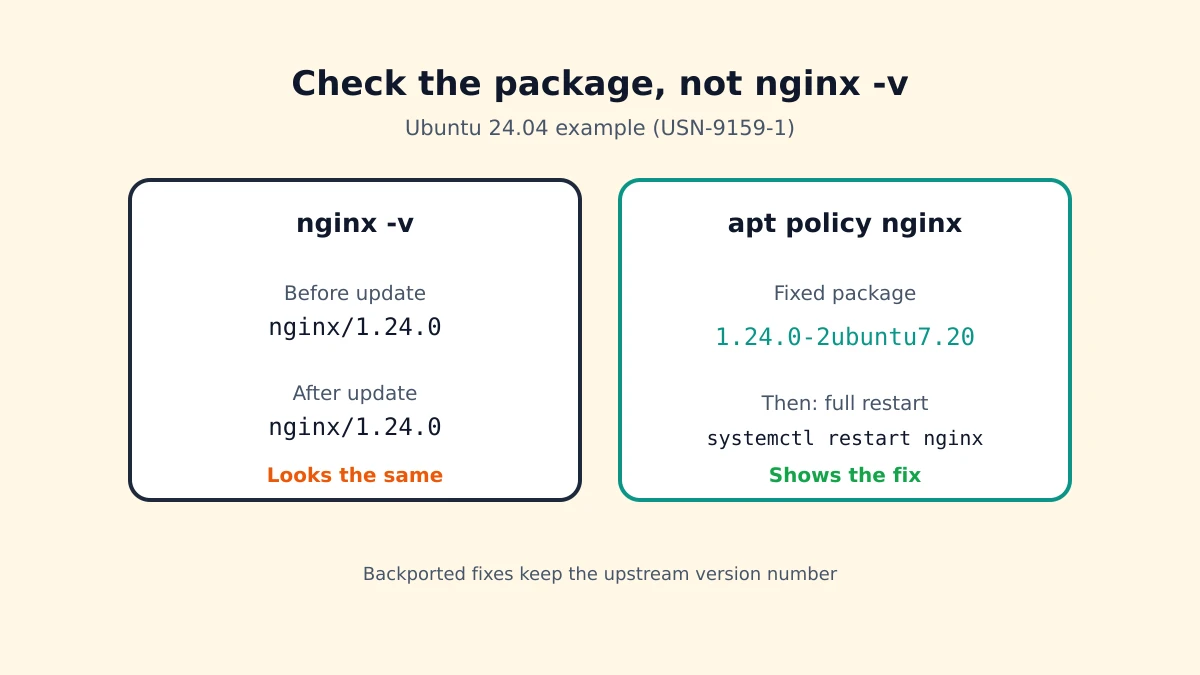
Check the package version, not just
nginx -v. On upstream builds, anything from 1.9.5 up to 1.31.8 that isn't 1.30.7 is in range. Distro packages are different, as the next section explains.Look for HTTP/2 in the running config.
nginx -Tprints the full loaded configuration. Look forhttp2onlistenlines (older style) or anhttp2 on;directive (1.25.1 and later). Check forquic,resolver,mirrorandauth_httptoo, for the other four CVEs.Confirm from outside that h2 is offered. Run the
openssltest below and look forALPN protocol: h2in the output.
nginx -v
sudo nginx -T 2>&1 | grep -nE 'listen|http2|quic|resolver|mirror|auth_http'
openssl s_client -connect example.com:443 -servername example.com -alpn h2 </dev/null 2>/dev/null | grep 'ALPN protocol'
Behind Cloudflare or another CDN, the third command tests the CDN, not you. Point it at your origin IP with the real hostname in -servername. Wiz notes that a CDN or WAF that terminates HTTP/2 may partly block the attack, but that only helps if attackers can't reach the origin directly. Don't paste raw nginx -T output into tickets or chats, since it can include secrets.
Why nginx -v can show an old number after you update
Ubuntu and Debian don't move stable releases to a new NGINX version. They backport the security fix into the version the release shipped with. Ubuntu 24.04's fixed package, for example, is still NGINX 1.24.0. Only the package revision changes, to 1.24.0-2ubuntu7.20, so nginx -v prints nginx/1.24.0 both before and after the fix. CIRCL and Xint both warn about this. Check the package version instead:
# Debian / Ubuntu
apt policy nginx
dpkg -l 'nginx*'

# RHEL, AlmaLinux, Rocky Linux
rpm -q nginx

# Alpine
apk info -v nginx
In apt policy, compare the "Installed" line with the fixed version in the table below. The wildcard in dpkg -l 'nginx*' also lists related packages like nginx-core, nginx-full and nginx-extras, which Ubuntu's notice updates too.
How to patch NGINX for nginx2root CVE-2026-123007
Upstream, the fix is 1.31.9 (mainline) or 1.30.7 (stable), and both fix all five CVEs. Most servers, though, run their distro's package or a Docker image, and the status differs by platform.
Fixed distro packages for nginx2root CVE-2026-123007, as of November 19, 2026
| Distro | Release | Fixed package version | Advisory / where listed |
|---|---|---|---|
| Ubuntu | 26.10 | 1.30.4-7ubuntu1.2 | USN-9159-1 |
| Ubuntu | 26.04 LTS | 1.28.3-2ubuntu1.13 | USN-9159-1 |
| Ubuntu | 24.04 LTS | 1.24.0-2ubuntu7.20 | USN-9159-1 |
| Ubuntu | 22.04 LTS | 1.18.0-6ubuntu14.23 | USN-9159-1 |
| Ubuntu | 20.04 LTS (Ubuntu Pro) | 1.18.0-0ubuntu1.7+esm5 | USN-9159-1 |
| Ubuntu | 18.04 LTS (Ubuntu Pro) | 1.14.0-0ubuntu1.11+esm6 | USN-9159-1 |
| Ubuntu | 16.04 LTS (Pro + Legacy Support) | 1.10.3-0ubuntu0.16.04.5+esm11 | USN-9159-1 |
| Debian | 13 trixie | 1.26.3-3+deb13u11 | DSA-6642-1 |
| Debian | sid (unstable) | 1.30.6-4 | Debian security tracker |
| Debian | 12 bookworm | No fix yet (1.22.1-9+deb12u10 is vulnerable) | Debian security tracker |
| Debian | forky (testing) | No fix yet (1.30.6-3 is vulnerable) | Debian security tracker |
| Alpine | edge and 3.24 | 1.30.7-r0 | Alpine package index (built November 18) |
| Alpine | 3.23 and 3.22 | No fix seen (1.28.3-r7, built July 2026) | Alpine package index |
| RHEL | 8, 9, 10 | No fix yet | RHSB-2026-019 |
Sources: Ubuntu USN-9159-1, the Debian security tracker, Alpine's package index and Red Hat's RHSB-2026-019 bulletin. Ubuntu's notice also lists a 14.04 package, but Ubuntu's CVE page marks 14.04 as not affected by this CVE, because its NGINX has no HTTP/2. Ubuntu's CVE page still showed every release as "Vulnerable" on November 19. The notice, published the same day, is the newer record.
Red Hat says it "is expediting the release of fixes" for RHEL 8, 9 and 10. ByteMuni found no AlmaLinux or Rocky Linux errata for this CVE on November 19. The official Docker nginx image already carries the fix: latest and mainline point to 1.31.9, stable points to 1.30.7, and 1.31.9-alpine and 1.30.7-alpine exist.
Update steps by platform
Ubuntu 22.04 and later, Debian trixie: run
sudo apt update && sudo apt install --only-upgrade nginx. Ifdpkg -l 'nginx*'still shows an oldernginx-core,nginx-full,nginx-extrasorlibnginx-mod-*package, upgrade those by name or runsudo apt upgrade.Ubuntu 20.04 and older: the fix ships only through Ubuntu Pro (ESM), according to the notice. Without Pro, use the mitigations below or move to a supported release.
Alpine 3.24 / edge: run
apk update && apk upgrade nginx.Docker: pin
nginx:1.31.9ornginx:1.30.7(or the-alpinevariants), rebuild every image that usesFROM nginx, and redeploy. Our Docker update and rollout checks for PHP2Shell apply here unchanged.NGINX Plus: move to 37.3.0.1 or 37.0.8.1. R34–R36 had no fix listed.
Restart: run
sudo systemctl restart nginx(on Alpine with OpenRC:rc-service nginx restart), then confirm with the commands below.
sudo nginx -t && sudo systemctl restart nginx
ps -o pid,lstart,cmd -C nginx   # every process should show a fresh start time
apt policy nginx                 # Installed: should match the fixed version
Do a full restart, not a reload. CIRCL puts it plainly: a reload doesn't replace the running executable, and old workers can keep running. Xint recommends a restart or NGINX's live binary upgrade. Ubuntu's notice says only that a standard system update makes the needed changes. It doesn't mention restarting NGINX, so don't count on the update doing that for you.
Debian bookworm, Alpine 3.22/3.23 and RHEL: no fix yet
Debian 12 bookworm had no fixed package on November 19. You have two options. You can apply the workarounds in the next section until Debian ships a fix. Or you can switch to nginx.org's own packages: its Linux packages page documents a repository for Debian 12 bookworm and 13 trixie on x86_64 and arm64. The steps from that page (stable branch) are:
sudo apt install curl gnupg2 ca-certificates lsb-release debian-archive-keyring
curl https://nginx.org/keys/nginx_signing.key | gpg --dearmor \
    | sudo tee /usr/share/keyrings/nginx-archive-keyring.gpg >/dev/null
gpg --dry-run --quiet --no-keyring --import --import-options import-show /usr/share/keyrings/nginx-archive-keyring.gpg
echo "deb [signed-by=/usr/share/keyrings/nginx-archive-keyring.gpg] \
https://nginx.org/packages/debian `lsb_release -cs` nginx" \
    | sudo tee /etc/apt/sources.list.d/nginx.list
echo -e "Package: *\nPin: origin nginx.org\nPin: release o=nginx\nPin-Priority: 900\n" \
    | sudo tee /etc/apt/preferences.d/99nginx
sudo apt update
sudo apt install nginx
Check that the key fingerprint printed by the gpg step contains 573BFD6B3D8FBC641079A6ABABF5BD827BD9BF62. These packages are built by nginx.org, not Debian, so test your configuration on a staging machine before switching production. The same page covers RHEL-family and Alpine repositories, which are options for RHEL 8–10 and Alpine 3.22/3.23 while those distros catch up.
If you can't upgrade today: mitigations and what each one misses
To turn off HTTP/2, CIRCL's steps depend on your version. On 1.25.1 and later, remove http2 from every listen line and add http2 off; in each server block. On 1.9.5 to 1.25.0, which includes Debian bookworm's 1.22.1, change listen 443 ssl http2; to listen 443 ssl;. Check every server block sharing the port, including IPv6 listeners.
server {
    listen 443 ssl;
    listen [::]:443 ssl;
    http2 off;   # 1.25.1 and later only; on older versions just drop http2 from listen
    # rest of your existing configuration
}| Mitigation | What it blocks | What it does NOT cover |
|---|---|---|
| Turn off HTTP/2 | CVE-2026-123007 and CVE-2026-123633 | The resolver, HTTP/3 and mail proxy bugs. It also breaks gRPC, and Red Hat warns it may affect clients that rely on multiplexing. |
Remove quic listeners, set http3 off; | CVE-2026-121810 | Everything else. Red Hat says the impact of this change is minimal. |
Use fixed upstream groups instead of request-time DNS | CVE-2026-123634 | Other paths. Xint says setting mirror_request_body on alone isn't enough. |
Remove mail blocks, or bind the mail proxy to localhost / firewall it | CVE-2026-113425 | HTTP-side bugs. Red Hat calls restricting access only a partial mitigation; removing the mail context is the full one. |
| Block the SCTP kernel module | Xint's step from worker to root | Worker-level code execution. It doesn't unload an already loaded module or disable SCTP built into the kernel. |
echo 'install sctp /bin/false' | sudo tee /etc/modprobe.d/disable-sctp.conf
lsmod | grep '^sctp' || true
Only block SCTP if nothing on the host uses it. In containers, the setting belongs on the host, since containers share its kernel. The kernel angle fits a wider pattern we covered in the Linux kernel flaws from OpenAI's privilege-escalation audit. After any config change, run nginx -t and restart rather than reload, so existing HTTP/2 connections are closed.
Who should act first: a patch checklist
These groups have the least margin on nginx2root CVE-2026-123007.
Debian bookworm, RHEL, and Alpine 3.22/3.23 servers with public HTTP/2. There is no distro package to install yet, so they need a workaround or nginx.org's packages today.
Public HTTP/2 origins reachable directly. Xint counted 56.7 million NGINX hosts on Shodan, and 98.9% of those with a readable version fell in the affected range. Xint notes those numbers don't confirm actual exposure, and no other source has published a comparable count.
Kubernetes ingress-nginx users. The community controller was retired in March 2026 with no further security updates promised. ByteMuni found no fixed ingress-nginx release. Check your platform vendor for a patched build, or plan the move to another controller. F5's own NGINX Ingress Controller is a separate product; follow F5's advisory for it.
Shared hosting and control-panel stacks. Wiz expects attackers to favor packaged products where many customers share one build and config. If you run NGINX in front of PHP-FPM for many sites, pair this with our PHP2Shell patches for PHP web servers.
Inventory every NGINX instance: VMs, containers, ingress controllers and appliances.
Record the package version (
apt policy nginx,rpm -q nginxorapk info -v nginx), not onlynginx -v.Note whether h2, h3, resolver or mail proxy is in use.
Install the fixed distro package, 1.31.9 / 1.30.7, or nginx.org's packages.
Restart fully and confirm no old worker processes remain.
Where no fix exists yet, turn off HTTP/2 and HTTP/3, and block SCTP where unused.
Keep ASLR on:
sysctl kernel.randomize_va_spaceshould return 2.Watch error logs and core dumps for worker crashes over the next few weeks.
My take and the bottom line on nginx2root
My read is that the most common mistake this week won't be skipping the patch. It will be believing a patch happened because a dashboard or nginx -v looked right. Backported fixes and reload-instead-of-restart both leave a server looking updated while the old code keeps running. Teams that track package versions, not upstream version strings, will close this faster. The exploit conditions are real friction, but Wiz and Xint reached code execution by their own routes, so they shouldn't set your timeline.
For nginx2root CVE-2026-123007, the decision is simple. On Ubuntu, Debian trixie, Alpine 3.24 or Docker, install the fixed package or image today and do a full restart. On Debian bookworm, RHEL or older Alpine, turn off HTTP/2 now and either wait for the distro fix or move to nginx.org's packages. If you run the community ingress-nginx controller, treat this as another reason to migrate, because no upstream fix is coming.
Frequently asked questions
Is my server vulnerable if I don't use HTTP/2?
Not to CVE-2026-123007 or CVE-2026-123633, which both need HTTP/2. Three other bugs in the same release involve the resolver, HTTP/3 and the mail proxy, so check whether you use those features too.
I updated Ubuntu but nginx -v still says 1.24.0. Am I patched?
Probably, if the package is new enough. Ubuntu backports the fix, and the fixed 24.04 package is 1.24.0-2ubuntu7.20 according to USN-9159-1. Run apt policy nginx to confirm, then restart NGINX.
Why doesn't nginx -s reload apply the fix?
CIRCL says a reload doesn't replace the running executable, and old worker processes can stay alive. Restart the service, or use NGINX's live binary upgrade, so the patched binary is actually running.
I run Debian 12 bookworm. What should I do?
The Debian security tracker listed bookworm as vulnerable on November 19, 2026, with no fixed package. Turn off HTTP/2 until a fix ships, or switch to nginx.org's own Debian packages, which support bookworm.
Has nginx2root been exploited in the wild?
The Hacker News reported on November 18, 2026 that F5, Wiz and Rapid7 had seen no in-the-wild exploitation and that the CVE wasn't in CISA's KEV catalog. A public proof of concept exists, but its README says it only works reliably against a fresh local Docker container.
Will blocking the SCTP module stop the attack?
No. It removes the kernel step Xint used to go from the NGINX worker to root, but worker-level code execution still works. It also doesn't unload a module that's already loaded or disable SCTP compiled into the kernel.
Concepts in this article
- CVE
- The public identifier system for disclosed security vulnerabilities.
- Cryptography
- Encryption, hashing and signatures that keep data secret and prove it has not changed.
- Docker
- A tool for packaging and running applications in containers.
- HTTP
- The request–response protocol of the web: methods, status codes and headers.
- Linux kernel
- The core of the Linux operating system.
- Node.js
- A JavaScript runtime for servers and tools, built on V8 and libuv.
- PHP
- A server-side scripting language behind much of the web, including WordPress.
- Vulnerability management
- Finding, ranking and fixing vulnerabilities across systems.
How we research, write and check articles