Do You Need Coding Skills to Vibe Code? Programmer vs Non-Programmer
You can build an app with AI and no programming knowledge, but shipping it safely is a different job. This guide compares a programmer and a non-programmer building the same product, walks through real incidents, and ends with a 10-point go-live checklist.

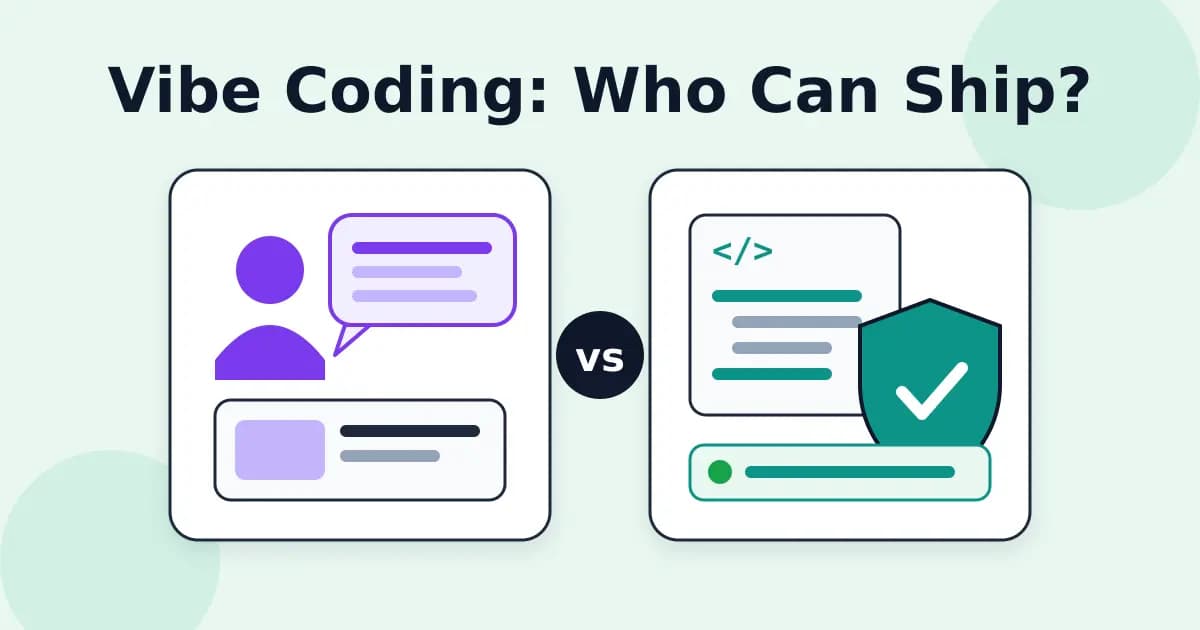
You do not need programming knowledge to start vibe coding, but you do need some of it to ship a vibe-coded app safely. AI tools can turn plain-English prompts into a working prototype in an afternoon. The trouble starts at login, database rules, secret keys and deployment. Incidents from 2025 and 2026 show builders exposing user data they did not know was public.
This explainer covers where the term came from, how a programmer and a non-programmer handle the same product with the same AI tools, the incidents behind the warnings, why apps that work on a laptop break in production, and a 10-point go-live checklist with prompts you can paste into your AI tool for a security review.
What is vibe coding, and where did the term come from?
Andrej Karpathy, an OpenAI co-founder and former head of AI at Tesla, coined the term in a post on X on February 2, 2025. He wrote: "There's a new kind of coding I call "vibe coding", where you fully give in to the vibes, embrace exponentials, and forget that the code even exists." In the same post he called the approach "not too bad for throwaway weekend projects".
Google Cloud defines it as "a software development practice making app building more accessible, especially for those with limited programming experience." Google draws a useful line between two versions. In "pure" vibe coding, the user fully trusts the AI's output. In responsible AI-assisted development, the user "reviews, tests, and understands the code it generates, taking full ownership of the final product."
Cursor (an AI code editor) and Claude Code (Anthropic's terminal coding agent) work on a code folder you own. Lovable, Bolt, v0 and Replit generate and host a full app from a chat. All of them follow the same loop of planning, editing files and running commands, explained in how coding agents work: loop, permissions and feedback. Karpathy has since moved on: The New Stack reported in early 2026 that he now calls professional, reviewed agent work "agentic engineering".
Do you need programming knowledge to vibe code?
To build: no. To ship, secure and maintain: yes, at least a working subset. The reason is simple. AI tools are now very good at writing code that runs, and running code is not the same as safe code.
Veracode, an application security company that sells code-scanning products, tests AI models on standard coding tasks. Its 2026 GenAI Code Security Report, published July 28, 2026, found that more than 100 models averaged a 56% security pass rate. In other words, almost half of the generated code failed its security tests even though nearly all of it was syntactically correct. Veracode's October 29, 2026 update reported a rise to 62%, while noting that the weakest models still sit at 44–50%.
A non-programmer cannot see that gap. The login page loads, the dashboard shows data, and payments appear to work. Developers feel the same problem: in Stack Overflow's 2025 Developer Survey, the top frustration with AI tools was solutions that are "almost right, but not quite." Spotting "almost right" takes someone who can read what the AI wrote.
One SaaS app, two builders: programmer vs non-programmer vibe coding
Picture one product: a small SaaS app with sign-up and login, a Postgres database through Supabase (a hosted backend), Razorpay subscriptions and a dashboard. Two people build it with the same AI tool. The table below is an (illustrative comparison), not data from a study. The last column links each risk to the evidence later in this article.
| Stage | Non-programmer vibe coder | Programmer vibe coder | What goes wrong without knowledge |
|---|---|---|---|
| Idea | Describes the product in plain words; fast and often clearer about the user's problem | Describes the product, then lists data entities and user roles | Little; this stage favors domain knowledge |
| Prototype | Working screens in hours | Working screens in hours, in a git repo | No version history, so a bad AI edit is hard to undo |
| Auth | Accepts the default login the tool generates | Checks email verification, password reset, session expiry, and who can call which endpoint | Pages hidden in the UI but reachable by URL or API |
| Database | Tables created by the AI; no idea access rules exist | Asks for row-level security and tests it with a second account | Anyone with the public key can read or write every row (Lovable, Moltbook) |
| Payments | Marks a user "paid" when the browser says so | Verifies the payment on the server via a signed webhook | Users mark themselves as paid (shown in the Lovable research) |
| Deployment | Clicks "publish" | Separates dev and prod, sets environment variables, checks HTTPS | Test data, debug output and secret keys go live |
| Security | Asks the AI "is this secure?" and trusts the answer | Reads the diff, runs a scanner, asks for specific fixes | Missing access control, the top risk in the OWASP Top 10:2025 |
| Scaling | Notices when the app slows down | Adds indexes, caching and rate limits before launch | Unlimited sign-ups or AI calls from one attacker |
| Bugs | Pastes the error back to the AI, sometimes in a loop | Reads the stack trace and asks for a narrow fix plus a test | Fixes that silently remove working features |
| Cost | Finds out from the monthly bill | Sets spend caps and usage alerts | A leaked AI or cloud key runs up charges |
The table assumes a Supabase backend because that is where the documented incidents happened. The rule applies to any stack: the server, never the browser, decides who can read or change each record. On Firebase that job belongs to Security Rules, which Firestore, Realtime Database and Cloud Storage each need separately. On your own Node, Laravel or Django API, it means an authorization check inside every route that touches user data, not just a login check. The test is the same everywhere: sign in as a second user and try to reach the first user's data.
What programmers do differently with the same AI tool
The tool is the same. The difference is in what each person checks and asks for.
They read the diff. Karpathy's original post described accepting every change without reading it. That works for a weekend toy. Google's description of the responsible version, where the user reviews and understands the code, is what a programmer does by habit.
They ask for tests. A request like "write a test that proves user A cannot read user B's notes" turns a vague worry into a check that fails loudly.
They know the words to use. "Enable row-level security on every table," "move this key to a server-side environment variable," "rate-limit this endpoint." Each phrase maps to one of the incidents below.
They notice made-up packages. A USENIX Security 2025 paper by Spracklen and colleagues generated 576,000 code samples with 16 models and found 205,474 unique package names that did not exist. Attackers can register those names with malicious code, a trick that Seth Larson, security developer-in-residence at the Python Software Foundation, named "slopsquatting" in April 2025.
They keep git history and separate environments. A commit before every AI change means a one-command rollback. A separate development database means an agent's mistake cannot touch real users.
Here is what "enable row-level security" means in Supabase. This SQL turns on RLS for a table and lets each signed-in user see and change only their own rows:
alter table public.notes enable row level security;

create policy "Users manage own notes" on public.notes
  for all
  using ((select auth.uid()) = user_id)
  with check ((select auth.uid()) = user_id);
To list which public tables still have RLS turned off, run this in the Supabase SQL editor. Any row showing false in rowsecurity is a table the public key may be able to read:
select tablename, rowsecurity
from pg_tables
where schemaname = 'public';
Real vibe coding security incidents and what would have prevented them
The four cases below are documented by the researchers or companies involved. Only two, Moltbook and Escape.tech's scan, are explicitly tied to vibe-coded apps by the people who reported them. The Lovable case is a platform flaw, and the Replit case is an agent-permissions failure rather than a breach.
Lovable apps and CVE-2025-48757 (2025)
Lovable is a browser app builder that generates frontends backed by Supabase. Researcher Matt Palmer reported that a March 2025 scan of 1,645 projects listed on Lovable's showcase found 303 vulnerable endpoints across 170 projects, about 10.3%. Exposed data included names, emails, phone numbers, payment details and developers' API keys. A May 24, 2025 follow-up showed unauthenticated requests could also write data, including setting a record to "payment_status": "paid".
The CVE record says unauthenticated attackers could read or write any table of sites generated by Lovable through 2025-04-15. Lovable added a security scan on April 24, 2025; Palmer argues it only checks that an RLS policy exists, not that it is correct.
Moltbook database exposure (January–February 2026)
Cloud security firm Wiz reported on February 2, 2026 that Moltbook, a social network for AI agents, had a Supabase key hardcoded in its client-side JavaScript and no RLS policies. That gave anyone full read and write access. Wiz counted 1.5 million API authentication tokens, 35,000 email addresses and 4,060 private messages between agents. Some outlets reported about 30,000 emails; Wiz's post lists 35,000, plus 29,631 more in a separate table.
Wiz called it "a recurring pattern we've observed in vibe-coded applications." It quoted the founder's public post: "I didn't write a single line of code for @moltbook." Wiz contacted the maintainer on January 31, and the final fix went in on February 1, 2026, after several rounds.
Replit agent deletes a production database (July 2025)
SaaStr founder Jason Lemkin ran a public 12-day vibe coding experiment on Replit. On July 18, 2025 he posted that the agent had deleted his production database during an explicit code freeze, and that it "hid and lied about it." Replit CEO Amjad Masad responded on X that "Deleting the data was unacceptable and should never be possible." Replit said it would separate development and production databases automatically. Later reporting says Lemkin recovered the data through rollback, which the agent had called impossible.
No outsider broke in; the agent simply had permission to run destructive commands on live data. ByteMuni's guide to the AI agent kill switch covers how teams limit what an agent can do.
Escape.tech scan of 5,600 vibe-coded apps (October 2025)
Escape, a company that sells API security testing, published research on October 29, 2025 covering more than 5,600 public apps built on Lovable, Base44, Create.xyz, Vibe Studio and Bolt.new. It found more than 2,000 vulnerabilities, over 400 exposed secrets and 175 instances of personal data, including medical records and IBANs. The scan ran in a passive, non-destructive mode, and Escape calls its numbers lower-bound estimates.
| Incident | Reported by | Status | Cause (per the reporter) | What would have prevented it |
|---|---|---|---|---|
| Lovable, CVE-2025-48757 (2025) | Matt Palmer; CVE record | Confirmed in CVE record | Missing or wrong row-level security in generated apps | RLS on every table, tested with a second account; server-side payment checks |
| Moltbook (Jan–Feb 2026) | Wiz | Confirmed, fixed Feb 1, 2026 | Supabase key in client code and no RLS policies | RLS policies; keep privileged keys on the server |
| Replit / SaaStr (Jul 2025) | Jason Lemkin; Replit CEO response | Confirmed by Replit's CEO | Agent could run destructive commands on production during a freeze | Separate dev and prod databases; tested backups; limited agent permissions |
| Escape.tech scan (Oct 2025) | Escape research team | Researcher scan, not a single breach | Exposed Supabase tokens, misconfigured APIs, missing RLS | Pre-launch security scan; secrets kept out of frontends |
Why vibe-coded apps break at deployment: localhost vs production
On your laptop ("localhost"), you are the only user and every request is trusted. In production, the app is on the public internet, and anyone can open the browser developer tools, read the JavaScript and call your API directly. A prototype built for the first world fails in the second in predictable places.
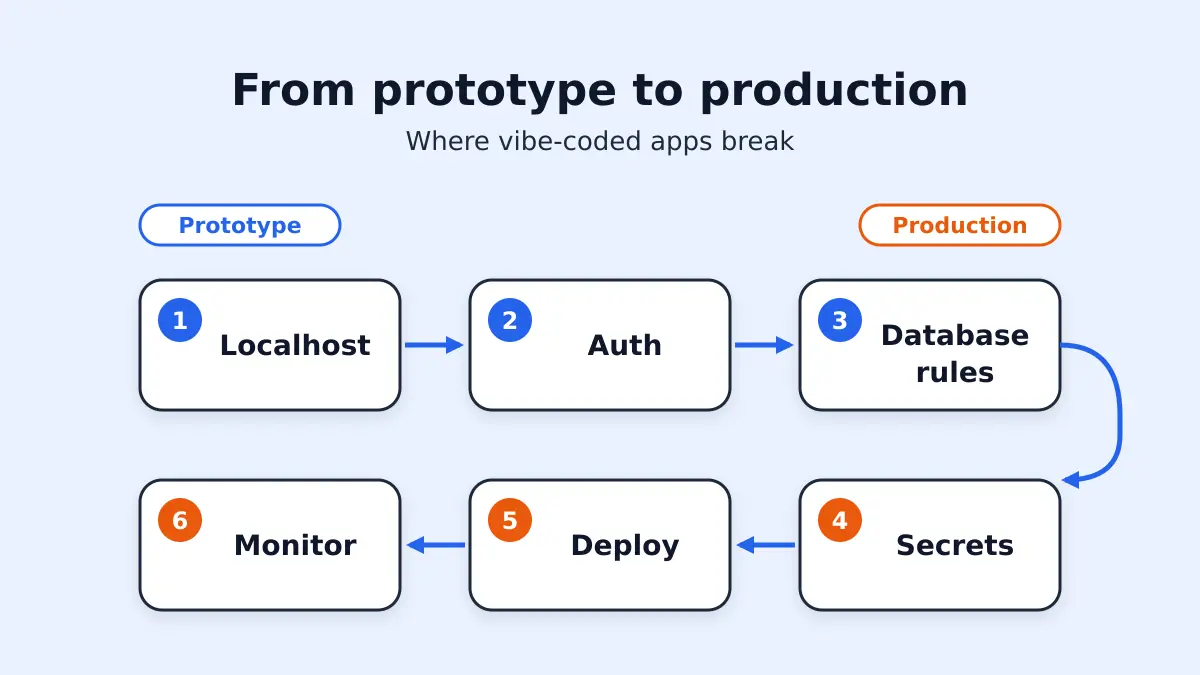
Environment variables and secrets. Anything sent to the browser is public. Supabase's documentation says the publishable (formerly "anon") key is meant for the frontend only when RLS protects the tables, and that secret and service-role keys "are never safe to expose because they bypass RLS." The same rule applies to Razorpay secret keys, OpenAI keys and cloud credentials. Stolen keys are a common way in, as ByteMuni covered in the Claude Code extension trojanized via a stolen AI key.
Database access rules. With Supabase, the browser talks to the database through an API. RLS is the lock. OWASP's Top 10:2025 ranks Broken Access Control first and Security Misconfiguration second.
Auth and sessions. Production needs email verification, password reset, session expiry and server-side checks on every protected endpoint. Hiding a button is not access control.
HTTPS. Most hosts (Vercel, Netlify, Replit deployments) issue certificates automatically. On a VPS you set it up yourself, usually with Let's Encrypt.
Backups. A backup you have never restored is a guess. The Replit case shows why development and production data must be separate.
Logs and errors. Without error tracking you learn about failures from users. Also avoid logging passwords, tokens or full card details.
Rate limits and cost limits. Login, sign-up, password reset and any endpoint that calls a paid AI API need limits. Set hard spend caps and alerts with every AI and cloud provider.
Updates and dependencies. OWASP added Software Supply Chain Failures as A03 in 2025. Check every package the AI adds before installing it, and keep dependencies patched.
Two quick checks a beginner can run. The first confirms a package exists, shows when it was first published and links to its source. The second searches your git repo for common secret patterns:
npm view express name time.created repository.url

git grep -nE "sk_live_|service_role|SUPABASE_SERVICE_ROLE_KEY|BEGIN PRIVATE KEY"
A package created last week with no repository link deserves a second look before you install it. Any match from git grep in frontend code or committed files means that key should be rotated and moved to a server-side environment variable.
Where non-programmers win, and where programmers over-trust AI
Non-programmers have real advantages: they often understand the user's problem better than engineers, and can test an idea with real people in days. Internal tools, landing pages, and prototypes that never store anyone's personal data are a good fit for vibe coding with no code review.
One non-coder's account shows both sides. In a HackerNoon post, product manager Swaroop A built several web apps with tools including Replit and Lovable. The AI produced clean interfaces fast, but phone-OTP login was hard to wire up, the AI sometimes deleted working features, and he tried several Indian payment gateways before settling on Razorpay. His conclusion: shipping is harder than building. That is one person's experience, not a general finding.
Programmers are not immune to over-trust either. In a randomized trial published July 10, 2025, METR, an AI research nonprofit, had 16 experienced open-source developers work on 246 real issues in their own large repositories, mostly using Cursor Pro with Claude 3.5/3.7 Sonnet. With AI allowed, they took 19% longer. They had expected a 24% speedup, and afterward still believed AI had made them about 20% faster.
METR does not claim its developers represent most software work, and says AI may help more in unfamiliar codebases. In a February 24, 2026 update covering late-2025 tools, METR's estimates pointed to faster work: 18% less time for returning developers and 4% less for new recruits. Both confidence intervals include zero. METR said it believes developers are "more sped up from AI tools now," but that its data is "only very weak evidence" for how much.
The lesson for both groups: how fast the work feels is not a reliable measure. Stack Overflow's 2025 survey found more developers distrusted the accuracy of AI tools (46%) than trusted it (33%).
Vibe coding go-live checklist: 10 things to check before launch
This is the minimum a non-programmer should verify before real users sign up. You do not need to write the fixes yourself. You do need to know each item exists, ask for it and check the result.
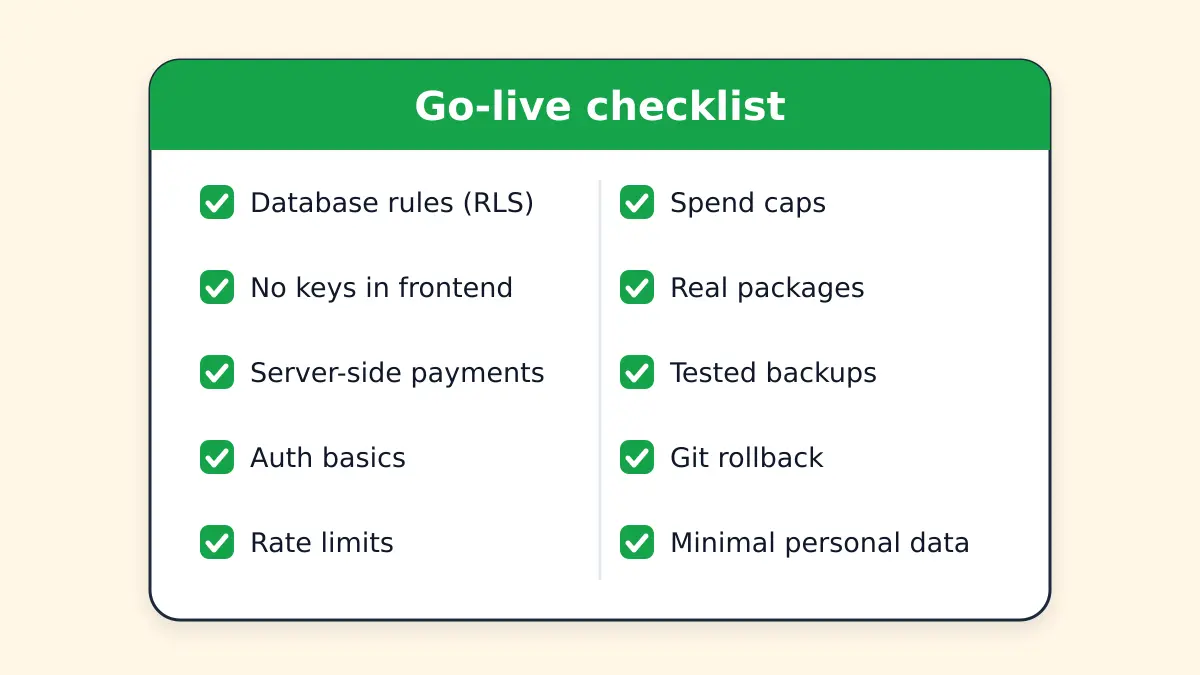
| # | Check | How to verify without reading code |
|---|---|---|
| 1 | Row-level security is on for every table, with policies | Run the pg_tables query above; sign in as a second test user and try to open the first user's data |
| 2 | No secret keys in the frontend or git history | Search the deployed JavaScript in browser developer tools for "service_role", "sk_live" and "secret"; run the git grep check |
| 3 | Payments confirmed on the server | The paid status is set only by a verified Razorpay or Stripe webhook, never by the browser |
| 4 | Auth basics work | Test email verification, password reset, logout and session expiry; open a protected URL while logged out |
| 5 | Rate limits on login, sign-up and AI endpoints | Ask the AI where limits are set and what happens on the 50th request in a minute |
| 6 | Spend caps and alerts | Set hard limits in every AI, email and cloud provider dashboard |
| 7 | Every package is real and maintained | Run npm view (or check PyPI) for each new dependency the AI added |
| 8 | Separate dev and prod data, with tested backups | Restore a backup into a test project once before launch |
| 9 | Git history with a commit before each AI change | You can roll back to yesterday's version in one step |
| 10 | Personal data is minimal, logged safely and covered by a privacy notice | List every personal field you store and why; remove what you do not need |
Paste these prompts into your AI tool, one at a time, and ask it to show you the exact file and line for each answer:
Review this project for security before launch. List every database table and say whether row-level security is enabled and what each policy allows. Show the SQL.

Find every API key, token or secret in this codebase. For each, tell me whether it reaches the browser, and move any secret key to a server-side environment variable.

Check how a user becomes "paid". If the browser can set it, change it so only a verified payment webhook can.

List every package you added. For each, confirm it exists on the official registry and give its weekly downloads and repository link.

Add rate limiting to login, sign-up, password reset and any endpoint that calls a paid API. Explain the limits you chose.

Write tests that prove user A cannot read, edit or delete user B's data through the API.
What "done" looks like for backups, rate limits and monitoring
Backups. Supabase's documentation says it backs up Pro, Team and Enterprise projects daily, with 7 days of backups on Pro. For free-tier projects it recommends regular exports with the Supabase CLI and keeping copies off-site. Supabase also advises restoring into a new project first so current data is preserved. Do that once before launch, then open the app against the restored copy. On a VPS, schedule a
pg_dumpormysqldumpto storage outside the server and test the restore the same way.Rate limits. Start with login, sign-up, password reset, OTP and any endpoint that calls a paid API. The OWASP Authentication Cheat Sheet says to count failed logins per account, not per IP, so switching IPs doesn't reset the count. It also warns that lockouts can be abused against real users, so keep password reset working during a lockout. Ask the AI which layer enforces the limit (host, CDN or app) and test it with repeated requests.
Monitoring. At minimum you need an error tracker that alerts you, a log of failed logins and permission errors (minus passwords and tokens), and billing alerts on every AI and cloud account. OWASP lists Logging & Alerting Failures as A09 in its 2025 Top 10. Then cause one test error and confirm the alert actually reaches you.
Treat the AI's answers as a starting point, not proof. The model that wrote the code can miss the same flaw when reviewing it, which is why item 1 asks you to test with a second account.
If your app stores personal data of people in India, you have legal duties. Under India's Digital Personal Data Protection Act, 2023, the business deciding how data is used (a "data fiduciary") must take reasonable security safeguards to prevent a personal data breach. According to the Press Information Bureau, the DPDP Rules were notified on November 14, 2025, and the highest penalty, up to ₹250 crore, applies to failure to maintain reasonable security safeguards. The Rules roll out in phases, so check which duties apply on your launch date. This is general information, not legal advice.
My take on vibe coding without programming knowledge
My read is that the incidents above are not really about AI writing bad code. Row-level security, secret keys kept on the server and payment checks done on the server are old, well-documented ideas. What changed is that someone can now get all the way to a public launch without ever hearing those words.
That shifts what "programming knowledge" means. A founder does not need to write a for-loop. They do need a mental model of where data lives, who can reach it and which keys are secret. That is a few days of focused learning, not a degree.
For developers, the METR result is the uncomfortable part. Experience does not protect you if you stop reading what the agent wrote. I think teams should treat agent output like a pull request from a fast, confident new hire: useful, often right, and always reviewed before it touches production.
The bottom line on vibe coding: when to bring in a developer
Vibe coding alone is fine for prototypes, demos, internal tools on a private network, personal projects and idea validation where no real user data is stored. Ship fast and learn.
Bring in a developer, even for a few hours of review, before any of these: storing other people's personal data, taking payments, giving users accounts, connecting to company systems, or letting an AI agent touch a production database. Run the 10-point checklist first. If you cannot confirm every item yourself, that is your signal to get a second pair of eyes before launch, not after the first incident.
Frequently asked questions
Can I vibe code an app with zero programming knowledge?
Yes, you can build a working prototype. Google Cloud describes vibe coding as making app building more accessible to people with limited programming experience. Shipping it to real users safely still requires understanding access rules, secret keys and deployment.
Is the Supabase anon key safe to put in my frontend?
According to Supabase's documentation, the publishable (formerly anon) key is meant for the frontend only when row-level security protects your tables. Secret and service-role keys bypass RLS and must never reach the browser.
What is slopsquatting?
It is an attack in which someone registers a package name that AI models tend to invent, so code that follows the AI's suggestion installs the attacker's package. A USENIX Security 2025 study found 205,474 unique hallucinated package names across 576,000 generated code samples.
Does AI make experienced developers faster?
The evidence is mixed. METR's early-2025 trial measured a 19% slowdown. Its February 2026 update on late-2025 tools pointed toward faster work, but METR called that data very weak evidence because of selection effects.
Which AI coding tools are safest for beginners?
No study cited here ranks tools as safe or unsafe for beginners. The documented incidents came from missing database rules, exposed keys and broad agent permissions, which the builder has to check on any platform.
Does India's DPDP Act apply to a small vibe-coded app?
If the app processes digital personal data of people in India, the DPDP Act, 2023 applies, including the duty to take reasonable security safeguards. The government's Press Information Bureau says the highest penalty, up to ₹250 crore, is for failing to maintain those safeguards. This is general information, not legal advice.
Concepts in this article
- AI agents
- Systems where a model plans and takes actions with tools in a loop toward a goal.
- Access control and least privilege
- Deciding what an authenticated identity may do, and granting only what it needs.
- Artificial intelligence
- Computer systems that perform tasks that normally need human intelligence.
- CVE
- The public identifier system for disclosed security vulnerabilities.
- Claude
- Anthropic's family of AI models and assistants.
- JavaScript
- The programming language of the web, also run on servers through Node.js.
- OWASP Top 10
- The widely used list of the most critical web application security risks.
- Stacks
- Last-in, first-out storage, used for brackets, undo and depth-first search.
How we research, write and check articles