Why GTA 6 Runs at 30 fps: The Game Tech Explained
GTA 6 targets 30 fps on every console, PS5 Pro included. Here's the engineering behind it: frame-time budgets, the CPU bottleneck, ray tracing, upscaling and frame pacing.

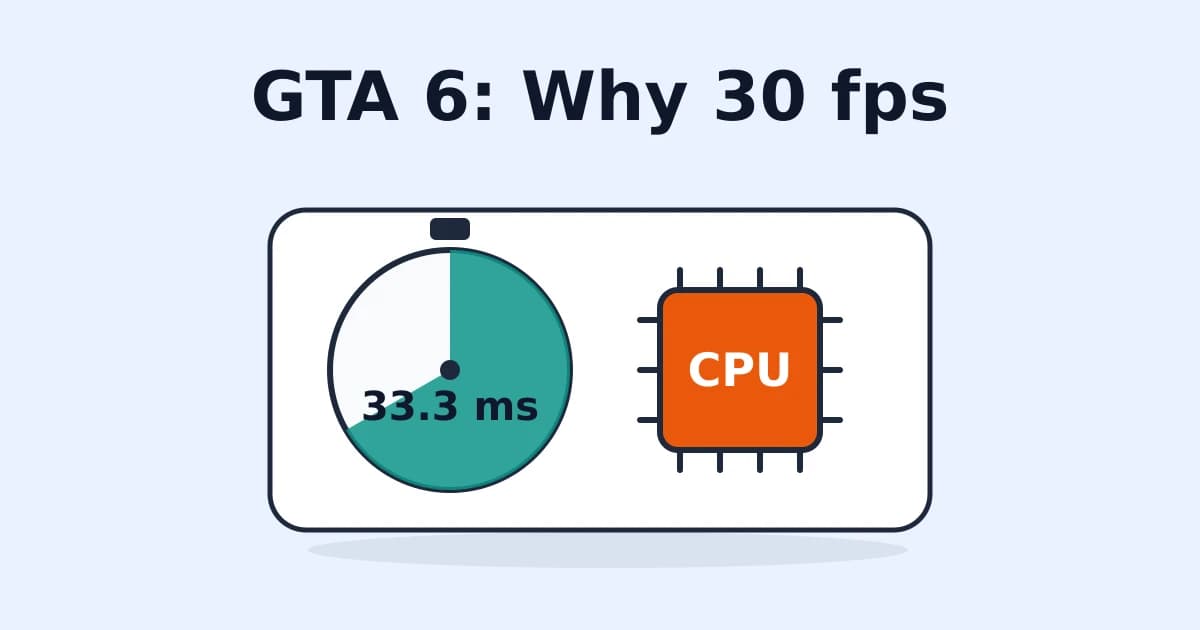
The short answer to why GTA 6 runs at 30 fps is the CPU. Rockstar's simulation of crowds, traffic, physics and a constantly streaming map needs more processor time than a 60 fps frame allows on 2020-era console CPUs. Rockstar now confirms a 30 fps target on every console, PS5 Pro included.
Status (checked November 19, 2026): GTA 6 launches today, November 19, 2026, on PS5 and Xbox Series X|S. Some performance details below come from pre-release footage and may change with patches. Review scores and sales figures are as reported on launch day.
This explainer treats GTA 6 as an engineering case study. It covers the frame-time budget in milliseconds, what the CPU and GPU each spend that time on, how the game's ray tracing and upscaling work, why frame pacing matters more than the headline number, and what each platform gets.
Why GTA 6 runs at 30 fps: what Rockstar and Digital Foundry say
For most of 2026, the 30 fps figure came from interviews, not from Rockstar's own pages. Rob Nelson, co-studio head at Rockstar North, told creators at a preview event that the game currently ran at 30 fps on consoles, according to Kotaku's report of his comments to YouTuber Davy Jones.
That changed on November 10. Rockstar's pre-load post on its Newswire states a 30 fps target on PS5, PS5 Pro and Xbox Series X|S, according to Beebom and TweakTown's reports on the post. Rockstar ties the target to preserving the density and detail of Leonida, the game's version of Florida.
Digital Foundry, a team that analyzes game graphics frame by frame, reached the same conclusion from the footage. After the August 2026 Extended Look, a 26-minute gameplay video captured on a base PS5, it called 60 fps on current consoles "extremely unlikely". Its reasoning: lowering resolution would not be enough, because the simulation load sits on the CPU.
How a frame-time budget works: 33.3, 25 and 16.7 milliseconds
A frame rate is a deadline. At 30 frames per second, the game has 1000 ÷ 30 = 33.3 milliseconds to finish one frame. Miss it and the previous frame stays on screen longer, which players feel as stutter.
| Target | Frame-time budget (our arithmetic) | Fits a 60 Hz TV evenly? | Fits a 120 Hz TV evenly? |
|---|---|---|---|
| 30 fps | 1000 ÷ 30 = 33.3 ms | Yes (every 2nd refresh) | Yes (every 4th refresh) |
| 40 fps | 1000 ÷ 40 = 25.0 ms | No | Yes (every 3rd refresh) |
| 60 fps | 1000 ÷ 60 = 16.7 ms | Yes (every refresh) | Yes (every 2nd refresh) |
Going from 30 to 60 fps means doing the same work in half the time. Going to 40 fps cuts the budget by a quarter. That gap is the core of why GTA 6 runs at 30 fps: the work per frame did not shrink to fit.
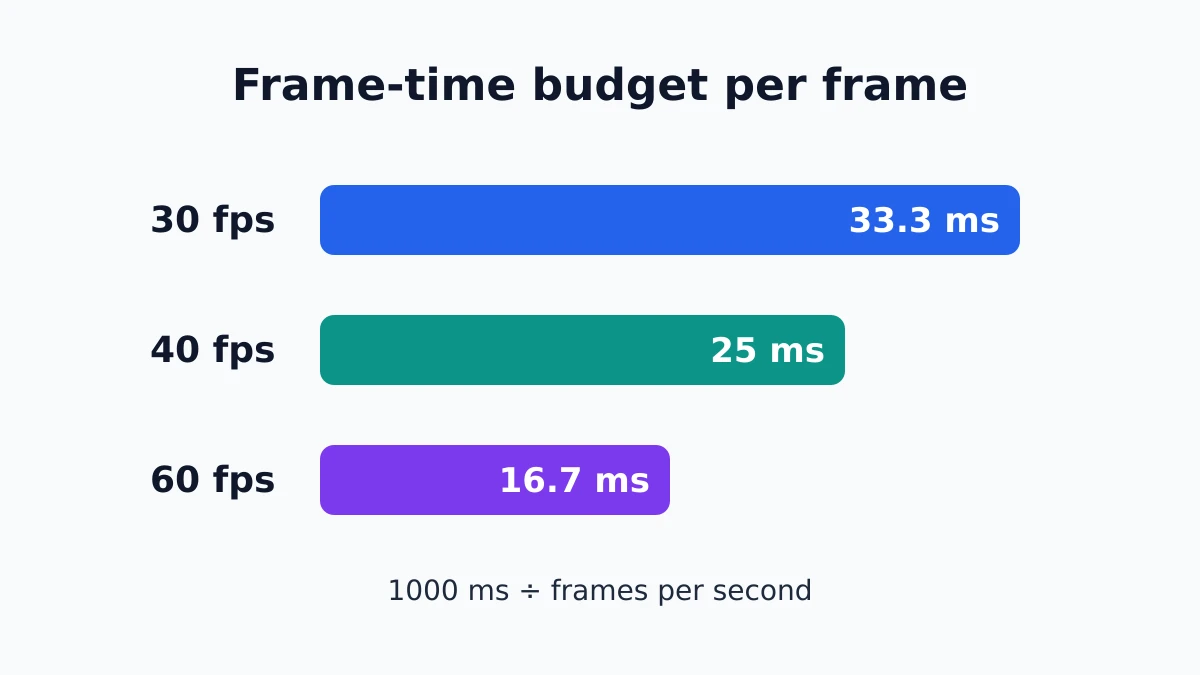
Digital Foundry's Richard Leadbetter walked through this math on the team's weekly show. His conclusion was that "30fps makes sense", and he described a 25 ms target as still needing heavy cutbacks.
Why is GTA 6 limited by the CPU, and why can't the PS5 Pro fix it?
A game engine splits each frame between two processors. The CPU decides what happens: who moves where, what collides, what loads next. The GPU, the graphics chip, draws the result. On consoles these two usually work in a pipeline, so the frame rate is set by whichever side takes longer.
An illustrative case: the CPU needs 30 ms per frame and the GPU needs 20 ms, so the frame takes about 30 ms. Double the GPU's speed and it finishes in 10 ms, but the frame still waits 30 ms for the CPU. That is a CPU-bound game, and it is how Digital Foundry describes GTA 6.
The sources point to several CPU-heavy systems:
NPC simulation and animation. Rockstar says the game has over 600,000 animations, compared with GTA 5's 55,000 and Red Dead Redemption 2's 300,000, according to TechRadar's report on Aaron Garbut's comments. By our count that is about 11 times GTA 5. NPCs also carry personality traits such as temperament and aggression that shape how they react, per Edge's cover feature. Every one of those decisions is CPU work.
Animation retargeting. Nelson told IGN that a new system retargets animations on the fly, so characters of different heights and builds line up when they fight or share a car. Adjusting skeletons at runtime costs processor time that a fixed set of body types did not.
Physics. Rigid-body physics (solid objects that tumble and crash) and vehicle handling run on the CPU in most engines. Every extra car, crate or ragdoll in view is another object to update before the deadline.
BVH updates for ray tracing. A BVH (bounding volume hierarchy) is the tree of boxes that rays are tested against. When cars and people move, the tree must be refitted or rebuilt every frame. In many console engines part of that bookkeeping falls on the CPU.
World streaming. Leonida is roughly twice the size of GTA 5's map, Nelson told YouTuber TGG. The engine loads and unloads it piece by piece as the player moves, and decompressing and setting up those pieces takes CPU time.
The PS5 Pro is mostly a GPU upgrade. Sony advertised 67% more compute units, 45% faster rendering and two to three times the ray-tracing speed, according to TweakTown's coverage of the 2024 reveal. Its CPU is still an eight-core AMD Zen 2. Leaked developer documents describe a "High CPU Frequency Mode" of 3.85 GHz against the base PS5's 3.5 GHz, roughly a 10% clock increase. Sony did not headline any CPU change.
GTA 6 ray tracing vs baked lighting: what older games did and what GTA 6 does
Ray tracing simulates light by following rays as they hit and bounce off surfaces. GTA 6 uses it for the two most expensive jobs in a scene: bounced light and reflections. The table sets each technique beside what games usually did before.
| Feature | Older approach | GTA 6 (per Digital Foundry and Rockstar) |
|---|---|---|
| Bounced light (global illumination) | Baked: computed offline and stored in the level | Ray-traced global illumination, computed while you play |
| Reflections | Screen-space: copies only what is already on screen | Ray-traced reflections blended with screen-space |
| Household mirrors | Planar: redraw the room from the mirror's side | Still planar, where that method works best |
| Sun shadows | Shadow maps | Refined shadow maps; ray-traced shadows only on PS5 Pro |
| Hair | Hair cards: flat strips with a hair texture | Strand-based hair, including on background characters |
| Skin | Simple shading that can look waxy | More realistic skin, sweat and makeup shading |
| Distant detail | Level of detail (LOD) | Still LOD: far objects use simpler models |
Baked vs ray-traced lighting. Baking works out how light bounces ahead of time and saves the result in textures. It is cheap at runtime but cannot react when a door opens or the weather changes. Ray-traced global illumination recalculates the bounce live, so sunlight through a window lights the floor, then the walls. Digital Foundry's Alex Battaglia has said the technique is inherent to the way the game works, so it cannot simply be switched off for a performance mode.
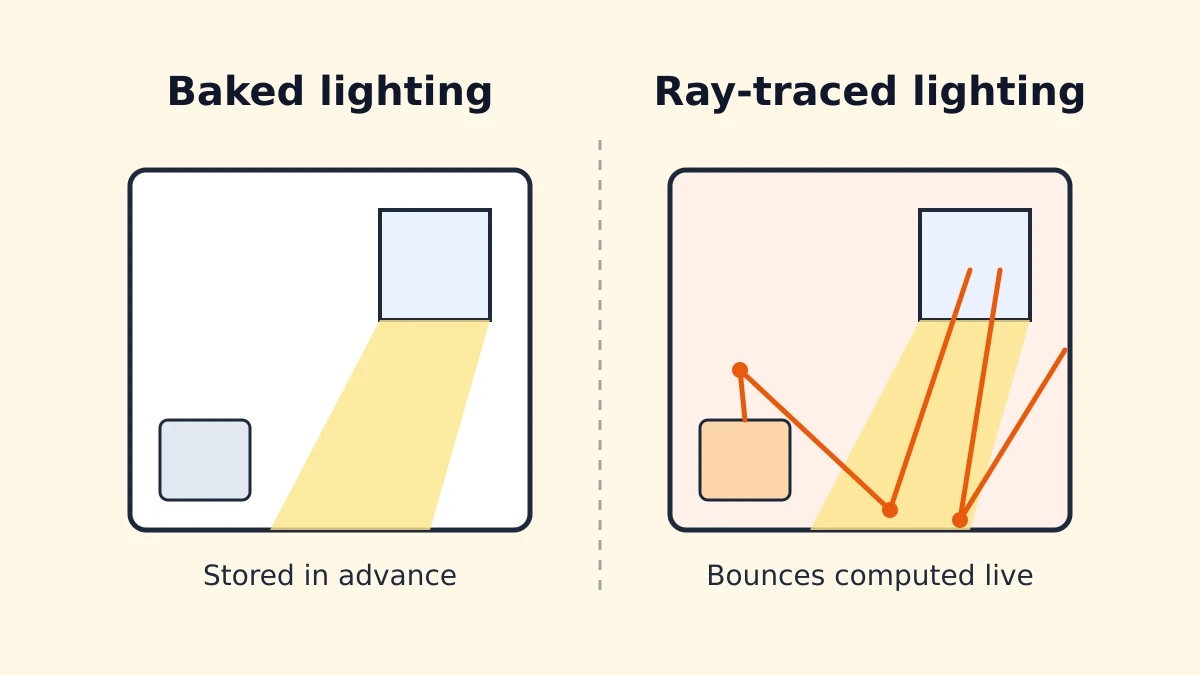
Reflections and the BVH. Screen-space reflections fail when the reflected object leaves the screen or is hidden behind something. Ray-traced reflections test rays against the BVH instead, so off-screen objects can still appear. Digital Foundry found characters visible in reflections where screen-space data alone would not be enough. The BVH is also a cost lever. When a Ferris wheel was missing from a water reflection in a 2026 skyline clip, Digital Foundry suggested developers had left it out of the ray-traced set to save GPU time.
Shadows. A shadow map renders the scene from the sun's point of view; anything the sun cannot "see" is in shadow. Rockstar's November post lists ray-traced shadows as a PS5 Pro feature, which suggests the other consoles rely on shadow maps.
Hair and skin. Strand-based hair draws thousands of individual strands that can swing and settle, which Digital Foundry noted in both cutscenes and gameplay. Skin realism depends partly on subsurface scattering, light entering skin and spreading underneath before it exits. It is why fingers glow red over a flashlight. Digital Foundry singled out skin, sweat and makeup as a large visible advance.
Spatial, temporal and AI upscaling: how GTA 6 reaches a 4K screen
Native resolution is what the GPU actually renders; upscaling stretches it to fit the screen. Digital Foundry counted GTA 6 at about 1440p on a base PS5, upscaled to 4K with a fairly basic method. Its Launch Trailer analysis found no drop from that resolution.
There are three broad kinds of upscaling:
Spatial upscaling looks at one frame at a time and interpolates new pixels from neighbors. It is cheap, but it cannot recover detail that was never rendered. Digital Foundry says this is what GTA 6 uses on base PS5, which explains the soft image and some shimmer on thin edges.
Temporal upscaling combines several recent frames, using motion vectors to line up pixels, and rebuilds detail the single frame lacked. AMD's FSR 2 and later versions work this way.
AI upscaling runs a trained neural network to do the reconstruction. Sony's PSSR (PlayStation Spectral Super Resolution) on PS5 Pro is one example, much like the GPU-side AI work covered in our explainer on NVIDIA RTX Spark Microduck training.
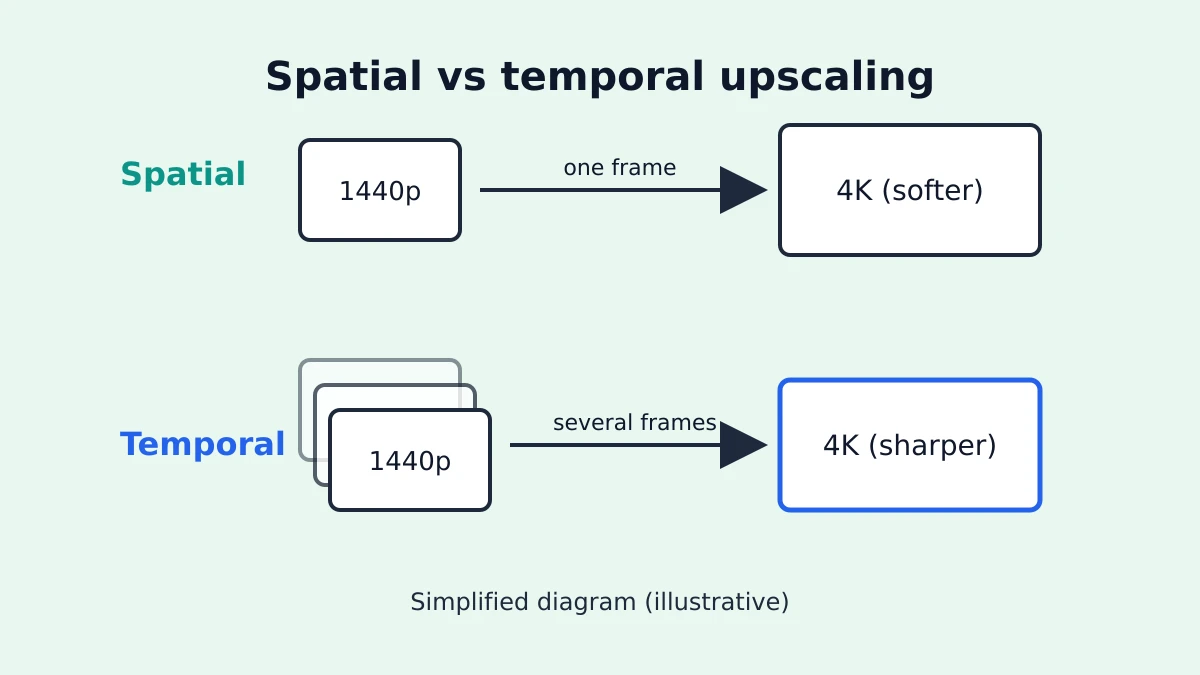
Rockstar confirms PSSR for GTA 6 on PS5 Pro. On October 1, 2026, Sony announced QSSR (Quick Spectral Super Resolution) for the base PS5, a lighter tier of its AI upscaler. Rockstar has not listed QSSR for GTA 6. Digital Foundry estimated that the 1440p-to-4K step would cost about 4 milliseconds, based on Marvel's Wolverine. In a 33.3 ms budget that is roughly 12%, by our arithmetic.
Dynamic resolution is different: the engine lowers render resolution in busy scenes to protect the frame rate. Digital Foundry's counts landed at the same 1440p in both the Extended Look and the Launch Trailer.
Why a steady 30 fps can feel better than an unsteady 60
The number on the box matters less than the gaps between frames. Frame pacing means each frame arrives the same time after the last one. A game that swings between 40 and 60 fps delivers frames at 16.7 ms, then 25 ms, then 16.7 ms. The eye reads that as judder.
GTA 6's 30 is unusually even. Digital Foundry reported a relatively stable and well-paced 30 fps in the Extended Look, with only occasional single-frame drops. Tom's Hardware later reported that the review covered all 48,242 frames of the video. Motion blur also smooths fast camera moves at this frame rate.
One known flaw is a camera judder in Rockstar's RAGE engine that Digital Foundry traces back to GTA 4. It was still visible in the Extended Look. In the October Launch Trailer, Digital Foundry's Oliver Mackenzie could not find it.
The 40 fps option comes down to arithmetic. A 120 Hz display refreshes every 8.3 ms. A 40 fps frame lasts exactly three refreshes, so every frame stays on screen for the same 25 ms. On a 60 Hz TV, 40 fps would alternate between one and two refreshes (16.7 and 33.3 ms), and that uneven rhythm defeats the purpose. That is why console games offer 40 fps only in 120 Hz modes. Rockstar has not announced a 40 fps mode for GTA 6.
GTA 6 frame rate and features by platform
This table separates what Rockstar has confirmed from what analysts expect.
| Platform | Frame rate | Resolution / upscaling | Other confirmed features | Hardware note |
|---|---|---|---|---|
| PS5 | 30 fps target (Rockstar) | About 1440p, spatial upscale to 4K (Digital Foundry, footage); QSSR not confirmed | DualSense haptics, Tempest 3D Audio, faster loading (Rockstar) | 8-core Zen 2 up to 3.5 GHz |
| PS5 Pro | 30 fps target (Rockstar) | PSSR (Rockstar); internal resolution not disclosed | Ray-traced shadows exclusive to Pro (Rockstar) | Same Zen 2 CPU family; much larger GPU |
| Xbox Series X | 30 fps target (Rockstar) | Expected near PS5 (Digital Foundry prediction, unconfirmed) | Not detailed | 8-core Zen 2 at 3.8 GHz; 12.15 TFLOPS GPU |
| Xbox Series S | 30 fps target (Rockstar) | Around 720p (Digital Foundry prediction, unconfirmed) | Not detailed | 8-core Zen 2 at 3.6 GHz; 4 TFLOPS GPU; 10 GB memory |
| Xbox One | Not native | Cloud streaming only (Rockstar) | Via Xbox Cloud Gaming | Runs on remote servers |
| PC | Not announced | Not announced | GamesBeat reports Q1 2027 (unconfirmed) | Not applicable |
The Xbox specs come from Microsoft's official breakdown. Digital Foundry's John Linneman said the team could "assume 720p target for the Series S", citing the game's dependence on ray tracing. That is a prediction, not a measurement.
On PC, Take-Two CEO Strauss Zelnick told Bloomberg in May that "Rockstar always starts on console." GamesBeat reported a first-quarter 2027 PC release, citing four unnamed industry sources. Rockstar did not comment. Other outlets expect a later window, late 2027 or 2028, based on past gaps. Rockstar says the console download is up to 212 GB, depending on the device.
The AI question: hand-written game AI vs generative AI
"AI" means two different things in this debate. Game AI is the traditional kind: hand-authored rules, state machines and behavior trees that decide what a character does next. A pedestrian with an "aggressive" trait who sees a drawn weapon follows rules a designer wrote. The personality traits Rockstar describes for its NPCs belong to this hand-authored kind.
Generative AI is a model that produces new content (text, images, animation, levels) from training data. Zelnick has ruled it out for this game: "With regards to GTA 6, generative AI has zero part in what Rockstar Games is building," he told GamesIndustry.biz, as reported by NME. He added that the worlds are built by hand, building by building and street by street.
Zelnick's statement covers GTA 6 only. Zelnick has also said Take-Two runs hundreds of AI pilots and implementations elsewhere in the company. It also does not conflict with PSSR. An upscaler runs a neural network at playtime to sharpen pixels the game already rendered. It does not create the game's content. For a refresher on the terms, see our guide to 40 AI terms every student should know.
My take on GTA 6's 30 fps
What critics said on launch day (November 19, 2026)
The 30 fps target did not hold back the reviews. GTA 6 opened with a Metacritic average of 99 out of 100 from more than 150 reviews, Al Jazeera reported as the game unlocked worldwide at midnight. BBC Newsbeat noted that the score ties The Legend of Zelda: Ocarina of Time, which has held the record since 1998.
IGN's Luke Reilly called it "the single most impressive video game I have ever played." Commercial demand matched the reviews: Sensor Tower estimated more than 15.8 million pre-orders and $1.54 billion in revenue as of November 17, according to Al Jazeera. The game also leads this year's Game Awards with eight nominations, including game of the year, BBC Newsbeat reported.
Neither roundup lists frame rate as a common complaint. The closest performance note came from journalist Jordan Middler, who finished the story in about 100 hours. He told BBC Newsbeat the game can "slow down" because so much is happening at once. He did not say whether he meant frame-rate drops or pacing, so treat it as one player's observation, not a measurement. Not everyone joined in, either: BBC Newsbeat found some forum posters tired of the hype.
My read is that the answer to why GTA 6 runs at 30 fps is a design decision, not a failure of optimization. The evidence points one way: the bottleneck is the CPU, the Pro's upgrade is mostly GPU, and ray-traced lighting is built into how the world is lit. A 60 fps mode would mean cutting the density that makes the game what it is.
For developers, the useful lesson is to profile before you buy hardware. Teams often buy a bigger GPU instance when the real wait is a single-threaded loop, a lock or I/O. GTA 6 shows at scale that the slowest stage sets the pace, and upgrading the wrong stage changes nothing.
The real trade-off is felt by players who switch between GTA 6 and 120 fps PC games; they will notice the gap. I would still prefer a choice of modes. GTA 5 launched at 30 fps and got a 60 fps mode years later on newer consoles; Red Dead Redemption 2 still has no official 60 fps console mode, according to TweakTown. So a faster mode on future consoles or PC is plausible but unannounced.
The bottom line: if you own a base PS5 or Series X, the version you can play today is the one Rockstar designed for, and the Pro mainly adds a cleaner image and ray-traced shadows. If frame rate is your top priority, the only higher-frame-rate route is a PC version that has not been announced.
Frequently asked questions
Will GTA 6 get a 60 fps mode later?
Rockstar has not announced one. Its November 10 post targets 30 fps on every console. Digital Foundry calls 60 fps on current consoles "extremely unlikely" because of the CPU load.
Does GTA 6 have a 40 fps mode on PS5 Pro?
No 40 fps mode has been announced. A 40 fps mode would need a 120 Hz display, because 40 frames divide evenly only into 120 refreshes per second.
What resolution does GTA 6 run at on PS5?
Digital Foundry counted about 1440p on a base PS5 in the Extended Look and the Launch Trailer, upscaled to 4K with a simple spatial method. Rockstar has not published a resolution.
What does the PS5 Pro add to GTA 6?
Rockstar lists PSSR upscaling for a clearer image and ray-traced shadows that only the Pro gets. The frame-rate target stays at 30 fps.
Does GTA 6 use QSSR on the base PS5?
Rockstar has not listed QSSR, Sony's AI upscaler for the base PS5. Digital Foundry estimates it would cost about 4 ms of the 33.3 ms frame budget.
Is GTA 6 coming to PC?
No PC version has been announced. GamesBeat reported a first-quarter 2027 release, citing four unnamed sources, and Rockstar did not comment.
Concepts in this article
- Artificial intelligence
- Computer systems that perform tasks that normally need human intelligence.
- Generative AI
- Models that produce new text, images, audio or code.
- Neural networks
- Layers of weighted connections trained by backpropagation to learn patterns.
- Objects
- Collections of key–value properties, the building block of most JavaScript data.
- React
- A JavaScript library for building user interfaces from components.
How we research, write and check articles