DSA vs AI in 2026 and Beyond: What Should Students and Developers Learn?
Is DSA dead now that AI won the ICPC? No, but "just grind LeetCode" is wrong too. This guide uses 2026 evidence, including Stack Overflow's survey, METR's study, Stanford's entry-level data, India's fresher hiring shifts and changing interviews, plus a ByteMuni benchmark where correct code was 1,150× too slow. It shows how to split your time between DSA, development and AI, and gives a year-by-year roadmap.

Open Instagram or YouTube as an engineering student in 2026 and you'll hear two loud, opposite messages. One camp says, "DSA is dead. AI writes all the code now. Just vibe-code and build." The other says, "Ignore the hype. Grind 500 LeetCode problems and your placement is set."
Both are wrong, and following either one can quietly hurt your career.
The real question isn't DSA vs AI. It's how much of each, in what order, for which goal. This guide answers that with evidence rather than reels: what the 2026 developer surveys show, what AI can and can't do (including the day AI beat every human team at the world's top programming contest), what Indian fresher hiring actually looks like right now, how interviews are changing, and a practical year-by-year plan. We also ran a small benchmark that shows, in seconds rather than opinions, why fundamentals still matter when AI writes your code.
Short answer. Learn both, in the right order. If you're a student, spend about 70% of your time on fundamentals (DSA, development, computer science basics, projects) and 30% on AI, learning to use AI tools well and, if you're interested, to build AI-powered apps. If you're already working, flip it. DSA is how you learn to think; AI is how you work faster. Companies in 2026 test both.
Why everyone is confused about DSA vs AI
The confusion is understandable. In just two years:
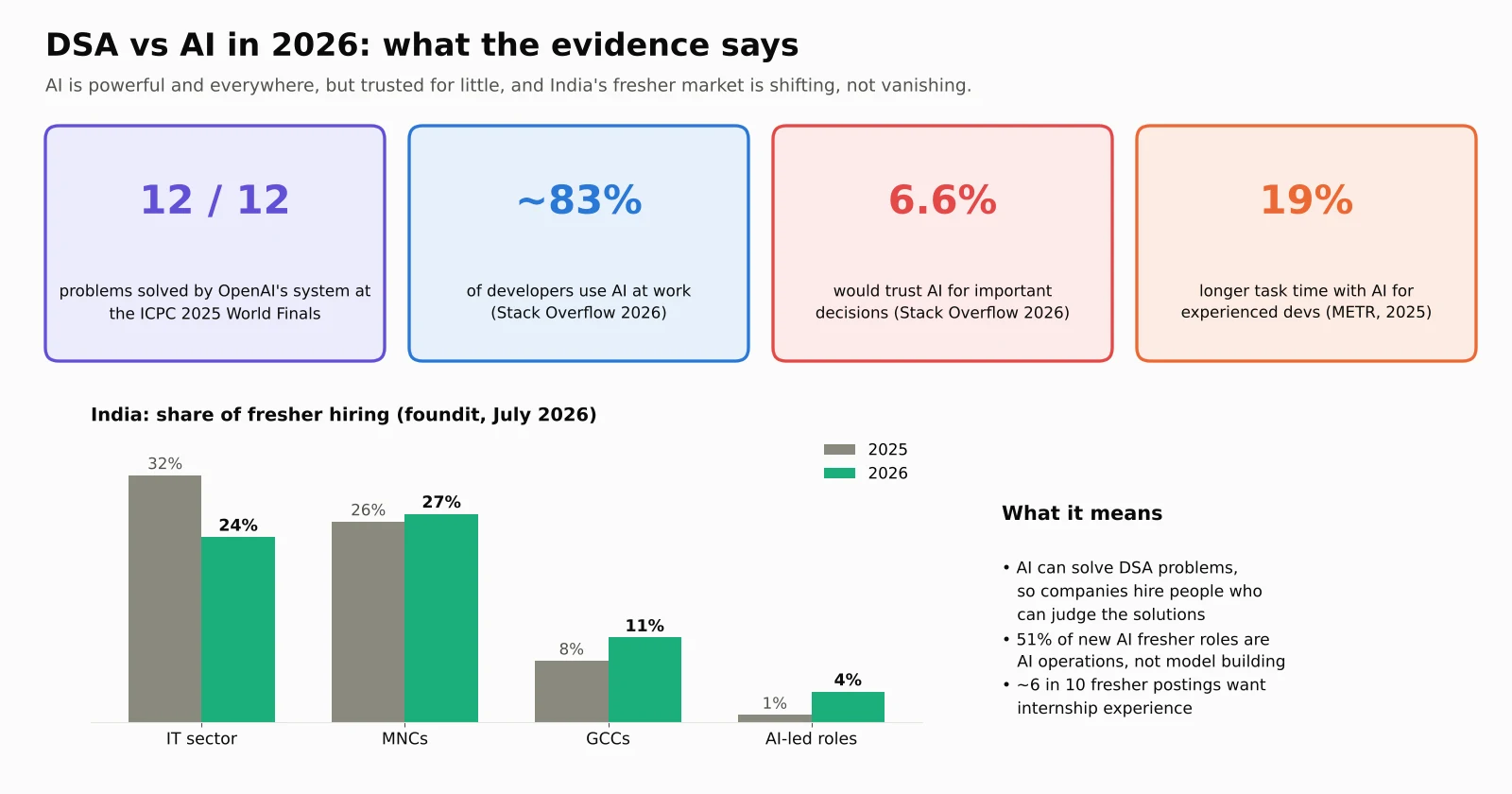
AI started beating humans at competitive programming. At the 2025 ICPC World Finals in Baku in September 2025, OpenAI's system solved all 12 of 12 problems under the same five-hour rules as the 139 human university teams, which would have ranked it first. Google DeepMind's Gemini 2.5 Deep Think solved 10 of 12, gold-medal level, including one problem no human team cracked.
Almost every developer now uses AI. In Stack Overflow's 2026 Developer Survey of more than 30,000 people, about 83% said they use AI at work, and 73% of those using AI coding assistants or agents use them daily.
Entry-level tech hiring got tougher. In India, the foundit Insights Tracker for July 2026 reported that overall entry-level hiring fell 10% year on year, and the IT sector's share of fresher hiring dropped from 32% to 24%. Foundit's CEO said, "One in four entry-level IT jobs has disappeared over the past year."
Put those together and "DSA is dead" sounds logical. If AI can win the ICPC, why should you learn graphs and dynamic programming?
But the same data has a second half that the reels leave out.
What the evidence actually says
AI is powerful but not trusted with important decisions
The same Stack Overflow 2026 survey found that only 6.6% of developers would trust AI for important decisions, and 93% said they need source attribution to trust what AI gives them. In the 2025 survey, 46% said they don't trust the accuracy of AI output (up from 31% the year before), and 45% said AI-generated code leaves them stuck in time-consuming debugging.
In other words, the people who use AI the most are the ones checking its work the most. Checking requires knowing what correct, efficient code looks like.
AI doesn't automatically make experienced developers faster
In a July 2025 randomised controlled trial by the research group METR, 16 experienced open-source developers worked on real issues from their own repositories, with AI allowed on some tasks and not others. Allowing AI increased completion time by 19%, even though the developers believed AI had made them about 20% faster. AI tools have improved since, and other studies find speed-ups on different tasks, but the lesson stands: AI's value depends heavily on the person using it.
Young workers are feeling the pressure first
The Stanford Digital Economy Lab's study Canaries in the Coal Mine?, based on US payroll data from ADP, found that employment of workers aged 22 to 25 in the most AI-exposed occupations, which include software development, now stands 19% below comparable groups (per the August 2026 version of the paper). Employment for more experienced workers in the same jobs has been stable or growing.
The authors' key point: the effect depends on whether AI is automating the work or augmenting the worker. Entry-level tasks that are easy to automate are shrinking; people who can supervise, verify and extend AI's output are still in demand. That's the skill set you want.
Indian fresher hiring is shifting, not disappearing
The foundit July 2026 data shows where entry-level jobs are moving:
| Fresher hiring share | 2025 | 2026 |
|---|---|---|
| IT sector | 32% | 24% |
| Global Capability Centres (GCCs) | 8% | 11% |
| MNCs | 26% | 27% |
| AI-led roles (of all fresher hiring) | about 1% | 4% |
Two details matter for students. First, 51% of those new AI roles are "AI operations" jobs, such as data analysis, prompt engineering and testing, not model building. Second, nearly six in ten fresher job postings prefer or require internship experience. That's a strong signal that employers want proof you can build and ship things, not just a certificate or a high LeetCode count.
DSA vs AI: is DSA dead?
No, but "DSA" has to mean the right thing.
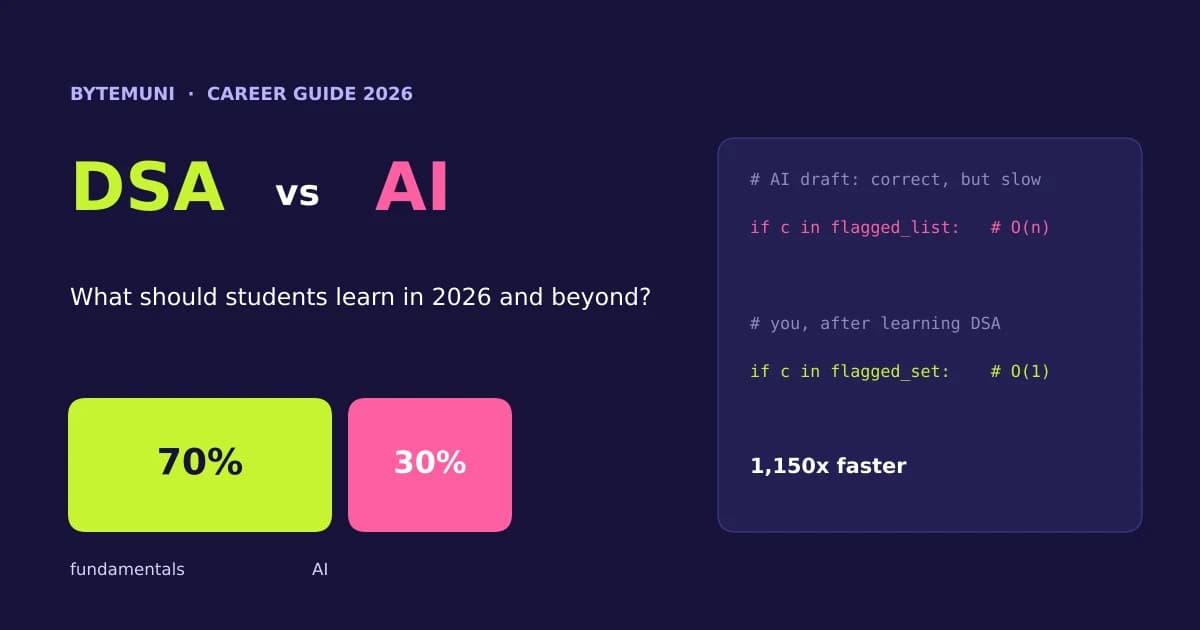
DSA isn't memorising 500 solutions. It's learning to look at a problem, break it into parts, recognise a pattern, compare approaches and know which one will still work when the data gets 1,000 times bigger. That skill is exactly what you need to judge AI-generated code.
A quick benchmark: correct code that's 1,000× too slow
To make this concrete, we wrote two versions of a common task: an e-commerce app must find today's orders placed by customers on a fraud watchlist.
# Version A: the typical "first draft". Correct, readable, passes small tests.
def flagged_orders_A(orders, flagged_ids):
    return [o for o in orders if o["customer"] in flagged_ids]   # flagged_ids is a list

# Version B: what someone who knows hashing asks for in code review.
def flagged_orders_B(orders, flagged_ids):
    flagged = set(flagged_ids)                                    # O(1) average lookups
    return [o for o in orders if o["customer"] in flagged]
Both return exactly the same result. We timed them in Python on the same machine:
| Orders | Flagged customers | Version A (list) | Version B (set) | B is faster by |
|---|---|---|---|---|
| 1,000 | 100 | 0.001 s | 0.0001 s | 19× |
| 10,000 | 1,000 | 0.100 s | 0.0007 s | 141× |
| 50,000 | 5,000 | 1.714 s | 0.0026 s | 663× |
| 100,000 | 10,000 | 6.603 s | 0.0057 s | 1,150× |
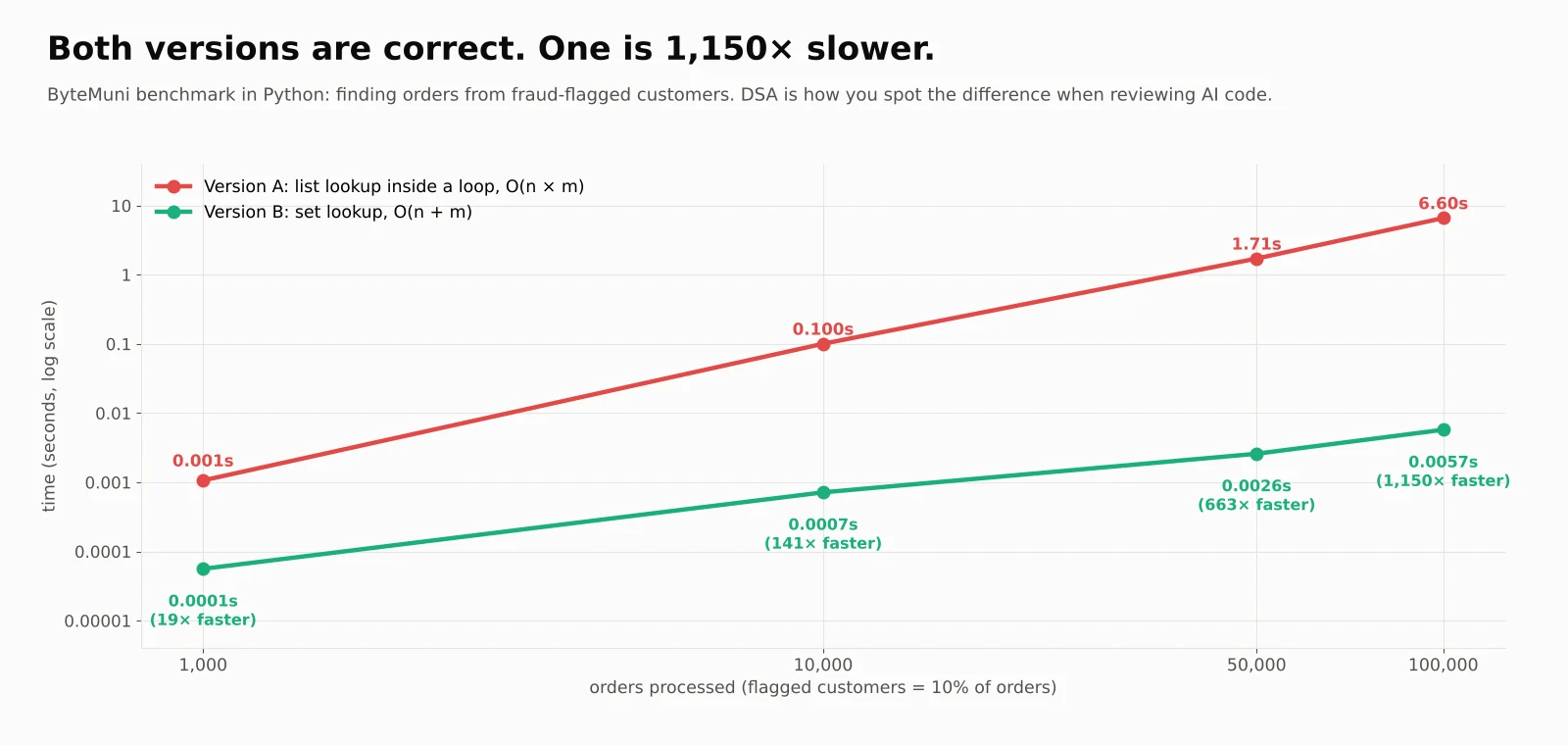
Version A has a hidden O(n × m) cost: every in check scans the whole list. At 1,000 orders nobody notices. At 100,000, a single API call takes almost seven seconds; at a million, it would time out. Version B is O(n + m).
AI tools often suggest the efficient version, especially if you ask. But not always, and a correct-looking draft that passes your tests is exactly the kind you're most tempted to accept. The developer who knows why a set is faster is the one who catches it in review. That knowledge is DSA.
Correctness traps are just as common. We also tried a "helpful" one-line de-duplication, list(set(ids)). It's fast, but it doesn't keep the original order: [5, 3, 5, 1, 3, 9] came back as [1, 3, 5, 9] in our run. If order mattered (say, a user's recently viewed products), that's a bug. list(dict.fromkeys(ids)) is also O(n) and keeps the first-seen order: [5, 3, 1, 9].
Interviews still test it, often twice
Companies haven't dropped DSA. They've added AI on top of it:
Google, per reporting on its 2026 interview pilot, added a code-comprehension round in which candidates work with Gemini inside an unfamiliar codebase, while reportedly keeping a traditional coding round without AI. ByteMuni covered this in detail in our guide to the new Google interview process.
Meta has run an AI-assisted coding round since late 2025, replacing one onsite coding round, not all of them.
Most Indian campus drives still start with an online assessment of arrays, strings and complexity, usually with AI blocked and proctored.
So fundamentals are now tested directly and indirectly, through how well you supervise AI. AI-assisted rounds reward candidates who form their own hypothesis before asking the model; you can't do that without the fundamentals.
So, is AI just a fad for students?
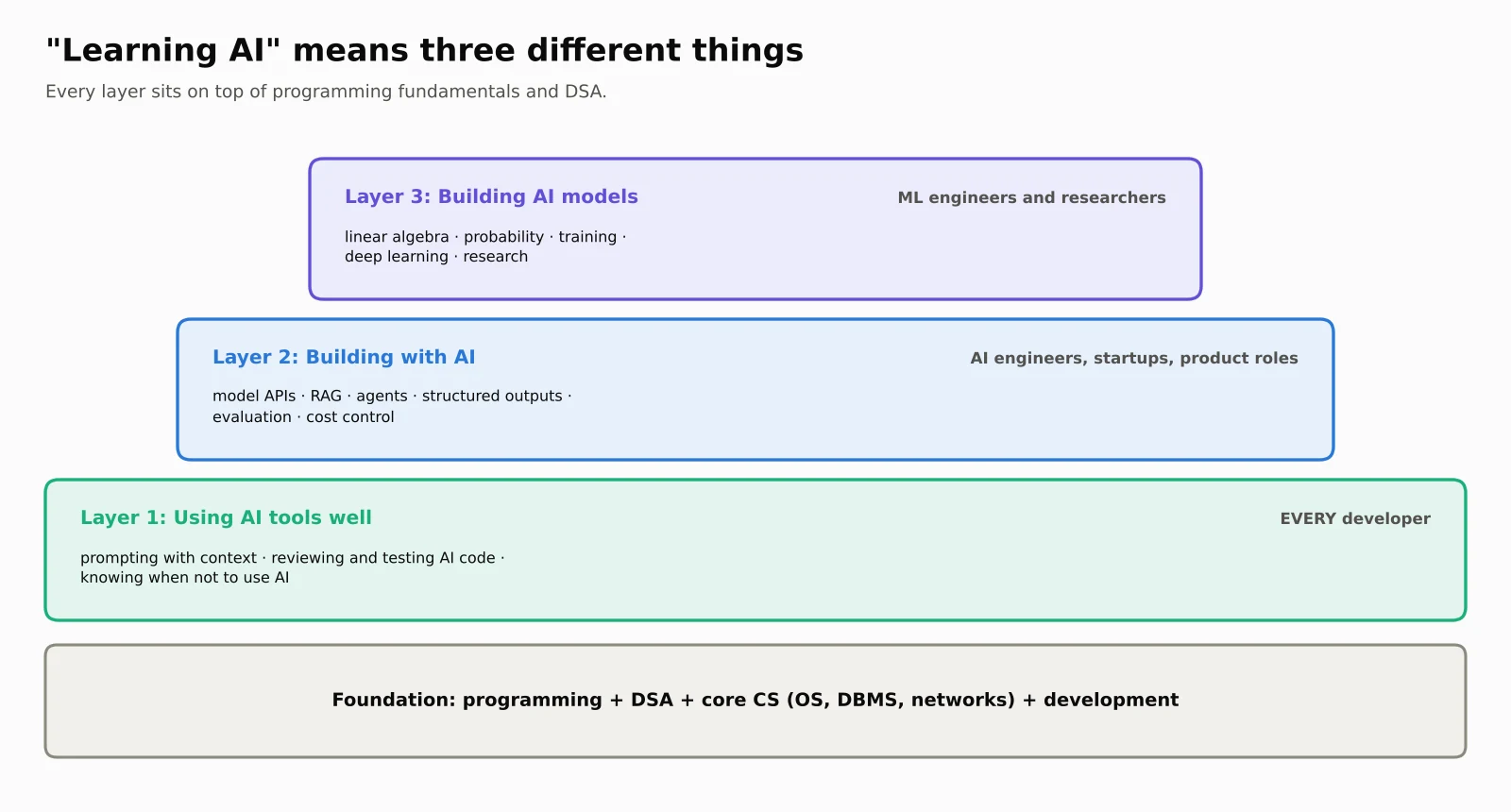
Also no. Ignoring AI in 2026 is like refusing to learn Git in 2015. But "learning AI" means three very different things, and students mix them up constantly.
| Layer | What it means | Who needs it | Depends on |
|---|---|---|---|
| 1. Using AI tools well | Prompting with real context, reviewing and testing AI code, knowing when not to use AI | Every developer | Programming fundamentals and DSA, so you can judge the output |
| 2. Building with AI | Calling model APIs, RAG, agents, structured outputs, evaluation, cost control | Students targeting AI engineering, startups or product roles | Development skills (APIs, databases, deployment) |
| 3. Building AI models | Linear algebra, probability, training, deep learning, research | ML engineers and researchers (a smaller, highly competitive set of roles) | Strong maths plus programming |
Layer 1 is now as basic as knowing an IDE. Layer 2 is where much of the new job growth is. Layer 3 is a real specialisation that rarely hires freshers in bulk.
Notice the "Depends on" column. Every layer of AI sits on top of fundamentals. That's why the honest answer to "DSA vs AI" is "DSA, then AI on top," not "one or the other."
If you want to go deeper on layer 2, ByteMuni's guides to AI system design and generative AI with LangChain are good next steps. For the vocabulary, start with 40 AI terms every student should know.
DSA vs AI: what to choose for your goal
| Your goal | DSA | Development | AI | Notes |
|---|---|---|---|---|
| IT services companies (mass hiring) | Moderate: arrays, strings, basics | Moderate | Layer 1 | Aptitude and communication matter too |
| Product companies and big tech | High: up to graphs and DP | High | Layer 1, some layer 2 | Coding rounds plus AI-assisted rounds |
| GCCs (the fastest-growing fresher employers) | High | High | Layer 1–2 | Often mirror product-company interviews |
| Startups | Moderate | Very high | Layer 2 | Shipping real products beats certificates |
| AI engineer / applied AI | High | High | Layer 2, some layer 3 | Most AI engineers were strong software engineers first |
| ML research / data science | Moderate to high | Moderate | Layer 3 | Maths and statistics are non-negotiable |
| Non-CS branch switching to tech | Build up gradually | High | Layer 1 | Projects and internships prove ability |
How to split your time between DSA and AI: the 70/30 rule
A practical split that many Indian tech educators now recommend, and which matches the evidence above:
College students: 70% fundamentals, 30% AI. Fundamentals means DSA, development, core CS (OS, DBMS, networks, OOP), projects and communication. AI means layer 1 for everyone, plus layer 2 if it interests you.
Working professionals: flip it to 30/70. Your fundamentals are already tested every day at work; your biggest gap is usually AI tools and AI-powered systems.
If placements are close, adjust by the calendar:
| Time before placements | DSA | Development / projects | AI |
|---|---|---|---|
| 12+ months | 40% | 40% | 20% |
| 6 to 12 months | 50% | 30% | 20% |
| Last 3 months | 60 to 70% | 20% | 10 to 20% |
The final stretch leans towards DSA because online assessments and coding rounds are the first filter. The earlier months lean towards projects because that's what gets you shortlisted, and remember that six in ten fresher postings want internship experience.
A year-by-year roadmap for engineering students
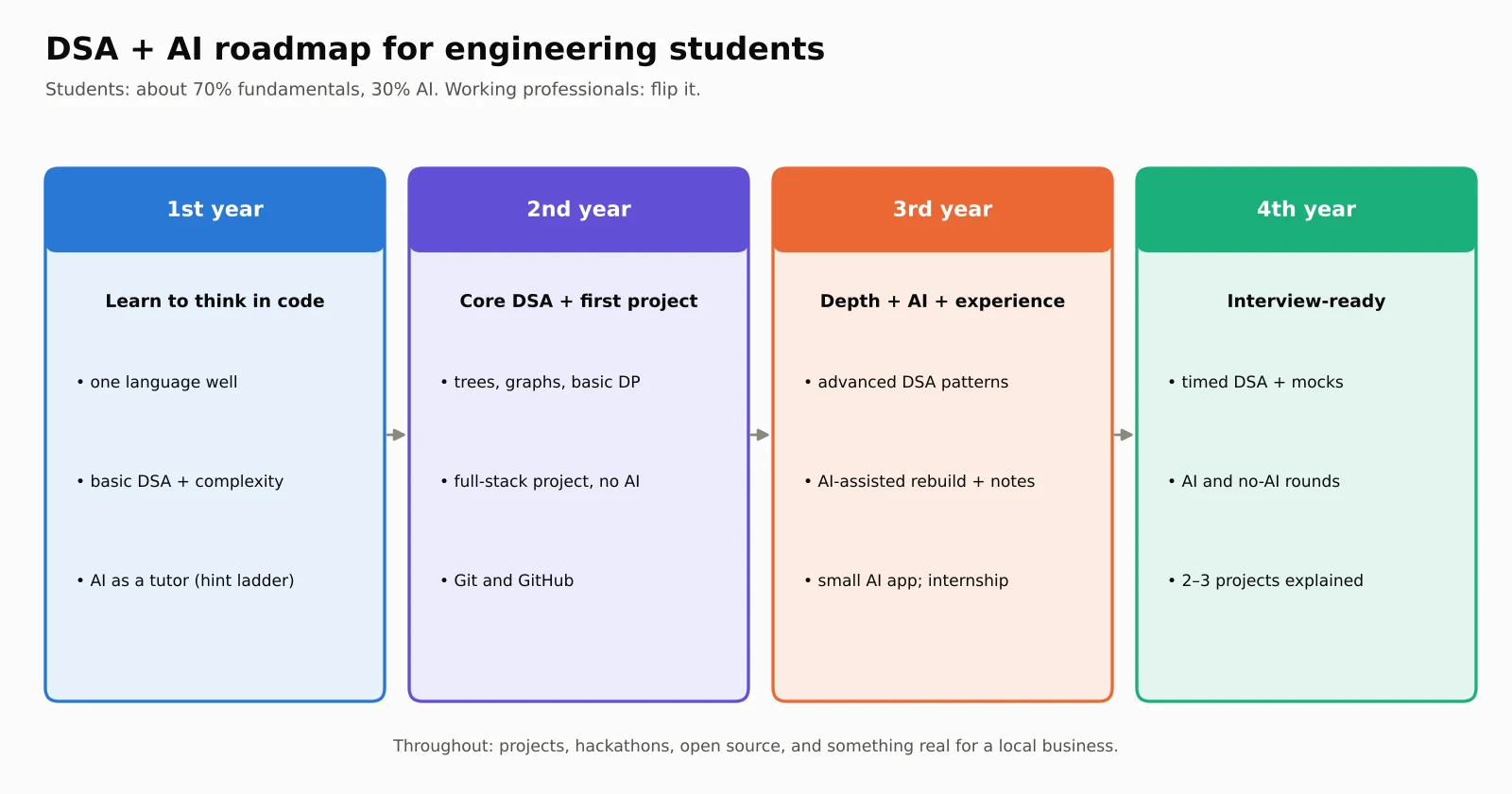
First year: learn to think in code
Pick one language (C++, Java or Python) and get comfortable with it.
Learn basic DSA: arrays, strings, hashing, recursion, sorting, searching, complexity.
Use AI as a tutor, not a solver (see the "hint ladder" below).
Second year: core DSA and your first real project
Linked lists, stacks, queues, trees, heaps, graphs (BFS/DFS), basic dynamic programming.
Build one full-stack project from scratch, without AI generating it: authentication, a database, an API, deployment.
Learn Git and GitHub properly.
Third year: depth, AI and experience
Advanced patterns: graphs, DP, sliding window, binary search on answers.
Rebuild or extend a project with AI tools, and write down where AI helped and where it was wrong. That reflection is a strong interview story.
Build one small AI-powered app (for example, a RAG chatbot over your college handbook).
Go after internships, hackathons and open-source contributions.
Fourth year: interview-ready
Timed DSA practice and mock interviews, both without AI and in an AI-assisted format.
Revise core CS subjects and system design basics.
Polish two or three projects you can explain line by line.
How to use AI to learn DSA without cheating yourself
AI is an outstanding DSA tutor if you use it the right way, and a disastrous one if you let it solve everything. Use a hint ladder: only climb to the next step if you're truly stuck.
Try it yourself first for at least 20 to 30 minutes, and write down your approach, even if it's wrong.
Ask for a hint, not a solution: "Don't give me code. Which data structure should I think about, and why?"
Ask for the approach in words, then code it yourself.
Ask AI to review your code: "What's the time complexity? Which edge cases fail?"
Only then compare with a full solution, and re-solve the problem from memory two days later.
The same rule works in AI-assisted interview rounds: hypothesis first, AI second. Interviewers watch whether you think before you prompt.
Build projects with AI and without it
Projects are where DSA and AI meet real life, and where most of your learning, and your resume, comes from.
Build at least one project without AI so you truly understand every layer: routing, database queries, authentication, deployment.
Build at least one project with AI, and keep notes on what it did well and where it went wrong.
Solve a real problem for real people. If your family runs a small shop, or a relative has a small business or works in a local office, build something useful for them: an inventory tracker, a WhatsApp order form, a simple dashboard. It may be unpaid and short, but it's genuine practical experience, and it gives you confidence and stories for interviews.
Add internships, hackathons and open source wherever you can. Given how many fresher postings now ask for internship experience, this isn't optional any more.
What's likely to change by 2030, and what isn't
These are informed expectations, not guarantees:
Likely to change:
More interview rounds will allow AI and judge how you use it, such as code reading, debugging and verification, alongside traditional rounds.
Routine coding (boilerplate, simple CRUD, standard algorithms) will be mostly AI-generated.
Entry-level roles will expect AI fluency by default, and AI operations, evaluation and integration roles will keep growing.
Unlikely to change:
Someone must understand the system, make trade-offs and take responsibility when it breaks in production.
Efficient code still matters at scale, and cloud bills punish slow code.
Reading, debugging and maintaining large codebases still needs deep understanding. AI can create a small project quickly; keeping a huge codebase healthy is a different skill.
India's competition for good tech jobs will remain intense, so fundamentals plus proof of work will keep being the differentiator.
Myths vs reality
| Myth | Reality |
|---|---|
| "DSA is dead because AI solves LeetCode." | AI solved every ICPC 2025 problem, yet companies still test DSA, because they're hiring people to judge solutions, not just produce them. |
| "Just grind LeetCode and you'll get placed." | That wasn't true five years ago either. Top candidates combined DSA with projects, CS fundamentals, communication and internships. |
| "Learning AI means learning machine learning maths." | Most developers need layer 1 (using AI well) and possibly layer 2 (building with AI APIs). Layer 3 is a specialisation. |
| "Vibe coding is enough to get a job." | Interviewers ask you to explain and modify your code. "Let me ask the AI" isn't an answer in a live interview. |
| "AI will make developers unnecessary." | Developers are using AI more than ever, but only 6.6% trust it for important decisions. Someone has to be accountable. |
Our take
The DSA vs AI debate is a false choice, and the people pushing either extreme are usually selling something, whether it's a course, a reel or a feeling of certainty.
Here's what the evidence says when you put it together. AI can now solve world-class programming problems, and almost every developer uses it. But developers don't trust it with important decisions, it doesn't automatically make people faster, and entry-level jobs are shrinking fastest where AI can simply replace the work. The way to stay on the right side of that line is to become the person who can supervise AI: someone who can think through a problem, spot a 1,000× slowdown or an edge-case bug, and build and ship real things.
That person learns DSA to think, development to build and AI to move faster. In that order, with steady practice, and with real projects that prove it. Learn the fundamentals, build things, use AI wisely and keep adapting. That strategy works in 2026, and it will still work in 2030.
To prepare for the interview side, see ByteMuni's generative AI interview questions for 2026.
Sources
TechRepublic: OpenAI and Google DeepMind outshine students at ICPC 2025 (September 18, 2025)
Stack Overflow: The results of the 2026 Developer Survey (October 6, 2026)
IT Brief UK: Stack Overflow survey shows developers trust AI with caveats (October 2026)
ITPro: Stack Overflow 2025 survey, 84% use AI but nearly half don't trust it (July 2025)
Simon Willison: notes on METR's study of AI and experienced open-source developers (July 2025)
Stanford Digital Economy Lab: Canaries in the Coal Mine? (August 2026 version)
The Register: Stanford study on AI and recent graduates' jobs (August 2025)
Business Today: AI, GCCs and India's changing fresher job market, foundit data (August 6, 2026)
DEV Community: DSA, Web Dev, or AI, what should beginners learn first?
takeUforward community: DSA vs Development vs AI for campus placements in 2026
Frequently asked questions
Is DSA still important in 2026?
Yes. Most fresher software roles, including at product companies and GCCs, still screen with coding rounds. DSA also gives you the ability to judge AI-generated code, catching slow algorithms and edge-case bugs that pass small tests. The focus has shifted from memorising solutions to understanding patterns and trade-offs.
Should I learn DSA or AI first?
Learn programming basics and core DSA first, then add AI. Using AI tools well should start early, as a tutor and assistant. Building AI-powered apps or models works best once you have programming, development and problem-solving foundations.
Can AI solve DSA problems?
Yes, increasingly well. At the 2025 ICPC World Finals, OpenAI's system solved all 12 problems and Google DeepMind's solved 10. That's exactly why companies now value candidates who can verify, explain and adapt solutions, which requires understanding DSA yourself.
How much time should I give to DSA vs AI?
As a student, a practical split is about 70% fundamentals (DSA, development, core CS, projects) and 30% AI. In the last three months before placements, increase DSA. Working professionals can flip the ratio, since their fundamentals are already in daily use.
Do AI engineers need DSA?
Yes. AI engineering interviews usually include coding rounds. Building reliable AI systems also needs strong software engineering skills: APIs, data handling, efficient code and debugging. Most successful AI engineers were strong software engineers first.
Will AI replace software engineers?
AI is replacing some routine coding tasks and has hit entry-level hiring in AI-exposed roles hardest. But engineers who understand systems, verify AI output and solve business problems remain in demand. The job is shifting from writing every line to designing, reviewing and owning solutions.
Concepts in this article
- Data structures and algorithms
- The core toolkit of programming problems: how to store data and process it efficiently.
- Technical interviews
- How companies test engineering candidates: coding, system design and behavioural rounds.
- Artificial intelligence
- Computer systems that perform tasks that normally need human intelligence.
How we research, write and check articles