Claude API vs OpenAI API in 2026: Which Should Developers Use, or Both?
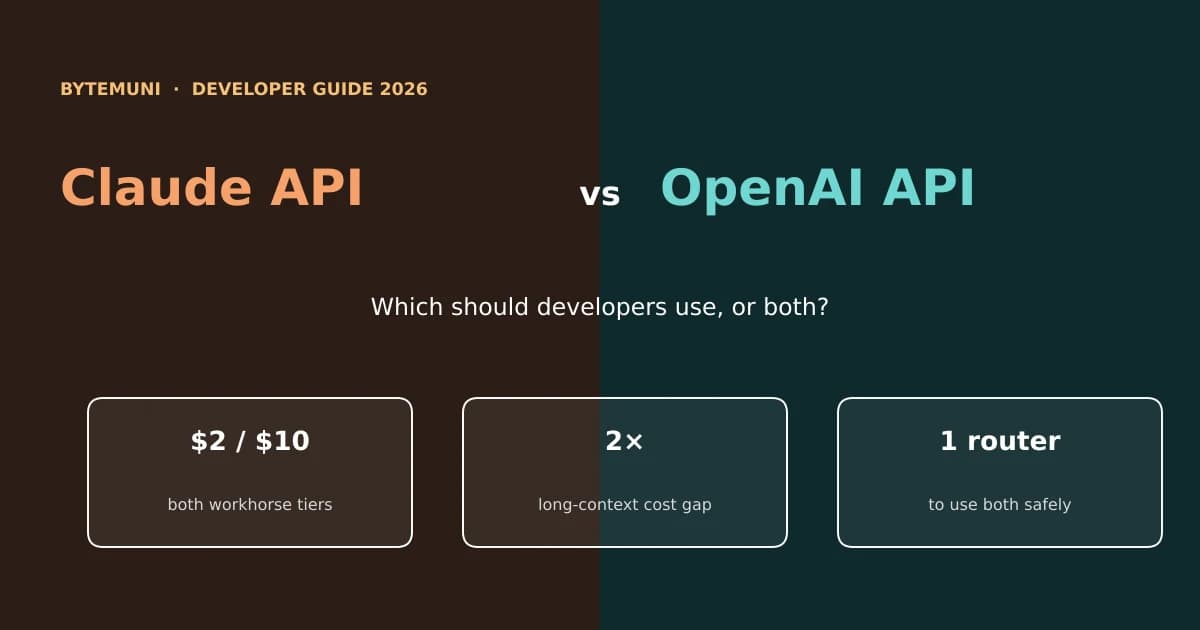
Claude Sonnet 5.5 and GPT-6.1 Sol now share the same $2/$10 list price, yet your real bill can differ by 2×. This developer guide compares the Claude API and OpenAI API using November 2026 pricing, five costed workloads, long-context and caching rules, tokenizers, API gotchas, structured outputs, data retention and India residency, plus tested Python code to use both with routing and fallback.

You've built the prototype. It works on your laptop. Now the real question lands in your team chat: "Are we going with Claude or OpenAI for production?"
Most Claude API vs OpenAI API comparisons answer that with a feelings-based table ("Reasoning: Excellent / Very Good") or with prices that were already out of date the week they were published. The truth in November 2026 is more interesting, and more useful: on paper, the two APIs now cost almost exactly the same, yet the bill you actually pay can differ by 2× depending on your workload. The differences that matter are hidden in long-context pricing, caching rules, tokenizers, data-handling terms, where your data is processed and small API quirks that break code when you switch.
This guide compares them the way a developer needs it: current models and prices from the official sources, real cost calculations for five common workloads, the API differences you'll actually trip over, privacy and India data-residency facts, and tested Python code for a provider-independent setup that uses both. All prices are as of November 12, 2026; they change often, so we show you how to recheck them.
Quick answer. For short prompts, Claude and OpenAI now have nearly identical list prices at every tier, so choose on quality for your task, ecosystem and compliance needs. Claude has a clear cost edge on very long prompts (its 1M-token window is billed at flat rates), and in-country inference in India via Amazon Bedrock. OpenAI's cached input has no write premium, and its broader multimodal and ecosystem tooling helps smaller teams. For anything serious, build a thin abstraction and use both, with routing and fallback.
Claude API vs OpenAI API: the 2026 line-ups
Both companies now sell three main tiers: a fast, cheap model, a balanced workhorse and a top model.
| Tier | Anthropic (Claude) | OpenAI |
|---|---|---|
| Small and fast | Claude Haiku 5.5 (released October 7, 2026) | GPT-6 Luna |
| Balanced workhorse | Claude Sonnet 5.5 (September 28, 2026) | GPT-6.1 Sol (announced September 29, 2026), GPT-6.1 Terra (October 26, 2026) |
| Most capable | Claude Opus 5.5 (September 22, 2026); Claude Fable 5.2 above it | GPT-6 Astra (listed on aggregator price tables; OpenAI says GPT-6.1 Sol is "roughly comparable" for most tasks) |
Anthropic's own documentation lists 1M-token context windows and 128K maximum output for Haiku 5.5, Sonnet 5.5 and Opus 5.5. Third-party price trackers list OpenAI's GPT-6 family at about 1.05M tokens of context.
Claude API vs OpenAI API pricing: almost identical on paper
Here are standard prices per million tokens (US$, standard speed, global processing):
| Model | Input | Cached input (read) | Output | Batch API |
|---|---|---|---|---|
| Claude Haiku 5.5 (prompt ≤100K) | $0.10 | $0.01 | $0.50 | 50% off |
| Claude Haiku 5.5 (prompt >100K) | $0.50 | $0.05 | $2.50 | 50% off |
| GPT-6 Luna | $0.10 | $0.01 | $0.50 | 50% off |
| GPT-6.1 Terra | $1.00 | $0.05 | $5.00 | 50% off |
| Claude Sonnet 5.5 | $2.00 | $0.10 | $10.00 | 50% off |
| GPT-6.1 Sol | $2.00 | $0.10 | $10.00 | 50% off |
| Claude Opus 5.5 | $4.00 | $0.20 | $20.00 | 50% off |
Sources: Claude prices from Anthropic's official pricing page; OpenAI prices from OpenAI's pricing page as reported by BenchLM (synced November 11, 2026) and API Evangelist (read November 5, 2026). We couldn't load OpenAI's page directly from our research environment, so always confirm on it before budgeting.
Claude Sonnet 5.5 and GPT-6.1 Sol have identical list prices. So do Claude Haiku 5.5 and GPT-6 Luna for normal-length prompts. If you stop reading the pricing page here, you'd conclude cost doesn't matter. It does. The differences are in the fine print.
The fine print that changes your bill
1. Long-context pricing. Anthropic says Claude 4.6 and later models (except Haiku 5.5) "include the full 1M token context window at standard pricing," so a 900,000-token request costs the same per token as a 9,000-token one. On OpenAI's GPT-6 tiers, according to BenchLM's tracker, prompts over 272,000 tokens are billed at higher rates: GPT-6.1 Sol goes to $4 input and $15 output. Haiku 5.5 is the exception on Claude's side: prompts over 100,000 tokens cost five times more.
2. Caching rules. Both discount repeated prompt prefixes heavily: on Sonnet 5.5 and GPT-6.1 Sol, a cached read is 5% of the normal input price. But Claude charges a premium to write to the cache (1.25 times the input price for a five-minute cache, 2 times for one hour), while OpenAI's cached-input pricing has no separate write fee in its price list. If your cache hit rate is low, Claude's write premium can cost you; if it's high, the difference is negligible.
3. Tokenizers. Prices are per token, and the two companies split text into tokens differently. Anthropic's documentation says that on its current tokenizer (introduced with Claude Opus 4.7), 1M tokens is "roughly 555k words," while earlier Claude models fit about 750k words. OpenAI's long-standing rule of thumb for English is also about 750 words per 1,000 tokens. If the same English text produces around 35% more tokens on Claude, "identical" prices aren't identical. The honest advice: count tokens for your real prompts with each provider's token-counting tool before comparing.
4. Regional processing surcharges. Both charge about 10% extra for keeping processing in a specific region on newer models: Anthropic's inference_geo: "us" option applies a 1.1× multiplier, and OpenAI's data-residency endpoints carry a 10% uplift for models released on or after March 5, 2026.
5. Speed tiers. OpenAI offers Flex processing at half price and faster tiers at higher prices for GPT-6 models; Anthropic offers a fast mode on some models. These can matter more than the base price for latency-sensitive or batch-heavy apps.
Claude API vs OpenAI API cost for five real workloads
We calculated the cost per 1,000 requests for five typical workloads, using the prices above. Caching assumes a realistic hit rate for each workload, and Claude's cache-write premium is included.
| Workload (per request) | Claude Sonnet 5.5 | GPT-6.1 Sol | Claude Haiku 5.5 | GPT-6 Luna |
|---|---|---|---|---|
| Support chatbot (2,000-token cached system prompt + 300 new tokens, 250 output) | $3.54 | $3.49 | $0.19 | $0.18 |
| RAG Q&A (1,500 cached + 3,500 retrieved tokens, 400 output) | $11.51 | $11.44 | $0.58 | $0.58 |
| Ticket classification (600 cached + 400 tokens, 20 output) | $1.13 | $1.12 | $0.06 | $0.06 |
| Long contract review (300,000 tokens in, 3,000 out) | $630 | $1,245 | $157.50 | $62.25 |
| Coding-agent step (60,000 cached + 4,000 new tokens, 1,500 output) | $50.60 | $46.10 | $2.79 | $2.56 |
Costs per 1,000 requests in US$. ByteMuni calculation; workload sizes and cache hit rates are assumptions (95%, 90%, 95%, none and 85%). Assumes equal token counts on both providers.
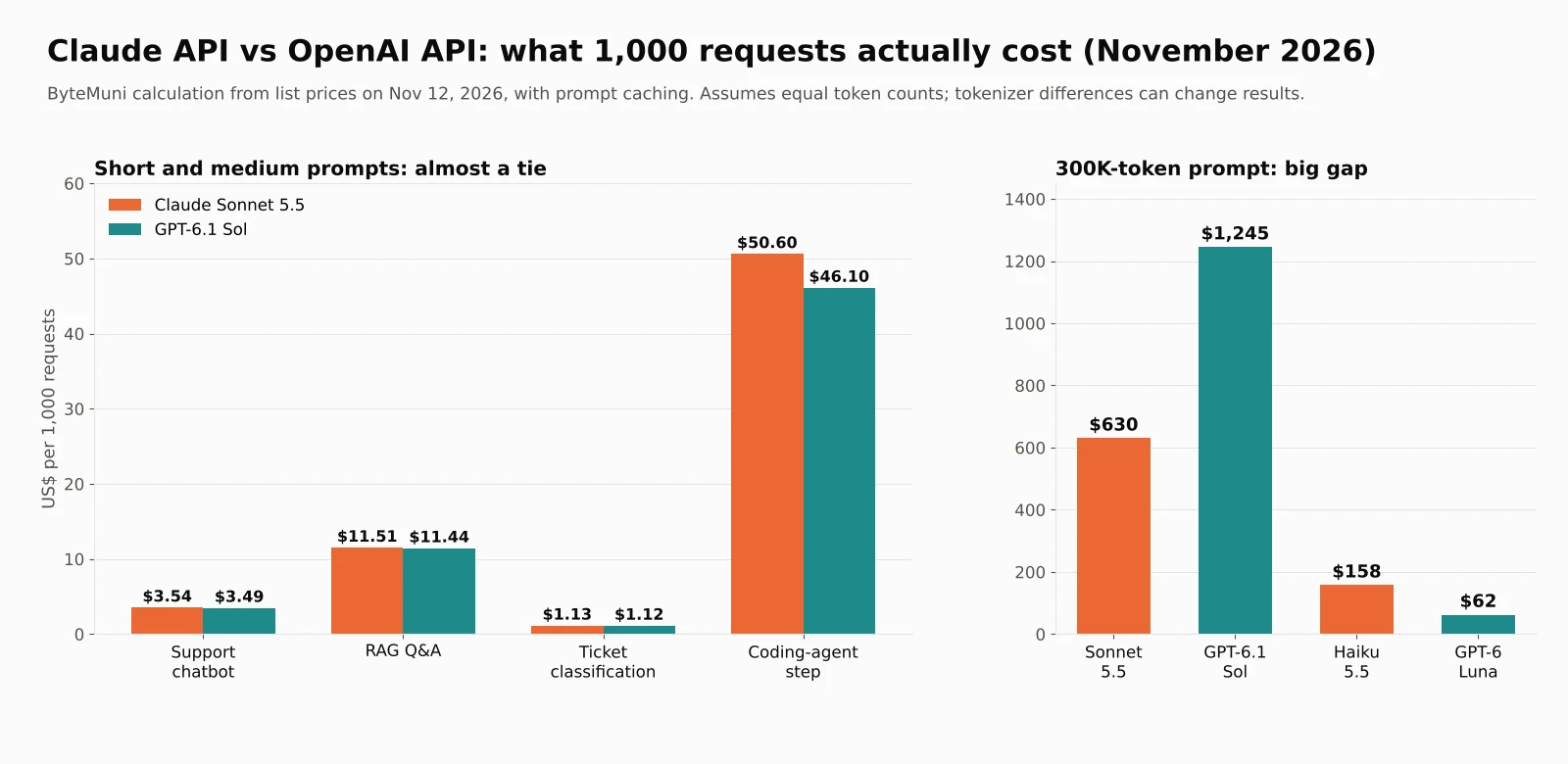
What the numbers say:
Short and medium prompts: a tie. For chatbots, RAG and classification, the difference is under 2%. Choose on quality, latency and features instead.
Very long prompts: Claude's mid and top tiers win clearly. Sonnet 5.5 costs about half as much as GPT-6.1 Sol for a 300,000-token request, thanks to flat long-context pricing.
Very long prompts on a budget: OpenAI's small tier wins. GPT-6 Luna's long-context surcharge kicks in later (272K) and is smaller than Haiku 5.5's (100K), so Luna is about 2.5 times cheaper for that job.
Heavy caching slightly favours OpenAI because there's no cache-write premium: about 9% cheaper for our coding-agent step.
Tokenizer differences can outweigh everything else. If Claude's tokenizer produced 35% more tokens for the same RAG request, Sonnet 5.5's cost would rise from $11.51 to $15.54 per 1,000, about 36% more than GPT-6.1 Sol. Measure this on your own data.
The biggest lever isn't the provider; it's the tier. Moving a simple task from the workhorse tier to the small tier cuts the cost by roughly 95% on either platform.
The API differences you'll actually notice
Both APIs do the same basic job: send messages, get text (or tool calls) back, stream tokens, use tools, return structured JSON. But the shapes differ enough that switching is never just a model-name change.
| Claude API (Messages API) | OpenAI API (Responses API) | |
|---|---|---|
| Main endpoint | POST /v1/messages | POST /v1/responses (Chat Completions is still available) |
| System instructions | Separate system field | instructions field (or a system/developer message) |
| Required output limit | max_tokens is required | max_output_tokens is optional |
| Response shape | List of content blocks (text, tool_use, thinking) | List of output items; SDK helper output_text |
| Tool results | Sent back as tool_result blocks in a user message | Sent back as function_call_output items |
| Structured JSON | output_config.format with a JSON Schema; strict tool use | text.format with a JSON Schema, strict: true |
| Reasoning control | effort parameter; adaptive thinking | reasoning effort setting |
| Server-side state | Stateless by default | Can store responses and conversations (store); set store=false for stateless calls |
| Token counting | count_tokens endpoint | Token counts in usage; tokenizer libraries |
Three gotchas we see developers hit:
Sampling parameters can be rejected. Anthropic's documentation for Claude Sonnet 5.5 says setting
temperature,top_portop_k"returns a 400 error." Code copied from older tutorials, or a generic wrapper that always sendstemperature=0.7, will fail on Claude's newest models. Use theeffortparameter instead.OpenAI's Assistants API is gone. OpenAI retired the Assistants API on August 26, 2026, in favour of the Responses API. Many 2025 tutorials (and at least one of the comparisons ranking high on Google) still recommend it.
Thinking costs output tokens. Both providers' newest models think before answering, and those reasoning tokens are billed as output. Two calls with the same visible answer can cost very different amounts. Watch the usage fields, and set effort levels deliberately.
Structured output: now guaranteed on both
A year ago, many comparisons said OpenAI had reliable JSON while Claude needed workarounds. That's no longer true. Anthropic's documentation says Claude's structured outputs "guarantee schema-compliant responses through constrained decoding," with no retries needed for schema violations, across its current models. OpenAI's Structured Outputs have offered the same guarantee with strict: true for some time.
We tested both official Python SDKs with the same Pydantic schema:
from pydantic import BaseModel
import anthropic, openai

class Ticket(BaseModel):
    category: str   # "billing", "technical" or "account"
    priority: str   # "low", "medium" or "urgent"
    summary: str

PROMPT = "Customer: I was charged twice for my October invoice and need a refund today."

def claude_ticket(client: anthropic.Anthropic) -> Ticket:
    r = client.messages.parse(
        model="claude-sonnet-5-5", max_tokens=512,
        messages=[{"role": "user", "content": PROMPT}],
        output_format=Ticket)          # sent as output_config.format (JSON Schema)
    return r.parsed_output

def openai_ticket(client: openai.OpenAI) -> Ticket:
    r = client.responses.parse(
        model="gpt-6.1-sol", input=PROMPT, text_format=Ticket, store=False)
    return r.output_parsed             # sent as text.format with strict: true
How we tested it: with anthropic 2.8.0 and openai 3.49.0 (the latest versions on November 12, 2026), against mocked API responses, because we didn't use live API keys. We confirmed that each SDK sends a JSON Schema format (with strict: true on OpenAI) and returns a validated Ticket object.
Edge cases still exist on both sides: a refusal or hitting the token limit can produce output that doesn't match the schema, and Claude's documentation lists unsupported schema features (such as numeric minimum/maximum and recursive schemas). Keep a Pydantic or Zod validation step anyway.
Privacy, data retention and where your data lives
For many Indian companies, this section decides the choice before quality or price does.
| Claude API | OpenAI API | |
|---|---|---|
| Used for training by default? | No. Anthropic says retained data "is never used for model training without your express permission" | No. OpenAI says API data "is not used to train or improve OpenAI models" unless you opt in |
| Default retention | Prompts and outputs "not retained by default," except Covered Models (Fable and Mythos), which require 30 days; some features keep their own data (batch processing, 29 days) | Abuse-monitoring logs kept for up to 30 days by default |
| Zero data retention (ZDR) | Available by arrangement with Anthropic sales, for eligible features | Available with OpenAI's prior approval, for eligible endpoints |
| Flagged content | May be kept for up to 2 years if flagged by trust and safety systems | May be kept longer where legally required or necessary for safety |
| India | In-country inference via Amazon Bedrock (Mumbai and Hyderabad), launched October 5, 2026, for Claude Opus 5, Sonnet 5 and Haiku 4.5 | Data stored at rest in India (in.api.openai.com), but regional processing isn't offered for India; eligibility requires ZDR or Modified Abuse Monitoring |
| Cloud marketplaces | Amazon Bedrock, Google Cloud, Microsoft Foundry, Claude Platform on AWS | Microsoft Azure (Foundry), plus OpenAI's own API |
Two of our reference articles are now outdated here. One said "neither platform currently offers data residency in India," which was true earlier in 2026 but has since changed for both. Check the exact models available in-country before you commit, because the newest models often arrive in regional endpoints later.
What this means for your team: if prompts must be processed inside India (common for banks, insurers and government projects under the DPDP Act and sector rules), Claude through Amazon Bedrock's India endpoint is currently the more direct route. If storage at rest in India is enough, both work. Whichever you choose, get the data processing terms reviewed; this guide isn't legal advice.
Quality: test it, don't trust a table
Every comparison article, including the ones we referenced, has a table that scores "Reasoning: Excellent." Ignore those, including any we might have written. Model quality changes every few months, vendor benchmarks are chosen by the vendor (OpenAI says GPT-6.1 Sol beat Claude Opus 5.5 on one agent benchmark; Anthropic publishes its own wins), and the only result that matters is performance on your prompts.
A lightweight evaluation takes a day:
Collect 100 to 300 real requests from your app, including hard and weird ones.
Write down what a good answer looks like (expected fields, facts, tone).
Run them through two or three candidate models from each provider at the same settings.
Score automatically where you can (exact match, schema checks, unit tests for code), and use a judge model plus human spot checks for open-ended answers.
Compare quality, p95 latency and cost per successful task, not cost per token. A model that's 20% more expensive per token but needs half the retries is cheaper.
Practitioner reports in our references point the same way: teams often prefer Claude for long-document and careful code-review work, and OpenAI for its ecosystem and multimodal breadth. But those are tendencies from anecdotes, not rules. Your eval set settles it.
Claude API vs OpenAI API: which should you use?
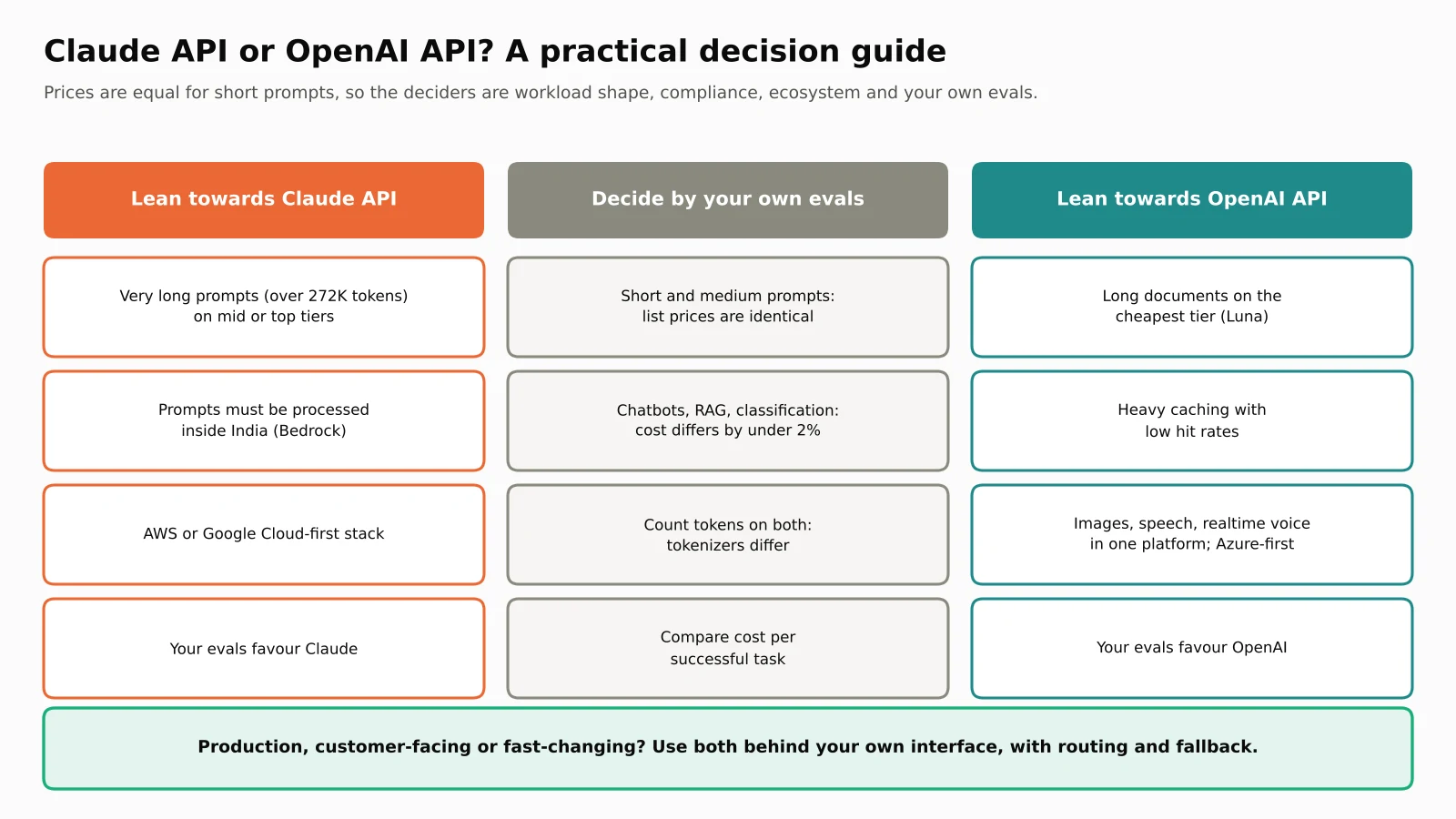
Lean towards the Claude API if:
You regularly send very long inputs (big contracts, codebases, long chat histories) to a mid- or top-tier model. Flat 1M-token pricing roughly halved our 300K-token example.
You need prompts processed inside India, via Amazon Bedrock's India endpoint.
Your company is already on AWS or Google Cloud and wants procurement and networking through them.
Your own evals show Claude is better at your task, such as careful document analysis or code review.
Lean towards the OpenAI API if:
You process large volumes of long documents on a tight budget: GPT-6 Luna's long-context pricing is gentler than Haiku 5.5's.
You rely heavily on caching but get low cache hit rates, since there's no write premium.
You need a broad set of modalities and tools in one place (image generation, speech and realtime voice), or your team is Azure-first.
Your own evals show OpenAI is better at your task.
Use both if:
The app is customer-facing and downtime costs money. Both providers have outages and rate-limit spikes; a second provider is your insurance.
Different tasks favour different models. Route long documents to one, high-volume classification to another.
You want negotiating leverage and freedom to move when prices change. They will.
For most production teams in 2026, "both, behind your own interface" is the answer.
How to use both: a provider-independent design
The pattern is simple: your application never calls a provider SDK directly. It calls your interface, and a small router decides which provider handles each task, with fallback when one fails.
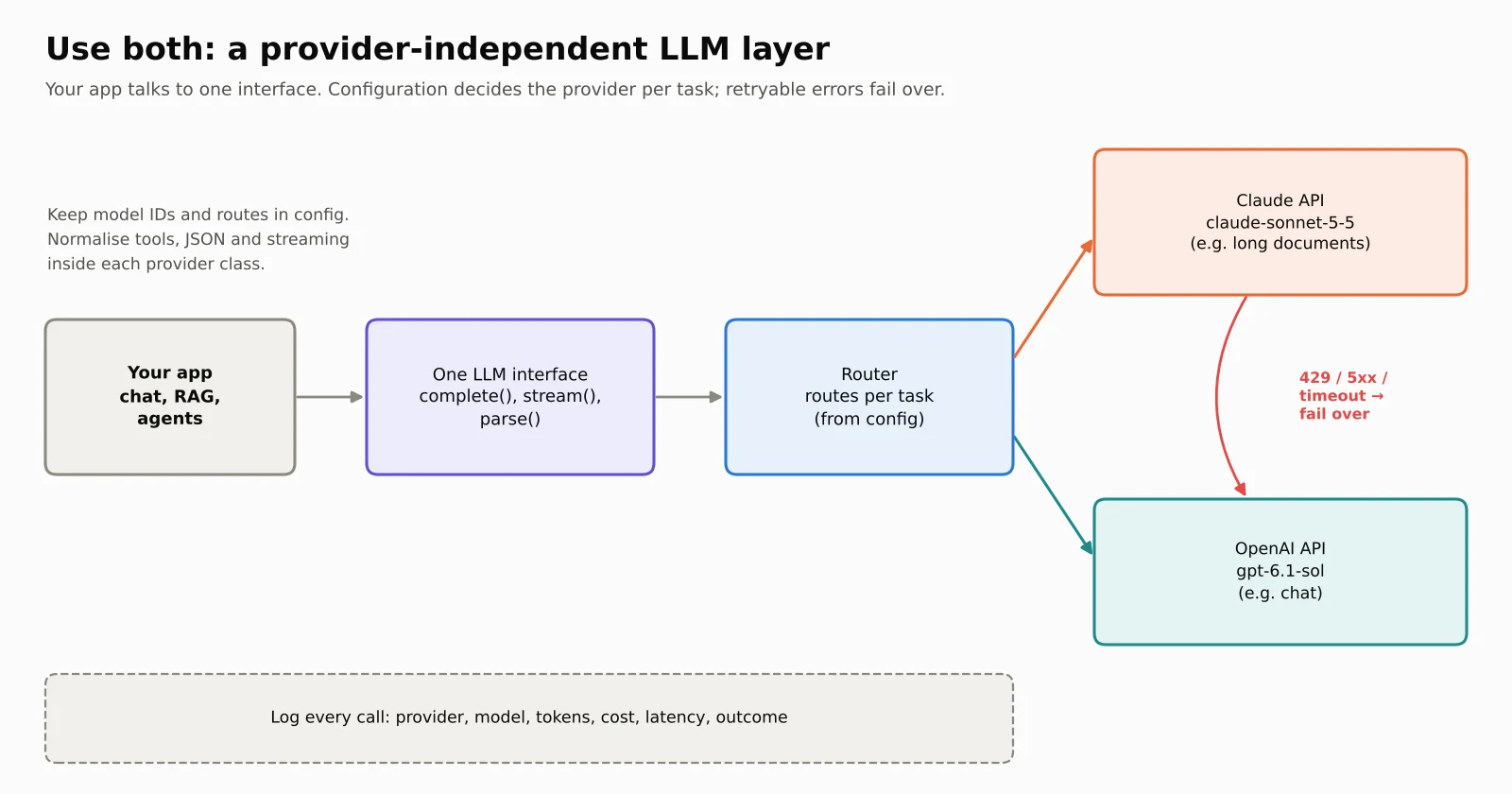
Here's a minimal version using the official SDKs:
from dataclasses import dataclass
import anthropic, openai

@dataclass
class LLMResult:
    text: str
    provider: str
    model: str
    input_tokens: int
    output_tokens: int

class ClaudeProvider:
    name = "anthropic"
    def __init__(self, model="claude-sonnet-5-5", client=None):
        self.model, self.client = model, client or anthropic.Anthropic()  # reads ANTHROPIC_API_KEY
    def complete(self, system, prompt, max_tokens=1024):
        r = self.client.messages.create(model=self.model, max_tokens=max_tokens, system=system,
                                        messages=[{"role": "user", "content": prompt}])
        text = "".join(b.text for b in r.content if b.type == "text")
        return LLMResult(text, self.name, r.model, r.usage.input_tokens, r.usage.output_tokens)

class OpenAIProvider:
    name = "openai"
    def __init__(self, model="gpt-6.1-sol", client=None):
        self.model, self.client = model, client or openai.OpenAI()        # reads OPENAI_API_KEY
    def complete(self, system, prompt, max_tokens=1024):
        r = self.client.responses.create(model=self.model, instructions=system, input=prompt,
                                         max_output_tokens=max_tokens, store=False)
        return LLMResult(r.output_text, self.name, r.model, r.usage.input_tokens, r.usage.output_tokens)

RETRYABLE = (anthropic.RateLimitError, anthropic.InternalServerError, anthropic.APITimeoutError,
             anthropic.APIConnectionError, openai.RateLimitError, openai.InternalServerError,
             openai.APITimeoutError, openai.APIConnectionError)

class LLMRouter:
    def __init__(self, routes, providers):
        self.routes, self.providers = routes, providers
    def complete(self, task, system, prompt, **kw):
        errors = []
        for name in self.routes[task]:               # preferred provider first, then fallbacks
            try:
                return self.providers[name].complete(system, prompt, **kw)
            except RETRYABLE as e:
                errors.append(f"{name}: {type(e).__name__}")
        raise RuntimeError("all providers failed: " + "; ".join(errors))

router = LLMRouter(
    routes={"contract_review": ["anthropic", "openai"],   # long input: Claude first
            "chat":            ["openai", "anthropic"]},
    providers={"anthropic": ClaudeProvider(), "openai": OpenAIProvider()},
)
We tested this offline with both official SDKs and mocked HTTP responses: each provider returned its text and token usage correctly, and when the Claude mock returned a 429 rate-limit error, the router automatically fell back to OpenAI.
To take it to production:
Keep model IDs and routes in configuration, not code, so you can switch in minutes.
Retry the same provider briefly (with exponential backoff) before failing over, and set timeouts so users aren't left waiting.
Don't fail over on every error. A 400 "bad request" will fail on the other provider too; fix the request instead.
Normalise the differences inside each provider class: tool-call formats, structured output, streaming events and usage fields. That's where most of the real work is.
Log every call with provider, model, tokens, cost, latency and outcome, so you can compare providers on live traffic.
Re-run your eval set on both whenever either provider ships a new model.
Consider an off-the-shelf gateway (such as LiteLLM, or an AI gateway from your cloud provider) if you'd rather not maintain this yourself, but understand what it does underneath.
For the bigger picture of where this layer sits in a production system, with caching, guardrails, RAG and evaluation, see ByteMuni's AI system design guide. If you build with LangChain, its init_chat_model gives you a similar provider switch; our generative AI with LangChain guide shows how.
A pre-launch checklist
Before you ship on either API, or both:
Benchmark on your own data: quality, p95 latency and cost per successful task.
Count tokens for real prompts with each provider; don't assume equal counts.
Choose the tier per task: small models for routing, classification and extraction; bigger ones only where your evals show a difference.
Turn on prompt caching with stable content at the start of the prompt.
Use batch APIs (50% off on both) for anything that can wait.
Use structured outputs for anything code depends on, plus a validation layer.
Set effort or reasoning levels deliberately, and track reasoning tokens.
Plan rate limits: check your account tier on each console, add backoff and queue background work.
Review data terms: retention, ZDR, training use and processing region.
Keep API keys in a secrets manager, never in code or front-end apps.
Monitor: tokens, cost per feature, error rates by provider, and quality samples.
Re-check prices and models every quarter. Both companies released new model families in the last two months alone.
Common myths, corrected
"Claude only has a 200K context window." That was true of older models. Claude Haiku, Sonnet and Opus 5.5 have 1M-token windows.
"OpenAI has reliable JSON; Claude doesn't." Both now offer schema-guaranteed structured outputs.
"Claude is much more expensive than GPT." At list price, the workhorse tiers are now identical ($2/$10), and the small tiers are identical too ($0.10/$0.50).
"Use the Assistants API for stateful conversations." It was shut down on August 26, 2026. Use the Responses API or manage state yourself.
"Neither offers data residency in India." Claude now offers in-country inference via Amazon Bedrock, and OpenAI offers storage at rest in India.
Our take
The "Claude vs OpenAI" question used to be about which model was smarter. In late 2026, both companies ship excellent models at the same list prices, and they leapfrog each other every couple of months. That makes the provider decision less important, and the architecture decision more important.
So our advice is simple. Don't marry a provider; build an interface. Measure quality and cost on your own data, route each task to the model that wins it, and keep a second provider ready for the day your first one has an outage. Teams that do this will benefit from every price cut and every new model, whichever company ships it.
If you're preparing for interviews, this is also a favourite system design discussion; ByteMuni's generative AI interview questions and our explainer on how ChatGPT and Claude are built are good next reads.
Sources
9to5Mac: Anthropic upgrades Claude with Opus 5.5 (September 22, 2026)
CRN Asia: Anthropic takes Claude inference live in India (October 5, 2026)
eCorpIT: OpenAI zero data retention and India residency (August 2026)
OpenAI Developer Community: Assistants API sunset, August 26, 2026
Boolean and Beyond: Claude API vs OpenAI API, cost, latency and quality
Enterprise DNA: Claude API vs OpenAI, what developers actually found
Frequently asked questions
Which is better, the Claude API or the OpenAI API?
Neither is better for every job. In November 2026, their mid and small tiers have identical list prices, and both support tools, streaming, 1M-token context and guaranteed structured output. Claude has an edge on very long prompts and in-country processing in India, while OpenAI has broader multimodal tooling and no cache-write premium. Test both on your own tasks.
Is the Claude API cheaper than the OpenAI API?
For short prompts, they cost about the same: Claude Sonnet 5.5 and GPT-6.1 Sol both list $2 input and $10 output per million tokens. For a 300,000-token prompt, Sonnet 5.5 costs about half as much, because Claude bills its 1M context at flat rates. Tokenizer differences can change the result, so count tokens on your data.
Can I use both Claude and OpenAI in the same app?
Yes, and many production teams do. Put both behind your own interface, route each task to the provider that works best for it, and fall back to the other on rate limits, timeouts or outages. Keep model IDs in configuration so you can switch quickly.
Do Claude and OpenAI use my API data for training?
Not by default. Anthropic says retained data is never used for training without your express permission, and OpenAI says API data isn't used to train its models unless you opt in. Retention rules differ, and both offer zero data retention for eligible customers.
Which API is better for Indian companies that need data residency?
If prompts must be processed inside India, Claude is currently available with in-country inference through Amazon Bedrock's Mumbai and Hyderabad regions. OpenAI offers storage at rest in India but not regional processing there. Confirm which models are available in-country and review the data terms.
How do I switch from the OpenAI API to the Claude API?
Move your system prompt to the system field, always set max_tokens, and replace temperature with Claude's effort parameter on newer models. Convert tool calls to tool_use and tool_result blocks, and switch structured output to output_config.format. Ideally, wrap both behind one interface so future switches are configuration changes.
Concepts in this article
- ChatGPT
- OpenAI's AI chat assistant.
- Claude
- Anthropic's family of AI models and assistants.
- LLM inference and cost
- Serving a model's answers: latency, throughput, batching, GPUs and cost per token.
How we research, write and check articles